Australian politicians rarely admit to thwarted ambitions, but Pat Conroy came close in a speech at Newcastle University about the government’s performance in the Pacific. “Things may not go Australia’s way every time,” he said during the university’s annual Asia-Pacific Address last month, “but we are going to patiently and persistently press our national interest in the region every day.”
The Pacific Island affairs minister (also in charge of defence industry) should know. He shared a big chunk of responsibility for the largest diplomatic debacle so far experienced by prime minister Anthony Albanese, albeit involving one of Australia’s smaller neighbours.
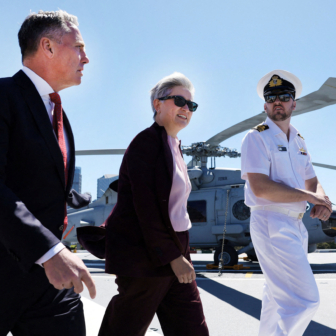
Conroy went to Vanuatu in August this year with defence minister Richard Marles and foreign minister Penny Wong convinced that its government was ready to sign an agreement giving Canberra approval rights over its security and infrastructure deals with third countries. In return, the island nation would receive A$500 million in aid over ten years.
Most of the Vanuatu government was out of the capital, Port Vila, when the Australians arrived, so Conroy and his colleagues followed them to the island of Tanna, where they were attending a cultural festival. The ni-Vanuatu hosts obliged them by signing a treaty draft at a table perched on the rim of Mount Yasur, an active volcano.
The location might have given a clue to the shakiness of the political ground. When Albanese arrived in Port Vila in September expecting to sign the final agreement, Vanuatu’s prime minister Jotham Napat informed him that signature was impossible due to continuing wrangles about the “wording” of the so-called Nakamal Agreement, named for the communal big houses in the island nation’s villages. As sources in Port Vila explain, the problem was the apparently sweeping veto powers Canberra expected.
In the section on security, one of Canberra’s “red lines” was any form of police cooperation between Vanuatu and countries outside the Pacific Island Forum — which would leave only Australia, New Zealand and island nations in the field. Vanuatu insisted on keeping its freedom to accept help from China and elsewhere.
Nor was Vanuatu happy about having to knock back infrastructure projects that could threaten Australia’s security, one local source told me. “We are worried about what Australia will consider a threat to their security: a wharf? A road? An airport? A threat according to who?”
More than two months later, the differences remain unresolved.
That setback was followed by another when Albanese went to Port Moresby later in September for the fiftieth anniversary of Papua New Guinea’s independence. There, PNG prime minister James Marape wasn’t ready to sign another document worked on by Marles and Conroy — a defence pact known as the Puk-Puk (Crocodile) Treaty — which would pledge each country to come to the other’s defence and allow Papua New Guineans to enlist in the Australian Defence Force.
As the government’s critics in the opposition and News Corp geared up to attack Labor for misreading the region, it emerged that the problem was simply that Marape’s cabinet members had dispersed to their electorates for independence celebrations before the treaty had been put before them. It was duly endorsed after they returned to Port Moresby and signed by Marape when he travelled south to watch a State of Origin rugby league game with Albanese.
The finer details — like how the ADF’s officers and sergeants are being readied to cope with up to 10,000 Melanesian recruits from PNG towns and villages when they are struggling to attract and retain enough personnel from Australia itself — aren’t yet being shared publicly by Marles and Conroy.
The Puk-Puk Treaty is definitely an achievement. But in the absence of any foreseeable external attack, the major security challenges in the South Pacific are domestic ones, particular from crime and violence.
Wong and former attorney-general Mark Dreyfus forged an earlier security agreement to help the PNG police force increase its numbers and deepen its crime solving and prosecution expertise. The government is pursuing similar initiatives elsewhere in the region, but with mixed success.
Two weeks ago, the Vanuatu government announced it would exclude all foreign advisers from its offices, including police and defence officers from Australia and New Zealand, to prevent “outside influence.” At around the same time it also accepted grants of some A$116 million from China to repair and rebuild buildings and roads in Port Vila damaged by last December’s big earthquake. As the government buildings among the worst hit had been built with previous Chinese aid by Chinese firms, though, this seemed more about restoring Beijing’s reputation than expanding influence.
In the Solomon Islands, coming up to a year since Albanese and prime minister Jeremiah Manele announced a A$190 million four-year plan to expand the police force and create a new police academy, agreement on the details still seems far off. Manele told the ABC the delay is due to “language in the agreement” being negotiated. While both countries could still “revisit” the pact, he said, there was no timeline for reaching an agreement.
Across the Melanesian boundary in Polynesia, the Albanese government is also pursuing further defence and police ties with Fiji and Tonga, their conservative governments both being willing partners. On the military side, the two island nations are already working on joint natural disaster responses with Australia and PNG. But they also face a new wave of criminality, deepened by factors in Australia and to some extent New Zealand.
The huge Australian demand for cocaine, methamphetamine and latterly fentanyl, pushing prices to among the highest in the world, has encouraged smuggling through Pacific nations, including on semi-submersible speed boats or narco-subs. Local intermediaries include convicted non-citizen criminals deported from Australia on “character grounds”under the Section 501 provision of the Migration Act — a provision ramped up by Peter Dutton as home affairs minister in Scott Morrison’s government.
Pasifika and New Zealanders, including Māori, form a disproportionately large segment of Australia’s prison population, so the bulk of deportees have gone to New Zealand and island nations. Many get dumped with no local connections or job prospects and turn to crime, their skills enhanced by jail associations. “If a country like New Zealand, with the resources it has in law enforcement, is struggling to deal with the 501 deportees from Australia, one can only imagine the impact deportees from New Zealand and Australia are having in small island states,” points out Canterbury University security specialist José Sousa-Santos.
The chair of New Zealand’s ministerial advisory group on transnational and serious organised crime, Steve Symon, warned in October that Pacific Island nations were at risk of becoming “narco-states,” their police, customs and other border agencies corrupted by crime syndicates. In the meantime, hard drug use is rising in the islands, with associated spread of HIV, leading Wong to announce a new A$48 million program to combat “increasing rates” of infections.
But these are just the start of the troubles the Albanese government faces in the region over the rest of its current term.
In New Caledonia, the government appointed by French president Emmanuel Macron is attempting to placate the indigenous Kanaks with the constitutional device of a new “state” within France. To further this plan, it has won parliamentary endorsement for expanding the territory’s electoral franchise, which could weaken the position of Kanak representatives in local institutions.
The territory of 290,000 people is consequently in an explosive state, with twenty of France’s 120 Gendarmerie (para-military) squadrons, amounting to 2500 troopers, stationed there. In 2024, when Macron’s government attempted a similar electoral rejig, the territory erupted in widespread rioting and arson, causing some €2 billion (A$3.5 billion) in damage, a 13.5 point economic contraction, and an exodus of expatriate residents.
Further afield, the pro-independence president of the autonomous government of Bougainville, Ismael Toroama, was re-elected with 70 per cent of the island’s vote in September. Bougainville’s people voted 98 per cent for independence from PNG in 2019, but under a peace agreement designed to settle a civil war the referendum result needs to be endorsed by the PNG parliament to take effect. Current estimates are that only around one in ten MPs would approve separation. Toroama, a former rebel commander who fought the PNG military, has vowed to declare independence unilaterally by September 2027 if it is not conceded by then.
These will be excruciating diplomatic challenges for Canberra: New Caledonia testing the “First Nations” priority that Conroy lauded in his speech; Bougainville destabilising the security pact with PNG.
But a bigger one, reaching deep into Australian politics, is the widening gap between the Albanese government’s posture as a good climate citizen — by virtue of its efforts to reach net-zero at home by mid-century, its support for the Paris accords, and its help for Pacific island states to cope with the effects of climate change — with its refusal to acknowledge responsibility for emissions from the fossil fuels Australia exports.
In July, the International Court of Justice in The Hague rejected Australian, Saudi, American, British and Chinese assertions that their climate responsibility was entirely covered by global agreements such as the Paris accords. The fifteen sitting justices unanimously found not only that all countries have an obligation to work together to hold global warming to 1.5C but also that obligations don’t simply rest with the end users of fossil fuels.
“Failure of a State to take appropriate action to protect the climate system from GHG [greenhouse gas] emissions — including through fossil fuel production, fossil fuel consumption, the granting of fossil fuel exploration licences or the provision of fossil fuel subsidies — may constitute an internationally wrongful act which is attributable to that state,” the judges ruled.
The ICJ action was launched by Vanuatu. While the judgement is advisory, it may be the foundation for specific litigation. With some ninety-four new coal and gas projects lining up in Australia, according to the Australia Institute, Vanuatu or others would seem to have ample cases to raise. They include the forty-five-year extension to Woodside Energy’s North-West Shelf gas project, approved by Albanese’s environment minister Murray Watt in September after objections met a ferocious campaign by Western Australia’s state government, trade unions, and media outlets in support of Woodside. The institute says that project alone adds the equivalent of twelve coal-fired power stations to emissions.
In his Newcastle address, Conroy made reference to the Coalition’s backing away from net-zero. “You can’t engage effectively with the Pacific unless you’re serious about climate,” he said. “They just won’t take you seriously — and with good reason.”
He went on: “Unlike them — I applaud the students of Vanuatu, and the Vanuatu government for galvanising the world to achieve the landmark International Court of Justice advisory opinion on climate change. In seeking this opinion, the Pacific has spoken with the moral authority and weight of lived experience.”
On the face of it, then, Albanese’s minister for Pacific Island affairs is supporting the case his own government opposed at The Hague and lending his weight to the notion his prime minister and the environment minister continue to reject.
How much longer can the Albanese government get away with trying to walk both sides of the street?
It suggests the government is under-powered in dealing with the region’s challenges and a broader political dialogue is needed. Perhaps some of the under-utilised talent in Labor ranks — economics PhDs Andrew Leigh and Andrew Charlton, and the technology-astute former industry minister Ed Husic come to mind — could be brought into the engagement. •