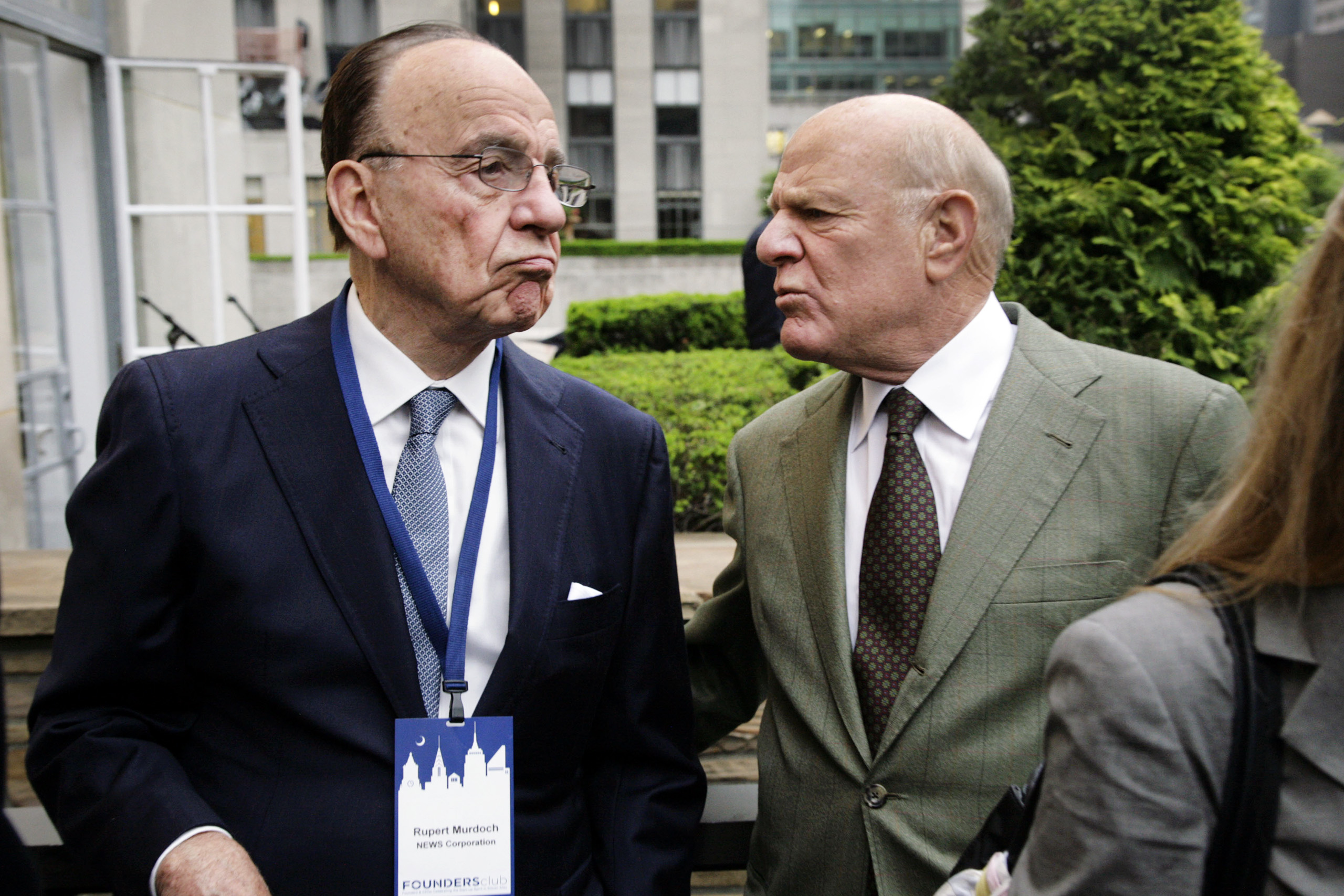
Three men, Barry Diller, John Malone and Rupert Murdoch, were at the centre of the American TV industry’s multi-decade transformation first from free-to-air terrestrial to subscription TV via cable and satellite and then to online e-commerce and streaming. Murdoch shows no sign of writing his memoirs, but Diller and Malone have just published theirs.
In their books both men profess mutual admiration: in Who Knew, Diller says Malone is “by far the smartest man in television”; in Born to be Wired, Malone says Diller is “a bona fide genius and a maestro of television and internet content.” And each of them has nice things to say about Murdoch. But if you’re a News Corp shareholder there is material in both books to make you angry.
Murdoch’s admirers can point to three cases where, as an outsider, he took enormous risks, overcame complacent incumbents and achieved commercial success. The first was his conquering of Fleet Street in the 1970s, where he drove his newly acquired Sun newspaper out of nowhere to become Britain’s biggest selling newspaper. The last, in 1996, was his founding of Fox News, which fused his political ideology with a sharp sense of the potential market.
In between was his launching of a fourth TV network in America in the 1980s. The ABC, the youngest of the three existing US networks, had begun broadcasting in 1948 and didn’t make any money until the 1970s. The prevailing consensus was that no one could break the stranglehold of the big three, but the shrewdly managed Fox became a profitable and influential player.
In each of these cases Murdoch had a strong manager — Larry Lamb in Britain and Roger Ailes at Fox News — driving the project. For the Fox network, the driving force was Barry Diller who, in contrast to Lamb and Ailes, had exercised wide-ranging business skills with great success before his time with Murdoch, and did so again afterwards.
Diller had worked his way up from the bottom to become, at twenty-five, vice-president of the ABC and the youngest-ever deputy head of an American TV network. His next move was to Paramount pictures, which he transformed into the number-one film studio. After an upheaval on the board, he left for Twentieth Century Fox.
It was there that Diller teamed up with Murdoch to build a new network, a move made possible by two unrelated events. He discovered that Twentieth Century Fox was badly in debt, contrary to what he had been told by its owner Marvin Davis, who was refusing to put any more money in. Just as Diller was preparing to sue him, Davis solved his immediate problems by selling half of the film studio to Murdoch.
Just as Murdoch and Diller were getting to know each other, they learned that John Kluge, head of the mid-sized network Metromedia wanted to sell. Diller immediately saw that Metromedia’s 25 per cent market share, which made it the biggest TV network outside the big three, could be the basis for a fourth major network. Davis wasn’t an ideal partner in this venture, so Murdoch bought him out, although this added substantially to his debt burden.
As Diller observes, Murdoch was determined to break into US television and was aiming for nothing less than a seat at the big-studio table. He paid Kluge’s asking price even though it was wildly exorbitant by the standards of the time.
Despite the flimsiest business plan, Rupert was “ecstatically on board,” writes Diller. “He didn’t flinch about the costs; he saw only the opportunity.” As he and Murdoch were driving to Kluge’s apartment to seal the deal, “Murdoch let out a gleeful ‘What a great adventure! We’re betting the company!’” Diller remembers “what sheer fun it was to be with him and his master gambler’s enthusiasm.”
Over the next seven years the pair built the network into a successful operation. But although Diller’s authority as chief executive was virtually unchallenged, he became increasingly concerned that, as in his previous jobs, he was an employee rather than a principal. He could be disposed of whenever it suited the proprietor.
“In the summer of 1991 I went to Rupert and told him I wanted to be a principal. He said give me some time to think about it. A few days later, he came back to me and said, ‘There’s only one principal in this company. I mean you make decisions, and that’s been fine for you and for me. But this is a family company and you’re not a member.’”
From then on he felt Murdoch was more distant. After Diller reluctantly accompanied him on a fundraising road trip, the deeply indebted Murdoch said to him, “Sooner or later I’m going to want to change things.” Diller’s reaction (in his own words) “was to go berserk.” After cooling down he told Murdoch he wanted to resign. They then worked out how to do this in the cleanest way.
In this very readable account, Diller is frank about his self-doubts, and about his insecurity in handling his bisexuality. His recounting of the various conflicts and deals he was involved in are broadly persuasive. But he also has his critics.
In The Fourth Network (2004), business journalist Daniel Kimmel developed two main critical themes. The first was that Diller was often given the credit for the achievements of others; in fact, instead of conceiving some of Fox’s greatest successes, he was initially sceptical. This criticism is at least partly misplaced, as it was Diller’s responsibility to make the final programming decisions, and he would have wanted to base choices on the best evidence.
Less easily dismissed is Kimmel’s second theme: that Diller used angry and abusive language to keep employees off balance. One executive who worked closely with him said he disliked Diller’s “style of management by intimidation and belittlement… I saw so many just get cut off at the knees.”
Whatever the downsides of Diller’s style, managerial instability increased considerably after he left. Murdoch was reported to be “delighted that he would now have Fox to himself.” He rebutted the idea that he was not on top of the task by declaring that “seven years ago I bet News Corp on buying Fox for $2 billion. It’s not as if I’ve been asleep for seven years.” As Murdoch exercised more day-to-day control, other senior executives left.
For whatever reason, none of Diller’s immediate successors lasted more than a year or two. One of them was Lucie Salhany. According to Kimmel’s account, which might be apocryphal, Salhany’s young son came up to Murdoch at a social function and asked “How come you make my mummy cry all the time?” True or not, Salhany certainly didn’t look back fondly on her experience working with Murdoch: “Rupert was always sneaking around, having people in, and having outsiders criticise what his employees were doing,” she recalled. “That’s his favourite game.”
After some false starts, Diller’s post-Murdoch career prospered. He took over the Home Shopping Network and within a year steered it from an annual $70 million loss to a $60 million profit. He later became a pioneering force in e-commerce.
During these decades his most constant business partner was John Malone, a much more controversial figure. In 1989, Al Gore described Malone as the “the King of the Cable Cosa Nostra” and likened him to Darth Vader. An NBC News profile opened with a clip of Democratic senator Howard Metzenbaum calling Malone a “big gorilla… intent on squeezing the lifeblood out of the American people.”
Malone’s notoriety reflected twin trends: as cable TV grew rapidly so too did public dissatisfaction with its providers. Cable had begun as an antenna-extension service for areas in the US where terrestrial transmission was problematic but later began offering programming to a wider audience. In 1978, after thirty years, it still only reached 19 per cent of American homes. A little over a decade later more than half American homes subscribed, and the number of national cable networks had grown from twenty-eight in 1980 to seventy-nine.
But although the public loved the novelty of cable TV, says Malone, many were justifiably upset about customer service. Journalist Mark Robichaux put it more sharply in Cable Cowboy, his 2002 book about Malone: “rude installers, no show repairmen, and [constant] busy signals… it was like getting the Hell’s Angels sent to your home.”
Malone’s rather self-serving explanation in Born to be Wired is that cable TV operators had started off in the construction industry and hadn’t adjusted to being in distribution. Monopoly arrogance might have been a more potent factor.
By 1982 Malone’s company TCI had become the biggest cable operator in the US, and Malone concedes that it was the ugly duckling. The industry’s performance overall had become a political issue: “In the eyes of Congress,” wrote Robichaux, “cable TV had gone from a fledgling industry in the shadow of the Big Three broadcast networks to an arrogant gang of monopolistic robber barons determined to hike rates and skimp on service.”
Malone not only had the largest network, but he also pioneered vertical integration in the industry: as well as owning networks he began acquiring channels. In Robichaux’s words, “TCI could own both the pipe and the water flowing through it.” In 1991 he formed Liberty as a holding company for the stakes he acquired in cable channels; by 2000, says Malone, it had a stake in twenty-two of the top fifty channels.
The evolving cable system had neither the obligations and accountability of a publicly regulated system nor the checks and balances, and consumer choice, of a well-functioning market. It was a ripe environment for lucrative alliances exploiting monopoly leverage.
When the Vail Colorado city council voted in 1973 to end TCI’s franchise to operate in the city, wrote Robichaux, “Malone’s response was silent but devastating”:
At 6.35 pm the TV screen of every TCI consumer in Vail went dark. TCI had pulled all programming, substituting it with the names and home phone numbers of top city officials, including the mayor. The blackout lasted through a Sunday Denver Broncos game against the St Louis Cardinals, and the phone lines lit up. By Tuesday the crisis was settled. After setting new terms, Malone wanted to send a message to any city thinking of squeezing TCI at this delicate stage, and it set a precedent for the scores of franchise renewals it faced down in other cities.
The welter of new cable channels needed access to subscribers. Malone “demanded that cable channels either allow [him] to invest in them directly, or they had to give [him] deep discounts on price,” according to Robichaux. He also made strategic partnerships both with cable operators and channels on the principle “collaborat[ing] even with your enemies — especially with your enemies — to avoid the large and costly fight of real competition.”
It was only a short step from hard bargaining to using monopoly control to block unwelcome competitors. Malone bought into the second largest home shopping network QVC in 1987. The biggest was the Home Shopping Network, whose head, Roy Speer, told a congressional committee that TCI had directed its affiliates in many large cities to drop Home Shopping Network in favour of QVC.
Another victim of monopoly power would be Rupert Murdoch. When he launched Fox News in October 1996, he began a long campaign to win over cable operators. He was so concerned by the slow take-up that he adopted a radical solution. He reversed the typical model of cable networks paying a fee to broadcast channels and offered by far the largest-ever fee to carry a channel: a one-time cash reward of $10 for every subscriber.
But in the biggest market, New York, Time Warner was refusing to run Fox News. Murdoch believed its aim was to protect CNN, its own cable service, and claimed that Time Warner chairman Gerald Levin had gone back on a handshake agreement to carry Fox News. Much mudslinging, many lawsuits and a great deal of political controversy followed, with New York mayor Rudy Giuliani coming in heavily on Murdoch’s side.
This was the setting for 1997, the year when — according to Australian Financial Review journalist Neil Chenoweth — Murdoch declared war on everyone, beginning with the cable industry.
In February, he pronounced that cable was a declining platform and the future was satellite. Cable operators would be calling Jack Kervorkian, the famous promoter of euthanasia, said Murdoch spokesman Preston Padden. Shares in the cable industry fell precipitately, wiping more than $1 billion in market value. Malone and other cable operators were furious, with some declaring they would no longer deal with Murdoch.
Murdoch thought he was speaking from a position of strength, that he had a satellite partner ready to go. But his deal with Echostar, a satellite communication company, fell through, as did a proposed one with Hughes Electronics. In both cases the split brought considerable acrimony. As Malone observed, “Rupert is so aggressive that he doesn’t really make a good partner.”
Aggressive — and unrelenting. Finally, in 2003, after six years of thwarted hopes, he succeeded in gaining control of DirecTV. “The benefits will be felt almost immediately,” he enthused, “… in the competition it will offer cable, [and] the richer services it will provide to American viewers.”
Murdoch had always said that winning control of DirecTV would be “a company-transforming deal.” Yet within a couple of years he sold it all to Malone.
Murdoch and Malone present interesting contrasts. Although they both approached entertainment businesses with a clear eye on the bottom line, in other ways they were polar opposites. Murdoch was energised by betting the whole company; Malone made an early promise to himself that “I will never bet the whole farm… on anything. No deal is ever worth doing that.”
Launching the fourth network, Murdoch was prepared to proceed on only the flimsiest of business plans. Malone preferred a “cautious but calculated mindset… If the financial numbers fail to support the big bet, it is time to make a smaller one instead.”
The Murdoch culture is aggressive, and competitive. As one journalist observed, “Within its chosen markets News tends to be the market leader, indeed domination seems to be a pretty constant theme.” Malone has had “a series of minority shareholdings and alliances” that worked well in the convoluted cross interests during the rise of cable TV and “would define my dealmaking for the next thirty years or more.” While Murdoch made many enemies, “everybody owes something to John.”
The Malone management strategy emphasises stability and sharing of the spoils. Indeed he was attacked in the Wall Street Journal for making deals that enriched his executives. This was part of his managerial strategy: “In the first sixteen years of the company,” he writes, “not one key executive had left for another job.” His “greatest shortcoming,” he adds, “is avoidance of conflict… In my almost two decades at TCI I fired only one person.”
The contrast with Murdoch is stark. Not only has he famously fired key editors but at lower levels in the hierarchy he was even more ruthless. According to journalist Michael Wolff, Murdoch suggested at a Fox network meeting that one way to boost advertising sales would be simply to fire whoever earned the least in the previous month. It had worked in Australia, he declared. When an unfortunate executive grinned sceptically at the suggestion, Murdoch yelled “Wipe that smirk off your face” and later ordered that he be fired.
In 2004 the two men’s ambitions changed their relationship in a way that unnerved Murdoch. As Chenoweth observed soon after, Malone and Murdoch had “been the closest and most dangerous of friends” for twenty years, and Malone was “probably the only man in the world that [Murdoch] fears.”
Murdoch announced in April 2004 that he planned to change News’s domicile from Adelaide to Delaware. Australian shareholders approved the move in October, and once the company was listed in the United States it was delisted in Australia. Many Australian fund managers sold their holdings, causing the company’s share price to dip. The person who spotted the dip and seized the moment was Malone; within days, to Murdoch’s chagrin, he had 19 per cent of voting shares, second only to the Murdoch family’s 30 per cent.
“Someone must have made a mistake for a family dynasty to allow that much stock to go on the open market,” writes Malone. He and Murdoch arranged a meeting where Murdoch offered to swap his shares in DirecTV — an offer to which Malone agreed. Although the transaction wasn’t consummated until 2006, Malone eventually got Murdoch’s stock in DirecTV — once proclaimed the jewel in Murdoch’s crown — and Murdoch got Malone’s shares in News.
According to Malone, “our latest transaction gave Rupert the one thing he cared most about — family control of the company. In redeeming the shares he popped from 28 per cent of the vote to a virtually unassailable 42 per cent.”
Malone got a better deal than other News Corp shareholders. In the next few years, DirecTV was a great success, its revenue growing from $14.8 billion in 2006 to $27.2 billion in 2011 and its subscriber base from 16 million to 20 million. Assuming that News could have managed DirecTV as well as Malone did, News Corp shareholders were denied a growing and lucrative revenue stream. The share swap had been in Murdoch’s interests, not theirs.
It was in Murdoch’s interest in another way as well. In 2007, with Malone safely off the share register, Murdoch made an acquisition that defied business logic. He bought Dow Jones, publisher of the Wall Street Journal, for $5.6 billion. The company had been trading at around $35 per share; Murdoch offered $60. None of the Dow Jones advisers “had ever seen quite such an overvalued offer,” wrote journalist Sarah Ellison in War At The Wall Street Journal. Less than two years later, in February 2009, News wrote down half its value.
Murdoch knew that Malone would have vigorously opposed his bid for Dow Jones. From a shareholder point of view, Murdoch had done one bad deal (the DirecTV swap) to free him to do another bad deal (the Wall Street Journal purchase).
Whatever Murdoch hoped to gain by ownership of the Journal it was not profits, at least in the immediate future. It might have been a way of attacking what he saw as the citadel of the liberal media, the New York Times: when the Journal launched a metropolitan section in 2010 he was quoted as saying he wanted it to “cripple, really cripple the New York Times.”
Malone foresaw earlier than most the decline of subscription television with the rapid rise of the internet and started reducing his holdings, including in DirecTV from 2010. Cable and broadcast TV still attracted around half the viewing audience in 2025 but, as Malone points out, the share taken by streaming services was still rising. Pay TV subscriptions had taken a steep dive, down to not much more than a third of US households from their towering 87 per cent reach in 2010.
Malone and Diller had moved onto the internet early, starting a new company focusing on promising e-commerce sites in 1993. The company cobbled together dozens of online businesses that started out being worth millions of dollars and ended up growing into companies worth billions of dollars. Their company, Silver King Communications, started with revenue of $46 million; when they disbanded in 2010 its revenues were more than $10 billion.
Malone’s business career in many respects is just as spectacular as Murdoch’s. “What began as a small regional operator in 1973 became one of the most remarkable investment stories in modern financial history,” says Malone. By 2024 a $1 investment in 1973 had grown to $900.
Diller’s and Malone’s books add up to an enlightening journey through the messy and little understood history of American media, where from the 1980s they moved from relative stability to rapid change. It was an era where policy always lagged well behind practice; where mergers to create synergies brought deals of astounding sums, often disastrously so, and where new technologies created new market possibilities while making old ones obsolete. Murdoch also moved skilfully with the times with his large sell-off to Disney completed in 2019.
In Murdoch’s dealings with both authors, he clearly placed family control ahead of shareholder value. The cost of securing dynastic succession is not just about the ability of the family inheritor, but of the talent lost in the process. Murdoch shareholders were the poorer because of the loss of their most talented executive Barry Diller. Likewise they would have benefited by having a shrewd strategist like John Malone on the board. Family purity was maintained, but at a cost. •
Who Knew
By Barry Diller | Simon & Schuster | $63.99 | 336 pages
Born to Be Wired
By John Malone | Simon & Schuster | $66.99 | 432 pages