In his new book, 1873, economist, investment banker and Pulitzer-winning writer Liaquat Ahamed tells us this was the year the modern world was made. Pumped up by mid-century gold discoveries in California and Victoria, rivers of cash and bank deposits fuelled a European and American boom in lending for construction of railways, the AI data centres of the era. In Austria and Germany the lending boom was augmented by reparations to Germany after France lost the 1871 war.
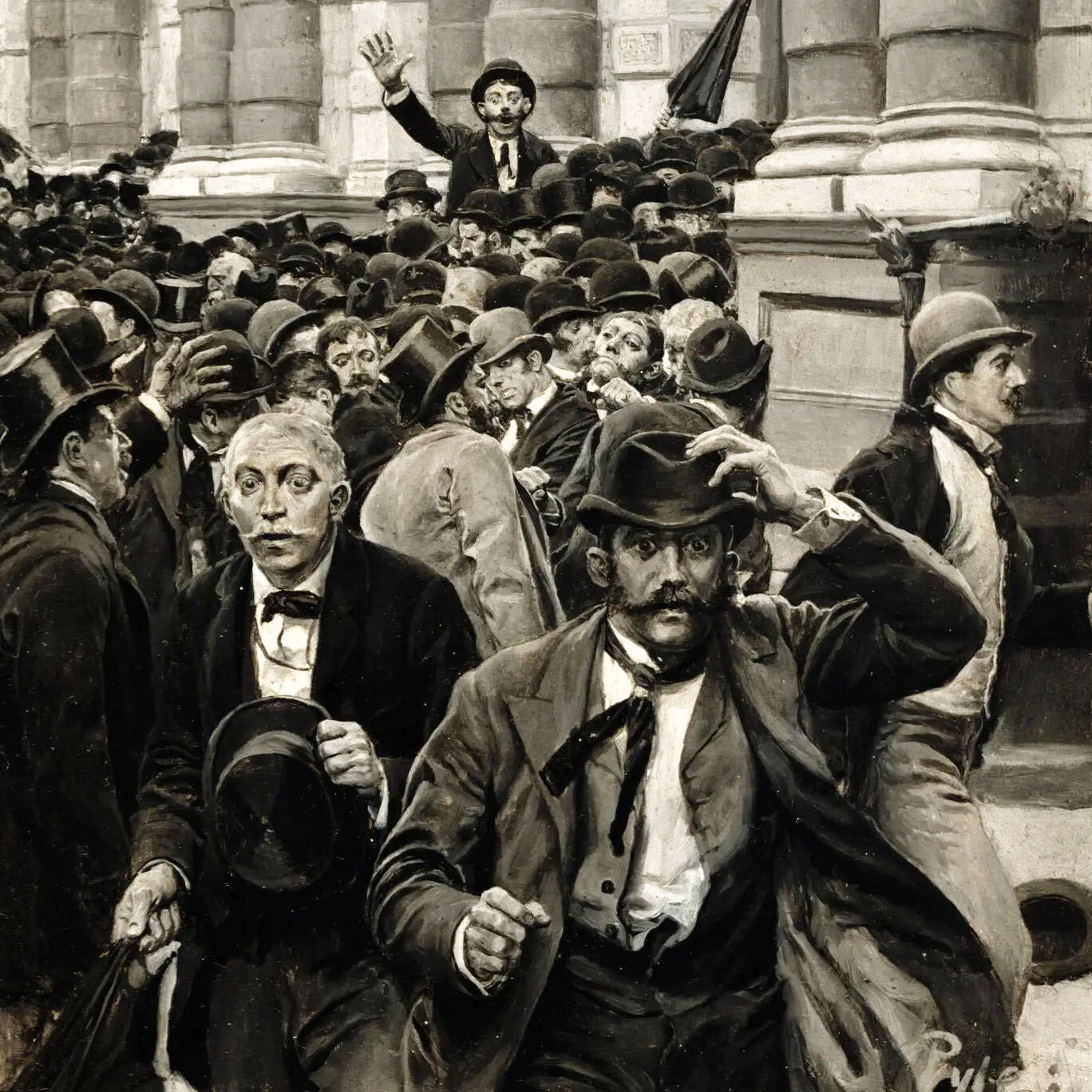
From railways, the lending spree widened recklessly. It soon included land booms in Germany and Austria, as well as lavish spending by dictatorships in South America, the Sultan of Turkey and the Khedive of Egypt. Then, in 1873, the bubble burst, with careless lending and fraud causing a collapse of bonds and shares and waves of bank failures. Recessions followed, providing the archetype of many broken bubbles to follow.
It’s a well-told story, uncluttered with unnecessary detail or fastidious technical explanation and enlivened by profiles of members of the Rothschilds banking family, the American spruikers Jay Cooke and Jay Gould, colluding European statesmen and profligate rulers of exotic countries. Ahamed is even able to make the development of bond markets in Europe and America entertaining, financing as they did railways, new business ventures, wars, national governments and the extravagant lifestyles of hucksters, sultans and banking fraudsters.
In Europe and America the long boom was most evident in hectic railway construction and increasingly elaborate and risky lending to speculative ventures and crooks. The rulers of Turkey and Egypt dipped in, borrowing amounts so vast that interest payments soon accounted for large and still larger shares of their total tax revenues.
The speculative frenzy was not entirely nutty. Most of the railways built then we still have today, still serving useful purposes. So too the Suez Canal, financed then with bonds as well as shares, remains today chock-a-bloc with ship traffic. True, the French bond-financed attempt to build the Panama canal went spectacularly bust. But the next attempt — primarily American — was also financed by bonds, and was successfully completed. While fortunes were lost in bonds and shares, many of the projects they so recklessly financed endured.
Ahamed makes a strong case, though I am not convinced 1873 was indeed the year the modern world was made, or even that it initiated the first great depression, both claimed in the book’s subtitles. As Ahamed himself points out, the industrial depressions following the 1873 financial crises “were not especially deep.” Industrial production was sustained in Britain, France and Germany. The US did indeed dip into prolonged recession, but as Ahamed shows this was largely because the second administration of president Ulysses Grant unwisely insisted on bringing the dollar back to a gold standard, prolonging and deepening the downturn.
In the making of the modern world I am still inclined to think the American war of independence mattered more, or the French revolution shortly after, or the more or less concurrent first industrial revolution. Then there was the Great War, creating as it did an embittered Germany, an exhausted France and Britain, and the Bolshevik Revolution, leaving the United States as the world’s greatest power. Between the great events at the end of the eighteenth century and those at the beginning of the twentieth, 1873 seems less remarkable.
But this is mostly a quibble over a publisher’s subtitle, for which no author should be held accountable. And even if it is a bit of a stretch to claim the entire modern world was created by the financial crises of the second half of the nineteenth century, modern Australia certainly was — though not in 1873.
Because of those fabulous gold discoveries, Australian bank deposits increased fivefold in the twenty-four months from March 1851 to March 1853. Particularly in Victoria, the result was a land boom like no other. Melbourne flourished as one of the world’s wealthiest and fastest-growing cities, with a rich architectural elaboration still evident today in Victoria’s Parliament House, the Windsor Hotel, the Queen Victoria Market, and in public parks and gardens. Australia, too, shared in the railway boom, with thousands of kilometres laid in the 1880s.
The year 1873 came and went, the boom ripping along. The Australian crash was postponed to the 1890s, when financial failures ushered in a depression far exceeding in depth the Great Depression of the 1930s. The land boom collapsed, along with the banks that handed out their depositors money to finance it. The collapse strengthened the case for federation, and for national laws to regulate the war between capital and labour, and to keep out cheap labour and cheap imports.
Any account of past financial calamities quickly brings us to now. Bond issues are again huge, much of them to finance the building of data centres to support the artificial intelligence industry. Share prices are again detached from current earnings, and depend on highly conjectural estimates of earnings at some future time. Nvidia, now the world’s most valuable publicly traded company and the biggest US maker of chips for AI, facilitates the sale of its chips by lending to or buying stakes in companies that buy chips, locking them into buying Nvidia.
The global AI investment spend will reach at least 1 per cent of global GDP this year, or close to a trillion US dollars. Next year it will be bigger. Yet lavish as it is, the AI boom is not without precedent. One precedent, as Ahamed engagingly reminds us, was the railways boom in the second half of the nineteenth century.
Another precedent is more recent. A big increase in spending on IT, software, computers and computing equipment in the US in the late 1990s added at least three-quarters of a percentage point to US growth in each of the last three years of the decade, a magnitude not much less than today’s AI boom. That boom terminated in the dot com crash of 2000 and 2001, bringing a shallow but prolonged recession that saw unemployment peak at 6.3 per cent in mid 2003 from 3.9 per cent three years earlier. By 2002, share prices were roaring again.
(The shallowness of the recession and the strength of the recovery were partly due to the 11 September 2001 attack on the World Trade Center. The Fed had already dropped the rate from 6.5 to 3.5 per cent due to a stock market rout and the recession. After the attack it took the funds rate down to 1 per cent. It later became apparent the recession had ended a year after it began.)
The ultimate revenues from artificial intelligence may or may not justify the spending. It will be quite some time before we find out. When and if it busts we will still have the data centres — nearly three hundred in Australia alone, and hundreds more scheduled. If it falters, bond values and share prices will fall, and many cheerful investors today will experience a more modest retirement tomorrow. But like those nineteenth-century railways or the telecoms roll-out of the 1990s that preceded the 2001 tech wreck crash, something useful will remain. •
1873: The Rothschilds, the First Great Depression, and the Making of the Modern World
By Liaquat Ahamed | Penguin Press | $62.99 | 368 pages