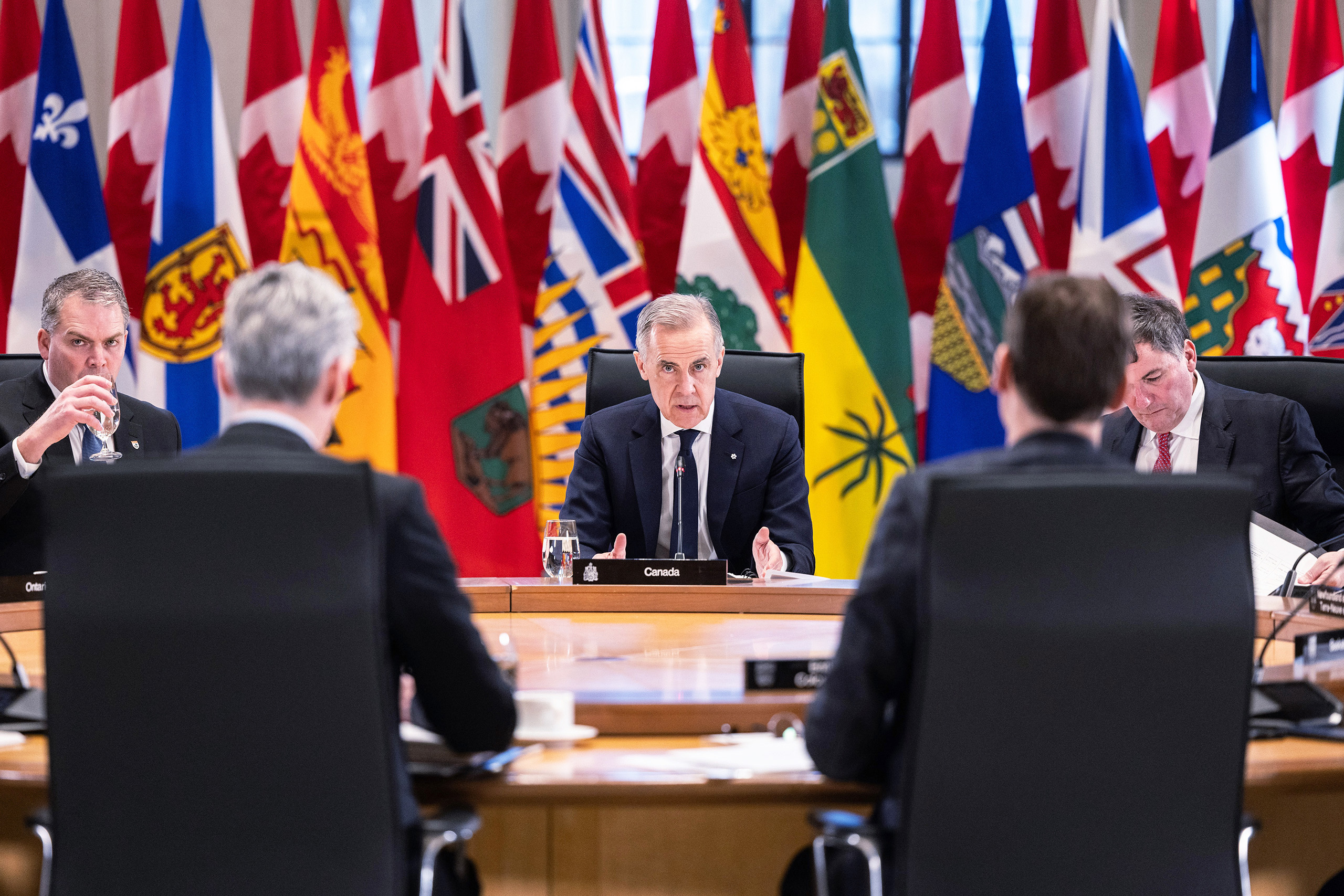
Mark Carney is a serious man. Prime minister of Canada for just under a year, he is overwhelmingly preoccupied with responding to the upheavals of the second Trump administration. The tone of the prime minister’s office has drastically shifted from the mood encouraged by his predecessor Justin Trudeau. Carney has reportedly banned open-necked collars in favour of ties for men, and can be brusque and volatile with subordinates. He dresses in sombre dark suits with white shirts and unremarkable ties, eschewing the colourful socks of his predecessor. Even his leisure is focused; in September, he ran a half-marathon.
He also thinks big. His government is prioritising large infrastructure projects to increase Canadian economic autonomy, and the prime ministerial jet regularly wings its way overseas. In one seven-day period in January, he signed a trade deal in China, pitched investors in Qatar, and stopped at Davos to give a speech. And in that speech he captured headlines around the world by arguing the rules-based order on which international relations has been based since 1945 is fading and “comfortable assumptions” about prosperity and security are no longer valid.
The Trump administration has overturned rules and conventions around the world, but the effects feel particularly intimate in Canada. The proximate American border means the United States is a day-to-day reality for Canadians. Thousands of trucks carry tariff-free goods back and forth every day; just-in-time manufacturing supply chains straddle the border. At this frigid time of year, sun-seeking Canadian tourists flock to Florida and Arizona. While the border has gradually thickened since 9/11 — before which passports weren’t needed — crossing it for business or leisure remains a familiar routine for most Canadians.
This familiarity has been upended in two ways. One is Trump’s love of tariffs. His 2018 renegotiation of the US–Mexico–Canada free trade agreement, or USMCA, seemed arduous at the time; now Canada is desperate to retain that deal. As with all the administration’s trade policies, it is almost futile to list its ever-changing barrage of tariff announcements affecting Canada over the past year, nor to explain the logic behind most of them and how they fit with the USMCA.
The opening shot was Trump’s November 2024 announcement of 25 per cent tariffs on goods from Canada and Mexico. Since then numerous tariff announcements have been made and variously postponed, withdrawn or extended, the only clear result being uncertainty among Canadian exporters and general chaos and confusion.
The second upset is even more vague. Although it didn’t come up in his first administration, Trump now regularly flirts with annexing Canada, referring to it as the fifty-first state and striking at the greatest perennial fear in Canadian hearts. The seriousness of this project is never clear — it is often pointed out that it is not in the interest of Trump’s Republican Party to add tens of millions of likely Democratic voters — but the abstract implication is obvious: a lack of respect for Canadian sovereignty, whether or not its territory is occupied.
Into this uproar stepped Mark Carney. His predecessor Justin Trudeau was already on the political ropes in 2024; after nine years in power, the last five in minority governments, his poll numbers were anaemic. His Liberals were losing safe seats in by-elections, and memoirs were emerging from former ministers with little good to say about the boss. The country had lost enthusiasm for a celebrity prime minister who seemed unaware the love affair was over and refused to move on.
Canadian prime ministers are very hard to overthrow internally, but the second coming of Trump finally did the trick, creating a crisis atmosphere and missteps by Trudeau that triggered the resignation of his long-loyal deputy prime minister, Chrystia Freeland. Recognising the ride was over, Trudeau announced last 6 January his intention to step down.
This created opportunity for Carney. The Canadian-born former Goldman Sachs employee with an Oxford economics doctorate — a man who has served as governor of both the Bank of Canada and the Bank of England — had made little secret of his political ambitions. But while a regular at Liberal Party gatherings in recent years, Carney hesitated to take the plunge, and seemed only interested in starting at the top. The party had previously turned to an expatriate novice as leader: Michael Ignatieff, the Canadian-born public intellectual who had spent almost all his adult life in Britain. Tagged by his opponents as “Just Visiting,” Ignatieff led the party to its worst-ever defeat in 2011.
While Carney had a more substantive record of actually running things and had returned to Ottawa in 2020 after completing his term at the Bank of England, his golden resume gave little sense of his actual political skills, and he sometimes looked like any other of the many business titans who are convinced they could easily run the country if they didn’t have to waste time with parties and elections. Only through a very unusual set of circumstances could one imagine Prime Minister Carney.
And so here we are.
Carney’s assuming the prime ministership as an entry-level position was assisted not only by Trump but also by his party’s perilous parliamentary standing. An imminent vote of non-confidence and ominous polls were suggesting a wipeout. Under these circumstances most Trudeau ministers declined to run for leader, leaving only recent ex-minister Freeland and two others. Carney blew this group away on 9 March with 86 per cent of the party’s mass-membership vote. Sworn in as a seatless prime minister, he soon called an election for 28 April.
The party slightly improved its seat count in that election to just short of a majority, a reversal from the blowout expected under Trudeau. While tasting political success — including winning a suburban Ottawa constituency for himself — Carney now had to turn to the real task: responding to the double-barrelled American threat against trade and Canadian sovereignty itself.
Two general philosophies have developed about how to deal with the Trump administration, both in Canada and internationally. The first is to wait out the storm, confident that bluster is often just talk, tensions will ease, deals are still plentiful, and all the fuss will one day pass. But the second is that everything has changed, that Canada and the rest of the world can no longer anchor their foreign, trade and defence policies to the whims of a few swing votes in Wisconsin and Ohio.
Carney is decisively in the second camp. “The old relationship we had with the United States — based on deepening integration of our economies and tight security and military cooperation — is over,” he said soon after taking office. In the April election Carney adopted the ice hockey term “Elbows Up,” indicating he was ready to fight. In May, he invited Charles III to make a hurried trip to Canada to read the throne speech, the first royal reading since 1977, and the most symbolic way possible to emphasise Canada is not the United States.
His government boosted defence spending in response to Trump’s pressures on NATO countries to spend more, but directed it in non-American directions, and the government is now entertaining submarine bids from Germany and Korea and taking a serious look at cancelling Canada’s current order for American F-35 jets in favour of Sweden’s Gripen.
Carney also turned his gaze internationally in other ways, seeking new friends. By coincidence Canada was scheduled to host the G7 summit last June; while the guest list has been expanded in previous years, Carney took the opportunity to invite Anthony Albanese to pop by, along with the leaders of Mexico, India, Brazil, South Africa, South Korea and Ukraine; with Indonesia, Saudi Arabia, and the United Arab Emirates declining with regret.
And while Trump’s 2024 tariff threat frightened Justin Trudeau enough to prompt a frantic impromptu flight to Mar-a-Lago, Carney did not rise to Trump’s bait in the same way, ignoring or downplaying presidential provocations and showing less interest in putting the relationship back together. In turn his early hustle and mettle appeared to impress Trump, who at least initially addressed him by his correct title rather than “Governor,” as he regularly termed Trudeau.
To move Canada away from its dependence on American trade, the Carney government announced a new focus on “major projects” — such as pipelines, mining developments, and container terminals to accelerate Canadian exports — fast-tracking approvals and reducing regulatory delays. But much of that red tape was linked to environmental assessments and concerns, and Carney had built his post-banking career primarily as an environmental capitalist, leading climate-related investments and task forces and writing a lengthy book, Value(s), that questioned the modern market economy.
Now those earlier views have been paused or thrown out, depending on one’s perspective. The Liberal Party of Canada, the last great centrist catch-all party, has long been noted for its opportunistic instincts, but the flip from Trudeau to Carney remains breathtaking.
On his first day in office Carney curbed the consumer carbon tax, a Trudeau centrepiece that the opposition Conservatives had targeted with great success. In November, he parsed his words in declining to say Canada still had an explicit feminist foreign policy — another top Trudeau jewel. The low priority on environmental concerns under the new regime drove Stephen Guilbeault, a Trudeau-era minister, to resign from cabinet in September, with other reports of grumbling in the caucus. But Carney insists he has not changed his values: “I’m the same me. I’m focused on the same issues.” According to him, it’s merely a case of implementing change pragmatically.
Still, redirecting a century of trade in response to American policies isn’t easy. The quest to diversify markets is a perennial chestnut in Canadian trade policy, seen in John Diefenbaker’s attempt in the 1960s to reverse back to prioritising Britain and the Commonwealth, Pierre Trudeau’s “Third Option” in the 1970s, and Jean Chretien’s 1990s “Team Canada” trade missions to China and elsewhere. None of these made significant dents when the world’s largest and most dynamic economy was right next door. Instead, the 1988 Canada–US Free Trade Agreement and later NAFTA locked Canada in closer with preferential access, and Canada fought hard to retain this with the 2018 USMCA.
Trade challenges affect the vast Canadian economy in different ways. The Trump tariffs and threat to abandon the USMCA particularly threaten the manufacturing province of Ontario, which houses all the country’s auto assembly plants and other goods producers most at risk from Trump’s America-first policies. Energy-rich Alberta, by contrast, exports significant oil to the United States; though this is now possibly at risk from renewed Venezuelan competition, the province, often considered the most American part of Canada, has fewer trade fears.
In September, Ontario premier Doug Ford, always a colourful figure, poured a bottle of Crown Royal rye whisky onto the ground at a press conference, angered by the company’s plans to move some production from Ontario to the United States, and in January announced Crown Royal would be removed from government liquor stores entirely. But this sparked protests from the premiers of Manitoba and Quebec, where Crown Royal jobs remain.
Ontario’s Ford is a generally unpredictable maverick whose behaviour contrasts with Carney’s cool approach; in October his government ran ads in the United States featuring a Ronald Reagan speech decrying tariffs. The ads so enraged Trump that he called off formal trade talks with Canada, which remain suspended.
Still, Carney seems willing to make tough choices and tradeoffs in his quest to redirect the Canadian economy away from the United States. The centrepiece of his January trip to China was an agreement to lift the current 100 per cent tariffs on a limited number of Chinese-made electric vehicles into Canada, a policy that had been in lockstep with the United States. (The change immediately led to grumbling from Ford, worried about his auto sector.) In return, the Chinese lifted their own retaliatory tariffs on commodities like western Canadian canola and lobster from the Atlantic coast. Saskatchewan premier Scott Moe sat happily beside Carney in Beijing.
Other challenges are more thorny. While Carney is busy circling the globe, his party’s lack of a parliamentary majority means the rest of his legislative agenda back home is modest and stalled, and his Liberals are neck-in-neck in the polls with the opposition Conservatives. And while the standing joke a year ago was that Donald Trump had managed to bring the country together more effectively than any Canadian politician, regional tensions beyond trade are alive and well. Alberta, which has never felt it gets sufficient respect, is moving toward a referendum on separating from Canada; in Quebec the Parti Québécois, which initiated sovereignty referendums in 1980 and 1995, is leading in the polls for this year’s provincial election.
Still, Carney’s grand mission is assisted by the lack of obvious alternatives. Conservative leader Pierre Poilievre, who was poised a year ago for a huge majority against Trudeau, has struggled to come up with a clear Trump policy. He did increase the Tory vote in the April election, but he lost his own seat and was preoccupied for much of the Canadian autumn by two defections from his caucus to the Liberals and a looming leadership review. Trump offers him little to work with — once calling him “not a MAGA guy” — and must straddle camps: one November poll found Conservative supporters divided exactly 50–50 in their approval of Trump. (Two per cent of Liberal supporters approved of Trump.)
Poilievre’s strategy is to remind voters that not so long ago they greatly disliked Carney’s party, and to change the conversation to the general cost of living pressures and lack of opportunity that existed before Trump came back on the scene. Just last week Poilievre easily won his party leadership review with 87 per cent support. But among voters as a whole, Carney’s approval rating far exceeds his.
Not long ago, Denmark was in a territorial dispute with Canada. The countries had long disagreed over ownership of Hans Island, a tiny Arctic outpost between Greenland and Canada’s Ellesmere Island. For several decades, contingents from Denmark and Canada made alternating visits to the island, with a tradition of leaving behind a bottle of Gammel Dansk liquor or Canadian Club rye respectively to signal ownership. The matter was finally resolved in 2022 by dividing the island roughly in half.
Now, in 2026, Trump’s very different approach to Greenland, devoid of good-natured humour and exchanges of alcohol, and the American intervention in Venezuela and proclamation of the “Donroe Doctrine” have moved Canada’s concerns back from tariff worries to sovereignty itself. In January Trump resumed using his memes of stars-and-stripes covering the Canadian map, and his accelerated disdain for NATO and allies — including disparaging the contributions of Canada, Denmark and others in Afghanistan — was a reminder that his disruptions went well beyond trade.
It was in this context that Carney made his Davos speech. Without mentioning the president by name, he delivered a graduate seminar on great power rivalry, emphasising “we are in the midst of a rupture, not a transition” and calling for solidarity among middle powers — another perennial Canadian theme. His most provocative passage evoked a Vaclav Havel essay about people turning a blind eye to communism, unable or unwilling to acknowledge the reality of what was really going on.
“The powerful have their power,” Carney said. “But we have something too — the capacity to stop pretending, to name reality, to build our strength at home and to act together. That is Canada’s path.” Trump predictably reacted negatively in his own Davos speech the next day and again began titling Carney as “Governor.” When US treasury secretary Scott Bessent claimed that Carney recanted some of his “unfortunate remarks” in a subsequent phone call with the president, Carney responded: “I meant what I said in Davos.”
Another Canadian prime minister was in the audience for Carney’s remarks: Justin Trudeau, accompanied by his partner of the past year, American pop star Katy Perry. Trudeau also gave a speech at Davos, though it attracted little notice. Instead, all eyes were on the serious man from Canada. •