Five genre-bending drama series made keenly anticipated returns to television this year, all of them meeting expectations convincingly enough to ensure a further season. Clearing the hurdle for renewal is a tougher challenge than ever. With risk-averse investors punting on what they assume to be tried and tested recipes for success, the cards are stacked against innovative programming.
One of the predicaments facing an original series is that it will either lose its edge by repeating its own hallmark qualities or disappoint its audience by failing to serve up what they expect. “Relevant, elevated, essential,” proclaims Morning Wars executive Corey Ellison (Billy Crudup) in a desperate pitch to a star threatening to quit. As a seasoned operator in an industry that runs on killer strategies, Corey knows he’s reciting clichés. There’s a playbook for everything, including whatever claims to transcend it.
The latest season of Morning Wars itself measures up pretty well against those criteria, which require equivalent levels of sophistication across all areas of the production. With its portrayal of life in the fast zone of prime-time television news, the series specialises in a kind of self-reflexive complexity.
Season 4 starts with a mind-spinning demonstration of network star Alex Levy (Jennifer Anniston) delivering a report to camera simultaneously in forty languages. This game-changing use of AI will scotch the global competition in coverage of the forthcoming Paris Olympics. But the technological wizardry backfires when the same technology is used to create fake dialogue in a recording of Levy’s conversation with an Iranian athlete seeking to defect.
The AI theme, with its geopolitical ramifications, typifies how showrunner Charlotte Stoudt works to give complexity to the narrative lines. Called to an urgent executive meeting, Alex is met by “John from legal” and told the whole Olympics coverage is in jeopardy because she is now implicated in an attempt to collude with the athlete and her father, who just happens to be an Iranian nuclear scientist. In skilled plotting, everything connects with everything else, and the twists continue with diversifying consequences for all the central characters.
A signature blend of personal and political dramas carries the season, though with mixed success on the personal side. All the effort made to deepen the characters by exploring their relationships has made them blander. Their affairs seem overblown, their romances improbable. A melodramatic showdown between Alex and her estranged father (Jeremy Irons) draws on an all-too-familiar playbook. Only Marion Cotillard, as a corporate diva managing the Parisian side of the Olympics, cuts a swathe through the emotional crises to bring back some of the acidity that gave the first season its distinctive flavour.
Season two of The Diplomat, meanwhile, finished with a bravura performance of the political diva by Allison Janney as US vice-president Grace Penn. She returns in season three as a rather more grounded presence with the full weight of the presidency suddenly cast upon her following the rather too dramatically convenient death of her predecessor.
The Diplomat runs on star power, with Keri Russell and Rufus Sewell setting the pace. But the high-quality supporting cast gives it an ensemble dynamic, a key to success so often missed by generically minded production companies. While “chemistry tests’” are common practice to assess rapport between lead actors, ensemble chemistry eludes such stratagems. A collective energy needs to develop, with instinctually managed cross-rhythms, shifts in tone, improvised reactions.
None of this happens without highly intuitive work from writers who anticipate what actors can do with non-verbal communication. Whatever its shortcomings (why, for instance, does a senior female ambassador have to be “hot” and wear catwalk outfits so clinging she can’t get out of them without assistance?), overarching dramatic control by series creator Debora Cahn keeps things on track.
An strong decision to hold to a central plotline through successive seasons has paid off. Season one kicked off with a diplomatic crisis after a devastating attack on a British aircraft carrier in the Persian Gulf killed forty British officers. Volatile prime minister Nicol Trowbridge is all too literally on the warpath: whodunnit? The plot’s twists arise from attempts to answer that question, with each season ending on a cliffhanger as a new revelation resets the axis of guilt.
Hidden guilt is a far more effective source of psychological tension than overt displays of violence and nastiness. Mike White, writer and director of The White Lotus, steers into a third season with this insight woven through his major storylines. There’s always a murder at the centre of the design, but guilt has its subtler modes, arising from personal betrayals and the behavioural pathologies of the wealthy.
One of the most ambitious and original drama series of the past decade, The White Lotus has created its own genre with an intoxicating blend of glamour, exotic environments, wild natural energies and human intrigue. It all starts with the location: each season is set in a luxury coastal resort whose stunning views are counterbalanced by gorgeous interiors. These are places where people come for their dream vacation and find something they didn’t bargain for: themselves.
How many times can White pull this off? Critics have been harsher about the third season, set in Thailand at a tropical health spa where lizards, dragonflies, snakes and chattering monkeys are non-paying residents exercising their own forms of influence. Perhaps the show has indeed become captive to its own genre. It was always a risk, and White has let it be known he’s looking to escape the motif of waves crashing against rocks in his choice of location for season four.
If you tire of wealthy power players and the luxury starts to pall, try spending some time with Slow Horses, the denizens of Slough House. As MI5 rejects, this miscellaneous team get to do the dirty work in cases the regular agents don’t want to mess with. Jackson Lamb, who runs the place, is the epitome of grunge: overweight, a stranger to any form of grooming or hygiene, prone to releasing gases that require urgent ventilation.
Played with relish by Gary Oldman, Lamb spends most of his time with his feet on the desk, speaking in a flat “sarf Lundun” drawl. He resists the incursions of MI5 proper in the person of Diana Taverner (Kristin Scott Thomas), whose professional elegance and crisply spoken demands fail to cut it because, contrary to all appearances, Jackson knows what he’s doing better than she does.
Add a cast of oddball non-agents, each of whom is some kind of socially dysfunctional obsessive with a random skill, and you have a set of ingredients for which John le Carré would have found no recipe. Series creator and writer Will Smith, drawing on the novels by Mick Herron, spins tortuous plotlines with all of le Carré’s logistic rigour, but here the genre — if Slow Horses has one — is black comedy.
Amid the carefully designed cause-and-effect links in the chain of events come eruptions of glorious disorder. A young female agent has a slapstick fight with a villain twice her size, using a broken skateboard as a weapon. Aerosols (vital accessories around Jackson Lamb) are ignited with cigarette lighters to chase off the MI5 vigilantes keeping the staff in lockdown after a debacle. And there are larger forms of chaos. “It’s not every day you get to see a bus driving through a house,” observes Oldman in relation to season three.
A warning: season five starts with a street shooting in which eleven members of the public are killed. If this is too close to home for Australian viewers right now, the earlier seasons repay a second viewing in preparation for season six, to be released next year.
Mystery Road has a track record stretching back to Ivan Sen’s 2013 film and its sequel Goldstone in 2016. Aaron Pedersen continued to star as the leading character Jay Swan in two seasons of the TV series, the first directed by Rachel Perkins and the second by Warwick Thornton and Wayne Blair.
The great landscapes in which these dramas were set gave them a mythic quality that successive directors and cinematographers interpreted with a largeness of vision that made them almost too big for television. When Thornton’s son Dylan River took over as director of Mystery Road: Origin, the back-story, featuring Mark Coles Smith as a young Jay Swan, he inherited something approaching a mythos.
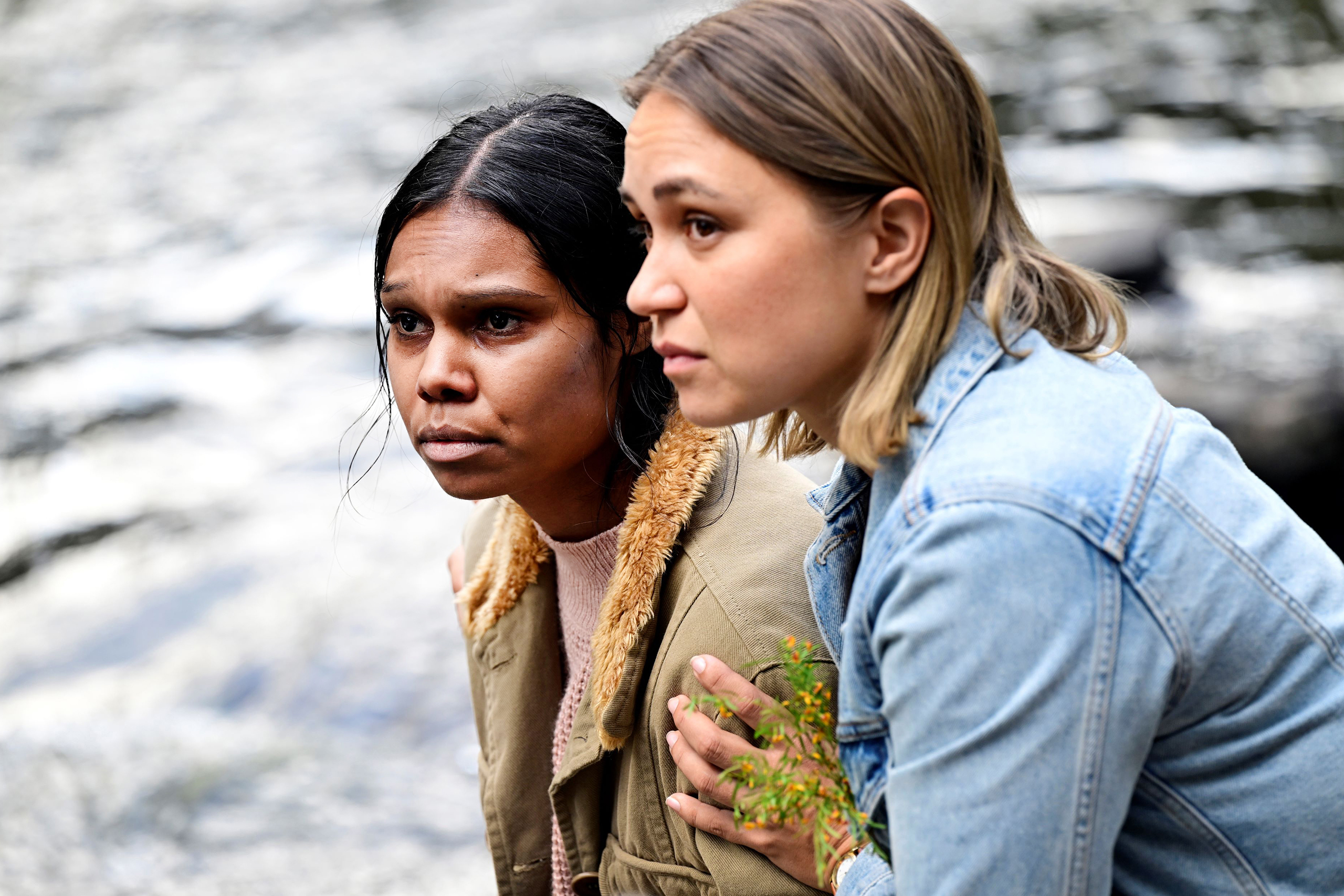
Wayne Blair, back as director for the second season of Origin, has used the license of success and reputation to reign in the ambition rather than expand it. Episode one opens in a low key and proceeds at a steady pace as Jay returns to his hometown near Kalgoorlie in outback Western Australia. He drives through a bush track with the trees close on either side. No great vistas here, and the first incident is a near collision with a lone vehicle driven by a runaway teenager.
People and their stories enter the scene in measured sequence as Swan tries to pick up on who might be up to what, who’s in trouble, who needs care. On the third count, it’s his family who have priority. His partner Mary (Tuuli Narkle), a local nurse, is in an advanced stage of pregnancy; her seven-year-old niece Anya (Shardae Pitt) is living with them while her own parents are “in lock-up.” Intergenerational trauma haunts the place not as high drama but as unrelenting trouble and sadness that continues to blight the lives of the youngest in the community.
It takes a certain kind of Stoic discipline to hold to this register of social realism in the face of expectations that there will be some bigger mystery to solve. Land is the ultimate healer, always larger than any human suffering, and yes, the fabulous cinematography associated with the Mystery Road saga once again has its moments. •