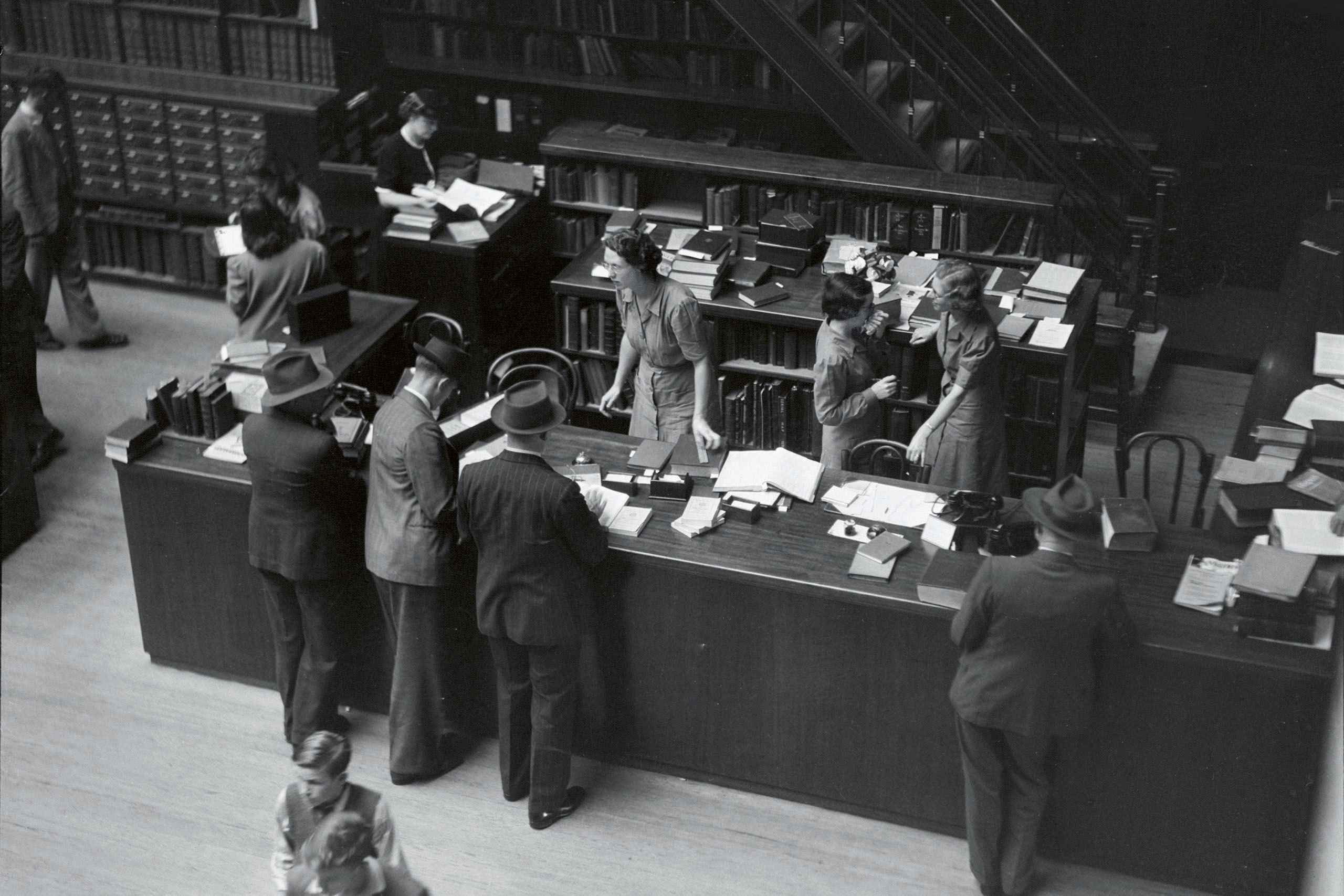
This year marks the two hundredth anniversary of the State Library of New South Wales, and to celebrate the library is offering a year-long program of events, exhibitions, performances, digital experiences and a beautifully produced and lavishly illustrated book, The Library That Made Me: 200 Years of the State Library of New South Wales.
GLAM institutions — galleries, libraries, archives, museums — love an anniversary or any excuse to publish a thumping great coffee-table book about themselves, although as a veteran GLAM worker myself I feel I’ve seen fewer of these in recent years. Resource constraints (certainly among national institutions) might be a reason. The Library that Made Me, co-published by the library and NewSouth Publishing, weighs in at nearly 350 glossy large-format pages and is certainly a thumper. Philanthropic support for the project presumably explains the very modest retail price of just $50.
Two hundred years of operation makes the State Library the oldest continuously running library in Australia, and that demands respect. State librarian Caroline Butler-Bowdon claims in her preface that the anniversary project “places a stake in the ground that speaks to the might and value of this library,” and she continues: “It signals that libraries — enduring, free, and open to everyone — must never be taken for granted.”
First, however, the book reckons with the library’s past. Regular users of its Mitchell building will know the entrance is guarded by three sets of massive bronze doors featuring relief panels depicting historical scenes. Two sets of doors are devoted to images of Aboriginal people. Damien Webb, a Palawa (Tasmanian Aboriginal) man, the library’s manager of Indigenous engagement, opens this book with an aptly named, deeply felt essay, “Stained Bronze: About Us But Without Us.”
The Mitchell Library opened in 1910 specifically to house the collection donated to the library by the celebrated collector of Australiana, David Scott Mitchell. The bronze doors date from extensions to the building completed in 1942. The doors project was personally managed by the principal librarian, William Ifould, who wanted the portrayal of Aboriginal people to be based on photographs taken in Australia’s central desert region because he shared the widespread belief at the time that Aboriginal people existed there in their “purest” and most “wild” state.
Intended as a tribute to the last of the “real” Aborigines who were “dying out,” the images on the doors are for Webb a “stark reminder of the white gaze”. His tone is blunt but not bitter. He writes:
Plucking Aboriginal people out of photographs and combining mismatching elements in this manner is deeply offensive and reductive, and suggests that actual Aboriginal culture mattered far less than non-Aboriginal people’s depictions of them.
Other embellishments to the building, in stone and metal, represented ancient stories woven into European myth.
Yet here we were: our ancestors and our kin cast as relics of ancient history even while our culture continued, breathed and adapted. It feels like a profound insult and a theft of our present, enacted by those who benefited from our ongoing destruction.
After a considerable effort, Webb managed to identify in the library’s collection many of the photographs, which were taken by South Australian anthropologist Herbert Basedow in the 1920s and 1930s, used for the designs. Working his way through these, any one of which could encompass sensitive cultural knowledge obtained without informed consent, was a personal challenge for Webb as an Aboriginal man.
He perseveres because the continuity of culture is the point he wants readers to understand. One image, taken in 1923, shows a young Aboriginal mother holding a baby, and as he points out, by the time the bronze doors were complete, the baby would have been eighteen. Her descendants could be alive today, walking among us.
Something needs to change, the author concludes. Does artistic merit warrant the cultural violation perpetrated in the designs on the doors? Should they be taken down, or left there as a reminder of past practices? There are no easy answers, and yet something undoubtedly has changed if the library feels able to open up a space for one of its own staff to identify and call out these practices.
There is much more of this work to do, in this library and other memory institutions in Australia and elsewhere, and precious few First Nations professionals to lead and guide it.
A photographic essay, “A Day in the Life of the Library,” with images taken by Joy Mei En Lai and Bruce Ford, follows. The emphasis is on people: the staff who keep the library running from day to day. We see librarians, conservators, curators, educators, and building maintenance staff including a gardener and a cleaner — all named — going about their daily work in a purposeful hum of focused activity. One shot takes us into the multicultural book stack, where staff are packing books to be sent to local libraries. At any one time 35,000 books in more than forty languages circulate among NSW public libraries in a service that has been running for more than fifty years.
The photographs easily succeed in challenging any notion the reader might have that libraries are gloomy repositories of mouldy books and dusty archives. Damien Webb makes this explicit: the library, he says, is not “a passive receptacle for the past, but a moving feast of curiosity, bias, power and stories.”
This theme is further explored by his colleague, Mitchell librarian Richard Neville, in a short history of the library from 1826 until today. The struggle for adequate buildings is a thread running through the history of this and countless other collecting intuitions. This and many other aspects of the library’s history: its wide-reaching collecting ambitions; its cultivation of wealthy donors and benefactors; its distribution of books and reference services in country districts; its support for the state’s local libraries; the role of women in the library; its rivalry with what was then called the Commonwealth National Library for the right to regard itself as “national” library for all of Australia; and its exploration of new technologies for copying and sharing its collections with new audiences.
The library’s desire to collect material related to pioneers, explorers and founders of Australia led to a triumphalist view of Australian history which, Neville observes, did not admit “the violence of its dispossession and occupation — even though it was hidden in plain sight in the records in its collection.” First Nations histories and cultures could be glimpsed only obliquely, because, as with women, working classes and non-European people, their records were collected “accidentally, marginally or not at all.” This situation prevailed until the 1970s when cultural historians and First Nations historians began interrogating the collections with fresh questions, drawing on lived experience. When exactly the library began actively collecting in these areas, Neville does not say.
Unsurprisingly for a multi-authored book, there are inconsistencies in perspective. These are not papered over but left for readers to ponder. For Caroline Butler-Bowdon, the library is “beautiful, safe and free,” but Damien Webb’s essay shows it may be far from safe for some First Nations staff and visitors. One set of the bronze doors is especially problematic for him, and he no longer walks with Aboriginal Elders through them.
And while Richard Neville describes the 1942 building as “didactic: a three-dimensional lecture on the foundations of British-Australian ‘civilisation,’” Webb goes much further. For him, the bronze doors and exterior designs constitute “a piece of the larger puzzle of Empire and appropriation, a gaudy pastiche of global iconography that drapes the Mitchell building.”
The “library that made me” concept has been running for several years in the library’s magazine, Openbook. Prominent Australians from different backgrounds, ethnicities and abilities have been responding to an invitation to reflect upon a library — any library — that has been formative for them. These essays comprise the second half of this anniversary book. “If we are made by the books we read,” the editors suggest, “the libraries that allow us to find them will have an impact beyond our wildest dreams.”
The idea denotes a departure from other anniversary thumpers I’ve seen. Here, the power and authority the library has built for itself over many decades, probed and critiqued earlier in the book by Damien Webb and Richard Neville, is decentred. The book is hospitable to the notion that libraries can only survive if they are used. So why not embrace the voice of the library user, and indeed, why stick to the State Library? Probably everyone who crosses the library’s threshold or logs on to its website has already been a reader at — has been “made” by — some other kind of library somewhere else. This all-embracing perspective reaches out beyond walls of the institution and the pedestals upon which libraries usually place themselves (often quite literally).
Naturally the fifty-eight external contributors were not selected at random from a bunch of library users who happened to wander in on a slow Tuesday wanting to take advantage of the free air conditioning. Such an approach is hardly going to sell many books. (It might, however, have turned up some interesting results when you consider one of Sydney’s most famous identities, Bee Miles, was once banned from the Mitchell Library’s reading room for smoking, though her manuscripts were later readily accepted into the collection.)
Anyway, one cannot help but be curious about how libraries have nurtured and inspired successful writers including Anna Funder, Sarah Krasnostein, Sheila Ngọc Phạm and Yumna Kassab; journalists (Annabel Crabb, Anne Summers), historians (Michelle Arrow, Mark McKenna) and many other public intellectuals. The library also invited contributions from governor-general Sam Mostyn, artist Cressida Campbell, violinist Skye McIntosh, bookseller David Gaunt, actor and director John Gaden, celebrity chef Nagi Maehashi and netballer Liz Ellis.
A pattern emerges in many of the narratives, beginning with a school or local library and moving onwards and upwards to a university library or celebrated institution overseas. For some contributors, library-love began with just a simple shelf of books in the family home. Together, these contributions are like a joint coming-of-age story, as each library advances the reader in their search for identity and voice. Some contributors still marvel at the glorious freedom granted them by a simple library card of their own. The enormous impact of local libraries (and librarians) in the post–second world war era is fully evident here.
Some contributors barely refer to a library at all, for what is a library, after all, other than a way to systemise knowledge? Architect Glenn Murcutt admits, having struggled to read, he learned from his father that observation is a different method of reading and learning. For him there’s legibility in the structure of a landscape; how, for instance, trees erupt from the ground, or how leaves hang from trees and turn to follow the sun over the course of the day. Reading the landscape is totally integral to his life, has says.
The written word is not everything. By the age of thirteen, writer Ellen van Neerven had read omnivorously from the Albany Creek Library in Brisbane, but when they came across the CD rack, they felt they had discovered a goldmine, for there was no music at home. They picked up a CD by the American rock band Yeah Yeah Yeahs, and at home fell into a “passionate spell,” partly because of the music but also because of the library they realised they could cultivate in their mind from the books and music to be borrowed.
“Dancing around in my bedroom… I rocked out in the moment without feeling the thoughts and judgements of others,” van Neerven writes. “I carefully curated an internal world brighter than everything around myself. Nobody loved my mind more than me.” •
The Library That Made Me: 200 Years of the State Library of New South Wales
Edited by Richard Neville and Phillipa McGuinness | NewSouth | $49.99 | 344 pages