It probably doesn’t happen very often that two tonally perfect novels (or novellas in this case) become adapted into two tonally perfect films. My claim is that this is the case with Irish author Claire Keegan’s two slim volumes, Foster (published in 2010, 88 pages) and Small Things Like These (2021, 110 pages), in neither of which is a superfluous word. I am grateful to have had Keegan brought to my attention quite recently and consequently to have seen the two film versions: Foster, filmed as The Quiet Girl (2022), and Small Things Like These (2024).
Both novellas depend on the reader’s being alert to subtle character shifts and inner lives, insofar are they are intimated, and both films, each set in Ireland, have found their own ways of dealing with those inner reflections. Neither novella and neither film depends on a conventional cause-and-effect narrative leading to a predictable conclusion. I came to the later book and film before the earlier ones, and will stick to this order as it probably influenced my response to them.
Small Things evokes a small Irish town, New Ross, and the kind of life in which the key figure, Bill Furlong, works and enjoys his happy marriage and family. Though he reflects on life’s other possibilities, Bill is clearly aware of and grateful for what he has. His mother died when he was young; he was subsequently looked after by Mrs Wilson, the well-to-do owner of the property on which his mother had worked as a maid. He has never known his father. Keegan creates a wholly credible sense of his marriage to Eileen and of their five children; he and his wife don’t agree about everything but this marriage clearly works.
A major moment in the novella’s plot — and in Bill’s life — occurs when he delivers coal to the local convent, a training school for girls that houses an abusive Magdalene laundry in which the girls are cruelly treated. In the coal shed he finds one girl, Sarah, who has been locked away as a punishment and tells Bill she wants to drown. When he talks to Sister Mary, the “Mother” of the convent, she smilingly bribes him with money as a Christmas present for his family. When he comes across Sarah again he must make a significant decision about how to respond.
Neither his action nor the possible identifying of his father is the object of melodramatic flourish or sentimentality in the book or in the film. Instead, they convey a feeling that these issues, however personally important, may be treated as “small things” in the scope of the larger world and its ongoing difficulties and beliefs.
The film, directed by Tim Mielants from Enda Walsh’s screenplay, pursues the same narrative course as the novella but finds its own way of rendering the recurring sense of inner reflection the text creates using Bill’s responses to events. Whereas Keegan’s prose does so immaculately, one of the triumphs of the film lies in Cillian Murphy’s performance as Bill Furlong, with his quiet changes of facial expression and subtly conveyed shifts of awareness.
As played by Eileen Walsh, Furlong’s wife Eileen is humanly companionable but capable of moments of sharpness. As mother of five children, she has plenty to occupy her, and she suggests appropriate affection as well as individuality. As Sister Mary, the ever-reliable Emily Watson endows a seemingly benign surface with a much chillier, more rigorous viewpoint.
The controlled tone of the film’s final moments is perfect. In a Hollywood version, there would have to be a group hug at very least — possibly joined by Bill’s father, whose identity remains unknown in the film as in the novella.
Having used the words “immaculate” and “perfect” in relation to aspects of Small Things, and being tempted use them again in relation to The Quiet Girl, the film version of Keegan’s Foster, I might appear to readers to be raving, and this may well be the case.
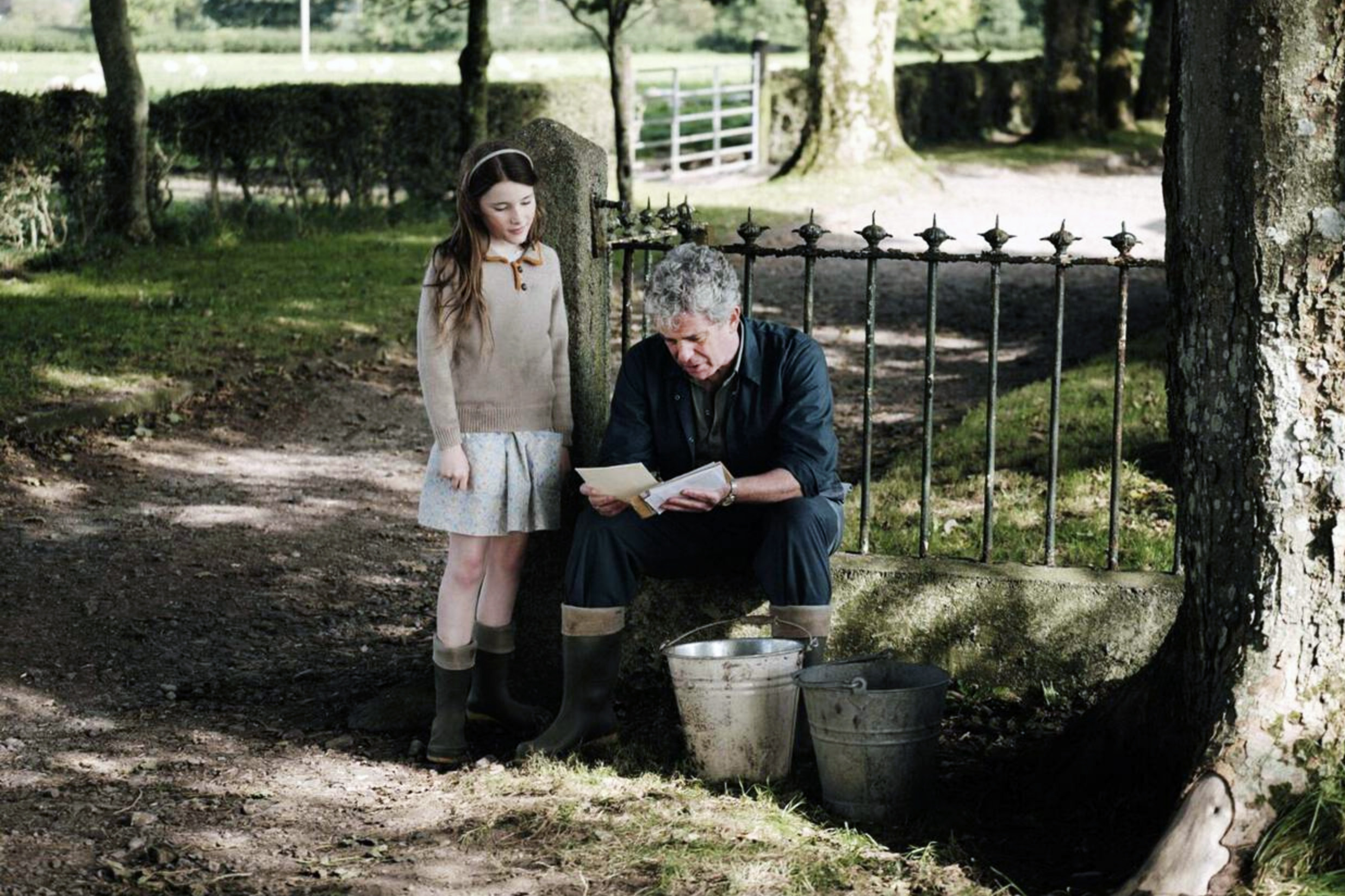
“Plot” scarcely seems the right word to describe what happens in Foster. Once the initial action has been made clear, it feels more like a life simply going on from day to day. It begins with the girl (unnamed) being driven by her father to stay with her godparents, the Kinsellas, because her mother is pregnant. When the father drives off with the girl’s belongings still in the car, Seán Kinsella tells her not to worry: “We’ll have you togged in no time,” and this proves symptomatic of how kindly the girl will be treated in the months ahead.
She has no idea of how long she will be there, but she will experience a kind of love her home and her parents never seemed to offer. Quite early on, she says (and the whole story is told in her words): “I wish this place without shame or secrets could be my home.” She helps Edna Kinsella with cooking and other jobs and is happy to do so. Seán teaches her to read and, for fun, regularly times her run for the mail in the post-box on their farming property. And so on. The ongoing warmth and affection she is shown leads her to think of “the difference between my life at home and the one I have here.”
None of this becomes a subject of easy pathos; rather, it is a means of exploring how, in this very different environment, the girl’s responses to life are changing. As we shall see, the film version, The Quiet Girl, will have a different way of articulating these responses, but with no less eloquence. Keegan creates some variance in how the girl is drawn to the two “foster” parents and they in turn show affection for her. The same cannot be said for her actual parents after Seán drives her home once her mother has given birth to a son.
The film captures the tone of Keegan’s story seemlessly transmuted into the new medium — with never a superfluous moment. In fact, Colm Bairéad’s telling (he is both director and screenwriter) renders a gentle change in life with a perfection for which it is hard to think of many competitors.
The Quiet Girl begins with a long shot of a hayfield in which a girl is calling out to her sister Cáit (Catherine Clinch), who is hiding in the hay, that “Mum’s looking” for her. Back home, Mum reprimands her for having mud on her shoes. This is part of the coldness of Cáit’s life at home, a matter not ameliorated by her father’s alcoholic tendencies, and there is no sense of family farewell as she leaves to stay with her mother’s cousins, the Kinsellas.
Her father (Michael Patric) is driving, but she sits in the back seat and he doesn’t talk to her. She is warmly welcomed by Mrs Kinsella, Eibhlín (Carrie Crowley), who hasn’t seen Cáit since she was a baby. The father leaves without a kiss for his daughter or thanks for the gift of rhubarb Eibhlín has given him. These and other details establish the environment Cáit is leaving and the one she is arriving at.
From there, events closely follow those of Keegan’s story, showing the viewer the immediate and continuing kindness Cáit receives from Eibhlín and the slower-to-start but equal warmth of feeling she experiences from Seán (Andrew Bennett), and how this is registered in Clinch’s performance as Cáit. In fact, “performance” seems almost too conventional term to describe how Clinch renders so many of her reactions to her changing circumstances in subtle shifts in facial expression as she gradually warms to affection so at odds with her own family.
She is pleased to help both Seán and Eibhlín in their daily work and is far from excited when she has to return home after her mother has given birth to a baby boy. “You’ve grown” is the nearest her mother can say (or do) in the way of welcome. When the Kinsellas drive off, Cáit races after to catch up with them in an emotionally charged moment that, like Small Things, never reeks of sentimentality.
Two beautiful Irish novellas have been adapted into two beautiful Irish films to which I hope that I’ve done justice. •