France’s national human rights body has detailed violations of human rights and “violent, often disproportionate repression” by French security forces during the 2024 crisis in New Caledonia, which pitted Kanak protestors against thousands of French gendarmes and police. Meanwhile, deep underlying disagreements over the future of the French dependency seem as far as ever from resolution.
The report on the May–November 2024 conflict by the Commission Nationale Consultative des Droits de l’Homme, or CNCDH, released last week, found “a worrying weakening of fundamental human rights, affecting the Kanak population in particular.” It pointed to “persistent structural discrimination, significant social inequalities and a questioning of the self-determination process implemented by the government.”
The 2024 unrest was sparked by French president Emmanuel Macron’s late-2023 proposal to transform the electoral rolls for New Caledonia’s provincial assemblies and Congress. The changes, which would have added thousands of French voters to the territory’s electoral rolls, angered independence supporters, mainly indigenous Kanak, who organised months of peaceful rallies, vigils and meetings in opposition.
Former French high commissioner Louis Le Franc and other officials seem to have misjudged the level of anger about this unilateral change, decided without a consensus of leaders in Nouméa. In March 2024, Le Franc told visiting French parliamentarians that “the independence movement, just like the Loyalists, are no longer able to mobilise as they did before. Their mobilisation will not exceed a few hundred people on each side, but we will be able to manage.”
Just weeks later, on 13 April, an estimated 30,000 people marched through the capital, waving the flag of Kanaky, during a rally organised by the CCAT network and independence coalition Front de Libération Nationale Kanak et Socialiste, or FLNKS. On the same day, an anti-independence Loyalist counter-rally drew 15,000-plus protestors, many of them waving the bleu-blanc-rouge French tricolour. The size of the two rallies was unprecedented in a country of just 268,000 people.
Trouble was clearly brewing. In late April 2024, I reported that “in coming months, further protests will convulse New Caledonia.” I was wrong — the crisis began in weeks, not months.
When Macron’s legislation reached the French National Assembly on 13 May, riots erupted across Nouméa and in nearby towns. Dodging teargas, flash-balls and police truncheons, protestors from the squatter settlements and public housing towers mobilised on the streets. Authorities responded with an overnight curfew, a state of emergency and, in a vain attempt to halt social media mobilisation, a shortlived ban on TikTok.
Le Franc urgently sought more police from Paris, but their rapid deployment was complicated by France’s massive security operation for the 2024 Olympics and Paralympics. In a 2025 court case, government lawyers acknowledged that “in the days leading up to 13 May, the high commission repeatedly warned the interior ministry. The warnings were ignored, as it was essential not to disrupt the organisation of the Olympic Games. There were only 500 to 800 police officers and gendarmes, a historically low number.”
As rioting expanded after 13 May, further deployments were hampered when protestors repeatedly blocked the fifty-five-kilometre road from central Nouméa to the international airport at Tontouta. With no safe route to the airport, hundreds of tourists were evacuated by Australian and NZ military aircraft using the shorter domestic airstrip at Magenta.
Supermarkets and shops were looted, and roadblocks and barricades sprang up in Nouméa and surrounding towns. Young protestors torched the Renault and Porsche dealership in Magenta, a striking symbol of the enormous economic inequalities in the French colony.
New Caledonia’s capital combines luxury apartments, tourist hotels and yacht harbours with peri-urban squatter settlements housing thousands of mainly Kanak and Wallisian islanders. As the CNCDH report explains, “these inequalities, which are significantly more pronounced than in mainland France, mainly affect the Kanak people, a significant proportion of whom live below the poverty line.” The result is very high unemployment among the Kanak population, especially young people and women. “Racial discrimination, deeply rooted in New Caledonia’s colonial history, exacerbates social inequalities,” said the report.
Social and cultural polarisation worsened in subsequent months. By year’s end, fifteen had died, hundreds had been injured and more than 2500 arrested. The economic damage was enormous: businesses were burnt out or shuttered, tourism, nickel smelting and other key industries foundered, and New Caledonia’s 2024 gross domestic product fell 13.5 per cent. Schools closed and the health sector suffered cutbacks to crucial medical services as French doctors, nurses and medical specialists fled the islands.
The initial failures of French security forces were highlighted last year, as the insurance company Allianz sued the French State over the destruction of businesses in the Kenu-In commercial complex between 15 and 17 May 2024. The shopping centre was looted and torched during nearby clashes between Kanak rioters and police.
During the subsequent case, the court was told of an internal report in which the gendarmerie commander in New Caledonia admitted a “mobile gendarmerie squadron and a GIGN unit were deployed, before being immediately withdrawn,” even though their mission was to protect Kenu-In. Having found the French State was “aware of the inadequacy of its security measures” in late May, the court ordered the government to pay €28 million (A$48 million) in compensation, a worrying legal precedent for Paris given hundreds of businesses were damaged and closed during the crisis.
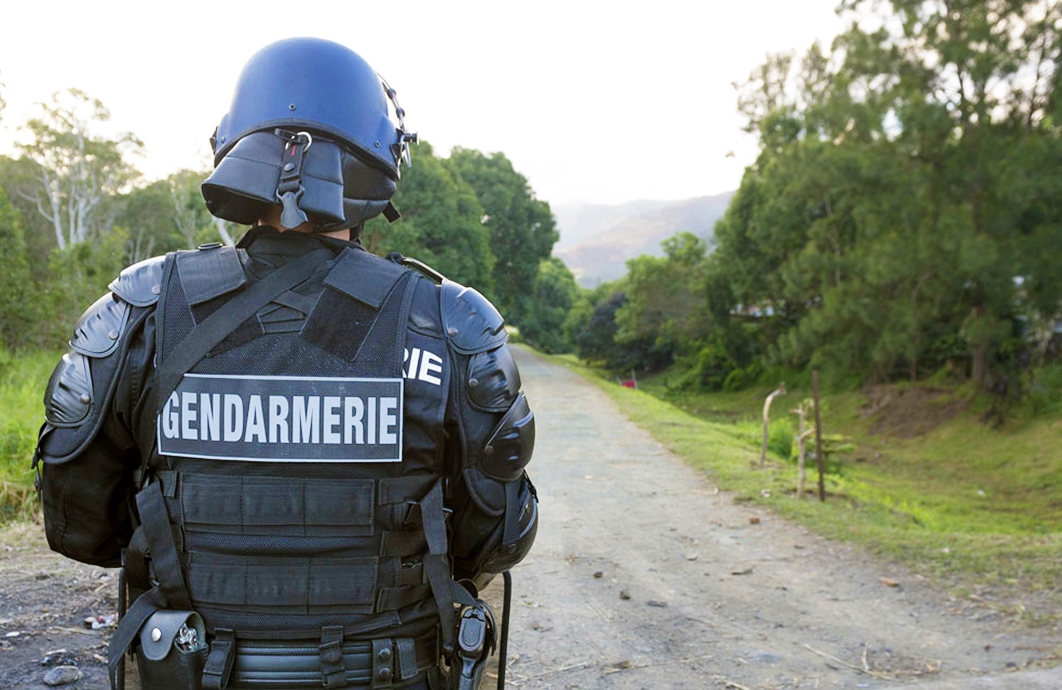
Within weeks of the start of rioting, a total of 3000 gendarmes and police officers had been deployed, supported by CRS riot squads from the Compagnies Républicaines de Sécurité, officers of the SDAT Anti-Terrorist Sub-Directorate, and nearly 150 elite GIGN paramilitary soldiers. As part of the Gendarmerie Nationale, the GIGN describes itself as “a unit dedicated to counterterrorism, extreme crisis management, the fight against organised crime as well as the security and protection of the vital interests of the French State.”
On 15 May, a day when four people were killed by gunfire, the security forces suffered their first death. French gendarme Nicolas Molinari was shot near Saint Louis tribe, on the outskirts of the capital. (Three people have now been charged over his death.) Molinari was one of two gendarmes killed during the 2024 crisis; the other was accidentally shot dead by a fellow officer.
In response to Molinari’s death, elite GIGN forces mobilised against a small group of armed independence activists in the Kanak tribe, the site of ongoing armed clashes. French forces established roadblocks near Saint Louis, banning vehicle movement and restricting access to basic goods, gas bottles or jerrycans of petrol. All men, women and schoolchildren were searched as they entered or left the tribe, and any without ID were turned back.
As gendarmes sought to clear the road to the outlying town of Mont Dore, where the community was isolated for months, GIGN sharpshooters killed three Kanak at Saint Louis: Rock Victorin “Banane” Wamytan in July, and Samuel Moekia and Johan Kaidine on 19 September. Calling for an independent investigation into the deaths of Moekia and Kaidine, the FLNKS condemned “the barbaric and humiliating methods used by the police, who did not hesitate to carry out a summary execution of one of the young people in question.”
As the crisis spread, anti-independence politicians and many non-Kanak New Caledonians, stunned by the protesters’ anger and resistance, called for police to respond with a massive show of force. In July, the freighter Calao carried Centaure armoured cars, trucks and other vehicles from Toulon in France to support police operations, their unloading captured in a striking video by dockworkers.
By September, forty-one police and gendarmerie units had been deployed, with more than 6000 personnel on the ground. The gendarmes were provided with helicopters, logistic and technical support from French military forces based in New Caledonia.
Throughout these months, church and community leaders called for an end to violent protests by young Kanak, while also criticising the excessive use of force and intimidation by security forces. They were worried that police, angered by the deaths of two gendarmes, would lash out against Kanak youth with extra-judicial acts.
The French high commission and public prosecutor, meanwhile, were angered by criticism of police tactics by the media, UN rapporteurs and human rights organisations like Amnesty International. Many journalists — including this correspondent — were denounced by the French high commission for “fake news” after they reported on police violence against Kanak communities and the spillover effects on non-combatants.
Yet the CNCDH, after months of inquiry, bluntly concludes that “the responses from public authorities have been essentially ‘repressive,’ relying on administrative policing measures, massive intervention by law enforcement agencies, exceptional judicial measures and measures at the local level perceived as collective punishment.”
Other lawyers and human rights advocates have documented how security forces breached their own regulations as they tried to control the colonial situation far from France. An August 2024 statement by UN human rights rapporteurs raised concern over “the absence of dialogue, the excessive use of force, the ongoing deployment of military forces and the continued reports of human rights violations.” They criticised the “exclusively repressive and judicial approach” to the crisis that is “not only anti-democratic, but deeply worrying for the rule of law.”
In its regular review of French policy in May 2025, the UN Committee Against Torture expressed concern “about allegations of excessive use of force, including lethal force, by police officers and gendarmes as well as by the armed forces that were deployed to New Caledonia in May 2024.”
French authorities have dismissed the UN criticisms by highlighting the use of firearms by activists at Saint Louis, the stoning of riot police by youth on the barricades and hundreds of officer injuries. Gendarmerie general Nicolas Matthéos said that he has “never seen such a level of violence and adversity” in his thirty-year career.
Yet the UN concerns are echoed by the CNCDH, which declares “the clashes led to violent, often disproportionate repression by the police, particularly in the Southern Province and more specifically against the Kanak people.” It cites “numerous testimonies that have indicated severe physical violence, including against minors, as well as deliberate destruction of property, all of which are disproportionate practices. A militarised police intervention involving armoured vehicles and firing from helicopters at civilians attempting to flee has also been reported.”
Back home in France, the French police have a reputation for militarised policing, and a long tradition of using tear gas and flash-bang grenades during protests by the Gilets Jaunes (yellow vest) movement, farmers, unionists and Palestine supporters. Human rights groups have documented a range of injuries caused by these grenades, including people losing a hand or eye.
Yet authorities weakened restrictions on the use of such grenades in late June 2024, although the relaxation only applied to forces operating in New Caledonia. Existing regulations restricted use the GML2L tear gas and flash-bang grenade to a specific launcher, but interior minister Gérald Darmanin’s office quietly informed the heads of France’s National Police and Gendarmerie that the grenade could be thrown by hand, leading to their being tossed into houses and enclosed spaces.
Police also trialled new riot control equipment during the unrest, adding new technology and infrared cameras on the Centaure armoured cars. The newspaper Politis reports that French authorities purchased weaponry classified as “war materials” at the start of the conflict. These included new launchers that could rapidly fire twelve gas grenades over distances up to 200 metres.
The CNCDH report also highlights discrimination in the court system and “unacceptable conditions” in New Caledonia’s prison Camp Est, where hundreds of protestors were held on remand. French authorities acknowledge that, by year’s end, 2528 people had been taken into custody with more than 500 brought before a magistrate. Fifty-eight per cent of detentions related to property offences, and around one in ten of those held were minors.
The influx of hundreds of new prisoners on remand exacerbated the already unacceptable conditions in the Camp Est prison, in facilities long acknowledged as “deplorable” by French authorities.
“The events of 2024 highlight a longstanding and persistent situation,” says the CNCDH. “Although Kanak represent around 43 per cent of the New Caledonian population, they make up between 90–95 per cent of those imprisoned at Camp-Est… This disparity is all the more striking given that, at the same time, Loyalist armed militias — which have been widely publicised and implicated in acts of violence — have not, to date, been subject to any known legal proceedings.”
In June 2024, key Kanak leaders were flown to France in handcuffs on military aircraft, to be charged with serious crimes. They were held in solitary confinement for pre-trial detention, in prisons scattered across France. Over time, French investigating judges abandoned most of the serious charges, and the detained Kanak — including current FLNKS president Christian Tein — were eventually released from detention, later returning to New Caledonia.
The CNCDH report criticises the breach of human rights in these transfers and eventual release, noting “some transfers to mainland France allegedly violated the rights of the legal defence and took place in complete secrecy, even from relatives. The release of certain individuals detained on French mainland territory, 17,000 kilometres from their homes, without winter clothing or return tickets, only reinforced a feeling of humiliation that was detrimental to the perception of justice.”
Just over a year after the end of clashes, the French State and local leaders are again debating a new political statute for New Caledonia. But two key texts, the Bougival Accord negotiated in July 2025 and the supplementary Elysée-Oudinot Accord in January 2026, are opposed by the main independence coalition, FLNKS. As France again moves to translate these agreements into law without consensus among leaders in Nouméa, some New Caledonians fear more conflict later this year.
New Caledonia’s current gendarmerie commander General François Haouchine confirmed last month that fifteen squadrons of mobile gendarmes from France were still deployed in the islands, alongside 1200 local gendarmes and police. He also said that “the director-general of the National Gendarmerie keeps five mobile gendarmerie squadrons on permanent standby, ready to be deployed to New Caledonia in case of emergency or necessity.” •