Financial Times reporter Sarah O’Connor confesses to having once been a techno-optimist, confident in technology’s power to automate away dangerous, dirty and boring work. Her new book, We Are Not Machines, superbly explains how she came to think otherwise.
O’Connor adopts a “show, don’t tell” approach to debunking some of our society’s most banal and unhelpful narratives about technology and work — among them the idea that AI will “free up” cognitive load and enable people to take on more creative and satisfying tasks and enjoy more leisure. Through nine lively chapters organised into sections on the “mind,” “body” and “soul,” she introduces us to many different kinds of people who work with, around and under highly automated and AI-infused systems, including coders, translators, drivers, warehouse workers, miners and screenwriters.
What emerges is not a ledger of winners and losers but a set of skilfully drawn portraits of power, self-awareness, hard choices and collective contestation. None of O’Connor’s informants is beguiled by grand narratives of human liberation, and none seems to accept at face value the idea that AI is “just a tool.” For O’Connor and many of her interviewees, the question of whether any particular job is robotised always co-exists with the question of whether and how human beings are being made more robot-like when they are forced to work in highly automated systems.
Where things stand within any particular occupation is, O’Connor observes, often detectable from the words people choose they use to talk about their jobs:
“We send him away, then we send him back,” the miner had said about the autonomous truck. Compare that to what the Amazon workers said: “The robot is moving and you have to move with the robot.” Or, indeed, compare it to what Rebecca, the translator, had said: “You still have to be quite fastidious in receiving all this machine translation output, and that’s exhausting, it’s stressful.” All of which is to say, sure, technology might be “just a tool,” but if you’re not the one with the tool in your hand, you’re not the master carpenter, you’re the screwdriver, or, worse, you’re what’s getting screwed.
One of the real strengths of We Are Not Machines is O’Connor’s deftness in showing how AI is, and isn’t, the latest act in a centuries-long drama of worker alienation in response to industrial capitalism. The varieties of anxiety, danger, resentment, acceptance, exit and resistance she chronicles are never detached from the history of capitalism and its critics. In describing the risks of machine users becoming machine-like, for instance, she quotes Ruskin: “It is not, truly speaking, the labour that is divided; but the men — divided into mere segments of men — broken into small fragments and crumbs of life.”
The hypermodern Amazon warehouses that bring the shelf to the worker (rather than the other way around) — and rely on a remote global workforce of “humans in the loop” to oversee mistakes — can be seen, she says, as a new iteration of Henry Ford’s moving assembly line. Appropriately enough, the American engineer F.W. Taylor plays a recurrent role as the architect of the most notorious system for using “time and task” techniques to deskill and speed up workers.
But O’Connor hasn’t written another weary “it’s capitalism, stupid” narrative. This is largely because she has a finely tuned ear for workers’ descriptions of the ways AI-infused systems shape their inner lives at work.
She tells us, for instance, about the silent mantra that Affan, a human “GO-AI Associate” for Amazon in Costa Rica, recites while watching videos of people putting items onto canvas shelves in nine-hour shifts. Faced with a 99.9 per cent accuracy rate requirement and the need to watch approximately 1200 ten-second videos a shift, Affan’s time before the screen is accompanied by the prayer, “Please God, save me from a defect, please God, save me from a defect.”
Poignantly evocative, too, are her presentations of translators’ lives and perceptions before, during and after the imposition of AI-based software. The creativity and sense of meaningfulness of translating from scratch shines through one translator’s explanation of the process:
[Y]ou take a message, a part of the message… then you render it in the other language, mostly through the equivalence of expression, the equivalence of feeling. “If I was thinking this, how would I say it?” That becomes automatic — it feels almost automatic. Sometimes you get stuck [but] if I am hitting the flow, then it feels fantastic.
Having to edit a machine translation, however, is “a bulkier process in your mind,” says Majkic, “it’s less rewarding, it takes more cognitive effort, not less.” In the words of another translator, Petr:
When someone presents you with a solution, and you’re looking at that, and you’re supposed to make it sound natural. It’s difficult to come up with your own solution… I compare this to counting from one to a hundred: one, two, three four — with someone whispering in your ear some random numbers. Imagine that. It’s so frustrating. That, to me, is what machine translation post-editing feels like.
O’Connor doesn’t present the degradation of translation work as something afflicting only the translators, either. End-users of the work — the readers and watchers of the films and TV series being translated — receive more literal translations that might be comprehensible but are also “flat and boring and uninteresting.” The loss here isn’t merely of “quality,” it is also of people’s capacity to recognise what “quality” is or be aware that any alternative might be possible in a market flooded with “good enough” products.
Noting that this, too, isn’t a new dynamic, O’Connor quotes George Orwell in The Road to Wigan Pier: “Mechanisation leads to the decay of taste, the decay of taste leads to the demand or machine-made articles and hence to more mechanisation, and so a vicious circle is established.”
O’Connor’s main example of a group of workers for whom the “AI is just a tool” maxim seems plausibly true is software engineers. Most of them view AI tools as a welcome addition to their workflow because they don’t see them as affecting the part of their job they really value, which is problem solving rather than simply writing code. Nor were AI tools forced on this group: because they wield relatively great labour market power, they retain control over whether and how to use them.
But they are very far from representative. For creatives, educators and carers, the application of productivity and efficiency values — even before they were expressed in AI form — seems like a category error in any attempt to grasp the purpose and value of their work. O’Connor depicts the sense of violation felt by artists, for instance, who see the idea of AI as simply a “tool” as profoundly misconceived. For them, it is “far more like an end-results machine than a new kind of paintbrush.” As the historian Lewis Mumford once explained, “the purpose of art has never been labour-saving but labour-loving, a deliberate elaboration of function, form, and symbolic ornament to enhance the interest of life itself.”
In care work, too, technology-reliant approaches provide new iterations of old ways of missing the point. Debates about AI-infused care robots are a distraction unless they recognise what is lost or degraded when we attempt to organise something inherently and profoundly relational (beautifully elaborated by sociologist Allison Pugh as “connective labour”) as if it were an industrial commodity to be produced via principles of scientific management.
The Buurtzorg nurses O’Connor interviewed (who have a high level of worker autonomy, are geographically embedded, and deliver client-centred, defragmented care) were aghast at the idea that performing “simple tasks” was a “waste” of their training. “You are not only there for that simple task, you are there to see the people, to see the life, to see what you are dealing with,” said one. “You can’t take care of someone who doesn’t trust you, because they won’t tell you the whole story, because sometimes they think it’s not important, but even the little signals can be something that’s really wrong.”
O’Connor doesn’t merely observe the multiple clashes between the AI-enabled Taylorism and the values that hold us together as human beings with bodies, minds and souls. She also delves into the structures of power that make contestation over those matters meaningful.
One of her key case studies describes underground miners in Sweden who don’t evince categorical hostility to digital technology and automation, and show openness, creativity and collaboration in how such systems might be integrated into their work. She describes how the agreement they reached about self-driving underground trucks and loaders reflected genuine give-and-take: how worker concerns that digital surveillance systems would drift from safety mechanisms into forms of discipline and speeding-up were worked through to the parties’ mutual satisfaction.
In that case, says O’Connor, the understanding and compromise on display rested on “a very human edifice: a system based on relationships of trust, underpinned by a careful balance of power. It struck me that it required a great deal of skill, effort and emotional intelligence to maintain it.” It was a system underpinned by collective bargaining not only at enterprise-level but also nationally, sectorally and locally. Employers and unions (the latter with 70 per cent membership density) were able to reach sector-specific agreements lasting one to three years within a system that, by its nature, is more responsive than one-size-fits-all laws imposed sporadically in the face of powerful political resistance.
Integral to the Swedish miners’ approach is a reliable and comprehensive welfare safety net that provides 80 per cent of pre-employment earnings to displaced workers. Through this lens, whether you see AI as a “tool” is not a matter of individual preference or psychological flexibility but intimately related to institutional arrangements that reflect collective workplace power.
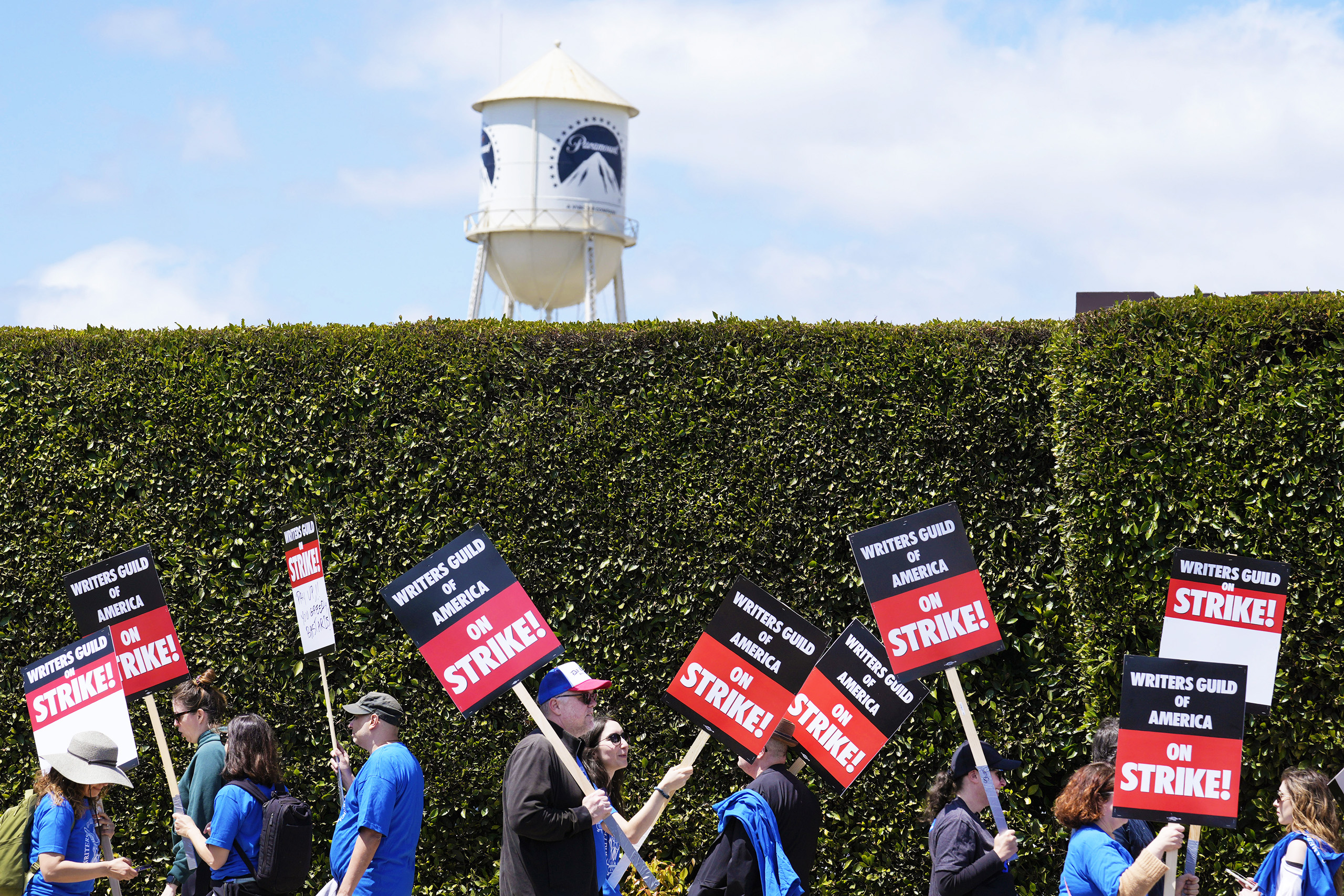
The nature of industrial power is also critical in O’Connor’s account of the Writers Guild of America’s agreement with film and TV producers that set the conditions for writers to control when AI is used. The new contract didn’t ban the technology, but it did remove the economic incentive for companies to use it to displace writers by specifying that AI content could not be classified as “source material” merely to be “revised” for lower rates.
The agreement wasn’t merely the product of enlightened and flexible thinking on both sides. It emerged from an industrial relations framework that supported sector-based contracts and permitted industrial action, in this case a 148-day strike in which writers were supported by actors and support from Teamsters and United Auto Workers. As well as generating countervailing power, the process ensured the issue wasn’t metabolised by workers as a private source of shame, lack of training or bad choices. By making the issue public and visible, says O’Connor, workers felt “as if the wider public was also on their side.”
We Are Not Machines concludes with persuasive observations about the importance of attending carefully to how we talk, and therefore think, about work and technology. It is impossible to disagree with O’Connor’s observation that “wave,” “tsunami” and other metaphors “encourage us to see this process as analogous to a powerful force of nature — something that cannot be controlled, but can only be prepared for, and then mopped up after.” As she says, “new technology doesn’t just unfold. It never has. It is created by people and implemented by people.”
Nor, she argues, should we accept the thin, desiccated view of humanity that makes up Silicon Valley’s view of progress: the idea that we are merely slower, stupider, weaker and more biased versions of the machines. Anyone who doubts her point — and in fact everyone that doesn’t — should urgently read the Papal encyclical Magnifica Humanitas.
O’Connor writes brilliantly, too, about the importance of not feeling boxed in when we ask difficult and complicated questions about where AI belongs and how it should operate:
To say you don’t want AI to clone musicians does not also mean you don’t want protein-folding, antibiotics, low child mortality rates or indoor plumbing. That is a ludicrous mental box to put oneself into. And people don’t do it with any other kind of produce. If you think heroin is bad, you don’t worry that people will think you are also against paracetamol.
O’Connor guides us, instead, to some better starting questions. She cites Neil Postman who suggested in his 1992 book Technopoly that we ask: “What is the problem to which this technology is the solution? And whose problem is it?” To Postman’s questions, O’Connor adds another, “Are there any other ways to solve the problem?” To these, I would perhaps suggest one more that emerges from her account: what structures are we building to enable answers to these questions to be meaningfully debated rather than simply imposed?
O’Connor is to be applauded for insisting we centre human agency when we talk about how AI is designed and introduced into workplaces, that we always ask who decides. The next step in the analysis — and one beyond the scope of her book — is to ask why we so often accept the formations of industrial power and corporate power inherited from the last century as “givens,” as if they are features of the natural landscape (“Norway has mountains,” “Australia is flat”) rather than as structures we have built and can choose to maintain or change.
If we know Taylorism is deeply corrosive to the forms of trust and relationality that are critical to care, for example, why do we increasingly choose to provide care via private equity companies, the institutional vehicles perhaps least capable of reversing disastrous low-trust, high-fragmentation “time and task”-based approaches? Why do we persist with collective bargaining structures that (with narrow and highly conditional exceptions) confine collective worker voices to the enterprise level and narrow range of “permitted matters”? These institutional structures were built in the time before AI, and whether and how we continue to use them is up to us. •