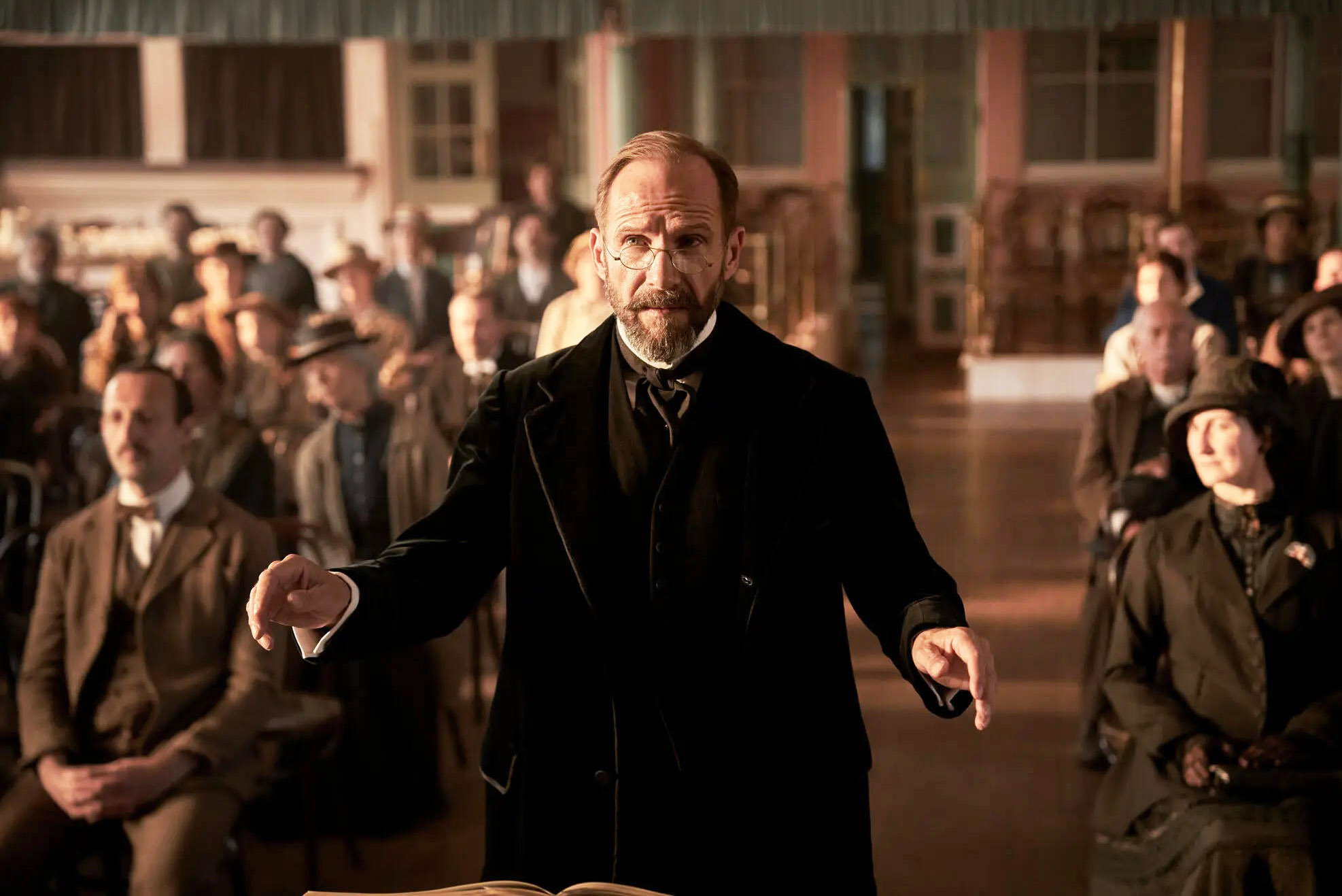
The Choral — Nicholas Hytner’s film of Alan Bennett’s screenplay — is worth 103 minutes of anyone’s time, even if, in many ways, it’s not very good.
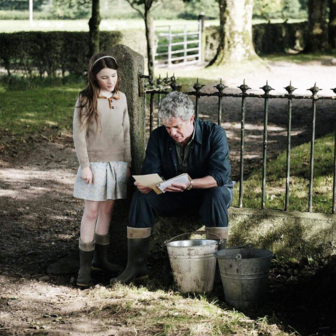
In a Yorkshire mill town in 1916 the local choral society has already lost most of its men to the Western front. When the conductor enlists, a replacement (Ralph Fiennes) is found — one who has, controversially, gained his experience working in Germany — and the remaining handful of superannuated tenors and basses is bolstered by teenage boys still too young to fight and injured soldiers returned from the trenches.
The film is a bundle of familiar themes: the pity of war and the loss of innocence, the transformative power of music, adolescents overwhelmed by sexual urges, and Bennett’s bluff northern characters (in some cases little more than caricatures). Then there’s the show-must-go-on trope, familiar since at least 42nd Street, complete with the last-minute discovery of a new talent (“Going out there a youngster… coming back a star”). There are even strong undertones of the Judy Garland/Mickey Rooney let’s-do-the-show-right-here films in the Ramsden Choral Society’s adaptation of Elgar’s oratorio The Dream of Gerontius to suit its available forces.
None of this is a problem. The problem is that the screenplay doesn’t fit the format of a two-hour film. As we left the cinema, my wife remarked that it should have been a miniseries.
Television has long been Bennett’s prime medium, the revelation of character his strength. I think I’ve read or seen everything he’s written and would argue that his best writing is the six, then twelve and, finally, fourteen Talking Heads monologues. These allowed us to be addressed directly by a character, often lacking in self-knowledge, whose true nature we learnt over the ensuing half an hour. The trouble with The Choral is that there are so many characters (the clue is in the title), all of whom are promisingly set up, few of whom the film has time to develop. Like so many England batsmen, they get a start but don’t go on.
Mind you, more time could have been found. For example, in a memorable scene, three injured soldiers — two missing limbs, another blinded — sing Gilbert and Sullivan’s “Three Little Maids from School” as their audition piece. Amid quite a lot of camp moments in The Choral, this is by some way the highest. It is also unnecessary — we never see these soldiers again — and a darling that might have been slaughtered.
Some of the film’s themes are familiar Bennett territory. In his play The History Boys the students have all memorised Philip Larkin’s poem, MCMXIV, about young men leaving for the Great War: “Never such innocence again.” In Bennett’s monologue, Waiting for the Telegram, set in a nursing home, Violet (Thora Hird), a woman approaching her hundredth birthday, remembers her soldier boyfriend undressing in front of her on his last night before leaving for France (“Not a mark on him”) and asking her to do the same: “And I didn’t. I didn’t. And I wanted him so much.” The next thing she remembers is her boyfriend’s family taking delivery of a telegram reporting his death. Late in The Choral, we see this same scene played out from the boy’s point of view as, hopeful of sex with his Salvation Army girlfriend, he undresses for her: “This is me.” She tells him that she has God’s word that if they don’t have sex, he’ll come home unharmed.
The film is well acted all round, and the cast members, for the most part, do their own singing (they are, after all, meant to be amateurs), but it comes most fully into focus when Fiennes is on the screen. This is partly because the conductor’s character is the most fully developed and partly because of the way Hytner and Bennett use the music.
The Dream of Gerontius is important to Bennett. He first heard it in the early 1950s and has written about it more than once in his diaries, in one entry comparing Cardinal Newman’s text in the Elgar to W.S. Gilbert’s for Sullivan, finding Newman’s “diction every bit as unintentionally arch as Gilbert’s was deliberately so.” Perhaps this accounts for the G&S audition pieces in the film.
At the start of the oratorio, Newman’s Gerontius is an old man “near to death.” The conductor and his choir decide not only to make do and mend with a handful of instruments instead of Elgar’s orchestra, but also to add action to the piece, staging it so Gerontius becomes a young soldier and his guardian angel a nurse.
Another theme of this overstuffed film is that art can come from art. “Not my art,” complains Elgar (Simon Russell Beale) when he discovers what the choral society is doing to his piece. But, yes, even his art. And the film, which becomes more bound up with Elgar’s music as it goes on, is itself a testament to that. The chorus’s “Praise to the Holiest in the height” works its magic in this new context as well as it does in Elgar’s oratorio. In both cases, it’s down to dramatic timing, and in both cases that means musical timing.
I came home from The Choral and listened to the Elgar right through and it’s been in my head for the past week. I now need to watch this flawed film again. •