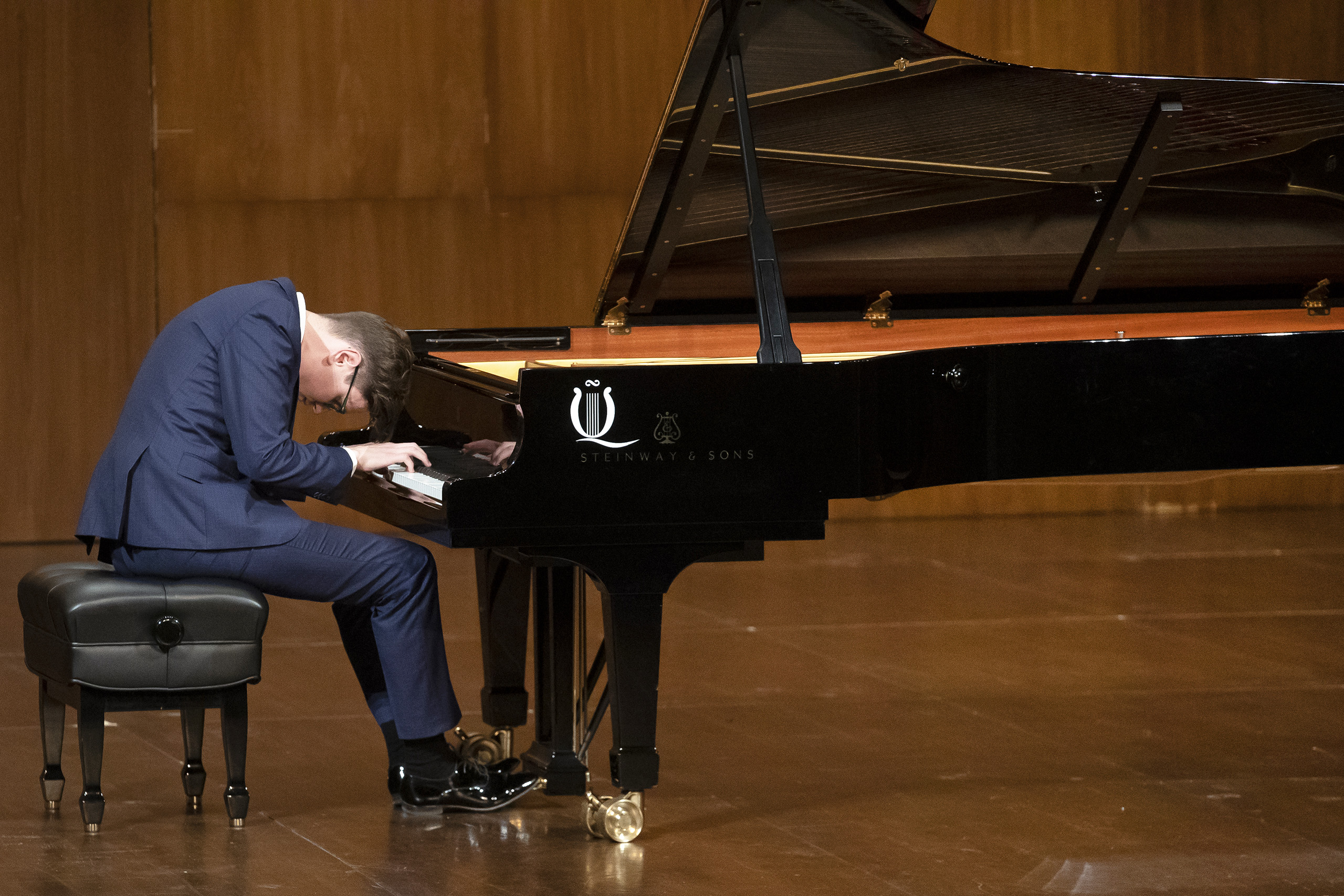
A new album from the Icelandic pianist Víkingur Ólafsson is a journey up to, through and away from Beethoven’s piano sonata in E major, Op. 109, the music making, as we’ve come to expect from Ólafsson, unconventional and wholly convincing.
The conventional approach to this piece is to record it along with Beethoven’s other late sonatas. The three of them, Opp. 109, 110 and 111, are sometimes performed together in concert but nearly always appear side by side on recordings; they make quite a satisfying sequence although there’s no suggestion Beethoven intended them to be heard one after the other. It makes sense, though. The works share musical concerns and characteristics, exploring lyricism and experimenting with form.
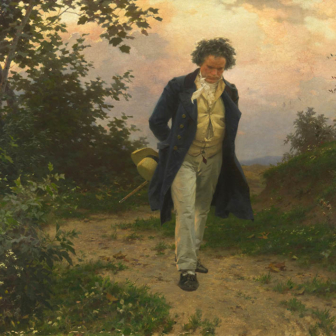
Beethoven was always a composer of contrasts, and as he grew older (and deafer) he was increasingly drawn to extremes. In 1814, the composer Louis Spohr attended a performance of the Archduke piano trio with Beethoven himself playing the piano part. He later remarked that Beethoven had played all the forte passages so violently the strings rattled, whereas in some of the quiet music the notes failed to sound at all. Evidently, Beethoven’s hearing loss was so advanced he could no longer judge his playing, but Spohr’s account also underlines how important contrasts of dynamic were to the composer. He wanted to get them across to his audience at all costs.
In the late sonatas and string quartets, Beethoven steered away from established three- and four-movement structures — the final sonata has only two movements, while the C-sharp-minor quartet (Op. 131) has seven and they are full of contrasts. The third movement of Op. 131 runs for under a minute, followed by a fourth movement that lasts nearly a quarter of an hour. There are contrasts of musical types, too. The quartet in B flat (Op. 130), which has six movements, follows a rustic German dance with the famous “Cavatina,” the most sublime outpouring of lyricism Beethoven ever composed. It is lyricism that seems to me the key to his late music.
By 1820, when he composed the Op. 109 sonata, Beethoven was completely deaf, and it is tempting to think of all this experimentation as the happy outcome (for us, at least) of his hearing loss, the lyricism an attempt at a musical utopia the composer would never hear for himself. In among the strongly motivic writing of his earlier music there had always been tunes — there’s the lovely, limpid melody, for instance, at the heart of the Pathétique sonata — but in the late music they take over, helping to generate the form.
The two formal devices that dominate the late music are variations and fugues. Both proceed from the statement of melodic material and go on — now playful, now profound — to explore and interrogate it. In the essay accompanying his recording, Ólafsson suggests that perhaps Beethoven had nothing left to prove.
In 2023 and 2024, Ólafsson toured the concert halls of the world playing Bach’s Goldberg variations and almost nothing else, but this set him thinking about the late music of Beethoven, full as it is of baroque devices. Ólafsson points out that the long last movement of Op. 109, which is itself a set of variations, returns to its theme at the end, just as the Goldberg variations do; that this is the only time Beethoven did this; and that both Bach’s and Beethoven’s themes are sarabandes — stately, triple-time dances.
What Ólafsson offers his listeners on the new album is a seventy-five-minute program that begins and ends with Bach — a prelude at the start, a sarabande at the close — and includes, in addition to Op. 109, Beethoven’s earlier sonata Op. 90, Bach’s last great keyboard partita and an early Schubert sonata. Everything is in E major or E minor, the note E conjuring the colour green for the synesthesiac Ólafsson. The key relationships allow him to build a sequence (as on previous albums) in which seemingly unrelated works flow into one another and make us listen anew.
Ólafsson sets up conversations, back and forth, between these pieces. The E-major rondo that ends Beethoven’s sonata in E minor seems like a relative of the variations in Op. 109 — a rondo being a movement in which a theme keeps returning. We hear Bach experimenting with form in his E-minor partita — the angular, fugal gigue (jig) at its close a remarkably astringent piece, not least for its refusal to be in triple time, as gigues are meant to be. Schubert’s E major sonata, believed by some to be incomplete, is here completed by Op. 109 itself, Beethoven’s music a seeming continuation of the Schubert.
As for Ólafsson’s playing of Op. 109, the first two short movements are boldly projected. The first, setting off so blithely before grinding to a halt — as though stopping to admire a view — is beautifully balanced between the need to move on and the need to contemplate. The second, marked Prestissimo, is often dispatched like so much bluster, but Ólafsson emphasises the baroque counterpoint that underpins the movement. His playing is always a model of clarity when it comes to untangling the contrapuntal voices.
Finally, those variations. This third and last movement is twice as long as the first two put together, and Ólafsson’s expansive approach accentuates this. He plays with a surprising amount of freedom regarding rhythm and tempo, allowing Beethoven’s little embellishments to pull the music out of time, while the semiquavers of the third variation take off like a rocket. And at the end, after the cloud of trills that formed and then dissipated during the last variation, the return of the theme is as touching as ever. And Ólafsson’s right — it can’t help but remind us of the return of Bach’s Goldberg aria.
There’s much more to be said about the music and this recording but, in the end, Ólafsson is not offering a history lesson or even an analysis of Beethoven’s late sonata, he’s simply inviting us to listen. If you can find the necessary seventy-five minutes to listen all the way through, you will want to repeat the exercise. •