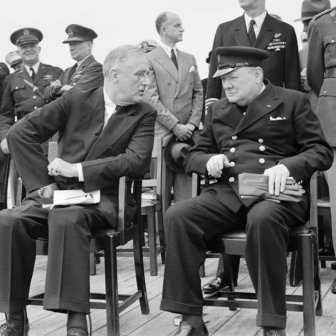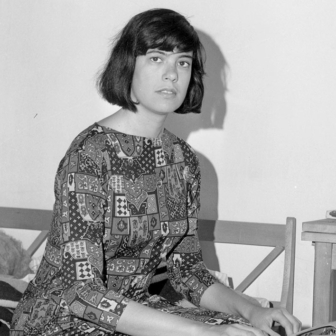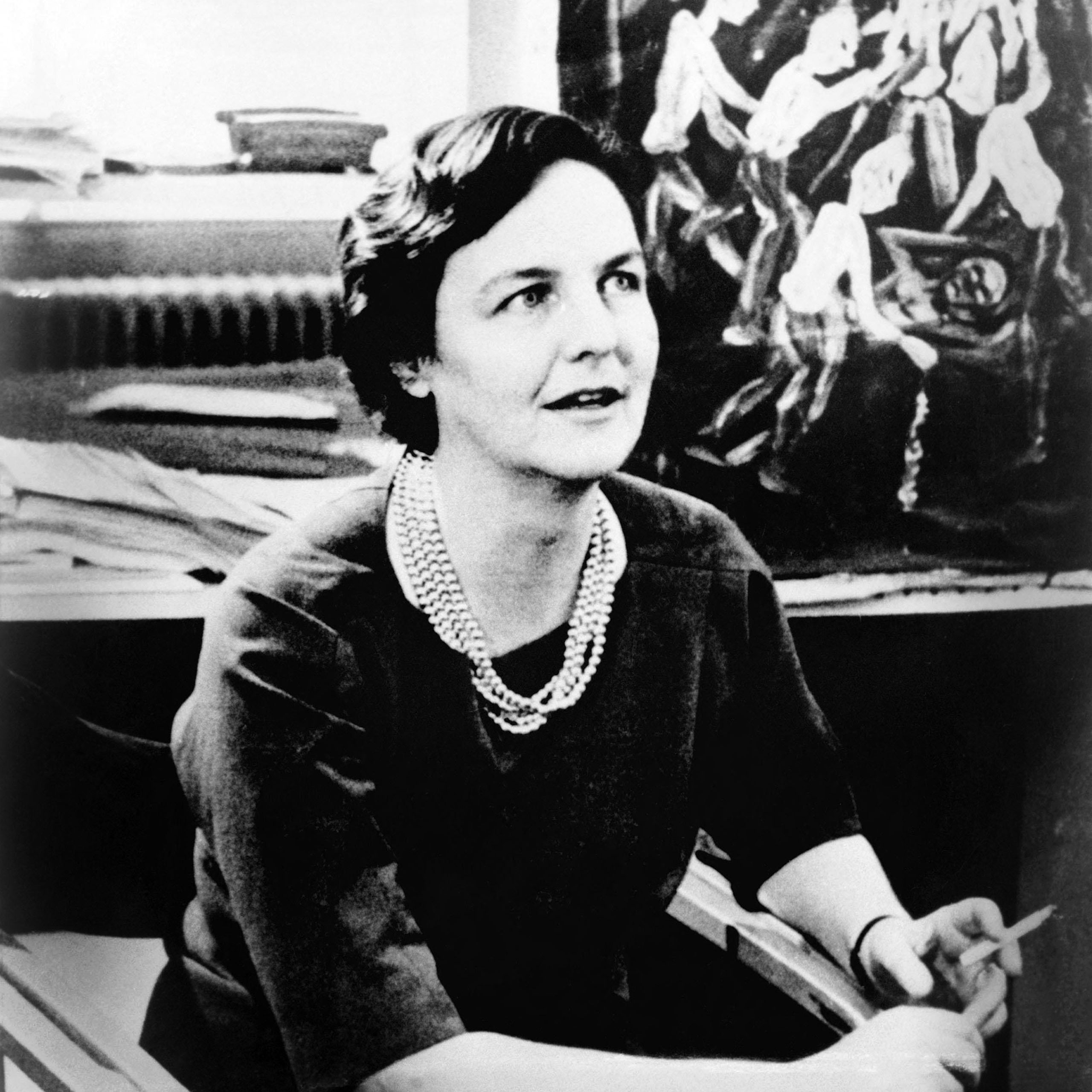
Winston Churchill arrived at the White House in December 1941 with much on his mind. It was less than a month since Japan’s attack on Pearl Harbor and the British prime minister needed to discuss wartime strategy with US president Franklin D. Roosevelt. He had flesh to press and war council meetings to attend. He had an address to a joint session of the US congress to write. He had a “dull pain” over his heart soon diagnosed as a “coronary insufficiency.” And yet, amid all this, he was also determined to meet with a runaway British communist and impress on her that her husband really was dead.
It might seem surprising that a leader with Churchill’s responsibilities, at such a crucial time, would undertake a task usually performed by the postal service. But Jessica “Decca” Mitford (1917–96) was rather a special case.
She and her five sisters had been fixtures in the British press ever since their “debuts” in the 1920s and 1930s, celebrated for their good looks, aristocratic upbringing, and wildly divergent politics. By the time of Jessica’s meeting with Churchill, Nancy (1904–73) was on her way to becoming a well-known novelist, Deborah (1920–2014) had become a duchess, and Pamela (1907–94) was a socialite. Diana (1910–2003), the most beautiful of the Mitfords, had famously left her first husband to marry Oswald Mosley, founding leader of the British Union of Fascists, and by 1941 was interned alongside him at Holloway Prison, regarded as a serious threat to British security.
But the most notorious of the sisters was the indomitably named Unity Valkyrie Mitford (1914–48). A glimpse of the moustachioed ranter at the 1933 Nuremberg Rally had transformed Unity into a slavish admirer of all things Nazi, to the point that she inveigled herself into a friendship with the dictator himself: “The Führer was heavenly,” she cooed in her diary after a lunch with Hitler. But the outbreak of war between her home country and “the greatest man of all time” left her distraught. She attempted suicide only to survive with permanent brain damage, and by 1941 was living in her mother’s care in Oxfordshire.
Jessica had always been closest to Unity, but her divergence from her siblings had become visible early. Alone of the sisters, Jessica had become disconcerted by the palpable differences between her cosseted existence and that of the people she spied living in the village nearby. Her family lived in palatial, well-kept surroundings; these people had small cottages smelling of years of tea and overcooked cabbage. The Mitfords were “slender, aqua-eyed, and graceful”; the women in the village were toothless, marked with cysts and goitres, and had backs bent from years of manual labour and poverty. “Could these poor creatures be people, like us?” Jessica wondered.
Her sympathy and her revulsion at the aristocratic life her parents had created for their children — no formal education, no children to play with, no modern medicine — didn’t stop her from reaching for dangerous ideas. When Unity began decorating their shared bedroom with Nazi paraphernalia, Jessica responded by drawing a chalk line down the middle and decorating her side with hammers, sickles, and photographs of Lenin.
She was searching for a way out and, in Esmond Romilly, her second cousin and nephew of Clementine Churchill, she found someone who could offer that. A handsome and rebellious young man, Esmond had been an early critic of the British upper-class fascination with fascism. He had twice been injured protesting against Moseley’s Blackshirts — including at the infamous Battle of Cable Street — and he had been among the first Englishmen to join the volunteer brigades that went to fight the fascists in Spain.
Sitting next to him at a dinner, Jessica asked if he would be going back to Spain. And if he was, would he take her with him?
Their elopement, in February 1937, caused a stir up and down the length of respectable Britain. So well-publicised were their plans that when they disembarked in Bilbao, the foreign minister of the Basque republic turned up to meet them. Jessica’s parents attempted legal action to bring her home, then brought in Scotland Yard, then appealed to friends in high places. Foreign secretary Anthony Eden ordered Britain’s consul to Spain to persuade Jessica to return home and deputised a destroyer-class warship to transport her.
Every inducement failed until that consul finally threatened to leave hundreds of Spanish refugees stranded unless Jessica acquiesced. She gave in — but only went as far as Bayonne, in southwestern France, where she and Esmond were married.
The couple finally returned to England in September, where Jessica bore a daughter, Julia, and found work as a marketer. But tragedy struck. One consequence of Jessica’s childhood isolation was that she had never been exposed to measles. She therefore had no immunity to pass onto Julia, who died in 1938 amid a measles outbreak. When supposed friends and acquaintances scoffed that she had bought it on herself, Jessica became only too ready to fall in with Esmond’s suggestion that they go and live in America.
Carla Kaplan, author of Troublemaker: The Fierce, Unruly Life of Jessica Mitford, believes the decision was of a piece with Jessica’s determination to get out of the class that she detested. Rather than retreat into its comfortable safety after Julia’s death, she decided to keep moving — and to put the bereavement behind her, not to be dwelled on or talked about again.
She did something similar when Esmond died. After their somewhat itinerant life on the east coast was interrupted by the second world war, Esmond enlisted in the Royal Canadian Air Force and Jessica settled in Washington, giving birth to a daughter, Constancia, in February 1941. Esmond was posted to England, where he was seconded as an observer with the RAF. That November, his plane set out on a bombing raid on Homburg but failed to return. Search and rescue found no trace of him, but Jessica — by now, pregnant with a boy — refused to believe that her husband was dead. Even Churchill’s insistence at that Christmas 1941 meeting could not move her. “WAITING FOR BETTER NEWS,” she telegrammed her mother, in mid-January 1942.
When she did give into reality, Jessica fled west, to San Francisco. “Separated by six thousand miles from family in England and by three thousand miles from my nearest American acquaintances, I could be virtually reborn as an anonymous bit of human flotsam in this remote outpost,” she later wrote. “I was both excited and a bit desolate at the prospect.”
Like the Lisbon girls in Jeffrey Eugenides’s The Virgin Suicides, the Mitford sisters have been the subject of fascination that borders on the voyeuristic. They arguably encouraged it. Nancy’s most famous novel, The Pursuit of Love (1945), was a family portrait lacquered with the veneer of a fictional romantic comedy, while Jessica’s autobiography, Hons and Rebels (1960), removed the veneer of fiction entirely. In a tone leavened by self-deprecation and shadowed by knowledge of what would come, she wrote of her upbringing with an eye for the telling detail.
One reason for the fascination lies in way history cuts across the siblings. The Nazi and fascist sympathies in the family were pronounced and proved ruinous. Parents David and Sydney Mitford became estranged after war was declared: he was willing to renounce his earlier Nazi sympathies but she remained steadfast. Tom, the only son, remained so sympathetic that he refused point blank to fight Germans. Posted to Burma instead, he was shot dead in 1945 by a Japanese sniper. Diana Mosley’s unrepentant views led her to deny the Holocaust and affect a lack of interest in her own actions that was, at best, repugnant. “I can’t regret it,” she wrote, of her involvement with fascism. “It was so interesting.”
Kaplan, a biographer of Zora Neale Hurston and professor of literature at Northwestern University, is interested in how Jessica could have emerged from this. While initial chapters will be hard going for readers unacquainted with “Mitford-mania,” she gives considerable space to the intellectual and emotional makings of a Mitford sister who, in works written largely by British writers, has often been derided as an eccentric, the “red sheep” of the family. She is sympathetic in her description of the halting process by which Jessica broke free from her family, with all the pain that it aroused, while remaining in her family’s orbit. She parses the contradictions and complexities that saw Jessica estranged from her father, reconciled with her mother, estranged from Diana, and simultaneously dependent on and disenchanted with her remaining sisters.
In doing so, Kaplan adds considerable depth and understanding to the turbulent years that shaped the “queen of muckraking,” as Jessica Mitford became. As Kaplan tells it, Mitford’s flight west plunged her into a heady period in which her outlook was both validated and remade. Jessica made up for her lack of formal education by reading widely and becoming alert to the damaging effects of racism, sexism, and class-based discrimination. As an investigator with the Office of Price Administration, she learned how to find information that people wanted hidden; as a member of the Communist Party, she tested her ideals and courage by refusing to answer questions when subpoenaed by the House Un-American Activities Committee. Her second marriage, to civil rights lawyer Robert Treuhaft, gave her a foothold from which to witness the struggle for civil rights.
All this informed her turn to writing and her focus on investigative book-length journalism. The American Way of Death (1963) was a needle-sharp exposé of avaricious pretension and blatant lies in the American funeral industry. The lingo alone was ridiculous: graves were referred to as “internment spaces,” she discovered, and undertakers called themselves “grief therapists.” They retailed devices to make a corpse’s breasts look perky, and flogged expensive metal caskets to mourning families with the promises they would preserve loved ones from decomposition. The truth was rather different: gas build-up inside those sealed caskets increased the speed of decomposition, and explosions were not unusual.
Published by Simon & Schuster’s Robert Gottlieb, with an enormous dollar-sign funeral wreath on the cover, The American Way of Death became a bestseller, and vies with Hons & Rebels as Mitford’s most notable and best work. Her other books — on prisons, on a high-profile trial, on her experiences in the Communist Party, and on the birthing industry — never reached quite the same heights, partly because those heights were so lofty. But a steady stream of articles identifying hucksters and frauds in other industries ensured that Mitford remained the “queen” of the genre.
Her books constitute the most substantive part of Jessica Mitford’s career, a claim to fame beyond her family upbringing. It is peculiar, and somewhat unfortunate, that the half of Troublemaker that deals with this part of her life is less enthralling and more abrupt than what precedes it. Her likely rape by a stranger seems to have warranted more attention, especially given the fact that she declined to report it and embroidered her later accounts with the well-timed but fictional intervention of her husband; or the revelation, late in their marriage, that Treuhaft had carried on a prolonged affair with a mutual friend. “It was typical of Decca to say least about whatever hurt her most,” Kaplan writes.
True — but in that silence is surely something more. But for Kaplan it is Jessica Mitford’s empathy and resolve are the most astonishing things about her, and the quality that makes her important right now. “She demonstrates the difficult process through which true empathy can be learned and practised… Those who seek to become good allies can learn a great deal from Decca’s ways of change. So can anyone who would like to start a life over, anyone who would seek a do-over that goes in unanticipated, improbable directions.” •
Troublemaker: The Fierce, Unruly Life of Jessica Mitford
By Carla Kaplan | Hurst | $49.99 | 616 pages