Driving a Sydney taxi one winter evening in 1987, I picked up a businessman in the CBD. He took me on a trip way out southwest to, perhaps, Liverpool, and at the end he paid the fare with Cabcharge and tipped me out of his own pocket, a rarity. But our conversation during the journey is the main reason I remember him.
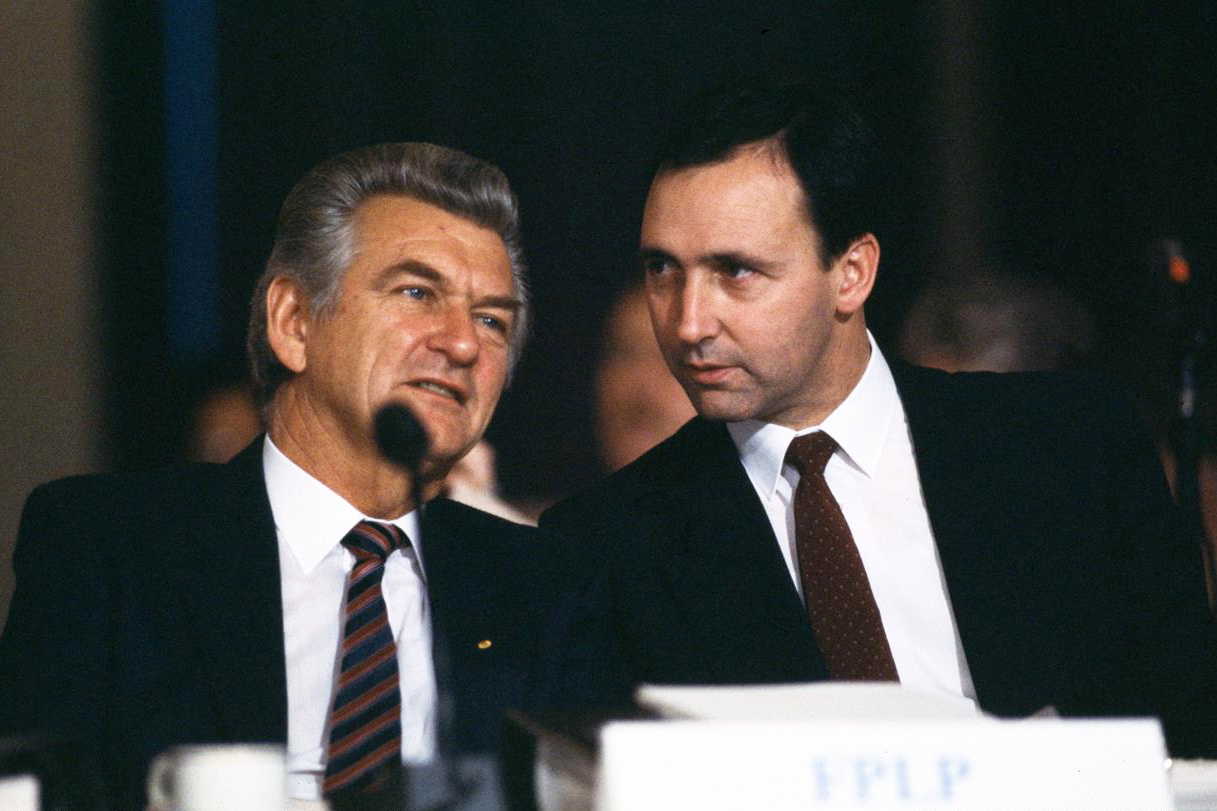
Me being a political science student, the talk had inevitably turned to the federal election campaign, which was nearing its end. He confided that while he was going to vote Liberal — he always did; “I’m a Liberal voter” — he hoped Labor would be re-elected. In these challenging economic times prime minister Bob Hawke and treasurer Paul Keating knew what they were doing, he said. Opposition leader John Howard and his erratic, untried team worried him.
It was a strange mindset, but then those were strange times, with the Labor government not greatly loved but widely seen as by far the better economic manager than the Coalition, a reputation subsequent Labor administrations have only fleetingly and modestly regained. Australia was well into the “current account crisis,” when it seemed everyone in the country knew we were living beyond our means. One of the few levers the government possessed to tackle the problem, at least in the short term, was (thanks to something called the twin deficits theory) big spending cuts.
During that gloomy time the government, and particularly the treasurer, successfully laid the blame at the feet of three decades worth of indolent predecessors, and if that meant throwing Gough Whitlam’s Labor government (1972–75) under the bus that was fine. Hawke and Keating had never thought much of that lot anyway.
This successful framing, and the force-feeding of greens down voters’ throats, had generated a huge incumbency benefit. Of course, the likelihood of more pain in their third term was not something they liked to talk about, but there was so much to say about the diabolical damage the Coalition would do to the country if it took office.
There’s a popular view that Howard would have won that election if not for the “Joh for PM” adventure — the attempt by Coalition conservatives to replace Howard with Queensland premier Joh Bjelke-Petersen — and of course we’ll never know. But the opposition’s manifesto was ambitious, and Keating in particular delighted in picking it apart. John Hewson’s Fightback! policy has gone down in history as “big target,” but Howard’s 1987 platform was no slouch: he would get rid of the capital gains tax, the fringe benefits tax and the assets test for pensioners and slash other taxes — and all would be funded by mostly unspecified spending cuts. It earned the ire of most mainstream economists and, it turned out, the electorate.
As with the other three elections at which Hawke was leader, opinion polls had greatly overstated the size of Labor’s win. But the government’s relatively slim 50.8 per cent after preferences did manage to produce a phenomenal eighty-six seats out of 148. (Eleven years later, for comparison, 50.9 per cent yielded Kim Beazley just sixty-seven.)
July 1987 happens to have also been the halfway mark of Hawke’s nine years and nine months as prime minister — the years under scrutiny in a new book, Gold Standard? Remembering the Hawke Government. Edited by Frank Bongiorno, Carolyn Holbrook and Joshua Black, it features chapters by sixteen authors, including one from each editor.
The question in the title is answered here in the affirmative — unsurprisingly, given every contributor is sympathetic, and quite a few were involved with that government in some way. Which chapters one likes will depend on taste: I particularly enjoyed Carolyn Holbrook’s one on Medicare, where I learnt of its tenuous beginnings in the face of a decidedly indifferent public. (That helps explains why the Coalition promised to demolish it at several elections before finally getting the hint. But it attained its national treasure status by the end of the decade, and retains it today despite increasingly obvious gaps and flaws.)
Hawke was an unusual character, extremely confident but thin-skinned (including about his height; hence the bouffant), a common combination among the greatly egotistical. Meghan Hopper is a good read on the prime minister’s overt masculinity intersecting with feminine strands such as public crying (the much-remembered 1984 campaign instalment perhaps deserves more interrogation in light of troubling revelations several years ago) and, perhaps less convincingly, reconciliation.
Reconciliation was one of Hawke’s three big Rs (along with recovery and reconstruction) in 1983; the Indigenous version is well-known as a disappointment to even Hawke himself. In his chapter, Peter Yu doesn’t disagree, though he believes Hawke’s genuine desire to make progress was held back by pollsters and general political timidity. In fact, a reliance on polling, and that widely used descriptor, at least in the early years, “pragmatism” (translation: “Don’t be like Whitlam”) tends to be missing from the most tales of their boldness.
Bruce Chapman filled in my knowledge of gaps in the Accord that Labor struck with the ACTU. Stronger unions sacrificed large wage increases, weaker unions got bigger ones than they could otherwise achieve, and there was moderation all round in exchange for the “social wage” — Medicare, tax cuts and government assistance. Much of those measures came in the name of combating inflation, although as every pet shop galah now reminds us (to mangle a Keatingism), anything a government does to assist Australians financially, particularly if it’s untargeted, is itself inflationary. That’s probably part of the reason Australia wasn’t as successful as comparable countries in containing 1980s inflation.
The Accord sits within the general consensus, in this book and elsewhere, that economically the Hawke government was Thatcher and Reagan (and New Zealand Labour) with a heart. Still, as Meredith Edwards’s contemporaneous 1986–87 notes show, a lot of the policy decisions were to her mind regressive.
We called it “economic rationalism” back then, which more or less equates with the twenty-first century’s “neoliberalism” but was generally expressed with less venom and glibness. (Or maybe that’s just the internet.) I must admit Chapman’s chapter got too technical for this non-economist (I skipped through the last few pages to the conclusion); Liam Byrne complements nicely on the same topic.
Gareth Evans’s retrospective, unlike his cabinet diary, Inside the Hawke–Keating Government, which was written in the mid-1980s and published in 2014, is perhaps infected by received wisdom; he identifies that government’s “narrative”, for example, but that is mostly an attribute applied in hindsight. Like everyone else in the book, Evans thinks the Hawke–Keating government was pretty terrific compared with those before and those that followed. But he really prefers Keating to Hawke, as was evident in his 1980s jottings (where he surprised himself with his admiration of and fondness for the treasurer).
Evans’s details include Hawke’s occasional petulance in cabinet when he wasn’t getting his way — a “quick to resort to school ground abuse (of the ‘You are just wanking yourself’ variety) and extremely crude misrepresentations of opposing arguments” — which nicely balances other accounts of the prime minister’s maturity and magnanimity. Evans is convincing when he contrasts the consultation and compromise that went into getting the Petroleum Resource Rent Tax up with the amateurish efforts of Kevin Rudd and Wayne Swan to impose a super-profits tax on miners in 2010.
Andrew Podger reminds us of Hawke’s skilled and intelligent chairing of meetings and approach to policy in general, and Troy Bramston his extensive and broad curriculum vitae, including decades in the labour movement and a breadth of other life experience.
Michelle Grattan, who has been contributing to books like this one for decades, is one of the more self-aware press gallery journalists. Her chapter ends with the admission that “a lot got done that benefited Australia — and the media, for their part, helped get it done.” Keating in particular was famous for charming the press gallery into joining his crusades.
The Albanese government can boast a majority of its MPs are female (partly because of the unexpected 2025 landslide win, just as Howard’s 1996 victory also brought in a lot of Liberal women). But Labor wasn’t always the more women-friendly of the two sides. The Whitlam government was the first to legislate extensively in this area, but as Marian Sawer reminds us, Susan Ryan in 1983 was “the first woman to hold [a cabinet] position in a federal Labor government” (my italics). Later, Ros Kelly was the sole cabinet representative of her sex.
It was all, of course, very blokey. The 1980s were a different time. A lot of the stories told today about those political giants are overblown, but one thing they didn’t lack was self-belief. They never harked back fondly to predecessors, and they really believed they were better than all that had come before them.
There were a lot of smart, hard-working people in the Hawke governments. They seemed politically timid at the time, relying on the guidance of Rod Cameron’s pollsters at ANOP, but it turned out they were more courageous than every government that followed Keating’s 1996 defeat. The fact that they faced a much easier Senate (a one-stop shop with the consciously centrist Australian Democrats) than any government post-Howard explains a lot, but not everything.
There’s plenty of interest to be found also in the chapters not mentioned above, but it must be said that the transcript of Barrie Cassidy and Craig Emerson chatting about their times in the prime minister’s office needed serious editing: specifically the many pages dealing with Hawke’s love of a flutter on the horses, and his roping in of staff to place bets for him. One par would’ve done for this reader.
The Hawke government never did fix the current account problem, and neither did its successors. In fact, the Howard government presided over the largest deficit (as a percentage of GDP) in history. The solution turned out deceptively simple: stop worrying about it. (American president Donald Trump never got this memo.)
Today, a popular genre of economic commentary simultaneously castigates the Albanese government for a level of spending higher than any (outside Covid) since the mid-1980s, while urging it to be more like Hawke and Keating. Left implied but not stated in those spending comparisons is that it was higher in Keating’s early years as treasurer than it is today. In fact, Keating presided over the highest federal spending, outside Covid, since the second world war. Then, to avoid becoming a banana republic, he and the government cut it to its lowest level (22.9 per cent of GDP in 1989–90) since Whitlam. No government has got it that low since.
Maybe that’s a neat microcosm of judgements about those heady days of 1983 to 1991: you can pick and choose which part you look at. •
Gold Standard? Remembering the Hawke Government
Edited by Frank Bongiorno, Carolyn Holbrook and Joshua Black | NewSouth | $39.99 | 352 pages