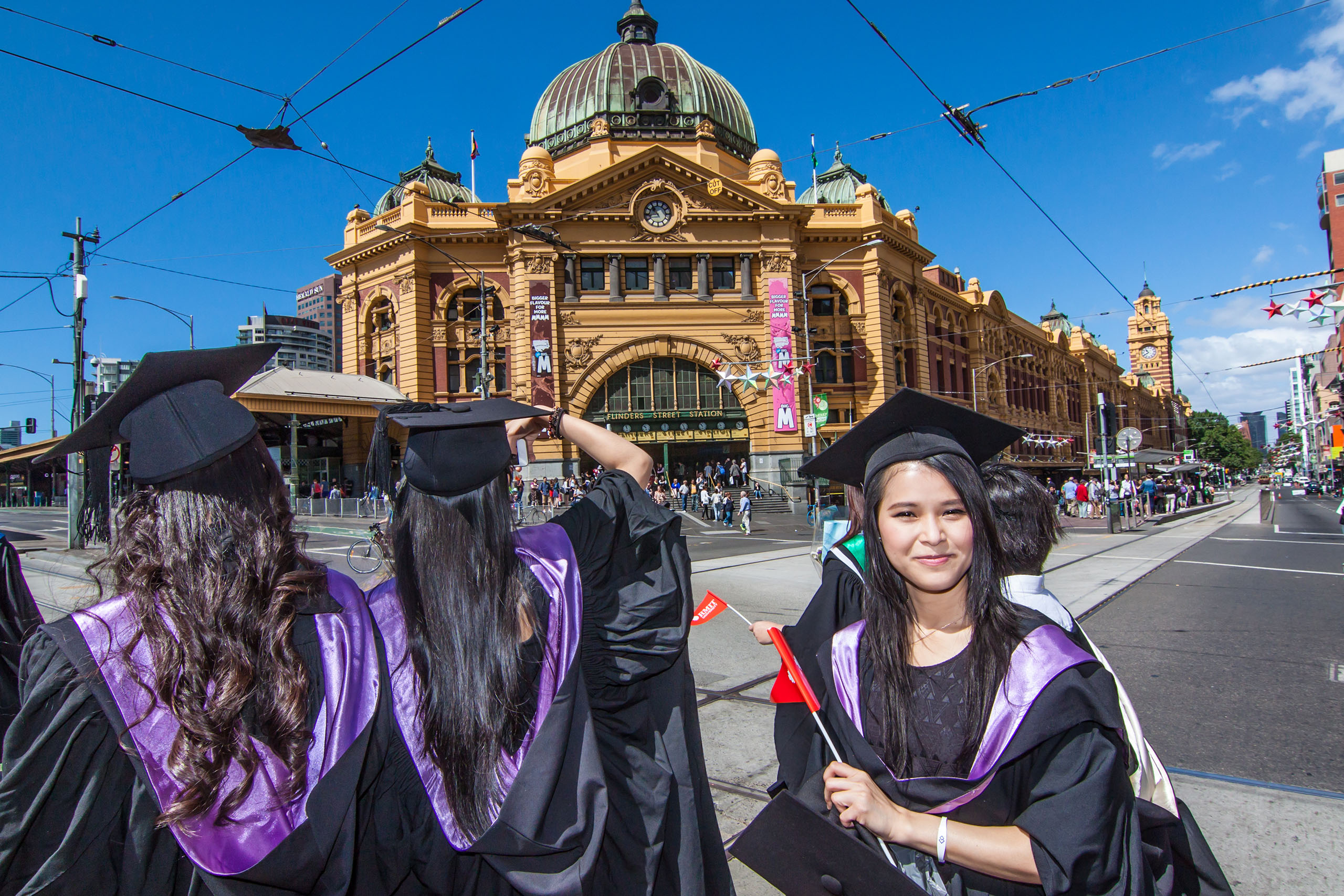
Australian universities have been the beneficiaries of three decades of demand from international students. Like governments and many private businesses, they have profited from an unexpected export industry with a significant social and geographical impact. So what happens if the number of students slows?
The Australian government announced it would allow public universities to enrol fee-paying international students back in 1986. This decision, enacted from 1990, built on strong foundations. Australia’s participation in the Colombo Plan had earned goodwill and a reputation for offering high-quality English-language education. Thousands of students from developing countries had studied in Australia from the 1950s, with many of them later enrolling their children in Australian schools so they, too, could study on an Australian campus.
The decision to open courses to fee-paying international students was a small component of a policy package that ended free university education for Australian students and introduced HECS, all with the professed aim of expanding access. Numbers from abroad were expected to be modest, and the minister’s staff debated whether international income should stay with the institutions or be returned to Canberra.
Yet something important had stirred. Australia’s public universities quietly but effectively built a new industry. The pieces were assembled at speed — expanded courses and facilities to cater for student demand, international agents to recruit students, new student housing to provide accommodation and, in some cases, offshore campuses for students not able to move to Australia.
The timing was fortuitous. Suddenly Australian universities — close to Asia and in proximate time zones — could offer degrees to a huge, rapidly developing region, particularly China with its profound need for tertiary level skills but as-yet insufficient domestic supply. The circumstances were right for a happy accident — an opening up at just the right historic moment. Like like Australian mining companies, universities were soon growing at the pace of the Chinese economy.
From a handful of international students in the early 1990s more than 550,000 enrolled in January this year. Estimates of the return to the Australian economy vary, but hover around $50 billion annually, roughly the national cost of the NDIS. In many towns and cities universities are among the largest employers, attracting industry, private accommodation and precinct investment. Tourists visit to see children, siblings or friends studying in Australia. Some graduates stay on for a year or two after study concludes, and around 25 per cent apply for permanent residency to become citizens.
International education has always attracted — and retains — many critics. International students have been blamed for housing shortages, despite the boom in specialist student accommodation. Coded messages hint at too many foreign faces on campus or, recently, demand an end to group assignments that require working across cultural boundaries.
Much disquiet plays into general community concern about migration, but some is specific to universities. The view that the educational experience has deteriorated is not necessarily shared by students, though: despite larger classes and higher costs, overall satisfaction rates with the university experience remain around 78 per cent across the nation, the long-run average.
Undoubtedly international students have changed the campus experience. As the late Emma Johnston commented when launching the University of Melbourne’s international strategy:
[A]ll our staff and students bring diverse perspectives to university life and society. Our international students are individuals and valued members of our university community. They are learners, researchers, friends, colleagues and our future alumni. We will continue to promote and celebrate staff and student diversity precisely because it enhances our education, research, engagement, and contributions to the public good.
International education has proved a major contributor to new teaching facilities across the nation. Through internal cross-subsidies international income supports expensive research infrastructure. It has made possible Australia’s stellar international standing, with multiple universities ranked in the global top 100, a per capita performance matched by few other nations.
Yet a happy choice can have unhappy effects. As income from international students rose, governments slowed increases in public funding. Under the Coalition’s Dan Tehan the portion of student funding nominally allocated for research stopped and investment in courses such as arts and business fell sharply. Universities were expected to make up the difference from international revenue.
Which brings us to a nervous present. Australia’s public universities depend on international students; the parents of Shanghai subsidise not only their own children but those of Australian families. Federal governments too have grown to depend on the income; alongside higher domestic fees for many degrees, international student income has allowed Canberra to fund an expanded national system without the public investment otherwise required.
What happens if international students stop showing up in their accustomed numbers? Location and first-mover advantage helped Australia in the short term, but the flow is slowing.
Since 1990 China has created its own impressive university system. Chinese investment in scientific and technical research now tops the United States, and Chinese researchers have reached parity with their American counterparts as authors of the top 1 per cent cited academic papers. As that nation reaches out, globally mobile students who might have chosen Australia now opt for a Chinese university. And China isn’t the only country in the region to have invested heavily in their tertiary sector.
For Asian students still looking for an overseas English-language education, numerous options now exist closer to home, from international campuses in South Korea to highly ranked universities in Singapore and elsewhere, all of them actively recruiting.
European universities have joined in with enthusiasm. As SciencesPo proudly advertises, a student can now study at undergraduate or masters level in Paris in English with “no need to speak French.”
In this global market, Australia has lost some of its shine. Applications from China fell around 25 per cent this year alone, following smaller but steady declines in previous years. Overall, the number of Chinese students seeking a place at an Australian public university has nearly halved since 2019.
Those changing opportunities within China, the strong Australian exchange rate, higher living costs and an abundance of choice are not the only factors. Influential too is the decision by the Australian government to cap the number of international students and discourage applications by charging the highest (and non-refundable) visa application charges in the world.
Responding to public disquiet about migration, both government and opposition risk treating international education as a problem to be managed rather than a remarkable Australian success story.
Universities meanwhile have long recognised the hazard of relying too heavily on one source of students. Some 17 per cent of the international student cohort, or around 92,000 students, are now drawn from India, not far behind the 23 per cent recruited from China. Universities have paid close attention to other markets, including Indonesia, Nepal and Vietnam, but these have expanded more slowly, and none has the unique scale and circumstances of China in recent decades. One leading indicator — enrolments in ELICOS English-language courses ahead of applying for study in Australia — fell 32 per cent last year.
Australia has probably passed peak international education. If the recent fall in applications continues, a sector that has enjoyed decades of significant growth must contract. The impact will be felt across the sector and, fairly swiftly, in the national economy.
The effects may be more far-reaching, touching on Australia’s place in the world. Sir Steve Smith, the UK’s International Education Champion, recently noted that international education is the primary vehicle for building enduring trust and comity between countries. Australia has reaped diplomatic and strategic benefits from educating Asia’s best and brightest for more than seventy years. These graduates have been pivotal in creating stable, prosperous societies in our region well-disposed towards Australia. Though such goodwill won’t end with falling international numbers, Australia could surrender a powerful avenue for soft power.
The biggest question is how governments will react should domestic higher education be required to pay significantly more of its own way. The federal government is already reluctant to repeal the Coalition’s Jobs Ready Graduates legislation because of the cost — around $1.9 billion annually according to work by the Innovative Research Universities group. With around 1.08 million domestic students enrolled in Australian universities, the cost of maintaining current class sizes, student facilities, research teams and capital expenditure without the contribution of international students would be formidable.
At a minimum governments may require more domestic students to pay up to 90 per cent of their own degree costs, a regime already applied to some graduates by Jobs Ready Graduates. Contraction means less capacity to tackle disadvantage, and fewer of the professionals urgently needed in health and other key sectors.
Are political parties, students and parents ready for the cost of a tertiary system more dependent on our own resources? Will the promises to make further education available to an even wider cohort survive an ugly encounter with fiscal reality? Now, before we hit a crisis, is the time for a candid discussion about how this nation supports its public universities. •