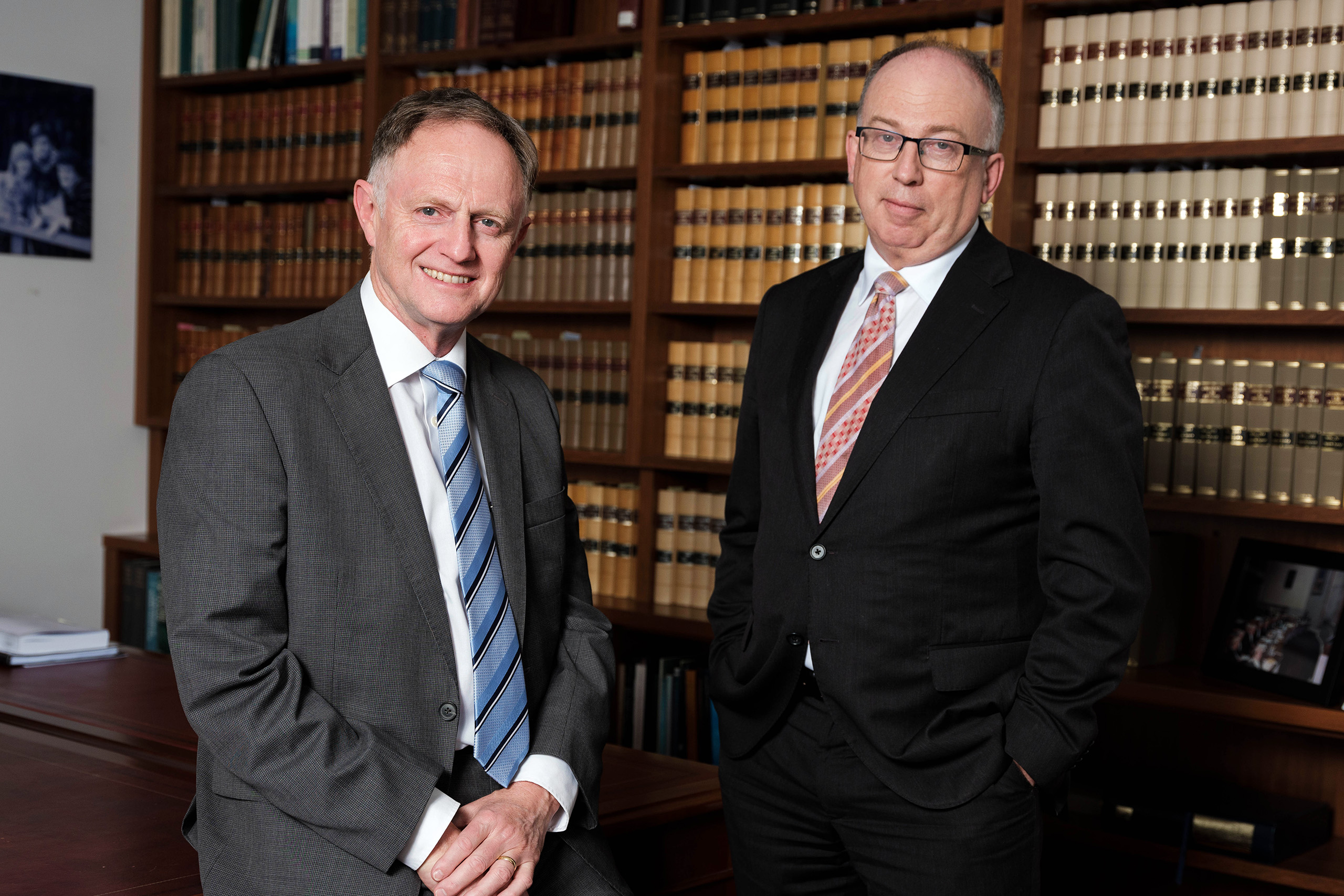
“As I was preparing for this talk I was not really sure what to talk about.” It was 9am on a Saturday in the middle of May and Justice Robert Beech-Jones found himself behind a podium in the largest conference room at the Townsville casino. “So I picked up the conference brochure,” he told the five hundred or so lawyers seated at tables around him, “and discovered that I was talking about contemporary issues and the High Court.”
You can bet that got a vocal chuckle, as did his quip about being the morning after to the conference’s night before “at a local bar.” Lawyers always laugh at jokes by judges, especially judges from the nation’s top court. As near as I can tell, the last time such a judge appeared at the North Queensland Law Association’s annual conference was when Susan Kiefel — then, like Beech-Jones is now, the highest court’s lowest judge — spoke in Mackay in 2008.
Beech-Jones’s appointment to the High Court in 2023 attracted no interest outside legal circles. He was of interest to me — a fellow science-law grad from the ANU, albeit before my time there — and I had recently praised a sentencing judgement of his, so I tweeted a few angles the media could cover: “the fiftieth man on the court,” “the first hyphenated justice!” But the media went for “married to Suzie Miller” (the playwright of the rightly feted one-hander, Prima Facie) and “born in Tasmania!” if it covered his appointment at all.
That’s how most High Court justices like it. In 2017, then justice Virginia Bell bemoaned her American counterparts’ relative fame:
For $24, you can buy a Ruth Bader Ginsburg coffee mug. It features a rather grim portrait of her honour under the words “I dissent.” How lucky we are that in Australia, outside the law faculties, very few people would be able to name the Chief Justice of the High Court let alone the six puisne justices.
And that seems to be how the North Queensland Law Association likes it too.
“I decided the best approach was to start you off gently,” the judge informed the northerners, “but maybe wake everyone up with something a bit pointier towards the end.” In its Facebook post summarising the event, the NQLA duly covered the gentle part — a mix of bland summaries of recent cases and quirky forays into Queensland history — but completely omitted the pointy bit: the judge’s no-holds-barred attack on a different legal association.
The body that drew the judge’s ire was the Samuel Griffith Society, which is well known in legal circles as a club of conservative lawyers, academics and ex-judges. Beech-Jones wanted the north Queenslanders to know that the club’s namesake — a favourite Queensland son, politician and judge who was the first national chief justice — was himself no conservative, but “was more than Marx curious, Marx adjacent if you like.”
Actually, one historian has argued that he may also have been racism adjacent, the justice allowed, but Beech-Jones refused to go there, saying that judges should never make such charges lightly. And then he called out a slew of papers delivered at the society’s events for criticising the High Court’s native title cases in angry and often racist terms, statements “that say nothing about Indigenous people or the decision in Mabo [No 2] but a lot about the author.”
What would Samuel Griffith have thought, he asked the crowd, of a more recent suggestion that the venerable Queenslander’s namesake society seek funding from a billionaire? “I do not think that question is very difficult to answer. But perhaps the better question is what do you think?’
The audience that day may well have learnt a few new things about Sir Samuel Griffith, but I doubt they learnt anything new about the Samuel Griffith Society. Queenslanders are all too familiar with conservative politics in general, and all but the younger ones will grimly remember the 1990s debates on native title, which made the recent Voice referendum debate seem more like an acknowledgement of country. The proceedings of a group of conservative legal types are easy to imagine and, in any case, are nearly all publicly available.
That being said, a comprehensive account of the society would have to wrestle with the platforms it has regularly given, sometimes repeatedly, to not-so-conservatives like George Williams, Anne Twomey, Michael Kirby and (my law school colleague) Cheryl Saunders. Beech-Jones, who had clearly pored through the society’s proceedings, chose to omit their participation in a society whose first leader was the second Queenslander to head the national court, Harry Gibbs. More pointedly, he didn’t mention the many judges who had delivered keynotes to the society, including Beech-Jones’s fellow north Queensland conference goer, Susan Kiefel, several other sitting chief justices and two of his own colleagues on the current court.
Was Beech-Jones’s speech a dig at his own colleagues? My initial reading was no. Beech-Jones didn’t criticise anyone for merely attending a Samuel Griffith Society conference. That being said, he did attribute some speakers’ unsavoury views to the society itself and urged law students to think twice about “defin[ing]” themselves by joining its “chapters.” You might call his speech “guilt-by-association adjacent.”
But, if recent reporting in the Australian is accurate, Beech-Jones has since rejected an invitation to speak at the society’s coming conference in Sydney. That wouldn’t itself be noteworthy, except that he reportedly cited the Council of Chief Justices’ Guide to Judicial Conduct as one reason, specifically its advice to avoid the appearance of continuing ties to political parties “such as might occur by attendance at political gatherings.” That’s clearly a dig at both the society and his fellow (and past) judges, I’d say. I’d also add that it’s a very strained reading, one that says nothing about the Samuel Griffith Society or the Guide to Judicial Conduct but a lot about its reader.
I’d usually leave such intra-legal tiffs to the Australian and its ilk. But this particular tiff raises some quite startling issues about the High Court’s medium-term future. This will all take some explaining, so bear with me. I’ll start you off gently, but wake you up with something a lot pointier towards the end.
Let’s start with some birthdays. We know that the current justices were born on 9 January, 7 March, 19 June, 5 July and 19 November. Attentive readers will note that, while there are seven justices, I’ve only listed five birthdays. That’s partly because two justices — as it happens, the two who have attended Samuel Griffith Society shindigs — share that birthday in early January. (Shared birthdays are likely in groups of twenty-three or more, but the odds of them in a mere group of seven are closer to one in twenty.)
It’s also because there’s no public information about Robert Beech-Jones’s exact birthday. That’s a little strange, because High Court judges’ birthdays are publicly significant, thanks to a 1977 referendum that mandates their constitutional retirement “upon… attaining the age of seventy.” (A quirky bit of Australian law means that that day actually comes a full twenty-four hours earlier than most people think.)
The judicial birthday that will matter soonest is that of the High Court’s oldest justice, chief justice Stephen Gageler, who was born on the 5 July. Crucially, Gageler turns seventy in 2028, the same year our current federal government turns three. That puts his seventieth birthday soon after the next federal election. Indeed, so soon that the question of who will actually choose the next chief justice is quite murky.
Gageler’s successor might be chosen by the outgoing government (as replacements are typically announced a few months early to ease the handover) or by the incoming one (which will be in power closer to the swearing in.) Or, if the government changes and the new one tries to undo the old one’s choice, the question of who chooses might end up before the High Court itself.
Chances are, this mild constitutional crisis will be dodged. Maybe the electorate will re-elect the current government. Maybe Gageler will quit months early to head-off any impasse. Or, perhaps most likely, Gageler’s successor will be an uncontroversial pick, as most such appointments are.
But all of this puts paid to speculation that Robert Beech-Jones’s speech is an equivalent to Dyson Heydon’s successful “application letter” for the High Court. The election timing means his entrée into politics last month was more of a disapplication letter: #anyonebutRBJ. Indeed, there are multiple reasons why he won’t be the next chief.
One is an unshaken Australian tradition that is perhaps aimed at stopping such power bids from within. Since Federation, every High Court chief justice has been either its next most senior judge — as Stephen Gageler and his predecessor Susan Kiefel both were when they ascended — or an outsider appointed straight to the top. So, unless Albanese or his successor decides that an election year is the right time to break a century-long practice, the top court’s next chief will either be the current second-in-seniority (Michelle Gordon) or someone who isn’t on the current court.
A second reason is one that won’t make me popular with the Samuel Griffith Society: gender diversity. Inside Story’s recent coverage of the Albanese government’s remarkable record of placing women in senior national roles didn’t mention its appointment of Jayne Jagot to the High Court in 2022, a step widely feted for placing women in the majority on the apex court for the first time. The catch is that that female majority ended just eleven months later with Robert Beech-Jones’s appointment.
This is actually the third time a man has replaced a woman on the national court, but it’s a first for Labor, and also the first time female majorities and chief justiceships reverted to male ones. But these unfortunate landmarks passed almost completely unnoticed in 2023. Perhaps everyone assumes a new High Court tradition has been established under which majorities and chief justiceships will see-saw between men and women from now on.
All three of these factors — 2028 electoral politics, the seniority tradition and the possible High Court sex see-saw — point away from the Albanese-appointed Beech-Jones and towards the Abbott-appointed Michelle Gordon as Australia’s next chief justice. But there’s another, very pointy, factor firmly against both of them.
In schooling the Samuel Griffith Society and his colleagues on the Guide to Judicial Conduct’s advice on judges attending “political gatherings,” Robert Beech-Jones perhaps unwittingly drew attention to another part of the guide that states judges “must avoid involvement in political controversy.” If the Samuel Griffith Society’s conferences are too political for judges to attend, surely that makes it too controversial for judges to attack.
But there’s an exception in the guide for a political controversy that “directly affects the operation of the courts, the independence of the judiciary or aspects of the administration of justice.” Perhaps that’s why Beech-Jones paired his criticism of the society with two bits of American judicial politics.
The first one is a perennial American debate about whether old constitutions should be read the way their drafters would or the way modern readers would. Beech-Jones archly pointed out that while the speakers at the society all seem to favour the first approach (known as “originalism”), their namesake (himself a drafter of Australia’s constitution) and successive High Court justices haven’t. He mocked both the society and a majority of the US Supreme Court for favouring reading the American constitution’s “right to bear arms” to fit eighteenth-century gun regulation traditions rather than twenty-first-century public safety concerns. “Which approach do you prefer,” he asked the north Queenslanders, “theirs or ours?”
I don’t know if the judge took audience questions but, if he had and I’d been there, I’d’ve asked him about the current American dispute about “birthright citizenship.” President Donald Trump has urged the US Supreme Court to stop reading a constitutional provision on citizenship the way its post–civil war drafters would (as granting citizenship to almost anyone who is born on the nation’s soil) and more like modern readers would (with an eye to an orderly national border, among other things.) “Which approach do you prefer,” I’d ask Beech-Jones, “the originalist approach or Trump’s?” (We’ll find out the American apex court’s own answer in coming weeks.)
But it’s the other spectre of American judicial politics Beech-Jones raised — the successful push by American conservative groups to have conservative judges appointed to that nation’s federal courts — that would surely have roused his Australian crowd. “There is a highly sophisticated legal term to describe that process,” the judge declared, “it’s known as court stacking.” And then he pointed out a 2020 paper by then senator Amanda Stoker about the High Court’s landmark (and divided) ruling barring the federal government from deporting Indigenous non-citizens that ends with a pointy bit proposing the society should learn a lesson from its American counterparts.
The Samuel Griffith Society will doubtless be chuffed at this seeming judicial endorsement of its potential dramatic influence on Australian politics and more. But Beech-Jones didn’t spell out how exactly Australian courts — staffed via behind-the-scenes ministerial consultations and expiring with each judge’s constitutional dotage, rather than the American method of frantic public hearings and horsetrading that place winners on the bench for life — can be stacked by anyone.
Back in 2017, Virginia Bell said it was “inconceivable that the outcome of an Australian election might turn on whether a Coalition or a Labor government would be in a position to make the next appointment to the High Court of Australia.” Beech-Jones likewise seems to think stacking is exclusively an American thing: “If anyone thinks this particular US style of court stacking and judicial decision-making is a good idea, then go and live there.” That is, he thinks Stoker’s paper says more about the Samuel Griffiths Society than it does about Australia.
But here’s my pointy bit: Bell and Beech-Jones are both very wrong. The reason? Beech-Jones’s appointment to the national court.
It’s time to look at birth years. The current High Court’s are 1958, 1964, 1965, 1966, 1969 and 1974. Eagle-eyed readers will notice I only listed six. That’s because, while Robert Beech-Jones’s birth day isn’t public, his birth year is: it’s 1965, the same year as his fellow Albanese-appointee, Jayne Jagot, and adjacent to the birth years of Coalition-appointees Michelle Gordon and Jacqueline Gleeson.
And that’s the rub. Beech-Jones’s appointment in 2023 meant that, for the first time since constitutional age limits were introduced, there are four very closely-aged judges on our national court, all of whom turn will turn seventy in a sixteen-month period between mid-November 2034 and early March 2036.
This spate of mandatory retirements, first noticed in online legal commentary in 2023, will very much complicate the work of the national court in the mid-2030s. It will need a solid pair of hands at the top while it endures an extended period of reduced staffing and judicial churn that will make it very hard to do its core task of resolving major legal disputes in lasting ways. That is why I say none of the court’s current early sexagenarians ought to be picked to replace Stephen Gageler in 2028. And neither, heaven forbid, should a fifth similarly aged judge be appointed that year, as chief or otherwise.
The process of filling these four vacancies will be quite different from the usual process too. They will be (and indeed should be) seen as a job lot, so that considerations of balance on the apex Court — between states, between genders, between fields of legal expertise and (I’d say) between birth years — can be properly managed. If the normal selection approach is taken, female legal highfliers from New South Wales born in the 1970s will be fielding a lot of behind-the-scenes enquiries next decade.
But the selection may well be very abnormal, for a reason election tragics will already have spotted. The four justices’ seventieth birthday parties might well fall entirely within a single federal electoral cycle, that of our nation’s future fifty-first parliament. Whichever party ends up with a majority or a workable minority of the lower house — be it Labor, the Coalition or maybe a new political force — in a federal election held in late 2033 or early 2034 would have untrammelled power to remake the national court.
There’ve been a few American presidents who’ve appointed a majority of that nation’s Supreme Court in a single term in office, including Washington, Lincoln and (Franklin) Roosevelt, but each of them also needed the approval of that country’s Senate for each pick. Australia’s prime ministers are more powerful than their counterparts in exactly this respect, but, aside from the early days of Federation, have only appointed majorities to the national court in between repeated national elections.
By contrast, our prime minister in 2034 — whoever he or she is — might need to win just a single election to personally remake a majority of the court as they wish. Or, to put it another way, to stack the nation’s most important court. Perhaps that possibility will dominate the relevant election. Or maybe, this unusual prime ministerial superpower will be ignored by an electorate focused on other concerns. Which would you prefer, Robert Beech-Jones? Neither? Well, maybe you should have thought about that when you took up Susan Kiefel’s vacancy in 2023.
Fortunately, Beech-Jones can reverse his (and Albanese’s) terrible error, but he’ll need to heed a hard lesson from America. Ruth Bader Ginsburg originally got her face on a mug labelled “notorious RBG” because of her iconic legal role and look in the mid-2010s, but these days she is much more notorious for a quite different reason. As recounted in Suzie Miller’s other one-hander, RBG: Of Many, One, when the judge was eighty, president Barack Obama carefully suggested she retire at a time when the nation and its elected institutions were united behind the Democrats, and her own court’s political affiliations were finely balanced. Alas, Ginsburg turned him down, out of a mix of pride, hubris and misplaced hope, easily her worst and most consequential decision.
Robert Beech-Jones, of all the current justices, knows this story and its many terrible judicial, political and social outcomes all too well. What would RBG have thought of a suggestion that a justice of the High Court of Australia should quit years early just to prevent a future prime minister stacking the court? I don’t think that question is very difficult to answer. But perhaps the nation-changing question is: what does RBJ think? •