One measure of the significance of a political concept is the persistence of contests over its meaning. As the political scientist Uriel Abulof pointed out in 2023, “self-determination” was “the single shared principle” to which Franklin Delano Roosevelt, Joseph Stalin and Adolf Hitler all subscribed — “in words,” at least, but “rarely in action.” Self-determination, he added, “so dominated twentieth-century political discourse that no prominent leader from any camp dared speak against it.”
As Bradley Simpson shows in his new book, The First Right, a concept so useful can’t help but evolve — in this case through “five distinct phases.” In using the word “evolution” he is accepting that self-determination will never have a final and true meaning, just as an evolving organism can’t attain a final and true form.
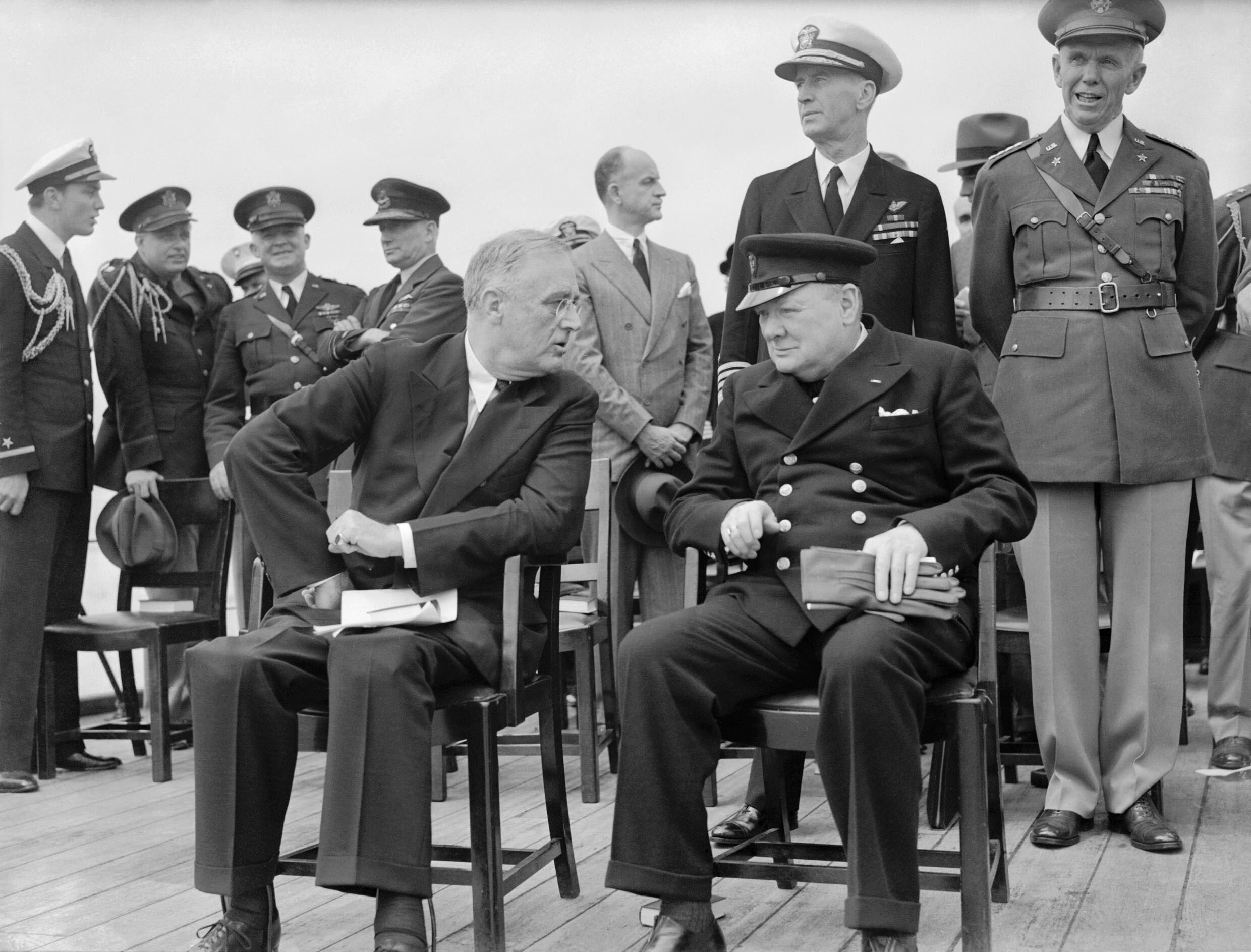
As a concept, self-determination can be traced back to nineteenth-century political thought. Important declarations about self-determination were also made during the first world war. But Simpson chooses to start with the August 1941 Atlantic Charter, formulated by Winston Churchill and Roosevelt as a means of shaping the still-distant postwar order.
The charter pledged there would be no territorial aggrandisement after the Axis powers had been defeated, and no territorial changes against the wishes of the affected people. Self-government would be restored to those deprived of it, and free (or freer) trade would extinguish imperial restrictions. The underlying belief was that a world released from imperial fetters would be more prosperous, bringing freedom from want, and disarmament of aggressor nations would bring freedom from fear. By January 1942 twenty-six nations, including the Soviet Union, had signed the charter.
Because it could be read as opposing colonial rule, the charter’s scope and meaning was qualified from the start. In Churchill’s mind, its emancipating effects would apply only to regions liberated from the Nazis, but for Roosevelt the charter meant all colonies, near and far, must eventually attain political independence. Black Americans agreed with him, their eyes on Africa.
But the United States soon revealed its own qualification when it imposed conditions on the Philippines in 1946. The Truman administration obliged the newly independent country to grant American citizens and corporations equal investment rights with Filipinos. In this way, the Atlantic Charter could be read as a means of making the world safe for capitalism’s tendency to expand territorially. To align the freedom of peoples with the freedom of capital raised an issue about “self-determination” that has never gone away: whether the political autonomy of former colonies includes full sovereignty over non-human resources within their territories. Ghana’s future prime minister Kwame Nkrumah raised this issue as early as 1944.
The difference between capitalist and socialist imaginings of self-determination is one of Simpson’s themes. The tension between the two originates in what Simpson — going back to the first world war — calls the second stage of the concept’s evolution, when US president Woodrow Wilson and his future Soviet counterpart, Vladimir Lenin, presented contrasting visions of how the world must change if peoples were to determine their futures.
Lenin, not yet in power, saw two kinds of colonial blockage. People in eastern Europe and the Balkans had to rid themselves of Russian, Austro-Hungarian and Ottoman rule, freeing them to develop as independent nations subject to the capitalist contradictions that would then make socialism possible. Asian, African and Pacific peoples under the rule of Britain, France, Germany, the Netherlands and Belgium, meanwhile, would achieve self-determination by overthrowing colonial authority — violently, if necessary — and seizing the colonist’s economic assets without compensation.
In his “Peace Without Victory” speech in 1917 Wilson also proclaimed nations to be legitimate only if they were governed with the consent of the governed. He particularly had in mind the peoples of three empires — Russian, Austro-Hungarian and Ottoman — whose colonies were contiguous with the colonial power.
Wilson differed from Lenin in two ways. He thought Asian and African peoples should be governed by their colonial masters until they acquired the capacities that would equip them to give or withhold the “consent of the governed.” In his view, those capacities needed to include a willingness to protect colonial-era investments from seizure by a politically liberated populace.
Wilson’s and Lenin’scontrasting formulations of “self-determination” underline revolutionary socialism’s twentieth-century challenge to capitalism, which is the deeper context of the Atlantic Charter. The Churchill and Roosevelt text was an artefact of war’s contingency, committing an endangered Britain to a global economic order preferred by the United States and allowing Roosevelt to bring his country into the war.
Hitler’s invasion of the Soviet Union in June 1941 made Stalin an ally of the liberal capitalist powers until 1945. Signing the Atlantic Charter, the Soviet Union declared support for all nations’ self-determination and, in 1945, “self-determination of peoples.” But Stalin imagined a world order in Lenin’s terms, not Wilson’s.
With the Third Reich defeated, the contest between the two visions of self-determination resumed. More territory was at stake than ever before. The first world war had dismantled the contiguous empires and enabled a number of self-determining nations to form, but the victors’ peace terms had left the other imperial powers, except for Germany, still in possession of their remote colonies. The second world war had weakened most of the victorious powers materially (the United States being the exception). The peoples of Asia, Africa and the Pacific, many having contributed blood and treasure to the Allied victory, were advancing their own forms of self-determination.
Several critical questions emerged in what Simpson calls the third stage of the evolution of “self-determination,” which was initiated by the Atlantic Charter and the founding of the United Nations in 1945. Should a “people” be defined by ethnicity, and was ethnic difference a justification for a group’s secession from a nation-state? Simpson devotes many pages to Biafra’s attempted secession from Nigeria in 1966, which the breakaway region’s leaders justified by referring to UN human rights covenants asserting the right of self-determination. In deft sketches of many regions that considered secession, he reminds us of the creation of Bangladesh, and he deals with agitation by leaders of Indonesia’s Aceh and Canada’s Quebec.
Did a self-determining “people” require their own state, or could their political entity exist within a state, or as a member of a confederation, or associated in other ways with some larger political unit? Faced with an international system dominated by large countries, says Simpson, leaders of small territories have sought “association, federation, imperial citizenship, or even [in the case of the French Seychelles and the North Marianas] annexation,” all of them secondary to self-determination as a new nation-state. Seating 193 member nations was not what the founders of the UN expected when they briefed the designers of the General Assembly’s main hall.
How should the rights of collectives (“peoples”) and the rights of individuals within those collectives be reconciled? The Soviets pushed unsuccessfully in 1947–48 for self-determination to be declared a human right, claiming the relative autonomy of republics within the Union of Soviet Socialist Republics was “one of the major achievements of the internal policy of the USSR.”
The Universal Declaration of Human Rights was not useful to anti-colonial movements, Simpson argues. The norms of international law that justified the colonies’ bids for sovereignty were to be found elsewhere, in another of the UN’s foundational documents: the UN Charter, which enshrined the sovereignty of nations. One of the ways the demand for human rights was politically significant was that it could delay a people’s achievement of self-determination. A criterion for assessing whether a people merited sovereignty was whether they had demonstrated sufficient respect for individual rights.
Because Simpson’s book is global in scope, mentions of Australia are fleeting. One such glimpse comes at the 1944 Dumbarton Oaks conference, which created the first (but not final) blueprint of the United Nations. There, the Curtin government was unhappy at the failure of the leading powers (the United States, Britain and the Soviet Union) to pay enough attention to the right to self-determination and to the formation of the UN’s trusteeship policies. Simpson notes Australian trade unions’ influence in shaping the government’s expectations, but he doesn’t mention that “socialist internationalism” was a strand of labour movement thinking.
When Australia did get its chance to shape UN trusteeship, according to Simpson, its influence included pointing out how profoundly the people of Papua and New Guinea lacked self-governing capacity. Meanwhile, Australia’s maritime unions were using their control over the supply of labour to support Indonesians’ self-determination.
Australia’s and New Zealand’s expectation of being given prolonged trusteeship over the peoples of the Pacific was consistent with their support for Britain and the United States maintaining their global networks of military bases. Here, Sydney University anthropology professor A.P. Elkin is an exemplary figure. Simpson sees in his 1944 paper “Notes on Anthropology and the Future of Australian Territories” a call for “a charter for the native peoples of the Pacific that would maintain guardianship arrangements while gradually granting them increasing self-rule.” Five years later, Elkin’s contribution to a UNESCO symposium on human rights made “an early case for Indigenous self-determination.”
True, but Simpson could also have mentioned that in 1946 Elkin supported the Chifley government’s designation of land that included Western Desert Aboriginal reserves as a site for Britain’s rocket testing. To have noticed that episode in Elkin’s career as a policy intellectual would have underlined one of Simpson’s themes: the cold war affinity of Free World trusteeship and Free World militarisation of Indigenous territories.
Simpson cites the Australian historian Christopher Waters on Australia’s continuing concern with how Pacific peoples might grasp “self-determination”: “the idea of independence for small dependent territories” should “not gain wide currency,” warned one cabinet paper in 1964. Simpson could have added that in 1966 the Australian government rejected the option of Papua New Guinea becoming Australia’s seventh state. As Waters’s colleagues Brad Underhill and Helen Gardner have recently reminded us, that idea emerged from parts of PNG’s political elite in the early 1960s as a more realistic goal than full independence.
Australia doesn’t figure in Simpson’s account of one of the more difficult questions of the third stage of the evolution of “self-determination”: could political self-determination secure economic sovereignty?
One US diplomat was far from alone in worrying that people who still lacked an “effective body of capitalist thought” wanted to determine the extent to which foreigners enriched themselves on their nation’s natural resources. That self-determination could limit the mobility of capital and threaten security of property troubled mid-century international legal scholarship which privileged “the rights of firms, capital, and alien property owners.”
When Britain took Iran to the International Court of Justice in 1952 over Iran’s nationalisation of the Anglo-Iranian Oil Company, international law didn’t have a clear answer to the question of whether the rights of a newly independent state should prevail over the rights of those who had invested in that territory under colonial rule.
Highlighting Latin American diplomacy and policies, Simpson traces the assertion of economic self-determination back to Mexico’s 1917 constitution. As Lenin had anticipated, self-determination became aligned with anti-imperialism. Cuba, with Soviet help, became an advocate and material supporter of many anti-colonial struggles, calling this global dynamic “tricontinentalism.” The repossession of colonised resources was its major objective, and violence was seen as a legitimate means. Many former colonies, whose membership began changing the complexion (in more than one sense) of the General Assembly from the mid-1950s, saw violent struggle — including seizure of colonists’ assets — as legitimate.
Critics of violent self-liberation found strength in other forumsof the UN, including the Human Rights Commission and the Committee on Terrorism. They argued that representative government and respect for property rights were markers of “civilisation.”
Moreover, the Soviet Union — especially after Kruschev exposed Stalinism in 1956 — was a problematic champion of anti-imperialist self-determination. It justified its control over eastern Europe (including invading Hungary in 1956 and Czechoslovakia in 1968) by saying, in Simpson’s words, “that socialist states had a duty to assist others to preserve their independence and sovereignty if they pursued a path that might threaten the socialist bloc as a whole.”
By making no provision for popular consent, Soviet-alignedself-determination was repellent to anyone who believed a self-determining people must be able to hold political elites accountable. But such illiberalism was necessary from the Soviet point of view if socialists were to resist another liberty — the free global flow of finance capital. For many anti-colonial thinkers and leaders of new nations, a world made safe for trade and capital would also be a world in which their political independence was compromised.
Would the world economy be undermined or made more equal by a form of self-determination that included “permanent sovereignty over natural resources”? UN studies and resolutions promoting such a form of sovereignty had begun to influence international law by the early 1960s. The Soviet Union and the United States vied to shape the General Assembly’s Resolution 1803 (XVII), which affirmed resource sovereignty “as a basic constituent of the right of self-determination.” According to Simpson, UN endorsement of the right of permanent sovereignty over natural resources “transformed international law and enhanced the power of resource-producing countries.”
How to settle “investment disputes” became an object of international legal thought and practice. In 1973, six months before he was murdered by his country’s US-backed military, Chilean president Salvador Allende incorporated resource sovereignty into “a new concept of self-determination” he presented to the UN Commission on Human Rights with the support of East Germany’s UN ambassador.
Economic sovereignty’s influence extended far beyond the USSR-aligned states. It was compatible with non-socialist development models, and it has certainly outlived the collapse of the Soviet Union. As Simpson writes, non-state actors — including Indigenous groups — have taken up the idea that political and economic control are two sides of the coin of self-determination.
(It’s worth mentioning that Australia’s land rights laws since 1966 have aligned, to various degrees, with resource sovereignty. Indeed, Australia has granted proportionally more land to Indigenous interests than have those other, treaty-making Anglo settler colonies, Canada, the United States, New Zealand.)
Simpson’s twenty pages on “Indigenous self-determination” and “Indigenous internationalism” are mostly about North America and Latin America. He shows how prominent Indigenous peoples have been in the fourth and fifth phases of the evolution of “self-determination.” This evolution in the final decades of the twentieth century was stimulated by pressure from below about “internal democracy, individual rights, and demands for substate sovereignty, especially by Indigenous peoples.”
In this part of his book (its final quarter) Simpson demonstrates how “self-determination” proved to be a political concept open to many non-state figures by the turn of the twenty-first century. “Evolution,” by definition, has no end, and he warns historians of self-determination to avoid becoming fixated on the state-making third phase. His conclusion calls attention to the proliferation of mechanisms (some of them violent) for resolving self-determination claims. He lists thirteen referendums since 1993 — some of them shams — fuelled by regional and/or ethnic claims to self-determination.
The First Right leaves us with the question of how the many entities that now invoke “self-determination” will manoeuvre between the sovereignty of states and the sovereignty of markets. It is welcome news (to me) that some answers are already coming from Princeton University’s Liechtenstein Institute for Self-Determination. Others are coming from small states, for among the problems to be studied and acted on is how the human community responds to climate changes that render lands and seas — the taken-for-granted “ground” of “self-determination” — uninhabitable. •
The First Right: Self-Determination and the Transformation of International Order, 1941–2000
By Bradley R. Simpson | Oxford University Press | £22.99 | 384 pages