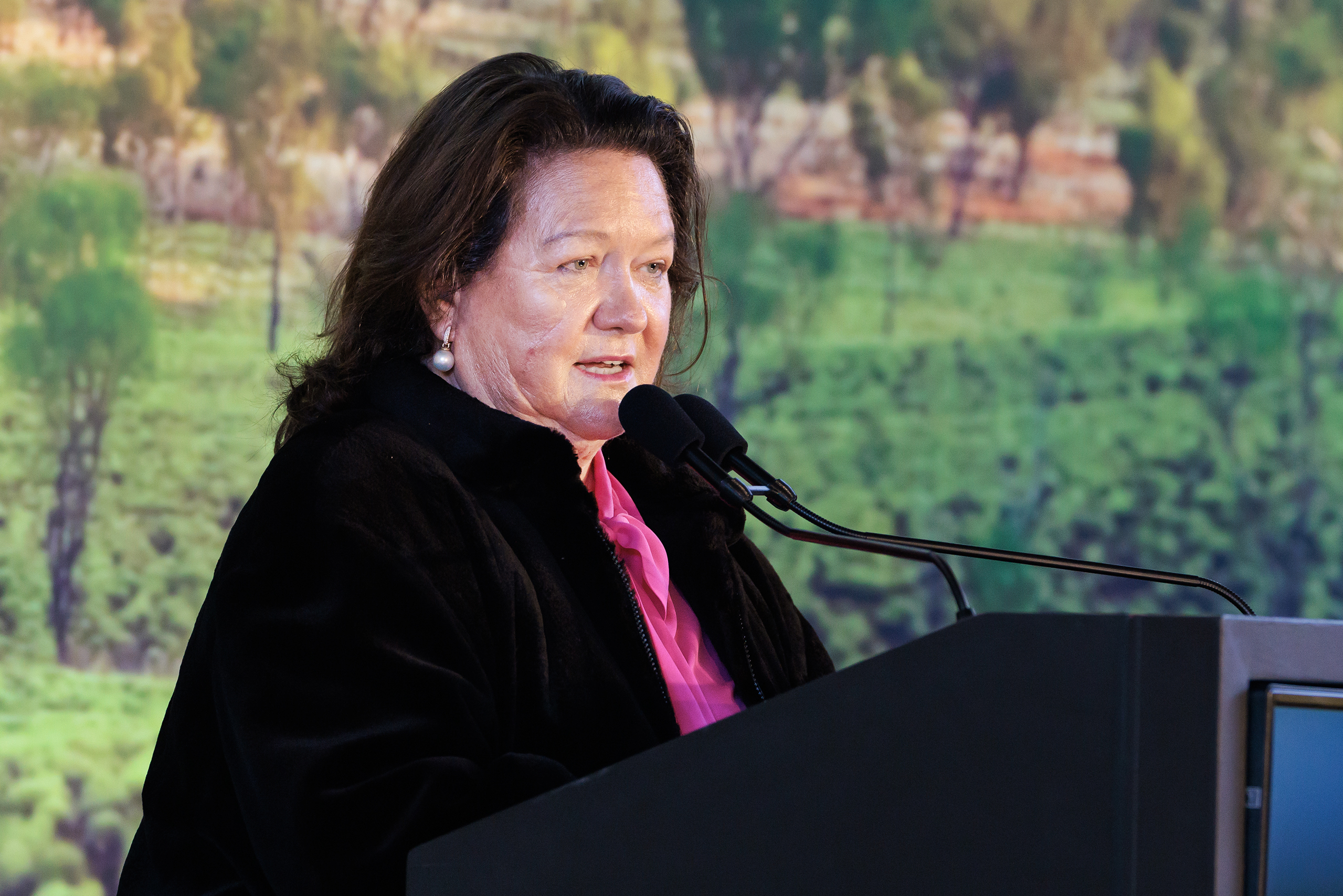
No long ago, Gina Rinehart asked an audience at a Queensland bush summit to imitate bulldozers. She had summoned on stage the bulldozer-in-chief, her ally Pauline Hanson, whose One Nation would — she said — smash the bureaucracy and red tape strangling initiative and enterprise. Rinehart seized on the precedent of Elon Musk’s chainsawing of US bureaucracy via the so-called Department of Government Efficiency, or DOGE.
DOGE had already been shown to have created chaos rather than efficiency, decimating service agencies, claiming savings that couldn’t be verified, generating multiple legal challenges, compromising the data of millions of people, adversely affecting the economy, sparking mass protests against public sector layoffs, and fuelling intense opposition to Musk and Trump’s agenda. Shortly after Rinehart’s vigorous advocacy, DOGE was quietly shut down. Its Australian disciples seemed oblivious.
Media coverage of Rinehart’s stunt noted that she is Australia’s richest woman; mentioned her funding of One Nation, to which she also gives policy advice; and acknowledged the populist appeal to grievance she and Hanson mobilised. But very little attention was given to her central message — let’s bulldoze bureaucracy — nor to DOGE’s actual record. Attention was soon diverted by a representative of the aggrieved, graffiti artist Jack Gibson-Burrell, who climbed a column of Melbourne’s Westgate Bridge to adorn it with “Pam the Bird” and then demanded lower taxes and a peanut butter sandwich from police before descending.
Rinehart’s stunt was clearly linked to her long-term campaign against bureaucracy and taxes, most clearly articulated in her ANDEV project, initiated in 2010, to create a special, tax-free economic zone across a vast swathe of Northern Australia. Tax breaks and deregulation would incentivise enterprise, create jobs and drive development; the “invisible” voices of the North would at last be listened to. Of course, such a zone would also benefit her own mining interests in those regions. Rinehart also suggested Musk’s SpaceX (in which she has invested) might be given land in the zone for rocket launches and technology experiments, driving AI development in Australia.
Here were two of the richest people in the world, with wealth already massively facilitated by governmental concessions, effectively demanding even more (Rinehart’s Hancock Prospecting helped defeated a proposed super-profit tax on mining; Musk is a preferred supplier to the US defense department.) This is no conspiracy, but an unselfconscious attack on government capacity, evidence of a loose international coalition of the super-rich working to accelerate their influence over government and their capture of wealth and the resources that belong to everyone.
It is illuminating to reflect on the comparison between the licence we extend to Rinehart to exploit and profit immensely from our resources with the persistent drumbeat of resistance to legitimate Indigenous claims to Northern lands on the grounds that this may lock up those resources.
The extraordinary concentration of wealth represented by Rinehart and Musk is indicative of market failure (increasing inequality, tax distortion and insufficient regulation), arguably only to be addressed by properly taxing the rich. Research provides strong evidence against the influential political–economic idea that tax cuts for the rich “trickle down” to boost the wider economy. Prominent economists internationally, such as Gabriel Zucman and Thomas Piketty, argue persuasively that the concentration of extreme wealth is undermining democracy. Yet all Gibson-Burrell (and many others) could see was the allure of lower taxes.
Australia’s democratic tradition fostered an enabling state: one in which governments act, through publicly owned agencies, to address conditions or circumstances that are beyond the control of individuals. Effective, properly regulated bureaucracy is the handmaiden of democracy, a partner in sustaining liberty. Seen through this lens, Rinehart’s project is profoundly unAustralian and likely, as did DOGE, to exacerbate the very problems of limited opportunity and fairness against which the aggrieved are railing.
Put aside the commercial media, all too ready to champion lower taxes, blame meritocrats and boost myths like “the Canberra bubble” and think for a moment of all those services on which some of us call or from which many benefit at one time or another: Medicare, Centrelink, JobSeeker, Australia Post, the NDIS, the Fair Work Commission, the ABC, SBS, aged care, the police, public schools, public universities, public hospitals, public libraries, public transport, firefighters.
We may be only intermittently aware of other agencies that protect our political, economic and civil rights: the Australian Electoral Commission, the Human Rights Commission and the Administrative Appeals Tribunal, alongside bodies that curb monopolistic tendencies, police market excesses and sustain small business, the Australian Competition and Consumer Commission, the Australian Prudential Regulation Authority, the Australian Securities and Investment Commission and so on.
As prime minister’s department head Steven Kennedy says, markets depend on laws, trust and public institutions to function effectively. And from his perspective, in a time of transformative change, Australia is in remarkably good shape. You would never know this while listening to Rinehart and Hanson.
The point is neatly made in “Connections,” a current exhibition at the National Archives of Australia that demonstrates how “every day, the public’s connection to government plays out in ways big and small. As citizens, it is in our interest to know that government is maintaining such services for the public good.”
Sustaining that public good depends not only on democratic legislatures, but also on all these public agencies. They are all reliant upon our taxes, and on ethically informed partnership between our elected representatives and effective bureaucratic organisation, to deliver what we demand: the means to pursue our aspirations, fair life chances.
Certainly, there needs to be transparency, parliamentary oversight and means of scrutinising and evaluating the performance of such agencies and addressing failures when they occur. We see this in practice through parliamentary committees, Senate estimates hearings and, when necessary, commissions of inquiry. Rinehart’s campaign to smash bureaucracy would do away with it all. It should be seen for what it is, deploying the siren call of lower taxes to demolish foundational public institutions: the bulldozing of democracy. •