Disruption, volatility, insurgency and polarisation are the buzzwords of this political age. Now Britain, fresh from the sixth change of prime minister in a decade, has given us another term: ungovernability.
In a 2021 study of the British prime ministership, the leading historian of 10 Downing Street, Anthony Seldon, asked if it had become “an impossible office.” It hadn’t, he concluded, and he still insists it isn’t. Yet the rapid-fire demise of David Cameron, Theresa May, Boris Johnson, Liz Truss, Rishi Sunak and Keir Starmer means the question is haunting British politics. Responding to the latter’s fall, Seldon admitted there has “never been a period like the present.”
Australia, of course, has endured its own turbulence in high office this century, cycling through seven prime ministers from John Howard to Anthony Albanese in the space of a decade and a half. Is the churn best explained by the fallibilities of the office holders or by larger structural forces that have increased the difficulty of the job? Inevitably, the answer is a combination of both.
At the same time, it’s possible to become too caught up in the dramas and vicissitudes of the current moment and lose a sense of proportion. It was Edward Gibbon, legendary historian of the Roman Empire, who warned, “There exists in human nature a strong propensity to depreciate the advantages, and to magnify the evils, of the present times.” Though the contemporary ferment has novel elements, heading a government has rarely been other than a harrowing and crisis-ridden occupation.
A survey of Australian politics since federation reveals precious few moments when the seas of administration were calm. Robert Menzies managed an impression of effortless command during his record-making second prime ministership, but it took him several years to win that supremacy (conventionally dated to the 1955 election at the time of Labor’s split) and even the salad days of his dominance featured cold war tensions, a severe credit squeeze and the incipient strains of an increasingly complex society.
One way of putting the turmoil of our times in perspective is to recall where things stood a century ago. Having barely emerged from the Great War and the Spanish influenza pandemic, Australia was about to plunge into the maelstrom of the Great Depression and what’s been dubbed the “Devil’s Decade.”
Labor’s Jim Scullin, a good and able man sworn in as prime minister just as the New York stockmarket crashed, was utterly overwhelmed by the challenge of trying to steer the nation through the economic tempest. His hair turned white and his health was broken. Joe Lyons, who followed Scullin, managed a little better but found the office a personal ordeal and privately longed to be relieved of its taxing responsibilities. Death allowed him to escape in April 1939.
Menzies, who replaced Lyons on the cusp of the second world war, was unable to win the confidence of the coalition parties or the public. His first prime ministership ended in abject humiliation in August 1941. “Let me lay down and bleed a while,” he famously declared. Acting against character type, Labor’s John Curtin succeeded where Menzies had failed as wartime leader, but the toll was immense: like Lyons, the burdens of the prime minister’s office hurried him to the grave.
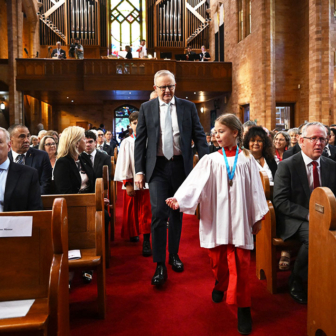
My sense is that a dearth of perspective — an almost slavish adherence to the narrative of dislocation and dissatisfaction — is distracting many journalists from what is unfolding before their eyes: Albanese’s steady-as-you-go evolution into a long-term occupant of the prime minister’s office. This month he passes Paul Keating (1991–96) and by October he will eclipse Ben Chifley (1945–49). At that point he will become Labor’s third-longest-serving prime minister behind Bob Hawke (1983–91) and Andrew Fisher, who held office across three separate terms during the early Commonwealth.
Among Australia’s post-1945 prime ministers, Albanese will soon trail only Menzies, Malcolm Fraser, Bob Hawke and John Howard. Since 1901, the average incumbency of prime ministers has been around four-and-a-half years, a mark Albanese will reach in November.
Albanese is, in other words, the face of a return to relative stability. The composition of his cabinet is another element in this story of durability. In the decade and a half after Howard’s defeat, ministerial turnover was frenetic: nine ministers of defence, nine ministers of immigration and nine ministers of education; eight ministers of trade, seven ministers of the environment, six ministers of social services, six ministers of infrastructure and trade, six ministers of the arts and six attorney-generals.
Albanese’s ministers, by contrast, have mostly held their portfolios continuously since Labor’s May 2022 election. In the same jobs throughout have been Jim Chalmers as treasurer, Katy Gallagher as finance minister, Richard Marles as defence minister, Penny Wong as foreign affairs minister, Don Farrell as trade minister, Jason Clare as education minister, Mark Butler as health minister, Chris Bowen as climate change and energy minister and Tony Burke as arts minister.
Of course, stability and longevity are not automatically synonymous with consequential government. On the two recent occasions when Australia’s political historians and political scientists have been asked to rank the nation’s prime ministers, four of the longest-serving (Billy Hughes, Stanley Bruce, Lyons and Fraser) have only rated in the middle order. The experts preferred activists: those office holders they assessed as having left behind a substantial legacy rather than merely occupying the office at length.
Nevertheless, the highest-ranked prime ministers have nearly all been stayers. That survival is a handmaiden to governing success is hardly surprising. Prime ministers and ministers learn on the job. Sustained occupancy enables mastery of portfolios and, most importantly, policy changes with a much greater chance of sticking.
Anthony Albanese has been keenly aware of these advantages from the outset. He lamented how the short-term prime ministerships of Kevin Rudd and Julia Gillard created the conditions for policy evanescence: the carbon tax being the most spectacular and regrettable example.
A popular view sees the Albanese government as a public policy tortoise, especially during its first term. The reality has always been more complex. Industrial relations is just one field in which it was busy from the beginning. Even journalist Paul Kelly — despite his abiding pessimism about a stunted post-Howard political class and what he dolefully views as a country mired in “economic, structural and cultural disappointment” — recently acknowledged that Albanese and his ministers were shaping Australia according to a discernible project. It was just that it was a project that did not much meet with his approval:
a more interventionist state; an expanded public sector with deeper social commitments in health, disability and education; an ideological faith in renewable energy as the pathway to a more dynamic and clean energy economy; an expanded care sector around childcare and aged care; a disposition towards universal benefits; a revamped industry policy; a drive to “making things” at home; a commitment to social housing and assistance for first-home buyers; the campaign to enhance union power via greater legislative regulation and protection in the industrial relations system; greater pay rises for care sector workers; a determination to lift wages generally; and a priority on gender pay equity and lifting women’s workforce participation.
Labor’s recent national conference afforded another manifestation of a prime minister who has attained an authority beyond that of most of his recent predecessors. The media predictably huffed and puffed about that dominance, with many journalists seemingly oblivious to the fact that describing an ALP national conference as carefully stage-managed and stitched-up is hardly novel: this has been the songbook of national conferences throughout this century and even further back.
The 2009 conclave under the stewardship of Kevin Rudd was probably the apogee of sanitisation. Rudd’s compulsion for control of the party ultimately proved combustive for his own government, but not the least whiff of any similar trouble is brewing under this prime minister.
Regicidal urges might have become commonplace in Australian politics following Howard, but Albanese has no terror of them. A lifetime of experience within Labor ranks means he is far more versed in the party’s arcane ways than the comparative interloper Rudd. He is also a much more adroit orchestrator of his colleagues than the unilateralist Rudd ever was.
But there’s another dynamic at play in the cohesion of the current government, and its importance can’t be overstated. In a similar way to Hawke Labor’s learning from follies of the Whitlam years, Albanese and his team have been steeled by the disorder of the Rudd–Gillard period. The motivation not to squander a second chance in office exercises a potent and continuing discipline within the ministry and caucus.
Yet pretty much since Albanese assumed the leadership in 2019, the electorate has been far from entranced. Paradoxically, the last prime minister to enjoy a period of sustained popularity with voters was Rudd. Putting aside a relatively brief flurry of excitement at Malcolm Turnbull’s ascension in late 2015, the Australian public has not been enamoured with any major party leader over the past decade and a half.
Historically, too, only a few prime ministers have found a place in the public’s heart: Lyons, Curtin, Chifley and Hawke come to mind. But they could earn respect. In these days of an unforgiving social media–fuelled culture of ill-will and character assassination, grudging tolerance seems about as good as a prime minister can hope for, which is a reasonable description of how the public seems to regard Albanese.
Notwithstanding the lukewarm assessments of the prime minister, the Labor government’s support is holding up reasonably well. If the published opinion polls are to be believed, the party’s primary vote is bouncing around the 30 per cent mark while the government is maintaining a modest but consistent two-party-preferred lead over the Coalition or One Nation.
When Labor was returned with a greatly enhanced majority at the May 2025 election, some observers cautioned that the party’s primary vote of 34.5 per cent showed this was a loveless landslide and warned the thinly rooted majority could easily be swept away. These caveats remain salient, but it is also worth noting that Labor’s primary support has now been largely steady, if unspectacular, for most of this century.
Apart from the Rudd landslide of 2007, support has hovered around the mid-thirties: the lowest in 2022 (32.6 per cent), the highest in 2001 (37.8 per cent). And Labor is doing comparatively well with the cohorts that will constitute a majority of voters by the time of the next federal election: Millennials and Generation Z joined by the coming Generation Alpha. It is comprehensively outflanking the opposition parties in that respect.
For all the incessant talk about voter alienation from the established parties, the compelling crisis is on the right side of politics. Beginning at the 2016 poll, the Coalition has shed nearly 14 per cent of its primary vote over the course of four elections and opinion polls indicate the haemorrhaging has only worsened over the past year. Between the two world wars, George Dangerfield wrote an influential book, The Strange Death of Liberal England; a similarly titled study of the politics of early twenty-first-century Australia awaits its author. The idea that the nation has only one viable party of government is no longer far-fetched, a development as extraordinary as it is troubling.
The structural developments discombobulating Australian politics — everything from the hollowing out of political parties to a fragmented media landscape, stubborn economic problems, policy uncertainty following the exhaustion of neoliberalism, and a fractious international order —won’t pass anytime soon. In an interview with the Saturday Paper’s Karen Barlow earlier this month, Albanese confessed that this is “a really difficult time. That’s the truth. Government is not easy. If you look around the world, last week I spoke with my fifth British prime minister. Five in Britain; three in Korea… Japan, three; Thailand, three at least; Singapore, two. The churn is extraordinary.”
In other words, he is surviving in a high-casualty game. When the record of Albanese’s prime ministership is written maybe this will be his signal achievement, as unromantic as that seems. Surfing the waves of disruption and turbulence and yet staying upright. Demonstrating that governing can still be done. •