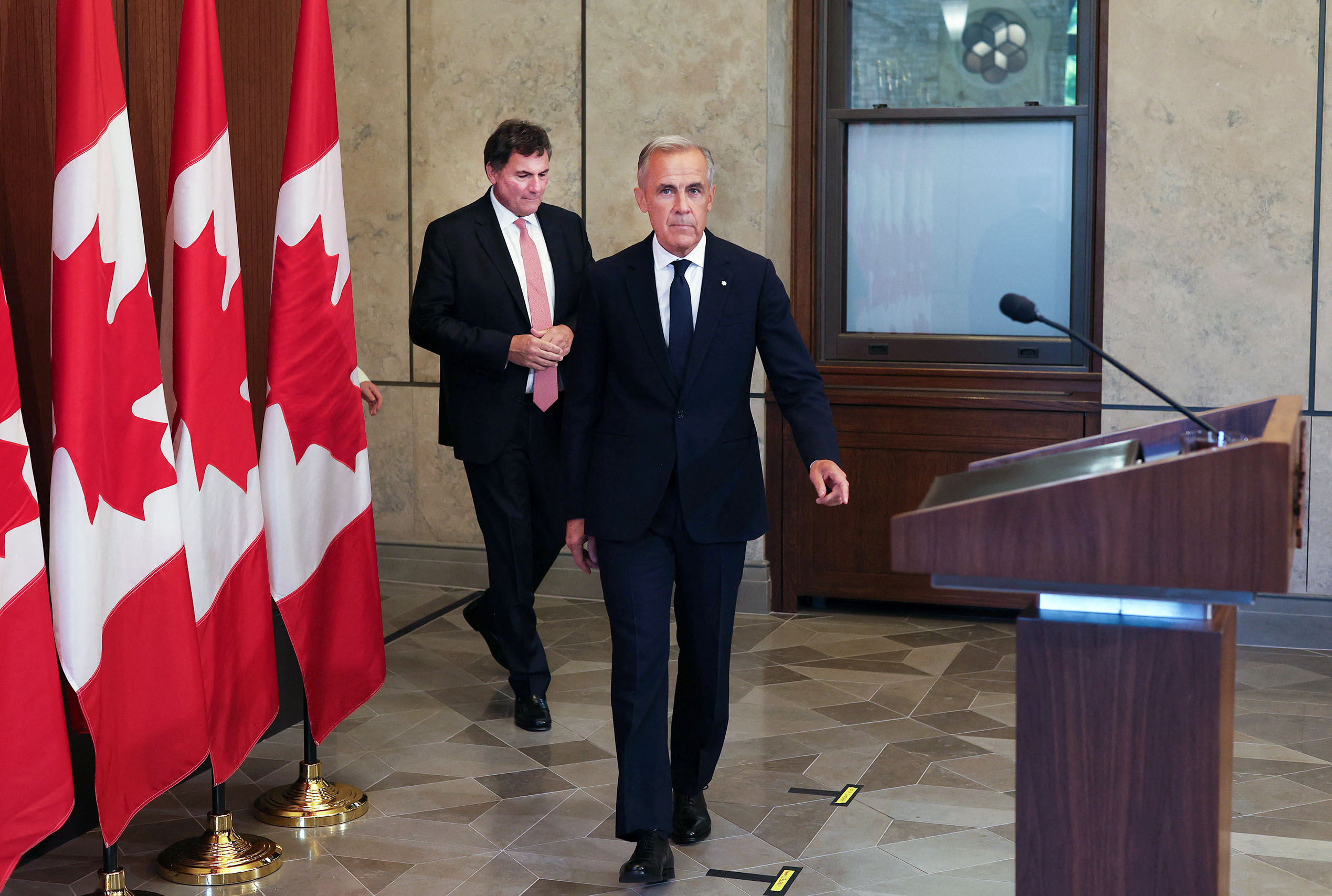
Two years ago the idea of Mark Carney as prime minister of Canada was as preposterous as believing, a decade earlier, that a certain New York celebrity businessman could become American president. But things have changed — and largely because of that same New York figure. Now, in the job he long wanted, Carney faces a momentous task: negotiating trade deals vital to the Canadian economy with the menacing administration of Donald Trump. The good news for Carney is that he has a nation united behind him.
Just last month the Canada–US relationship appeared to be on a minor upswing when the two countries joined Mexico to host the World Cup. On 19 July Trump, Carney and Mexican president Claudia Sheinbaum appeared together at the final, with Trump and Carney smiling and chatting with each other. Yet only hours later the Trump administration announced its latest round of tariffs, imposing 50 per cent levies on a range of Canadian goods, to take effect on 19 August.
Accustomed to the absence of good faith in the Trump administration, few Canadians were surprised by this latest punch in the face. Still, Canadian negotiators boarded the plane for the short trip to Washington to try to head off the tariffs as part of overall negotiations to renew the US–Canada–Mexico free-trade agreement. That agreement, reached in 2018 under the previous Trump administration, is now termed a bad deal by the same president.
Intense negotiations took place over the course of August, with regular leaks and briefings from the Canadian side to prepare the country for painful concessions. On Tuesday 18 August, hours before the new tariffs were to take effect, Trump announced the two sides had reached a deal, “subject to the finalisation of documents,” and paused the tariffs for three days. But no details were released, and negotiations continued for the rest of the week with all-new demands from the American side.
Having broken off talks and called his team home, Carney declared last Saturday that “you are at war when you get attacked. We got attacked.” He announced a new round of Canadian counter-tariffs and affirmed what Canadians had also learned over the last two years: that when the Americans sign a deal, it is “written in pencil.”
Carney’s decision may have been frustrating but it was not difficult. Praise from all sides supported his view that no deal was better than a bad deal. He may have a challenging job, but his short political career has been golden.
Much has changed since November 2024 when the American president-elect announced plans for 25 per cent tariffs on Canada and Mexico, prompting a frantic visit to Mar-a-Lago by then-prime minister Justin Trudeau to clarify what surely must be a mistake. But the very different nature of the second Trump administration rapidly became clear, especially when Trump raised the ultimate Canadian bogeyman by repeatedly proposing that Canada become the fifty-first state. The shock dislodged Trudeau from office, triggering a leadership race for the dubious prize of leading a governing Liberal Party running as low as fourth place in polls.
Enter Mark Carney, the former governor of both the Bank of Canada and Bank of England, who had long made his political ambitions known but had taken few steps to advance them. In the crisis atmosphere of early 2025, Carney romped to victory in the leadership race, took office as a seatless prime minister, called an election, and won a near-majority of seats, bettering Trudeau’s last two minority wins.
Carney’s political star continues to rise. Since January this year, after being neck-in-neck for popularity for much of 2025, the Liberals have developed a clear polling lead over the opposition Conservatives, and Carney has turned his minority into a majority by attracting a surprising array of floor-crossers to the Liberal benches. The Liberal Party itself, long known for shameless opportunism, has outdone itself with a rapid turnaround, discarding the progressive environmentalism and general wokeness of the Trudeau years in favour of the dark-suited business image of Carney.
Still, his full vision is unclear. In the January Davos speech that attracted world attention, he spoke of a rupture in the world order and the need for “middle powers” to act together. What this means in practice remains vague, and in May he also said, speaking of the US–Canada–Mexico trade agreement, that “Canada remains open to deeper integration, including options for Fortress North America in [certain] sectors.”
To much fanfare, the government has set up a Major Projects Office to expedite domestic infrastructure projects designed to strengthen the Canadian economy, but actual progress is limited on projects that will in any event take years to complete. A year ago Carney gathered pledges from provincial premiers across the country to demolish the many trade barriers within Canada; yet my nearby Ontario government liquor store stocks a vast selection of Australian wine but not a drop of alcohol from any other Canadian province. And while the standing joke is that Donald Trump has done more than any Canadian politician to bring the country together, the province of Alberta has scheduled a referendum in October on whether to seek independence.
Regardless, Carney retains enormous freedom and political capital because of the American menace, and especially its incoherent aggression. A year ago Canadians were debating the best way to negotiate with the Trump administration; now it is increasingly clear that the normal tools of diplomacy are useless.
An example of Carney’s latitude is the negotiations over the Gordie Howe Bridge. A new connection over the Detroit River, named after a noted Canadian who played ice hockey for the Detroit Red Wings, the bridge supplements the longstanding Ambassador Bridge, a privately owned crossing that carries a staggering quarter of all Canada–US trade. First agreed upon in 2012, with construction beginning during the first Trump administration, the Howe bridge was set to finally start taking traffic in June. But Trump blocked the opening because Canada, which paid for the entire bridge, would collect all tolls. Lobbying and a campaign donation by the Moroun family, which owns the rival Ambassador Bridge, may well have been a factor.
The opening ceremony was cancelled, and Carney and his government negotiated to get the bridge open in July. At first they managed to keep secret an agreement to siphon more revenue to the American side and give the US a veto on toll changes. After the media pried open the details, Carney faced some minor criticism for not being upfront about what had been given away; yet most of the country shrugged, knowing that shakedowns like this are the cost of doing business with Trump and necessary to keep the Canadian economy moving.
That context means Carney can do no wrong. The challenge is figuring out what to do at all. As we have seen in his war on Iran, Trump enters into conflict with no plan other than an assumption of total capitulation; when this fails to occur, he doesn’t know what to do. This is why Canadian negotiators struggle; one cannot outwit the opponent if the opponent is blundering around with no wits of its own.
Despotic regimes tend to have overlapping and incoherent bureaucracies, with sycophants competing to please the leader, and this appears to have been key to the breakdown in the August talks. According to numerous Canadian sources, the “deal” announced by Trump was reached with US trade representative Jamieson Greer but then challenged by commerce secretary Howard Lutnick, who added all-new demands Canada couldn’t accept.
Indeed, it is sometimes unclear whether the American side has really thought out its own proposals or is deliberately sabotaging the negotiations with ultimatums no Canadian government could accept. An example was the last-minute demand to relax Canadian bilingual packaging requirements for American goods; while minor in American eyes, any informed observer would know this would be unacceptable political dynamite in Quebec and French-speaking Canada.
The incoherence on the American side has allowed Carney to escape truly difficult decisions about the future of key sectors, notably the Canadian auto industry and the protectionist supply-management system for dairy and other agricultural products. While Australian experience in these areas serve as a reference point, both have long been sacred cows no prime minister has dared touch. Indeed, the deal close to fruition would have conceded significant ground in the auto sector, and could well have faced a firestorm of domestic criticism as going too far.
Despite the daunting tasks he faces when he gets up every morning, Carney looks like a man who enjoys his job. He punctuates his serious banker persona with just enough smiles to seem human, and gets fully into less conventional activities, such as inviting the president of Finland to join him for an ice hockey practice, giving the sense of a well-balanced person who enjoys a light moment before getting back to the work of the nation.
This image is astronomically aided by the contrast with his predecessor Justin Trudeau, whose romance with pop star Katy Perry has become international tabloid fare, confirming for many the suspicion that Trudeau’s career goal has always been celebrity rather than public policy, and making Carney look even more suited for the serious job at hand. Carney’s mature bearing contrasts not only with the Trump cacophony but with others on the Canadian side, noticeably Ontario premier Doug Ford, who enjoys mixing it up on the same level as the administration, calling Trump “the king of bankruptcies” who can “kiss my ass.”
Carney’s winning image in turn attracts others to his team. In the past year five MPs have crossed the floor to join his party, a wave not seen since the nineteenth century. They range from an Inuit member of the left-wing New Democrat Party to a Conservative with a history of vaccine scepticism. Further boosted by successful by-elections, the Liberals have had a majority in the House of Commons since April, allowing them — after nearly seven years of hung parliaments — to control committees and pass legislation without opposition bargaining.
Carney has also had remarkable success holding together his caucus, most of whom were elected under the Trudeau progressive banner. While there are reports of internal grumbling, the only notable dissenter is Stephen Guilbeault, an environmentalist who resigned from cabinet with plans to soon depart politics completely.
While Carney has had the luck, the great loser is Conservative leader Pierre Poilievre. In 2024 Poilievre seemed to have a lock on the prime ministership, it being only a matter of time before he demolished the hated Trudeau. But Trudeau’s resignation and Carney’s magical turnaround left him losing not just the general election but also, embarrassingly, his own seat. Having returned to the House in a byelection, Poilievre continues to struggle for traction, unaided by Trump’s total lack of interest in cultivating allies.
A more sophisticated US administration might have attempted to split Canadian opinion by offering conservatives some kind of olive branch; instead, Trump’s antics are political third rails that no Canadian politician can touch. Yet a striking poll in October found that while 98 per cent of Liberal and 97 per cent of NDP supporters disapproved of Trump, only 50 per cent of Conservatives did so, with an equal 50 per cent approving. This awkward split leaves Poilievre hamstrung, sniping away at things like the bridge deal but able neither to articulate better options nor to change the subject from the dominant agenda of Trump and trade.
With his failure to win the 2025 election and the sagging polls, floor-crossers and internal divisions, rumours of Poilievre’s imminent demise are rife; but he is saved by the lack of alternatives, especially since a party split down the middle about Donald Trump is not well-equipped to agree on a new leader. The most obvious candidate is Michael Chong, a longtime MP whose reputation as an overthinking policy wonk left him in fifth place in the party’s 2017 leadership race. Having sat out the subsequent 2020 and 2022 races and given the loyal service, especially on foreign affairs, that has propelled him to the frontbench, Chong is an attractive and thoughtful moderate. The only problem is that he significantly duplicates the thoughtful moderate already in office, Mark Carney.
Carney’s shift to the right has at least given some oxygen to the social democratic New Democrats, whose horrid few years culminated in their loss of parliamentary party status in last year’s election after they won only seven seats (now down to five after the floor-crossing and a Quebec MP’s departure to provincial politics). The NDP warrants some sympathy: for decades they consistently railed against becoming too dependent on the United States, only to see their support collapse in the 2025 election as voters raced to their new nationalist champion Mark Carney. But as Carney moves clearly to the right, the NDP once again has some wiggle room under their new leader Avi Lewis.
Despite lacking a parliamentary seat and having been defeated twice in his attempts to do so, Lewis brings new energy to the party, along with a noticeable bloodline. His grandfather David Lewis once held the same job as federal party leader and his father Stephen Lewis was a former leader of the Ontario NDP. While a July poll found only 12 per cent of Canadians could even name Lewis as party leader (compared to 57 per cent for Conservative Poilievre), there is at least a chance for the NDP, with nowhere to go but up.
The more serious challenge for Carney is the return of provincial separatism to Canadian politics, though in a different jurisdiction from usual. The Parti Québécois, which held unsuccessful referendums for independence in 1980 and 1995, is poised to return to power in the upcoming Quebec provincial elections with an unabashed separatist platform; but PQ leader Paul St Pierre Plamondon has pledged not to hold a referendum until after Trump leaves office. The western province of Alberta, meanwhile, which perpetually grumbles about being taken for granted, will hold a vote in October on whether to commence a separation process.
Alberta’s vote was initiated by premier Danielle Smith, who nevertheless pledges to personally support staying within Canada. This fence-sitting is characteristic of Smith, who overthrew her predecessor for not being sufficiently militant, especially against Covid measures, but who knows that a majority of Albertans, even if irritated by their relationship with the rest of the country, still wish to remain Canadian. This all aligns with the Trump threat, with a strong correlation between the approximately 30 per cent of Albertans that favour independence and the somewhat smaller proportion who have a favourable view of Trump; and Alberta’s oil-rich economy is under less threat than the manufacturing provinces of the east.
Still Carney, himself raised in the Alberta capital of Edmonton, must watch carefully as the referendum nears. He is at least aided by his own infrastructure agenda, which includes pipelines, so near and dear to the landlocked province, and the departure of the aforementioned environmentalist Guilbeault, whose name evoked even more loathing in the province than that of Trudeau. The greater risk is that Carney will put too much emphasis in trade talks on preserving the economic interests of Ontario and Quebec, such as autos and supply management, at the cost of Albertan oil and other exports. This is his greatest vulnerability in his confrontation with Washington.
After Carney broke off talks on 21 August a poll found 76 per cent of Canadians approved of his decision, including 67 per cent of Albertans. But the future is uncertain, with the possibility of ever-higher tariffs and the complete collapse of the free-trade framework that underlies so much of the Canadian economy. Mark Carney long dreamed of being prime minister, and fate allowed that unlikely circumstance to occur. The country is solidly behind him for the moment, but the road ahead is hard, and at times his dream must seem more like a nightmare. •