A year ago, in the cabinet room, Australia’s most senior bureaucrat, Stephen Kennedy, made some remarks that surprised a few people. Meeting with economy-wide leaders gathered in Canberra for treasurer Jim Chalmers’ roundtable on productivity, the head of the prime minister’s department was discussing how the bureaucracy was using artificial intelligence.
He described how the government had initially tried to ban public servants from using personal AI accounts for work purposes but quickly discovered it wasn’t practical. So many people were already using AI that the rule was both unenforceable and unrealistic.
We tried to stop it, Kennedy told them. “And we can’t.”
It seemed, having discovered just how useful it was, they no longer wanted to.
A whole-of-government AI system was still being developed, so public servants had been told they could use the commercial models as long as whatever they fed in wasn’t too specific and contained no classified or identifying information.
This was unremarkable to some in the room but raised eyebrows among others. One participant who had been wrestling with data security recalled being taken aback that personal AI accounts had proximity to any sort of government information. Another, familiar with the scale of private-sector AI deployment, was surprised the government seemed so far behind.
A lot has changed in a year. The Australian public service now has a central government AI portal, a service-wide licence for Microsoft Copilot and a pro-AI ethos. Every department has a chief AI officer and designated “AI champions” to promote the technology’s use wherever practical. In short, it is all-in.
The Albanese government’s AI ambitions have followed a similar trajectory. In the past two years, its public posture has swung from notably cautious to forward leaning, paired with declarations about upholding local laws and protecting Australians. Even its chief champion within government, assistant science and digital economy minister Andrew Charlton, emphasises equity, social harmony and safety in rolling it out.
“We are walking and chewing gum at the same time, which means making sure we capture the opportunity for Australia in a way that mitigates the risks,” Charlton tells Inside Story. “We want to make sure this technology benefits Australians and doesn’t cause harm to local communities. And we’re introducing this world first framework, this AI standards framework the prime minister announced a few weeks ago, precisely to learn the lessons of previous technology waves and previous booms.”
Charlton insists that setting the government’s course on AI was never a binary choice because regulation and opportunity need each other. “You have to do both together, or you will achieve neither,” Charlton says. “I think only if we can guarantee safety and public confidence will we be able to get the opportunity. And so I think they are they are fused. We’ll succeed in both or succeed in neither.”
With state governments jostling for investment opportunities, the tech sector complaining about a lack of coherence, and internal Labor tensions requiring negotiation, prime minister Anthony Albanese stepped into the AI frame in July. Inside his party, some were pushing to minimise regulation and dangle legal exemptions to attract frontier AI companies. Others were more inclined to put the whole thing in a box. Just ahead of his party’s national conference Albanese moved to take control of debate, defining and defending the combined pro-innovation, pro-data-centres and pro-regulation policy his government is pursuing.
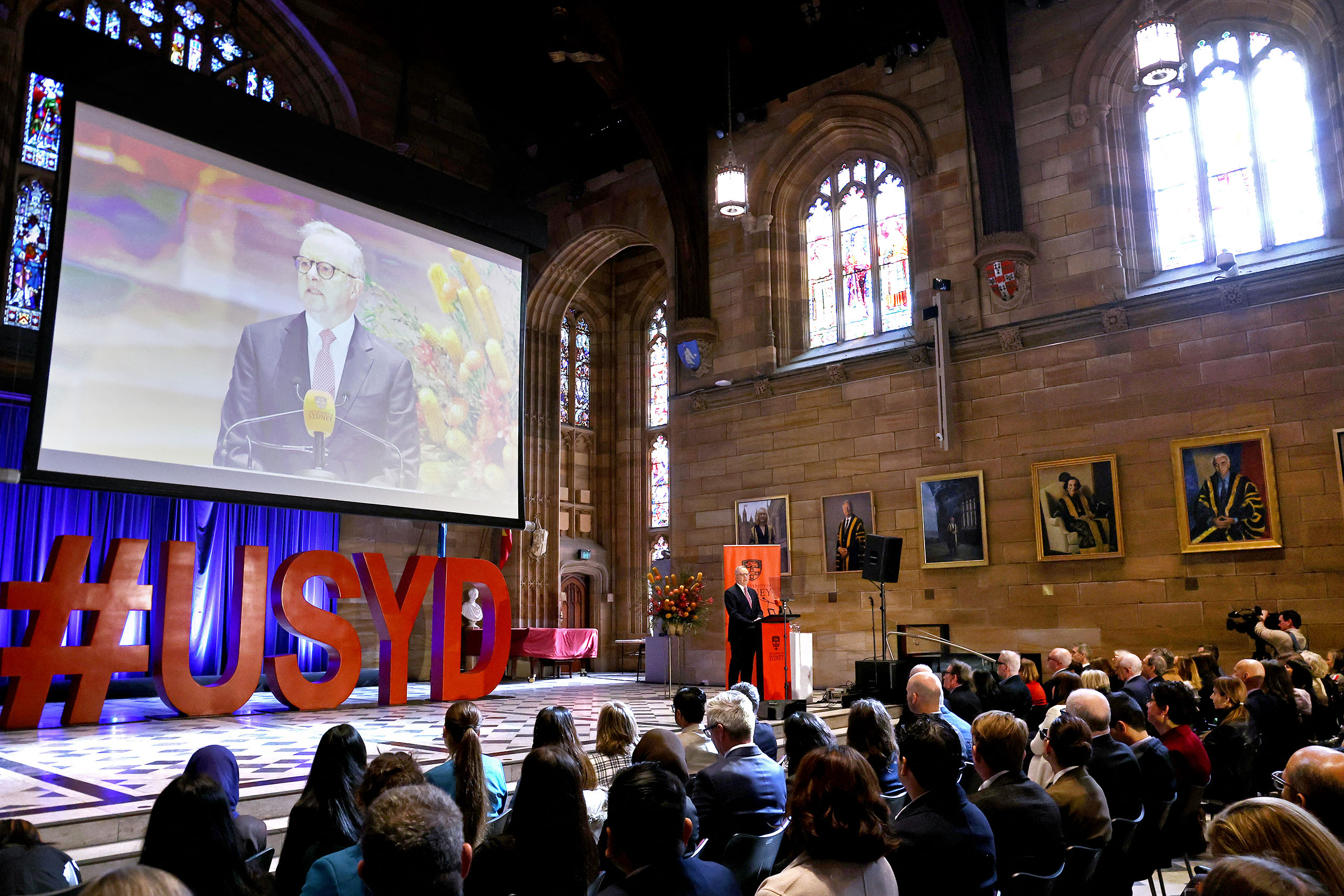
“We can set the terms, we can determine AI’s social licence,” Albanese said in a speech at his alma mater, Sydney University, on 15 July. “But we have to do it now. We cannot revisit this issue after companies have built whatever they want, wherever they want, and try and then re-open negotiations. This is our time to decide what AI looks like here in Australia. It is not a question of ‘if’ or ‘when’ AI will transform our economy. We are past that. The question that matters, the choice that we have, is how.”
Navigating the AI policy universe is like playing four-dimensional chess. The opportunities and challenges — for productivity, security, regulation, energy and leveraging Australia’s assets to secure influence and value — are monumental. There are also concerns about energy, water, social licence, the rule of law, democracy and, yes, the future of humanity. The politics of AI start at the top and go all the way down — or perhaps the other way around.
In a recent two-hour interview with tech podcaster Joe Walker, Charlton acknowledged both the uncertainty and the possible consequences.
“These models are becoming incredibly powerful and the rate of their power is accelerating,” Charlton said. “And that means we’re dealing with an incredibly capable and, in some ways, incredibly dangerous technology.”
For every amazing possibility, there’s another that could be dire. AI is redesigning work and promises enormous gains but is also making entire job types redundant. It offers massively lucrative investment and tech-development prospects but threatens the rights of content creators and human creativity itself. Its infrastructure could further strain the energy grid but could be harnessed to entrench and accelerate the sustainable energy transition if approvals have conditions attached.
It also has almost unfathomable implications for security at every level and potentially heralds a radical power shift from governments to a handful of private corporations. It will sort the world into countries that can leverage their assets and those relegated to customers. It isn’t exactly easing the US–China contest. It could help cure intractable diseases; it might render humans extinct.
And although Australians are using it widely, research consistently shows most don’t trust it and worry what it will bring. As disruptions go, it’s the biggest we will see in our lifetimes. The arc of social media’s impact shows we have only one chance to get it right.
“Imagine if the world had acted a decade ago,” Albanese said in his July speech. “Imagine the difference it would have made if these limits had been put in place when the world first grasped the risks of these platforms, when we first understood their reach and indeed their power. That is the opportunity — and the choice — we have now with artificial intelligence.”
The government’s AI direction has been buffeted by numerous influences since its first term in office, not least the realisation that the AI wave isn’t coming, it’s here, and Australia needs to figure out how to ride it or be swamped.
Charlton has been a strong advocate for Australians to be tech builders, not just users, pressing the case for not missing “the critical window to back AI.” He points to our world-leading uptake of new technology but argues adopting isn’t the same as adapting and developing.
AI companies started knocking on Australian doors at least eighteen months ago, with big budgets and bigger demands for concessional data-centre deals on land, law, energy and water. They’ve been knocking more forcefully in recent months.
Global uncertainty and the United States’s brutally unsentimental attitude towards its friends have necessitated efforts to protect Australia’s interests more aggressively and pursue ways to make ourselves indispensable. Donald Trump’s June edict restricting global access to Anthropic’s powerful Mythos large-language model and the ringfenced version, Fable 5, only reinforced that imperative. Mythos is said to be able to hack some of the world’s most secure systems, making access crucial to protecting them. Despite membership of the US’s five-eyes intelligence network, Australia wasn’t on the list until Trump eased the ban. The government has been in talks about ensuring access to future models and Albanese has also been consulting like-minded international counterparts.
The prime minister and his senior ministers have watched other countries position themselves, with mixed success, for advantage in an AI contest founded in the US and China. Leveraging our political stability, abundant land and energy diversification, government is promoting Australia to big AI companies as a data-centre host.
At the same time, concern about workforce implications make AI a hot-button issue for Labor internally. Powerful unions nationwide demand protections for workers and content creators.
ACTU assistant secretary responsible for AI Joseph Mitchell argues that working people need more regulation to keep them safe. “The government has made some important steps forward, but there still needs to be further policy coordination to make sure Australians are protected,” he says. “At the end of the day it isn’t too much to ask that Australians have a say in how technology is changing our lives, have proper protections in place so our rights aren’t undermined, and to make sure workers enjoy the benefits.”
Andrew Charlton points to the three pillars of the national AI plan, unveiled in December: capture the opportunities; spread the benefits; protect against the risks. “We think that you are either going to achieve all of those things,” he says, “or you are going to achieve none of them. I don’t think there is a world where we go hard after the opportunity and are successful, because we will just lose social licence. Bad things will happen and it will all fall down.”
The government believes success means working across orthodox political lines. For more than a year, employment minister Amanda Rishworth has been convening regular informal meetings on AI with union and business representatives. In April, the group was expanded and formalised as the AI Employment and Workplaces Forum.
Australian Chamber of Commerce and Industry chief executive Andrew Mackellar supports collaboration and says business isn’t anti-regulation.
“We’re not against standards which are tailored to the Australian context,” Mackellar says. “But we are wary about how those might be reinterpreted or applied if they’re to become a real constraint for business.”
His counterpart in manufacturing, Australian Industry Group chief executive Innes Willox, presses consistency. “Under the principles of a single national economy, we need to have a single approach to AI,” Willox says. “That doesn’t mean one piece of legislation that becomes the AI arbiter across the country. We have to have an approach which is transparent, coordinated, which involves a lot of consultation between government, business, unions and community, to assess the impacts and opportunities that AI presents.”
Complicating the unity project, state governments are in a Hunger Games–style battle for frontier data-centre investment. Premiers are also scrambling to respond to the deep public antipathy that could stymie it. Tasmania’s parliament has called a lightning-fast inquiry into data centres. South Australia has just announced a royal commission into the tech’s broader implications, including for education.
SA Premier Peter Malinauskas, who blindsided the tech sector and didn’t consult his federal colleagues before deciding to proceed, says his inquiry will not look back on the past but try to chart a path forward. “People hear ‘royal commission’ and I think they can be forgiven for assuming that someone’s going to get skewered somewhere,” says Malinauskas.
Its terms of reference, not finalised, aren’t expected to cover data centres, which he has described as not the main game. He insists it’s not about finding somewhere to direct public anxiety, it’s meant as reassurance. “It says to the people of South Australia that we are using this highest level institution. When people are unsure about things, they look to their leaders to ensure they’re taking it as seriously as we want them to.”
A federal parliamentary inquiry into AI and data centres has been under way since May and is due to report in November. Since Malinauskas’ announcement, the federal government has now created its own special joint select committee, with opposition backing, to run another inquiry, this one with sweeping terms of reference examining the opportunities and implications of AI across the economy.
South Australia and Victoria have published data-centre plans. New South Wales unveiled one last week, offering fast-track development approval as bait. This week Albanese will convene a national cabinet meeting to discuss his proposed data centre minimum national standards. Queensland and the Northern Territory are already pushing back on moves to run the centres entirely on renewables. Whether state governments end up marching to the High Court, waving the Constitution, is anyone’s guess.
Another more left-field intervention — Pope Leo XIV’s May encyclical on safeguarding humans in the time of AI — has carried considerable weight with Albanese and sections of his government. It marked the 135th anniversary of his namesake predecessor Leo XIII’s own papal letter Rerum Novarum, or “New Things.” Forerunner to the Catholic church’s social doctrine, the 1891 encyclical reflected on the industrial revolution and defended working people’s rights on moral grounds. Leo XIV’s Magnifica Humanitas, or “Magnificent Humanity,” declared prioritising and preserving human dignity to be imperative. It warned against allowing private monopolies armed with powerful technology to engineer away the human limitations and vulnerabilities that generate empathy, wisdom and connection.
The Pope has revealed that his predecessor’s contribution was precisely why, on his own elevation to the papacy on the brink of another profound revolution, he chose the name Leo. His 40,000-word treatise was widely read at senior levels in the Australian government.
NSW Labor senator and former national secretary of the Transport Workers’ Union Tony Sheldon endorsed the encyclical’s core messages in a thoughtful opinion piece published in the Australian Financial Review less than twenty-four hours after it was released. Sheldon has been among the most active advocates for worker protections.
Albanese has referred to the encyclical repeatedly, most recently in parliament last week after meeting Australian Nobel laureate Brian Schmidt to discuss how Australian can provide “global leadership” on AI. Albanese endorsed Pope Leo’s reminder that technology, far from being neutral, adopts the character of those who create, define and use it.
“People are not data points to be reduced to economic entities,” Albanese said. “They must be recognised as individuals with inherent dignity and humanity. That includes recognising that flaws are what make us human. We must reject the idea that human weaknesses are problems to be engineered away.”
These many factors influenced the Catholic prime minister and his colleagues to conclude Australia couldn’t afford to be a bystander in the global transformation but nor could it embrace the opportunities without public buy-in. They knew social licence was required for both the technology and the infrastructure to house it. They also knew it was seriously lacking. It still is.
A few days before last year’s federal election, Melbourne University and KPMG published global survey results on attitudes to AI. They found Australians among the least trusting of the technology worldwide, just ahead of Americans. A more detailed study of Australian opinion conducted by the Minderoo Foundation in January this year found Australians aren’t averse to AI innovation but want to know there are guardrails to keep them safe. Those findings were also widely read in Caberra.
Albanese and his ministers have tracked the anti-AI protest movement gaining widespread support in the United States as Americans push back on the massive data centres — and associated hikes in power prices — springing up in their communities. Some US states have imposed moratoriums on construction. Australian leaders can see the political risks. They’re insisting frontier-sized AI data centres here will need to generate their own energy.
At national cabinet this week, Albanese is set to outline location restrictions to be included in legislated national minimum standards. A new DemosAU poll commissioned by Capital Brief shows only 23 per cent of Australians would be happy to have a data centre built nearby. The national standards would also require the centres to contribute to the energy transition and not put upward pressure on prices, and to minimise and disclose water use and fund its infrastructure. Given the companies want the centres pronto, it’s not clear how even renewable energy infrastructure could be built in time, or where interim power would come from without straining the grid.
There’s also public anxiety about the technology itself, which already exacerbates the kinds of online dangers the government’s under-sixteens social media ban highlighted. The ban itself has emboldened Albanese to stare down the collective tech juggernaut and refuse to acquiesce to their we-are-special, old-rules-don’t-apply, agree-now-or-miss-out approach. After going it alone on social media and seeing other countries follow, he is convinced the same approach could work with AI standards. Similar thinking is behind the news bargaining initiative, designed to force tech companies pay for re-publishing local journalism.
“They said ‘oh, you can’t take on the tech companies’,” one Albanese backer observes. “He said ‘hold my beer’.”
His government is looking for the sweet spot where the nation and its citizens get the best from world-changing technology while being protected. He has established a coordinating Office of AI in his own department and a full national framework is coming. Social licence is central to all the government wants to do.
Unions whose members are at the social licence coalface have been highly engaged on AI’s workforce implications since the technology started being widely used. The Shop, Distributive and Allied Employees Association highlights the case of a supermarket worker of thirty years’ experience who received a written warning about inaccurately scanning products at the checkout based on alerts from an AI monitoring system. This was despite the employee’s error rate being better than the advertised accuracy of AI robots at major distribution centres.
The employee wasn’t told the acceptable rate, how it was benchmarked, how AI alerts were verified or what triggered discipline. They received a final warning on what the union called opaque AI-generated metrics. The case has been cited in talks with government and business.
The ACTU’s Joseph Mitchell, suggests it’s hardly surprising that trust in the tech is so low. “Workers are seeing some of the richest people in the world talking about the oncoming of a technology that is apparently going to take away jobs for many workers and intensify work for many others,” he says, arguing it should be used “to make our working lives safer and better, not worse.”
“The social license for AI is just completely gone because of the way this technology has been developed and deployed by so many big businesses, which is why people are pushing back on this. They want to see regulation and they want to see accountable standards.”
To understand where we are on AI, and where we’re going, it’s handy to traverse where we have been. A coordinated push on standards has been under way since before last year’s federal election, with this year’s NSW Labor conference endorsing the creation of a Fair AI taskforce, then securing the same federally.
Given what’s happened in AI this year alone, the previous parliamentary term seems like another century. When Labor took office in 2022, AI policy development was largely contained in the industry portfolio under minister and former union leader Ed Husic, who emphasised regulation and proposed mandatory safety-focused guardrails for AI. Everyone was acutely aware of how the Coalition’s robodebt scheme had affected public sentiment about automated government processes and it wasn’t rushing to invite comparisons.
In 2023, Husic produced a discussion paper, Safe and Responsible AI in Australia. The same year, Australia signed the international Bletchley Declaration on the safe and human-centric use of AI. In 2024, a Senate select committee chaired by Tony Sheldon began examining issues around adopting the technology in Australia. Its final report in November that year emphasised protections and favoured regulation via a single Act.
“What became very clear,” says Sheldon, was “a growing fear about the lack of agency… particularly of individuals, but also very much of governments around the world, and the lack of preparedness for what was this wave — tsunami — that was coming our way. And it wasn’t one of those little one-inch, one-centimetre ones. It was a mile high.”
Husic had already begun consultations on a draft set of mandatory guardrails. Laying out policy options, he picked up the tone of the inquiry’s evidence and what would become its key recommendation – that a single piece of overarching AI legislation was required. By then, though, the election was on the horizon. The government parked a formal policy decision until afterwards.
Husic’s dumping from the ministry after the 2025 election coloured some perceptions of Labor’s direction on AI in its second term. Factional politics saw his job go to another former unionist, senator Tim Ayres, a NSW leftwinger and confidant of Albanese. The NSW right endorsed backbencher Charlton for promotion to an assistant ministry and Albanese made him cabinet secretary and gave him responsibility for AI.
Charlton has a PhD in economics and a background in politics, business and tech. Some more AI-cautious colleagues feared his appointment signalled the government was more amenable to what the American “tech bros” were seeking. Sections of the caucus and labour movement feared a “pro-bros” group was pushing to remove hard-fought industrial and legal protections.
Charlton has certainly pushed for AI innovation but has never been inclined to simply let it rip. The Ermington branch of the Labor Party in his own electorate has been instrumental in driving community education on AI and pushing for community needs to be factored in, and voices heard, as policy is formed. Branch members have worked closely with Charlton and Sheldon in securing cabinet undertakings and negotiating a Labor-wide position.
After last year’s election, Ayres and Charlton were under pressure to finish the process Husic had started. But there were differing views on Husic’s path towards a national AI plan.
The pace of AI development through 2025 demolished any idea they had plenty of time. The release of an updated Chinese large-language model turned competition between duelling American companies into an arms race for uptake.
In mid-July last year, a month before the economic roundtable, the ACTU launched a rapid survey finding that 51 per cent of workers believed they needed more skills training to deal with AI. Less than a week later the Productivity Commission issued an interim report, Harnessing Data and Digital technology, which advocated pausing Husic’s mandatory guardrails plan and reviewing existing law to see where AI gaps exist. In a different context this week, Albanese described the Productivity Commission as generally presenting “the economic rationalist view of the world.”
Then, on 11 August last year, Charlton went to the US and met with the frontier companies in Seattle and San Francisco. The economic roundtable was on 19 August.
In November, the government announced creation of a National AI Safety Institute. When the national AI plan was published on 2 December the mandatory guardrails were gone. In their place was the three-pillared strategy embracing large-scale economic opportunities in data-centre hosting and technological business development along with safety and equity.
This year, frontier company executives started turning up in person. When Anthropic’s co-founder Dario Amodei visited Australia in late March, even that most pro-regulation of AI executives pressed the case for a copyright exemption so Australian content could be used for training and help shape AI models’ behaviour. Microsoft chairman and CEO Satya Nadella visited soon after. The government signed memorandums of understanding with both.
The frontier companies want to access Australian data, including copyrighted works, to train their models. The government sees their use of Australian works as advantageous because it allows Australian culture to help shape them. Sheldon says enforcing copyright, privacy and other law is also about reinforcing “cultural expectations” — that humans remain more important than AI.
Albanese has declared Australian law will apply. But there’s also been talk that some laws might need changing. Charlton argues the current copyright system doesn’t serve creators’ interests well enough. Sheldon suggests that shouldn’t be seen as capitulation. He is firm that laws must not be bent to powerful demands but may need revising.
“When it comes to AI tech bros, we need to say, ‘wait a sec, our laws apply to them now’,” he says. “And if they don’t technically apply, the intent of those laws — which we have a 120-years history in this country of applying — should then be brought up to date.”
Attorney-General Michelle Rowland is still working on a copyright overhaul. That debate continues. New digital-duty-of-care legislation is also being drafted, putting further onus on tech companies to build safety features into their systems.
Since the national AI plan was finalised, there’s been an avalanche of policy statements, safety guidance, signpost documents and speeches as the government grapples with what AI means for Australia, how to gain most and lose least from it and calm the public fears that will determine which way it goes, as the powerful technology upends life as we know it.
Tony Sheldon defends where they have collectively arrived. “I think we’ve actually now articulated a clearer strategic view about what we’re trying to do by saying: ‘This is the roof.’ We’ve put out the broad plan of where we’re going to go and what we have to do is we’re building those pillars. Some want to build them really quickly, some want to build them at pace. But whenever you’re building those pillars, it’s got to hold that damn roof up.”
Sheldon believes bureaucracies and governments worldwide have been too slow in understanding what the technology can do and what that might mean. A self-acknowledged tech sceptic, he says his own knowledge has grown so exponentially since his committee reported that he’s now changed his view about a single piece of legislation being the best option. The government has rejected the idea, too, arguing it would take too long and risks leaving holes in existing laws.
Sheldon is among those urging speed with caution. He points back to Uber’s arrival in Australia fifteen years ago as evidence of what happens when new tech-related capabilities aren’t well enough regulated from the start. Governments failed to grasp how popular the new rideshare business model would be and how effectively it would undermine industrial law, heralding a gig economy that left workers exploited.
“Before they realised what it was, it got such a consumer hold that governments around the world weren’t responding to the regulatory breaches,” he says.
Andrew Charlton also cites Uber, but for different reasons. “I call this the Uberisation of the Australian economy,” he said in a speech earlier this year. “A new wave of technology arrives, we adopt it eagerly, and because we have too few local champions, the economic benefit accrues to someone else’s country. We get the convenience. They get the wealth.”
The sceptic and the champion have taken different roads to the same place. For the government overall, it’s been quite a journey. •