Was it good luck or a unique misfortune for Australia’s federal Labor government to be born at the same time as Generative AI? Labor was elected in May 2022; in the following month, OpenAI released GPT-3, a powerful new version of its large language model. ChatGPT followed at the end of November, based on the revised GPT-3.5, and Anthropic released the first public version of Claude not long after, in March 2023. Since those early days Labor has been entangled with the increasingly complex threats and opportunities of AI. Its reaction so far has taken a few twists and turns.
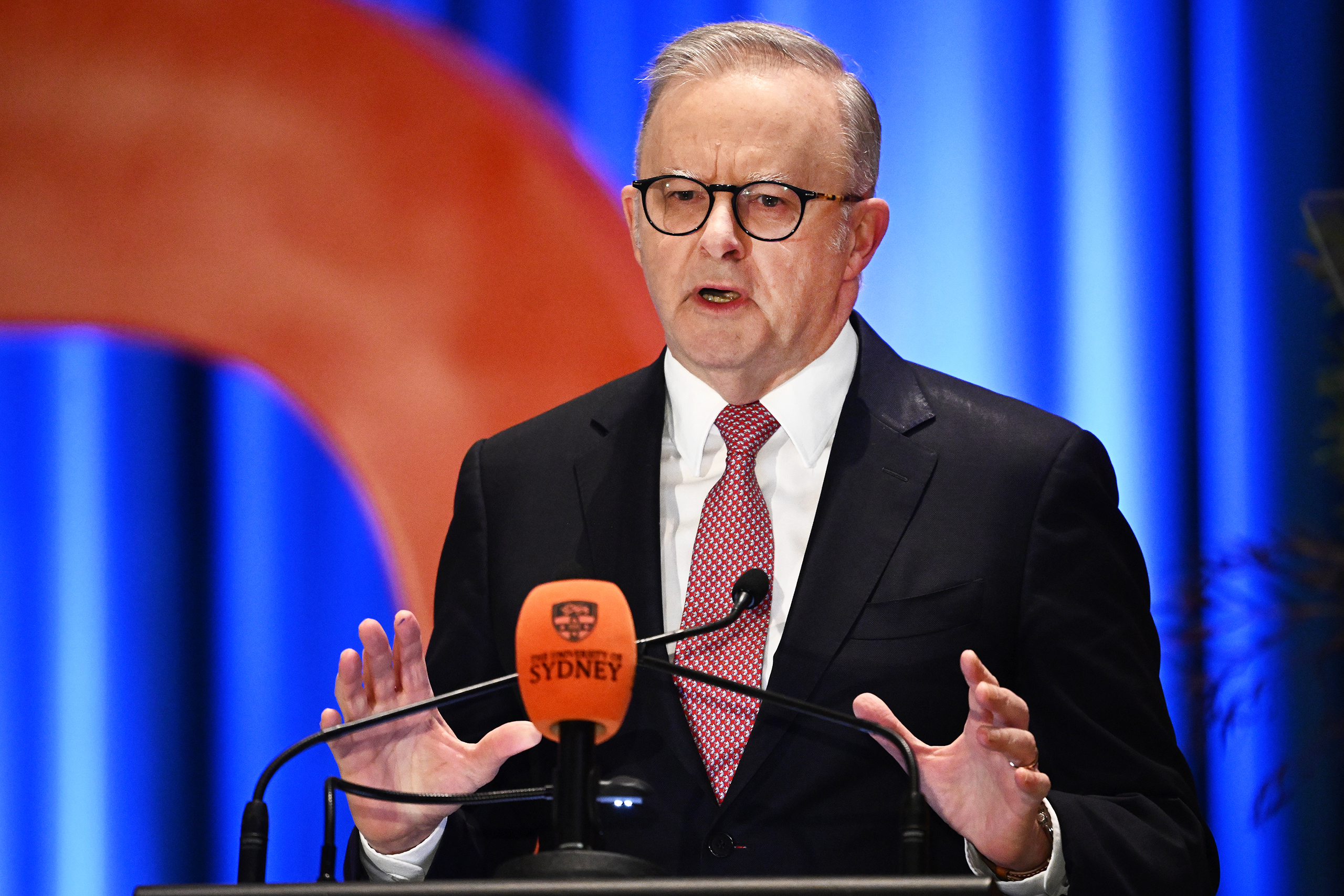
The latest repositioning was announced by Anthony Albanese this week. He was responding to growing unease about the potential consequences of AI across a widening front of environmental, social and economic issues, from data centres to cybersecurity and jobs.
The PM pointed to the success of Labor governments in creating adaptive, strong institutions capable of protecting workers and their living standards in the face of change. His starting point was a belief that the national social and economic significance of AI demanded a suitably national, whole-of-government response. A new office in his own department will coordinate policy across education, employment, defence, communications, copyright, and other portfolios. A national cabinet agreement will enshrine a new set of legislated AI standards. Responding to specific tensions, he promised a legal framework for data centres and a fair return for Australian copyright owners. All this, he said, would secure a more resilient, “more sovereign” Australia.
It’s useful to briefly retrace the route the government has taken to this point. Under first-term industry minister Ed Husic, progress was made towards a broad-based regulatory framework for AI covering critical questions of safety, discrimination, accountability and transparency. But while other jurisdictions, notably the European Union, pushed forward with regulatory action in 2023–24, Australia wavered.
One probable reason was the difficulty of framing effective regulation for a rapidly developing general-purpose technology. But the international climate also changed dramatically with a second Trump administration openly hostile to the foreign regulation of US companies. At the same time, a new Labour government in Britain was placing a stronger emphasis on the economic promise of AI. Other countries were taking a similar path.
Australia seemed to have missed the moment to deal comprehensively with AI safety and responsibility. With a new industry minister and partly guided by Productivity Commission recommendations, second-term Labor produced a national AI plan that emphasised the economic opportunity of inclusive AI while proposing a more incremental commitment to filling regulatory gaps as they appeared. With the government encouraging investment in largely self-regulated data centres but moving slowly on issues including copyright and privacy, pressure began building.
While the commitments announced this week will be important for the necessary coordination of AI policy, they don’t necessarily foreshadow a return to a broader regulatory model. The prime minister said little about what the government actually intends to do in relation to the difficult challenges he described. Nor did he describe what the new AI standards may entail.
Other elements in his speech have received less attention, but may turn out to be more significant. First of all, he went further than before in identifying the “social licence” of the AI industry as a critical issue. The government will develop “a framework for faster decision-making, better supporting infrastructure and genuine community engagement,” he said, adding that “this is about building Australians’ confidence and trust in AI and our nation’s capacity to manage it.”
The measures proposed will contribute to Australia’s AI governance capabilities, but he is saying several things here, including the idea that confidence in AI and confidence in its effective public governance are to be closely linked. And because AI will not now be managed by one specific area of government, or dealt with entirely within existing fields of sectoral regulation, trustworthy AI is to be seen as a central responsibility of government.
Albanese is right to focus on the need for a strong social licence, and right to be ambitious about what Australia should do with AI. But too much confidence may also be a problem, if we overestimate our room to move in a space we still know little about, and where concerted action depends on others. Confidence is a good thing when it is justified on the basis of knowledge. Trust is a good thing when the object of our trust is trustworthy. But we don’t yet know what agentic AI is becoming, what risks it might entail, and whether governments in countries like Australia will be able to work together well enough to manage these risks effectively. AI may well enable very positive outcomes — a cure for cancer? — but a significant body of experts believe it could also produce bad, or very bad, outcomes. Even if there were a comparatively small chance of these, governments and communities would be well advised to be less rather than more confident.
The second key element in the prime minister’s speech concerned employment in the future digital economy. He discussed his own path from university to a secure graduate job in the Commonwealth Bank, where he worked on the adoption of ATMs and other new technologies. The real risk of job destruction, he said, would arise from the absence of an effective national AI policy.
Pointing to recent employment department statistics, he noted the lack of evidence so far of a wide-scale labour market upheaval in Australia, or of any structural change in the labour market that could be attributed to AI. While this analysis is encouraging, the report he was quoting also suggests labour markets in the most AI-exposed occupations may already have been negatively affected. The report emphasises that AI’s employment effects are highly uncertain, and its main contribution is to provide an empirical framework for gauging employment effects over time.
But the creation of good jobs, not their destruction, is central to the prime minister’s vision of AI in the national interest; his conviction that work must remain central to human dignity and agency reflects a deep conviction, and one that remains institutionalised in the ALP. Here again there may be a political and economic risk of over-confidence. A considerable number of economists still consider AI likely to have serious impacts on the labour market, notwithstanding the fact it will also create new jobs.
Anthony Albanese’s version of the future of work is not the only Labor perspective. Barry Jones, a Hawke government science minister, published Sleepers Wake!, his book about the social and economic impacts of technology, in 1982. He shared Albanese’s concern with national sovereignty but believed that automating technologies were indeed likely to change the labour market in ways that would significantly reduce employment. Can we be sure that this won’t happen, even with the best possible public investments in new industries and training? The policy challenge then would be redistributive, a separation of income from work.
Both Albanese and Jones appreciated the strength of Australia’s economic and political institutions. For the prime minister, these demonstrate our capacity to manage change in ways that sustain work and enhance welfare. For Jones, our institutions were also a source of national complacency. •