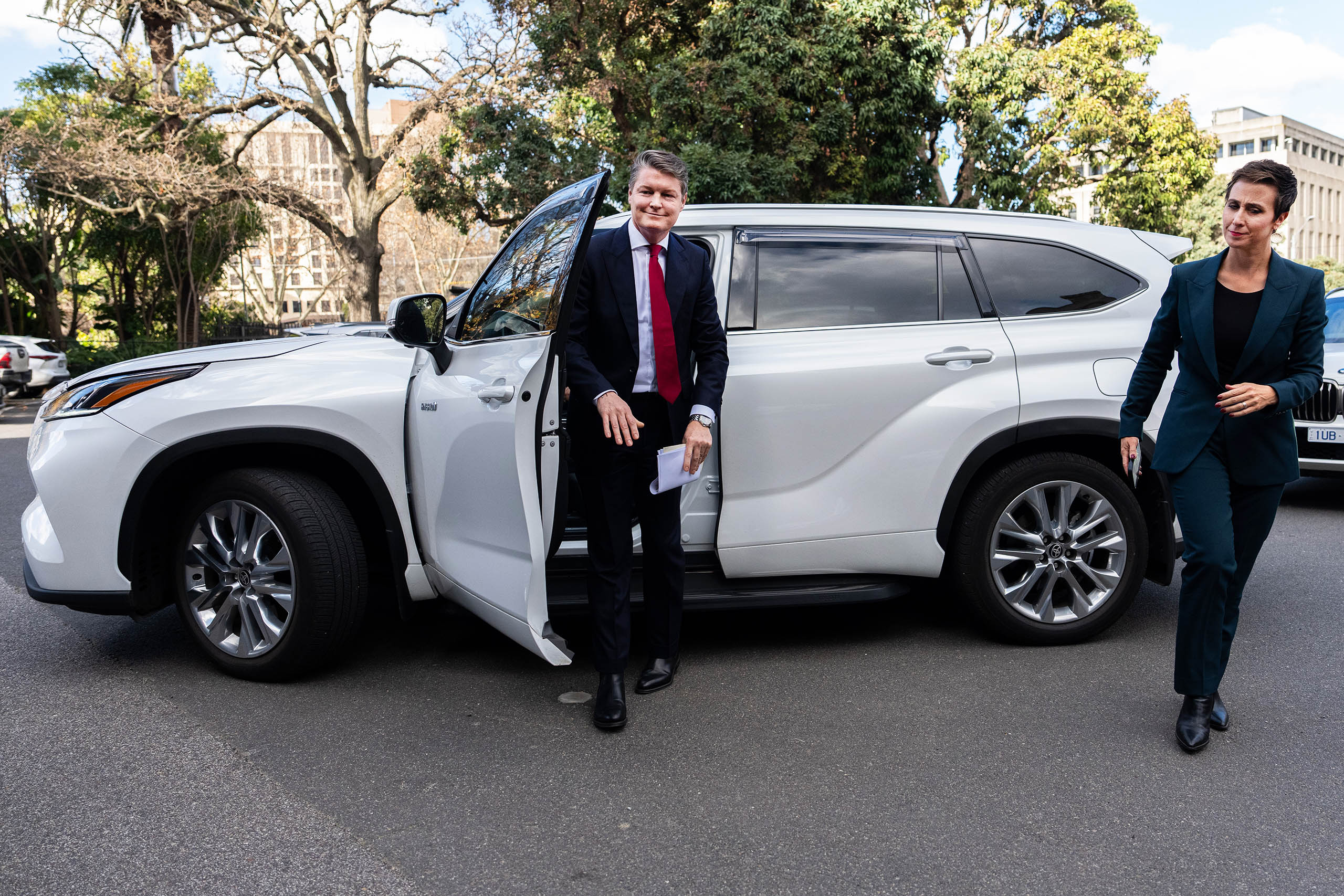
One hundred and nineteen days: that’s how long new Labor premier Ben Carroll has until Victorians are due at the polls. Less even, given many — maybe a third — will vote early. It’s not long to shake the stink that voters seem to smell on the state government: in most state polls Labor has been trailing the Coalition for months.
But not by much. The Coalition has led by only a few points on two-party-preferred polls, and such polls are of course quite deceptive at the moment considering One Nation has been polling almost level with the Coalition on primaries lately. The real issue Carroll seems to have been brought in to fix is rock-bottom leader approval for Jacinta Allan. Allan’s ratings started low when she took over from Daniel Andrews in 2023 and sank from there to what psephologist Kevin Bonham confirmed to be “the worst net satisfaction recorded for a state premier in the history of Newspoll.”
Keen observers of politics may ask if that was actually an impediment to electoral victory: in 2013 voters approved of Kevin Rudd far more than Tony Abbott yet swept the Coalition to power anyway. But perhaps Victoria’s Labor powerbrokers thought it wasn’t worth risking — in plenty of other elections leader unpopularity eventually translated into party unpopularity: federally, Labor in 2019 (Shorten) and the Coalition in 2022 (Morrison).
Will Carroll prove more popular than his predecessor? Polls from before he took the premiership rated him lower than Allan, but he has basically been unknown to the electorate. He will probably enjoy a bump in the approval ratings. Whether it is big enough to turn around media narratives of Labor heading for an electoral iceberg in November is the question. Can he make the party look and smell like a winning prospect? Has he got time to make voters think twice about his party?
Other state leaders have found themselves in similar spots. Indeed, Carroll has almost the same amount of time on the electoral clock as did Steve Bracks when he became Victorian Labor leader in 1999. Bracks replaced opposition leader John Brumby in March, when AC Neilson had Labor eleven points below the Coalition: 38–49. By election day he’d turned it into a statewide two-party vote of 50.2 percent, with 48 per cent of seats in parliament — close enough to cut deals with independents and wrestle the treasury benches from Jeff Kennett.
But Bracks, of course, was running from opposition against a polarising government in its second term, which is very different from the political situation confronted by Carroll, taking over from a government in its third term. Queensland’s Stephen Miles, who came to the premiership after Labor had governed for eight years, is perhaps a better comparator. He didn’t need to challenge his predecessor, Anastasia Palaszczuk, who had resigned, but there was something of a contest over who would replace her. Having won the leadership, Miles had more time than Carroll — 316 days — and Labor trailed the Coalition 33–37 in the polls. Come election day in 2024, Miles lost, and badly: the Coalition won with 53 per cent of the statewide two-party vote and a gain of seventeen seats.
Perhaps, like Miles, Carroll intends to continue on as leader if Labor loses in November. Or perhaps he has offered himself up as sacrificial lamb: perhaps he is this generation’s Joan Kirner, who took over from Victorian premier John Cain in 1990 when Labor was polling just 29 per cent, turned things around and won 44 per cent come election day 1992, but nonetheless lost nineteen seats in the Kennett landslide.
An electoral flogging is by no means inevitable, though. History shows us other possibilities. In his usual encyclopedic fashion, Antony Green has looked at every late-term chief-executive across the federation since 1901 to try to understand the task confronting Carroll. One of the examples he riffles through proves particularly interesting on closer inspection: the case of New South Wales’s Eric Willis.
Willis, a Liberal, came to the premiership after the party had governed for the eleven years, same as Carroll. Most of those years — 1965–1975 — were dominated by one major political figure: here, Bob Askin is our NSW stand-in for Daniel Andrews (one assumes both Askin and Andrews would be appalled by this comparison). Like Carroll, Willis replaced not the big fella but his unsuccessful anointed successor: Willis took over from premier Tom Lewis in a party-room coup before the latter could face an election. The déjà vu is overpowering.
Having gained the premiership, Willis had until the end of 1976 to hold a state election. But when a resignation triggered a by-election, and prime minister Malcolm Fraser phoned to warn him of a grim austerity budget on the way federally, he opted to bring the general election forward to May, giving himself just ninety-nine days from taking the leadership to facing the voters. In an incredibly tight election, Labor and Neville Wran won by just two seats. The districts of Hurstville and Gosford were each won by less than seventy-five votes. Really, it could have gone either way.
And this was in 1976: near the very height of major-party support for Australian voters. How much closer could the result be in Victoria in 2026, with One Nation polling in the 20s, and other candidates mounting credible challenges in a swag of seats? There is more than a slim pathway here for Carroll to emerge from a confused result leader of the largest party, best able to form a government, even if it is a minority one.
Maybe that makes the most relevant comparator Julia Gillard. Gillard had even less time than Carroll: just fifty-eight days between replacing Rudd as prime minister and facing the people. When she took over, Labor was polling 35 per cent to the Coalition’s 40 per cent. On election night Labor recorded 38 per cent nationwide and won just enough seats to make minority government possible. In 2010 that outcome was not widely expected; in 2026, non-major parties are polling so high in Victoria that minority government — of Labor-plus, or Coalition-plus — seems the most likely outcome.
Naturally, Carroll won’t campaign on forming minority government: he’ll say no deals no way; he’ll say the real danger is the Coalition going into government with One Nation; he’ll say the only alternative is a Labor majority. Realistically, though, a Labor majority would be a Labor miracle — greater than the one bestowed by the Almighty on Scott Morrison in 2019. “Winning,” for Carroll, would be somehow keeping enough seats, and getting a good enough crossbench, that he somehow gets a real go at being premier. •