The twenty-nineth of January 2025. Three-and-a-half weeks to go until Germany’s federal election. The Bundestag, the country’s federal parliament, is sitting. Since the Free Democrats left the governing coalition, the government of Social Democrat Olaf Scholz no longer commands a majority. The Christian Democrats have tabled a motion calling for a tough new refugee regime. That’s not surprising, for issues of migration and asylum have dominated the election campaign.
The motion succeeds, courtesy of votes from the far-right Alternative for Germany, or AfD — the first time a democratic party has relied on the far right’s support in the Bundestag. The Social Democrats move for the session to be adjourned. Heidi Reichinnek, the fast-talking thirty-six-year-old co-leader of the Linke, is the last to speak on the motion. The Linke, the successor of the East German communist party, is only a minor player in parliament, its twenty-eight seats dwarfed by the 707 held by the other parties. The most recent poll puts it at 4 per cent, one percentage point below the mandatory threshold designed to guard against political instability. They may well be on the way out.
For most of her short speech, Reichinnek directly addresses Friedrich Merz, leader of the Christian Democrats and soon to be chancellor: “I tell you, you are making yourself an accomplice. You have changed this country for the worse.” At the end, she turns to an audience outside the Bundestag: “Don’t give up, fight back, resist fascism in this country.” In conclusion, she cries: “Auf die Barrikaden!” (To the barricades!)
Her speech goes viral. Suddenly her party no longer needs to fret about surpassing the 5 per cent threshold. On election night, with 8.8 per cent of the vote, the Linke is an undisputed winner. That’s not least because of its support among young people: more than one in four voters under the age of twenty at that election. Reichinnek’s “Auf die Barrikaden!”, watched millions of times, turned the party’s fortunes around.
What did the young people moved to cast their vote for the Linke associate with Reichinnek’s call? “Auf die Barrikaden!” may have reminded some of them of a protest song that had featured at recent rallies against the AfD. In translation, its lyrics read: “Defend yourselves, resist! Against fascism in this country! To the barricades, to the barricades!”
Reichinnek’s words are also those of “¡A las Barricadas”, a Spanish adaptation of the Warszawianka, sung by Polish socialists since the late nineteenth century. “¡A las Barricadas” was the anthem of the anarcho-syndicalist National Confederation of Labour during the Spanish civil war and has remained popular within the radical left in Spain and elsewhere.
Many of last year’s Linke voters were presumably blissfully unaware of these references. But they would not have been oblivious to the broader connotations of Reichinnek’s pathos-laden words. “Auf die Barrikaden!” (which literally means “Onto the barricades!”) is more than an appeal to protest. Those issuing that call and erecting barricades are defying the state’s authority. They resort to violence to counter the violence directed at them. They don’t hide behind barricades but climb on top of them, waving flags and taunting their enemies.
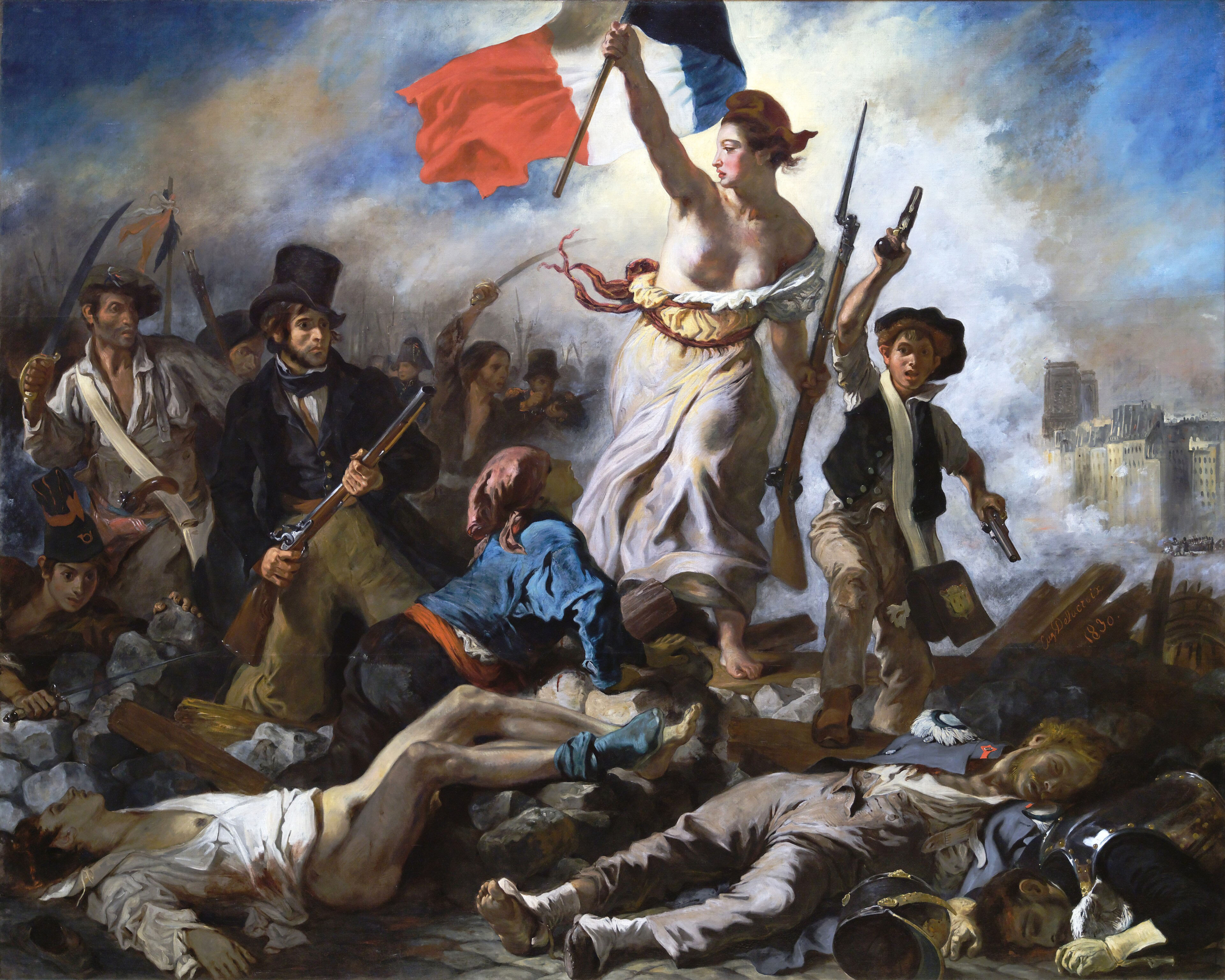
Barricades are associated with the sort of violence that turns the world upside down. A feature of revolutions, their most emblematic depiction is Eugène Delacroix’s 1830 oil painting “La Liberté guidant le peuple” (“Liberty leading the people”). In it, a bare-breasted Marianne (personifying Liberty), wearing the Phrygian cap sported by the eighteenth-century revolutionaries in North America and France, strides across a barricade towards the viewer.
The German poet Heinrich Heine, who had moved to France after the revolution of July 1830, saw the painting in 1831. The flag-waving Liberty reminded him of prostitutes and poissardes, the market women who had played a key role in the events of 1789. “That she is actually meant to represent the [goddess of liberty] is not entirely clear,” he wrote. “This figure seems rather to embody untamed people’s power, which is casting off a deadly burden.”
“La Liberté guidant le peuple” was enacted for a global audience during the opening ceremony of the July 2024 Paris Olympic Games. The ceremony’s curators had good reason to assume that revolutions are central to modern French history and therefore deserved to feature in the four-hour spectacle along the banks of the Seine. France’s national day is 14 July, the anniversary of the storming of the Bastille in 1789, which is sometimes considered the opening salvo of the French Revolution. It was followed by the revolutions of July 1830 (depicted by Delacroix) and February 1848 and the Paris Commune of 1871. In the twentieth century, the tumultuous events of May 1968, while not sparking a revolution, were nevertheless experienced by its participants as having the potential to turn the world upside down.
I suspect most Germans associate revolutions and the call “Auf die Barrikaden!” with French (or Russian) rather than with their own history. They sometimes refer to the events of autumn 1989, when East Germany’s communist leaders effectively abdicated, as the “peaceful revolution.” A revolution it was not, and anyway, barricades weren’t part of the demonstrations of October and November in Leipzig and elsewhere.
The German revolutions of 1848–49 failed (though Berlin did see barricades in March 1848). The revolution of 1918–19 was not a long-lasting success either: the fragile democracy installed after the abdication of Emperor Wilhelm II fell to pieces fifteen years later when Adolf Hitler was appointed chancellor.
Although revolutions arguably did not shape the course of modern German history in the way they did in France or Russia, they feature prominently in school curricula here in Germany. So too in Australia, a country whose association with revolutions does not extend much beyond the hospitality offered to a few former members of the Paris commune who in 1874 escaped from New Caledonia, then a French penal colony, to Sydney. Yet the study design for year 12 history in Victoria offers students “Revolutions” as one of three choices (the others being “Ancient History” and “Australian History”).
Given how much revolutions have captured people’s imagination, and how extensively their histories are taught in school (not just in Germany and Australia), it’s no surprise that they are a favourite subject matter for political scientists and historians. Donald Sassoon, emeritus professor of comparative European history at Queen Mary University of London and literary editor of the centre-left Political Quarterly, is the latest eminent scholar to devote a book to them.
Revolutions: A New History would disappoint readers looking for a typology — not to mention a new theory — or expecting a comprehensive survey; those wanting to learn about, say, the Haitian Revolution (1791–1804) or the Cuban Revolution (1953–58) may want to turn to other books. Instead, Sassoon singles out the English civil war, and the American, French, Russian and Chinese revolutions. A sixth chapter deals, in much less convincing fashion than the others, with the European “national revolutions” of the nineteenth century.
Sassoon’s understanding of what constitutes a revolution differs from that of most other historians. Instead of focusing on momentous events and their immediate context — the beheading of Charles I on 30 January 1649, the signing of the American Declaration of Independence on 4 July 1776, the storming of the Bastille, the assault on the Winter Palace on 7 November 1917 and the proclamation of the People’s Republic of China on 1 October 1949 — he writes about revolutions as long-term processes.
He begins his account of the French Revolution, for example, in August 1788 with the convening of the Estates General, and concludes it not in 1794 (the ousting of Maximilien Robespierre), nor in 1799 (Napoleon’s military coup), but after numerous twists and turns in 1879, when France finally became a republic. Rather than featuring five events, Revolutions effectively covers a century each of American and French history, and three quarters of a century of English, Russian and Chinese history respectively.
That is not the only unexpected aspect of Sassoon’s book. It’s full of surprising observations and conclusions. He has good things to say about the much-maligned Robespierre, for instance, and provides a nuanced assessment of Lenin’s role. Even Mao Zedong is recognised as “a brilliant war leader.”
Karl Marx, “who was supposed to know a thing or two about revolutions,” although he “did not provide a Marxist theory of revolution,” is cited frequently. That’s because he was a contemporary observer. Sassoon gives much space to the analyses of authors like Marx and Alexis de Tocqueville — but he also frequently quotes contemporary poets. By contrast, he largely ignores the views of other historians. That too adds to his text’s readability.
The book’s most surprising focus is on slavery and colonialism. Nowhere is Sassoon’s history of revolutions celebratory. It’s true, he writes, peace finally prevailed in England, but “elsewhere there was much blood.” “Violence was exported: to Ireland, the Australian First Nations, India, Africa, the Caribbean and China.” And the American revolution was “far less than the establishment of a society based on the idea that all are ‘created equal’” (as the 1776 Declaration of Independence had claimed), even after the conclusion of the civil war. This failure, he writes, has “reverberated for more than one hundred and fifty years.”
Not least for its novel insights and new perspectives, Revolutions is entertaining and is likely to keep readers engaged over the course of its 344 pages. They may also appreciate that Sassoon’s evident erudition allows him to get away with being opinionated.
In writing about dispossession in Australia or about transatlantic slavery, he makes us think twice about the achievements of the European and American revolutions. When detailing the violence accompanying a revolution, he also likes to put things into perspective. Violence was not specific to Russia’s twentieth-century history, he says, but “intrinsic to European history.” In the nineteenth century, the “two great civilised liberal democracies” exported it to the colonies. And in the first half of the twentieth, “violence, authoritarianism, murder and genocide plagued the whole of Europe — a historical dimension often forgotten by those who speak glibly of ‘European values’.”
More recently, I would like to add, when European values (“the successful struggle for peace and reconciliation, democracy and human rights”) were recognised by the 2012 Nobel Peace Prize, the violence against irregularised migrants at the European borders has once again made a mockery of claims that Europe is somehow more civilised than other parts of the world.
Trying to put violence into perspective, Sassoon sometimes seems obsessed with casualty figures. He argues that the death toll of the Kuomintang’s massacres of between 18,000 and 28,000 of Taiwan’s indigenous inhabitants in 1947 was, proportionately speaking, higher than that for the Chinese Cultural Revolution, that China’s Great Leap Forward cost, in relative terms, fewer lives than the Irish famine of the 1840s, and that proportionately fewer demonstrators were killed on 3 and 4 June 1989 on Tiananmen Square than in May 1980 in the South Korean city of Kwangju. But does that make the Chinese figures any less horrific?
Similarly, Sassoon observes that the number of people killed during the French Revolution’s so-called reign of terror may pale into insignificance when compared with the death toll of the English crushing of the United Irishmen’s revolt of 1798. I suggest the point here could only be that the latter has not been as well remembered as the former.
In terms of its subsequent historicisation and commemoration, the uprising in Ireland — a revolt, not a revolution — was no match for the French Revolution, which has probably been written and talked about more extensively than any other event of the eighteenth or nineteenth centuries.
Sassoon’s book, published by Verso rather than by an academic press, is evidence of a widespread fascination with revolutions. It does not account for that fascination, and nor does it explain the feeling of exhilaration experienced by the revolutionaries — not by Lenin or Robespierre but by the women and men erecting barricades and risking their lives climbing onto them to wave flags and taunt soldiers or police. Much like revolutions — which, according to Sassoon, arrive “unexpectedly, catching the revolutionaries themselves by surprise” and “follow an unpredictable course” — this feeling erupts, sometimes without prior warning.
We remember pasts beyond our own lifetimes if they are part of social memory, the memory shared by the group to which we belong. It is now also widely accepted that suffering, and memories of such suffering, can be transferred across generations. The children and grandchildren of Holocaust survivors are often haunted by traumas they did not experience personally but which they inherited. It is therefore conceivable that extreme positive emotions, such as the feeling of exhilaration experienced during a revolution, are also remembered — in this case, perhaps the more so since the pathos of revolutions has been preserved in music, poetry and other works of art.
Songs such as “¡A las Barricadas” or calls like Reichinnek’s appeal to people yearning for an opportunity to make their own history, for a radically different present, for the world to be turned upside down and for a new calendar marking a new beginning. Such yearning may be informed by subterranean memories of barricades and, as Walter Benjamin reports about the Paris events of July 1830, of revolutionaries firing “simultaneously and independently” on the tower clocks as if to arrest time itself. •
Revolutions: A New History
By Donald Sassoon | Verso | $62.99 | 426 pages