For most, Australia’s Great War began before dawn on 25 April 1915 when the first diggers stumbled ashore at Anzac Cove to begin a nine-month misadventure that would claim 8700 Australian lives, end in a humiliating retreat and yet forge an unshakeable mythology of Australian pluck and heroism.
In the shade of Gallipoli, what hope was there for the celebration of another, earlier feat of arms in which Australian soldiers and sailors inflicted one of Germany’s first defeats of the war, swiftly securing a territorial prize that would entrench and enrich Australia as a regional colonial power for much of the next century.
In September 1914, barely a month after the outbreak of war and six months before Australians had ever heard of Gallipoli, the battle cruiser HMAS Australia — flagship of the Australian Naval and Military Expeditionary Force — led the biggest armada assembled in Australian history into the waters off Rabaul in New Guinea. Australia was accompanied by the cruisers Sydney, Encounter and Pioneer, the destroyers Yarra, Warrego and Parramatta, the submarines AE1 and AE2 and a volunteer force of about 1500 men.
Their task was to seize New Guinea, the northeastern mainland of what is now Papua New Guinea, along with present-day New Britain, New Ireland and the Bismarck Archipelago. It had been a German protectorate since 1884, the same year Britain took control of Papua, the southeastern portion of the mainland that it would cede to Australia in 1902.
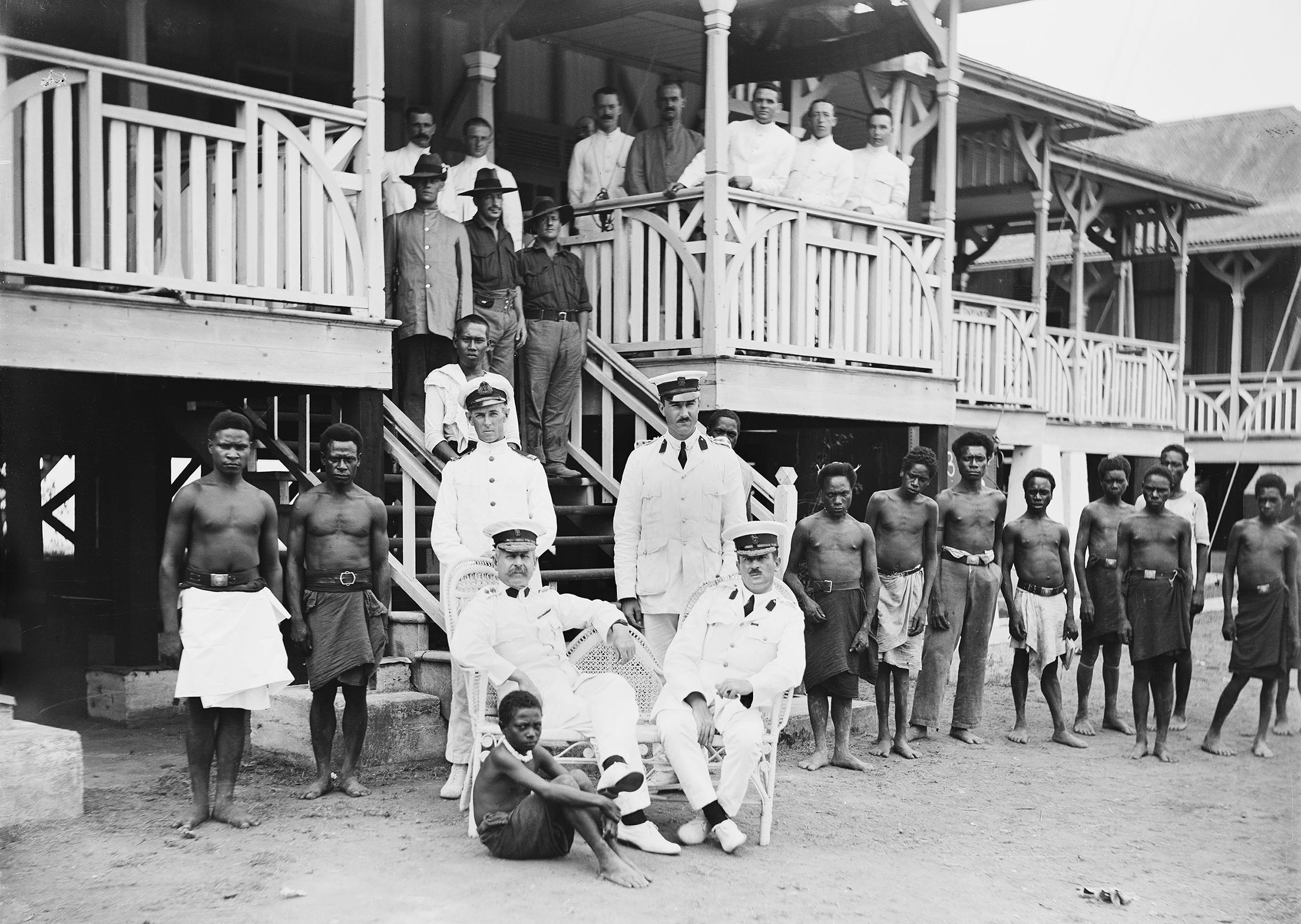
The battle was over almost as soon as it had begun. Arriving on 11 September 1914 the ANMEF landed virtually unopposed, capturing within two days the two main German garrisons at Rabaul and Herbertshohe (Kokopo) on New Britain. The only serious fighting was on the road to Bita Paka, about forty-five kilometres south of Rabaul, where the force captured the wireless station and tower that provided vital communications for the German East Asia naval squadron. Six Australians were dead and four wounded against their opponent’s casualties of thirty-one dead (all but one of them New Guineans) and eleven wounded.
On 17 September Germany’s acting government signed “terms of capitulation” that gave Australia control of all the resource-rich territories of New Guinea and its 400,000 people — control that would continue in various forms until Papua New Guinea achieved its independence in 1975. The Battle of Bita Paka was a one-day wonder, but it became Australia’s first victory of the war and its first as a sovereign nation.
The fall of Rabaul might well be celebrated as a mostly seamless military success, despite the fact that the defenders of that outpost of the Kaiser’s far-flung empire were massively outnumbered and outgunned. Indeed, the attacking force was significantly bigger than the territory’s entire European population, which numbered fewer than 1300. The German garrison comprised just sixty-one men supported by about 240 native police.
In his new book, New Feller Master, Canberra-based archivist Michael Piggott concedes that “the ANMEF presence in New Guinea pales to near invisibility compared with the AIF in Gallipoli, France, Belgium and Palestine.” But is the comparison fair or even relevant? Why should the New Guinea operations be considered, let alone judged, in the context of events that followed on the other side of the world?
The author himself seems ambivalent on the point. He laments the lack of attention to the capture of New Guinea in the annals of Australian military history and widespread ignorance about the events, while also ridiculing the veterans (many of whom went on the serve at Gallipoli and in France) who struggled vainly for greater recognition of their contribution to the war effort in its opening weeks.
Piggott notes the fixation with “firsts” among those determined to cast the operations at Rabaul in a more heroic light: “The first to depart for war, the first success against the enemy and, crucially, the nation’s first casualties of the war.” And there were more added to the list as the special pleading became more intense: “First burial at sea, first female Navy entrants, first hospital ship, first joint operation, first ship to fire in anger, first boat to be lost, first Allied submarine to be lost…”
“Yet even the participants in those events could not assuage their own sense of inferiority compared to the much greater and more costly confrontations with the enemy that followed from 1915,” he writes, later adding: “Harping on being first only reinforced the implication there was nothing more to it than the capture of a radio tower.”
Those Australians lamenting the lack of recognition for their achievements in the capture of New Guinea might have been more careful what they wished for.
Previous histories have documented the extent to which the record of the ANMEF victory and its aftermath was sullied by the often industrial-scale looting and souveniring of German and New Guinean property by soldiers, officers and even some of the most senior officials. Piggott’s book, augmenting and amplifying that of earlier historians, reveals in disturbing detail the brutal and often lawless methods employed to control, subjugate and exploit the people of New Guinea. Of what in many respects amounted to Australia’s heart of darkness, Piggott describes Australians encountering their “racial inferiors” and reacting “with disgust, mockery, exploitation, corporal punishment and rape.”
The pervasive institutional racism of the new administration in Rabaul was hardly surprising given the attitudes that prevailed in “White Australia” before and after the first world war, but its callous implementation was. “Kanaka, coon, the bucks, duskies and nigger were the standard epithets,” says Piggott. “Almost nowhere in the Rabaul Record or the soldiers’ diaries and letters can a positive or sympathetic sentence be found.”
The attitudes towards New Guinean women were especially appalling. Major Harry Ogilvy, head of the native affairs department, wrote in 1915: “The beauteous damsel… is non-existent… I have seen more fascinating pigs than most of the ladies.” Sergeant Ernest Baker wrote to his sister that the women “give me horrible shudders down the spine.” And, in an ANMEF souvenir publication, “Mayo” wrote: “Like most of the south sea islanders, the males are awfully simple. On the other hand, the females are simply awful.”
Despite such declarations of revulsion, there were repeated incidents of sexual abuse and rape against New Guinean women. Captain Jens Lyng, who served as interpreter with the first Australian administration, wrote in his 1925 memoir about the rape of a local woman who had been locked up for two months by the ANMEF in a male prison. Other documented rape cases led to modest and begrudging official action.
In 1920 Lieutenant Benjamin Singleton, the acting officer in charge on Manus Island, took a group of women and children hostage to try to induce the surrender of the killers of a white settler. Piggott recounts how Singleton then “selected the best looking of the women and divided them amongst the white soldiers.” Singleton later admitted his guilt, as did Captain Charles Wittkopp, the district officer, who in mitigation stated that he had held one of the women in his tent with intent to rape but had not proceeded with the assault.
The then administrator, Brigadier-General Thomas Griffiths, was more concerned with covering up the scandal than punishing the rapists. Seeking to “avoid the publicity that would be entailed, and the loss of prestige of Australia if such stories were noised abroad,” Griffiths offered Singleton the opportunity to resign rather than face a court martial. “He did not appear to consider that he had done anything very wrong in violating the women held by us as hostages,” the general recorded. “I was unable to relieve the other men concerned as I had nobody to replace them at the time.”
Physical abuse was endemic against both the male and female population. Until it was outlawed in 1919, flogging was frequently used to punish offences including “gross insubordination” and the breaking of labour contracts. “District officers could authorise such punishment when planters and missionaries bothered to seek permission,” Piggott writes. “Beyond the law, the belief that New Guineans responded to a good ‘licking’ was commonly held by Australians.”
Many patrols to outlying villages turned into violent punitive expeditions. Soon after a garrison was established at Kavieng in New Ireland, patrols were sent into the interior requiring “stringent measures with the natives” described by German historian Hermann Hiery as “downright orgies of beating.” In one village, between twenty-five and thirty “boys” each received more than 400 strokes with rope whips.
Piggott estimates that more than seventy New Guineans were killed during such expeditions in the first year alone after the capture of Rabaul, and dozens more in the years that followed. In May 1915, two expeditions to investigate the murder of the master of a coastal vessel and a labour recruiter in southern New Britain “resulted in at least sixteen New Guineans killed; severed heads were displayed as a warning.”
While the Australian government appears to have been wilfully ignorant of or complicit in much of the serious misconduct of its personnel in New Guinea, an especially infamous episode would scandalise the territory, raise alarm back in Australia and trigger a diplomatic crisis that reverberated to Europe.
In late October 1914, senior Methodist missionary William Cox was visiting a mission station near Namatanai, New Ireland, shortly before the Australians took control of the island. He was confronted by a group of drunk and armed German residents who accused him of spying and summarily stretched him over a wash tub and delivered about twenty strokes of the cane.
When news of the incident finally reached Rabaul, Colonel William Holmes, the ANMEF commander who had been appointed as the first administrator of the territory, was outraged. An expedition led by Major Alexander Ralston, was dispatched to New Ireland to apprehend the culprits. After a brief investigation, Ralston reported back to Holmes, who dispensed with a formal trial and ordered the public flogging of Cox’s three assailants and two accomplices.
Mid-morning on 30 November the prisoners were marched to the centre of Proclamation Square, Rabaul, held face down over a trunk with handcuffs and legs tied to tent pegs and “caned with great enthusiasm” by four soldiers — each prisoner receiving up to thirty strokes. To reinforce the spectacle and compound the men’s humiliation, Holmes had assembled all available troops with bayonets fixed and ordered all male German residents to be present. Countless New Guineans also looked on, presumably in shock and awe.
The summary justice outraged the German population of New Guinea. Flogging the locals to enforce servitude and obedience was one thing but flogging white men was beyond the pale. When the news reached Australia there were questions in parliament and political embarrassment. When the news reached Europe there were fierce protests by the German government and fears that the episode might affect the treatment of British POWs in Germany.
In an attempt to defuse the diplomatic row, the Australian government advised London to tell the Germans the assailants had been tried by court martial. Charles Bean, who had to fight to have the truth told in his official history, advised the Defence Department’s chief clerk that the Germans were very angry about the public punishment without trial, adding “it was always said that if Holmes fell into their hands in France he would be tried.”
Holmes was spared that fate by one much worse. On 2 July 1917, by then commander of the Australian Fourth Division, he was mortally wounded while escorting NSW premier William Holman on a tour of the battlefield at Messines. His dishonour would be expunged by his martyrdom as the most senior Australian officer to be killed in the first world war. •
New Feller Master: Beyond the Trenches Australia’s Neglected WWI Story
By Michael Piggott | Big Sky Publishing | $36.99 | 384 pages