I tried calling Susan just before we slipped our moorings for the ride to Samarai Island, an abandoned entrepôt in the southwest of what once was British New Guinea. I wanted to let her know I was on the way to the old stamping ground of Beatrice Grimshaw, an Irish writer about the islands who grimly fascinated us both. The phone rang out that Saturday morning, as it often did these days. I hoped she was still alive.
John the boatman, his arms as thick as fire extinguishers, made short order of lugging fuel drums onto the boat. I carried my overnight bag and a cooler with corned beef and tomato sandwiches, beef biscuits, four cans of beer and bottled water from the local pharmacy marked “Made in China.” We whooshed away from the dock into opalescent waters.
About twenty minutes later the boat cleaved close to a coast of mangrove, rattan, nipa ferns, splayed pandanus trees and manioc. Little villages with church steeples peeked out from the clearings. We had cleared the southern tip of the mainland of Papua New Guinea and I could feel my worries — existential, writerly, born of having spent too much time wrestling with words and wondering about the point of it all — sloughing off me. Samarai Island was another hour away.
“What’s the name of that writer woman again?” John shouted over the roar of the engine, experienced enough in the way of the dim dims to know the value of feigning interest in niche topics, especially when those topics were the reason for the boat hire.
“Beatrice Grimshaw,” I replied.
A century ago, she was one of the world’s bestselling authors, her South Seas melodramas and pot-boilers with titles like Conn of the Coral Seas and When the Red Gods Call likened charitably to Conrad, Kipling and Stevenson. She exerted a grip on the imaginations of middlebrow Australian readers that is almost impossible to imagine nowadays. She dabbled in movies, writing the script for Australia’s first talking movie, The Adorable Outcast. Yet she has disappeared without trace, her name not even a whisper of a memory.
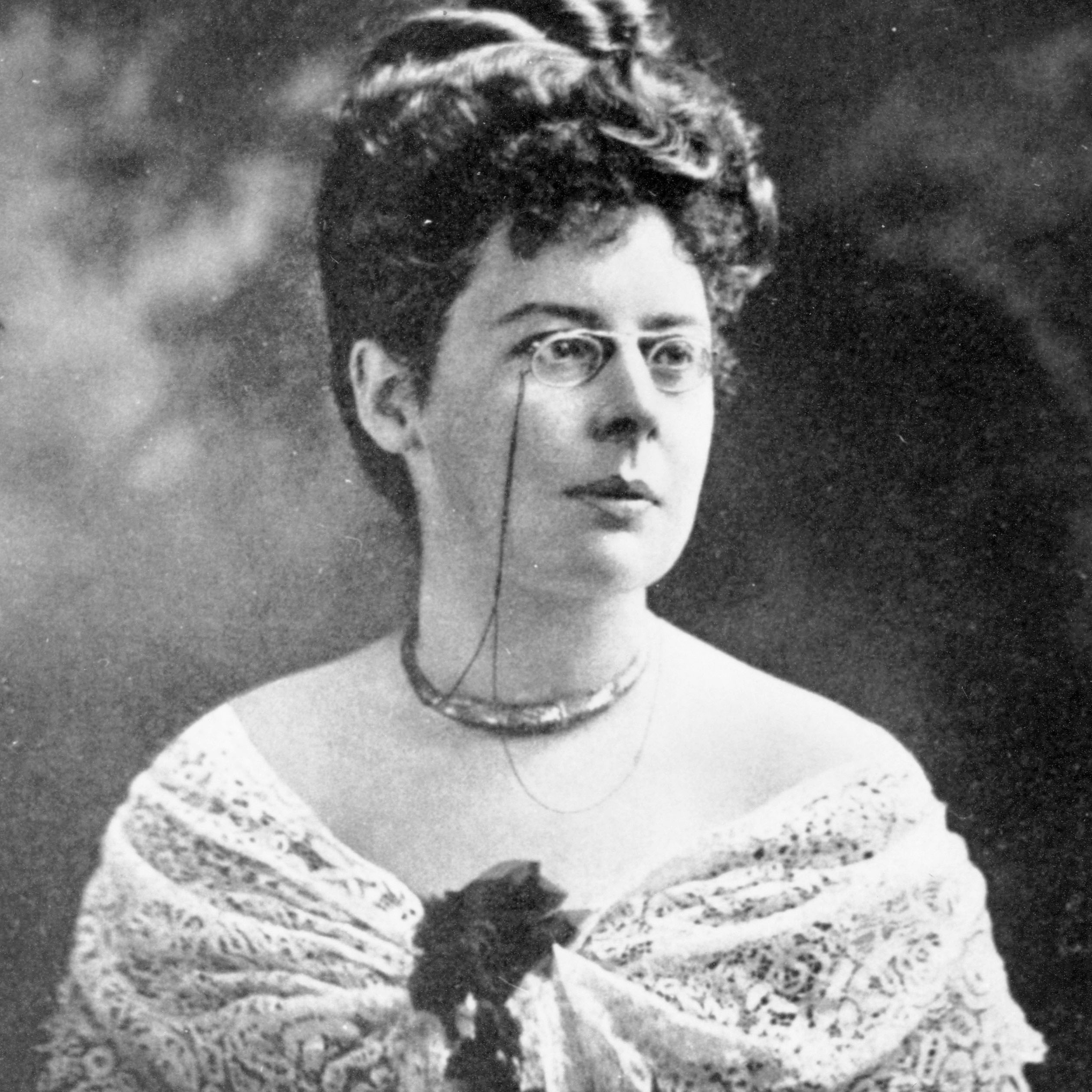
She and I came from the same part of Northern Ireland, I told John, both born with a desire to escape, both having beachcombed in the islands and ultimately settled in Australia. Born in Belfast in 1870, she moved to Dublin as a young adult, worked as a journalist, and published a first novel about unsuccessful getaways. At one parlour party she met a young W.B. Yeats, whom she found to be a “gifted young extremist.” Susan had sent me early studio shots of a young Beatrice, taken shortly after her first novel was published: a young woman with a dress of shimmering white, her hair a contraption of hair pins under a Florence Nightingale hat, mouth in a quarter-smile, eyes hard to read.
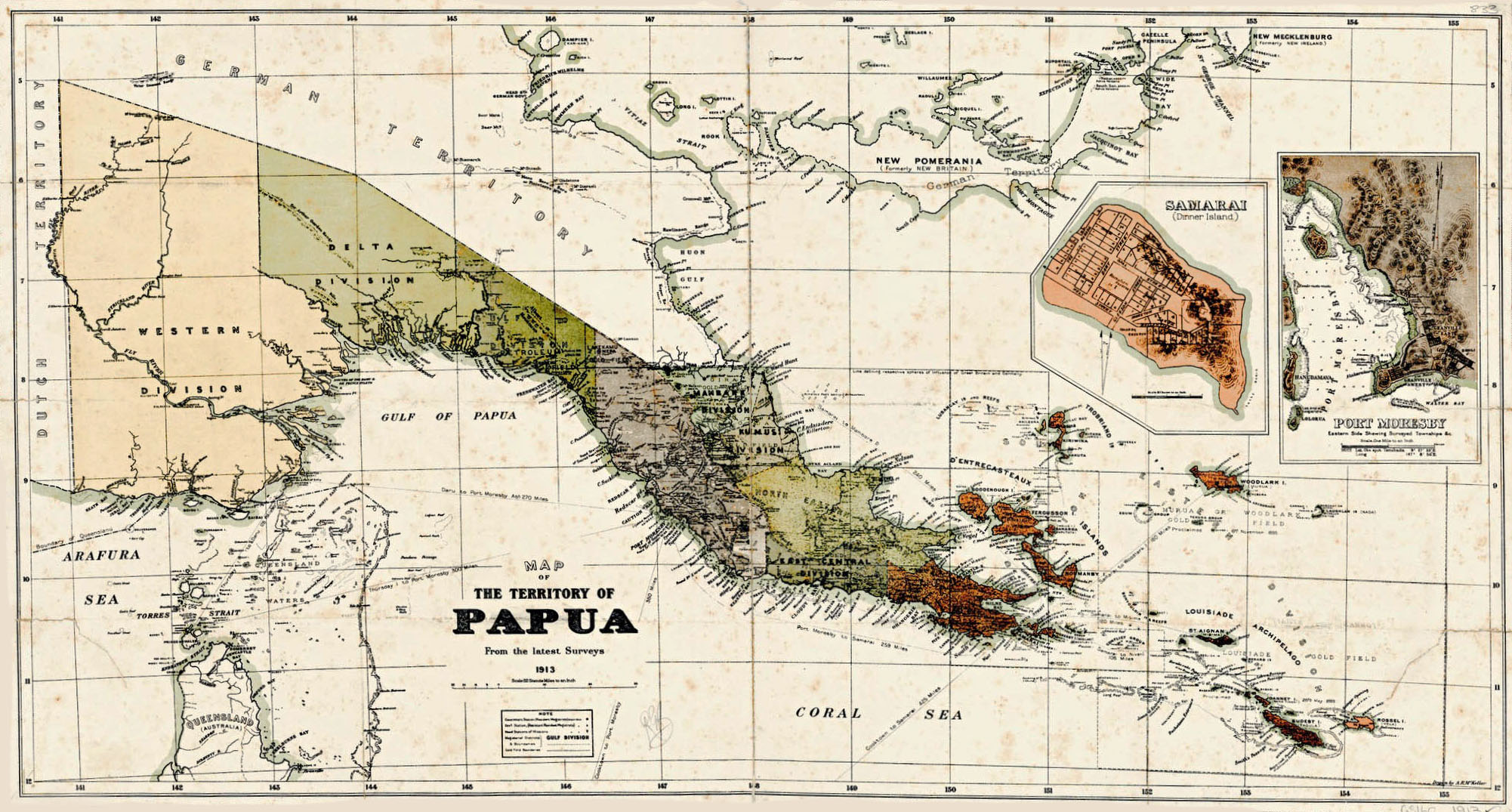
A 1913 map of Papua, with Samarai Island (just off the southwestern tip of the main island) shown in an inset. Click to enlarge. National Library of Australia
Dublin was too small for her, too cramped, its literary society too stale. She left Ireland soon after her encounter with Yeats, crossing the Atlantic and then the continental United States, setting sail from San Francisco for Fiji, paying for her passage by organising tours and writing alluring advertising puff for “in-ship” magazines about palm fronds swaying and canoes cresting waves. Their tropical orientalism didn’t read too differently in tone from in-flight magazines I read on my own journeys in the Pacific.
She wrote and wrote, publishing travelogues and pulpy adventure novels which, a Spectator reviewer whooped, were “extremely virile and will certainly not remind any reader of the work of other women novelists.” I found that quote — like so much about Beatrice — in Susan’s doctoral thesis, which I’d fished out from the bowels of the ANU library.
I had looked Susan up soon after, knowing from experience that if there’s one thing a writer on obstruse topics reliably likes, it’s unexpected fan mail. Her phone number was attached to a hospice in North Carolina, close to the university where she had last been teaching. She was palpably nearing the end, but I enjoyed my conversations with Grimshaw’s chronicler. A month before the trip, she had mailed me what she said were all of Beatrice’s possessions remaining on earth — three portraits and a piece of sail cloth as small as a doily — because she didn’t want them to die with her. I had packed the cloth in my overnight bag.
Grimshaw’s books bought her fame, I told John, a man clearly practised in the art of affected listening. Politicians, diplomats and other worthies sought her counsel. Among them was an Australian prime minister, Alfred Deakin, who made her a proposition: would she write a travel book about the Australian portion of the island of New Guinea? His aim was to encourage settlement in this territory Britain had given Australia upon its own independence. The purpose of Grimshaw’s commission was to produce for Australia a brighter chapter, an assignment that needed someone with creative writing skills.
When Grimshaw had arrived a few years earlier, in the early 1900s, Port Moresby was a dozen corrugated iron shacks with no roads, no hospital, no telephone, no electricity, one tennis court and a drinking saloon called McCrann’s, which was little more than a tin shed on which hung the notice, “Men are requested not to sleep on the billiard table with their spurs on.” Recalled Lewis Lett, another writer, “Hard-living hard-drinking men would fight joyously at the drop of a hat.”
Grimshaw’s travels for the book took her to all the mapped parts of the territory, including Samarai, which she described as the “very prettiest place in the whole tropic world.” Paths made from crushed coral circled the island’s crimson and begonia hedges, its well-tended gardens and the seats arranged to take in the view. It was a significant transport and trading hub, a point on the Tokyo–Shanghai–Samarai–Brisbane shipping line and a day-and-night stop on the P&O cruises, which amped up the beautiful and the diabolical in its promotional material (“Come see the cannibal islands”). Lascars and porters loaded turtle shells and shark’s fins into boats bound for ports across Cathay. The supply ship that picked up the gold miners and dropped them off at isolated wooded camps was the Joseph Conrad, Susan told me, an unimprovably apposite name.
Beatrice’s book, The New New Guinea, has many stock elements of an adventure travelogue. After visiting Samarai, she engages in the slow chase of a Japanese pearling vessel and flings herself into the Coral Sea to forage for pearls. She drinks tea in china cups on a mudflat, developes saddle sores, meets a sorcerer and contrives to get herself stoned on coffee, thereafter restricting herself to twelve cups a day.
Her Australian backers approved the book’s questing tone and so did her literary agent, who suggested New Guinea’s trackless jungles and makeshift mining camps would be ideal backdrops for “good and evil” adventure novels. Living on the little island of Samarai for many years, she drew the outlines of her adventures from the roughhouse colonists who drank far too much in clammy shacks with names like the Golden Fleece and the Commercial. The more she wrote about cannibals and pots of bones, she told one admirer, the more she got paid.
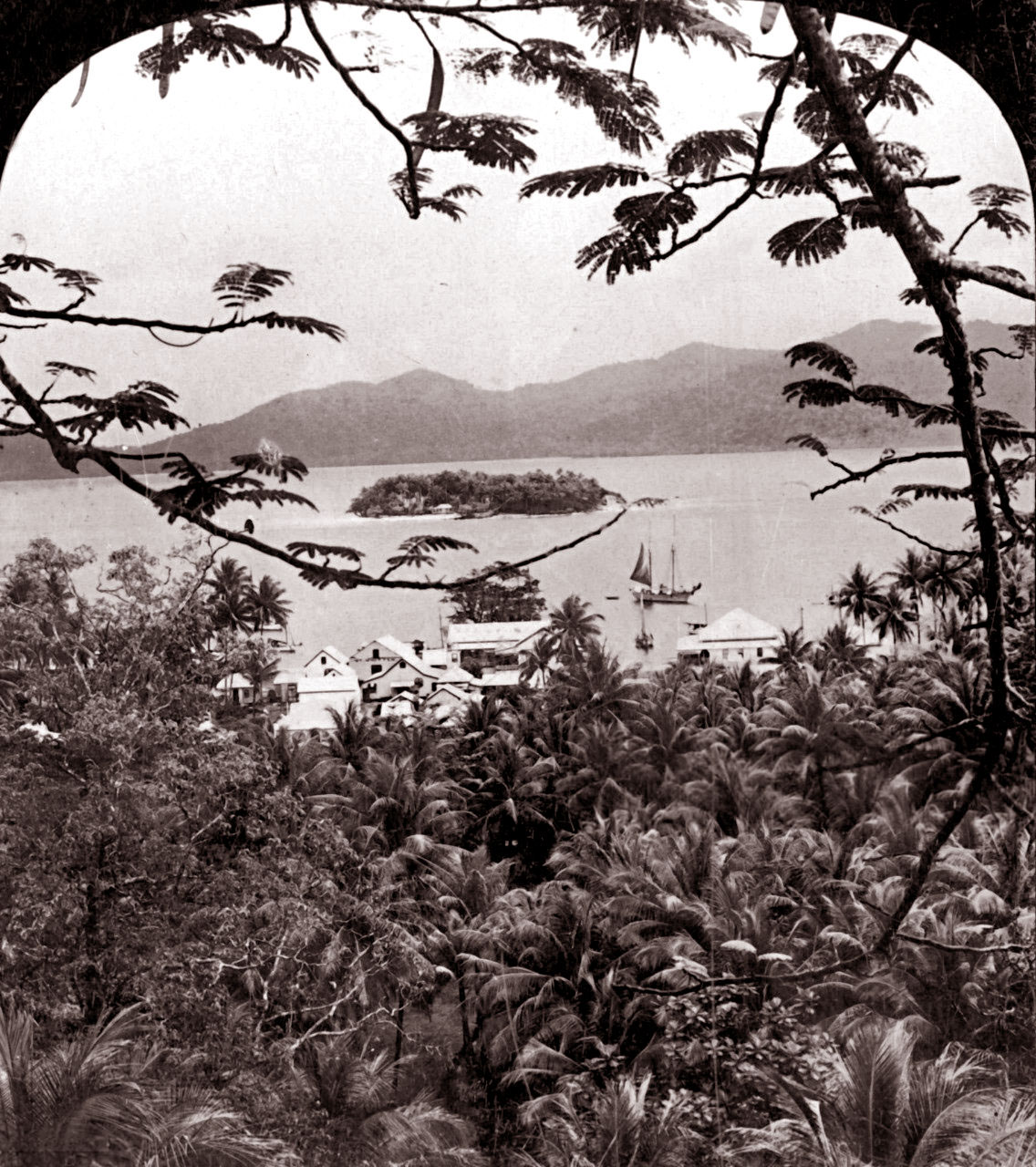
A view of Samarai Island, c. 1909, from a pair of stereocards by the Rose Stereograph Company.
The commercial imperative was understandable, yet I wondered if something else was going on too. There was something gleeful about her descriptions of the “natives” as loinclothed half-devils and her grand guignol amplifications. She did more than anyone to create the image of the islands as a dangerous sinkhole. Her writing brought to mind Orwell’s essay about “Boy’s Weeklies” and the drip-drip-drip effects of popular fiction on popular attitudes.
For all her ability to turn a phrase, there was something off about the books, and about the woman who wrote them. She rarely wrote anything positive about New Guinea. What motivated her to stay? The saddest thing I found out from Susan’s thesis was that Grimshaw dedicated only one of her forty-something books to anyone — and that was to her debauched father, who had glugged the family fortune. I sensed an unhappiness that only an emigrant can truly know, self-exiled on distant shores and unable to report back that things were not going well.
Perhaps it was the allure of relevance that made her stay. She travelled extensively throughout the South Seas, cultivating the role of expert-adventurer-eccentric, acclaimed by all the newspapers of record. When she visited London in the 1920s, the police stopped traffic to let her pass. A later portrait from Susan’s collection depicted a monocled woman in middle age wearing a ballgown, a pistol beside her on the table. Her frequent travelling companion was the governor of Australian Papua, Hubert Murray. The pair never got together and I imagine, perhaps fancifully, Murray engaging in Yeatsian levels of unrequited love for Grimshaw throughout his life.
Steering us speedily past canoes, John asked if Beatrice had ever married or had children. I told him she had remained resolutely single, and described the wretchedly lonely manner of her death in Australia, where she was now living. Commissions had dried up and her bank balance had dwindled to the point that in her final months she could afford only to heat the kettle for one cup of tea each day. Afflicted by diabetes, she wore a dress of mourning black and walked the streets by night shouting obscenities. I showed him the final picture Susan sent me of Beatrice, now a puffy woman in a mourning dress with dejected eyes.
“Beatrice had no line,” John said definitively. “Lain” is a Papua New Guinean pidgin word for children, family or personal connections. Papua New Guinea runs entirely on “lines,” family networks, finely threaded relationships and contacts as well as favours owed, stored, remembered and returned. Having a strong and reliable line is fundamental to getting anything accomplished, especially in a place where the state itself rarely works as it should. Personal and professional lines had gotten me this far and connected me with John, who was anxious to tell me he was giving me a discount on the price.
John is a former soldier, the musculature of his arms explained by his visits to a gym every morning. He pointed ahead and handed me his binoculars. I saw what looked like a giant whin bush erupting from the water. Samarai beckoned and we crested towards the once administrative centre of what was then Britain’s vast empire of the South Seas, a place with a twang as evocative as a Timbuktu or a Xanadu.
My daydreaming was interrupted when John had to give me a fireman’s lift onto the dock. I already knew that the image I had in my mind for the place would be out of sync with reality: there would be no midshipmen lugging sea-chests, tourists lolling and women walking around with parasols. Still, the state of the place was shocking. The old capital was on its knees.
We wandered past paint-peeled warehouses, two busted water-tanks and closed trade stores. We had brought overnight bags to stay in the island’s last hotel, but found it shuttered. Fading too was any semblance of administration: the police were gone, the secondary school too; the little wooden hospital building was little more than a shack without medicine, the discoloured posters about wearing a condom and a tuberculosis campaign remnants of the early nineties. Clapboard churches and chapels from every denomination seemed all that endured. The sepia air was almost bottleable.
Old signs were affixed at the entrances to many of the shuttered buildings, like badges on a boy scout’s scarf. Among the insignia were palm trees and artillery from an old servicemen’s association, the long swooshing tail of the bird of paradise topped by the British crown, and a plaque to a Frank Pryke which declared “the territory owes much to this British gentleman.” A mate of Grimshaw’s, Pryke was a gold prospector, island bon vivant and penner of the most godawful doggerel who made it a condition of his will to be buried on the island to be far away from his wife in Australia.
To cap it all off, we found a memorial to Christopher Robinson, an administrator during British times whose “aim was to make New Guinea a good place for white men.” Robinson himself died tragic death, succumbing to suicide via professional despair.
I imagined the rutted path circling the island was once the coral park parade. The little hillock where Grimshaw lived was thick now with the brambling bush I’d seen from the water; Pryke would have been buried somewhere beneath.
My thoughts turned introspective. I’d met so many Grimshaw-and-Pryke types on my travels. Nowadays they are the first person liking a social media update, the nurturers of weekend whirls of social activity, top-class tittle-tattlers and bon vivants who raise their voice and abruptly change the conversation when the subject of personal life came up. I knew them well. Hell, I was well on the way to becoming one of these types myself. I’d found my footing by falling in love with an amazing Australian woman when I was in my mid-thirties. But what if I hadn’t? I had been cultivating the multiple passport-stamps of an interesting but desolating life. I thought of Susan too, another who had led an interesting life, soon to sink barely a trace.
In my imagination I had assumed Samarai to be a large island, so innumerable were its literary ghosts. Not so: it took all of fifteen minutes to arrive back at the quayside, where women were selling coconuts, papaya, and sweet potato smoked and wrapped in banana leaf. There were no seats in the market; the women were flopped under umbrellas bearing the logo of the mobile phone network whose signal extended in the most sporadic sense. For “morning tea” — one of those olde-world phrases still used in the islands — we bought from a stooped woman fresh fish fried in an orange batter. She wrapped the fish in newspapers from a few years back whose stories of government chicanery rhymed exactly with the edition I had read that morning.
“Let’s ask her if she knows Grimshaw,” suggested John, who then rattled off a rapid-fire explanation of who Beatrice was and when she was around.
“How dare you?” the woman chided him with a smile. “I’m sixty-one years old.” She told us to look for Grimshaw in the library.
The library, it turned out, was at the two-room school, a generous description of a place with a chalkboard, no chalk, a mildewed smell, and six plastic chairs lying on their sides on a bare concrete floor. It was as if the state had conceded and receded. In the corner of one room, sitting just below a curtain of thin pink material flapping in the hot, humid air, were thousands of books squeezed together and piled atop one another on sagging plywood shelves.
What we were looking at was the vast literary remains of old Samarai. Most of the publication dates ranged from turn of the century to the sixties. Titles included A History of the Polar Regions, The High Deeds of Finn McCool and a travel guide to Hanoi when it was still a French possession. Some of the classics were there, too: an Austen, a couple of Trollope’s Barchester novels, a few hardback Dickens and, most fittingly of all, a Joseph Conrad novel entitled The Outcast of the Islands. The most recent volume I could find was a 1999 in-house Australian aid magazine, a document that might be best placed on the fiction shelf if the library was organised in any discernible manner.
When I opened a few of the older books, it was as if the pages squinted in unfamiliar light. I combed the spines hoping to find some of the many books written about Samarai itself — the backdrop to a bookstall adventure novel, starting point for an anthropologist or explorer’s tale, port of call on an administrator’s rounds, exhibit for the prosecution or defence in disquisitions about the ills or wonders of colonialism. There were none. Those living here perhaps felt they knew enough. There were no Grimshaws. Feeling her neglect, I took out a few copies of her Samarai oeuvre that I had read these last few days and laid them face-out on the shelf to resemble a bookstore’s title-of-the-month promotion.
“We treated them like Gods, those dim dims. They could ask for anything, and it was theirs,” I heard John whisper as I picked my way through the collection. I hoped he was holding forth about the old denizens rather than having a swipe at me. He was talking to a woman in a green, blousy dress whom he introduced as Cecilia, the school’s teacher, who had come in to find out what two men were doing unannounced in her school.
Cecilia struck me as happy for this wild-goose author chase as a break from the day’s tedium. She hadn’t left this island for twenty years, she said; the government owed her a leave fare but there was no way of getting it. She couldn’t remember the last time anyone had come looking around.
This temporary home for the books was now twenty years old. Originally, these books sat resplendent on three high bookcases made from ship’s timber within the island’s War Memorial and Library Institute, a once-imposing green-tea-coloured building fronted with a cannon. But all the members of the institute died, the cannon fell off its joist, the walls of the building caved inwards and the collection was evacuated. I asked if anyone used the library. She shook her head. Few read for pleasure and the hardest subject to teach was English.
“They spend all their time looking for a phone signal,” she said, which our experience suggested to be a thoroughly exasperating endeavour. She picked up a Grimshaw and said she would read it. I nabbed An Outcast of the Islands and left the sailcloth in its stead.
A few days later, back in Port Moresby. I finally managed to reach Susan. I was looking out at a channel of water that separated me from the city’s yacht club, a place where Grimshaw had lived in a houseboat back in her heyday. I was in a high-end café frequented by those present day outcasts of the islands, police officers, miners, bankers and weathered consultants to the aid program.
I told Susan about Samarai and the side trip John and I had taken afterwards to Doini, the island where the cruise ships docked nowadays. Apart from a horse with flies buzzing around a sore in its right eye and the intriguing presence of a llama, the island was empty. Yet John knew the place well: he came over here once a week to flog statues, prints and trinkets to the tourists. He pointed to the room where he’d disrobe and put on loincloths and feathered headdresses as if he were a murky side character from a Grimshaw novel.
She was lucid, pleased when I told her I’d found a copy of her thesis in Port Moresby’s national library. I mentioned a sentence early in Conrad’s book that resounded almost perfectly with me: “his little excursion into the wayside quagmires had produced the desired effects.” The decay and decrepitude of Samarai had broken something open in me. It was as if encountering its loneliness made me more appreciative of what I had.
I told Susan I had found in the library a selection from the diaries of the Polish anthropologist Bronislaw Malinowski. He overlapped with Grimshaw on Samarai — she gave him lessons in navigational theory and signed copies of her books — and in his diaries he described himself as being in a Dostoevskian state after a few months there. How isolated Grimshaw must have been in exotic but empty abodes over those years; it might in part explain her callous tone.
“Maybe you should write a book about her?” Susan said.
Perhaps it was our shared upbringing in Ireland’s north or her quintessentially Ulsterite turns of phrase that reminded me of my grandmothers, but I had found something oddly diverting about Grimshaw’s novels. That so many of the heroes were Northern Irish always made me smile, even if other parts of them left me appalled. Unlike Hubert Murray, though, I didn’t think I wanted to spend much more time in Grimshaw’s company.
I reminded Susan of a winning line in her thesis that understanding Grimshaw’s personality was “a task that only a psychoanalyst would welcome.”
“That was a good sentence,” she said. “All right, go write something else then.” She had to go. Someone was knocking; I heard the lightly patronising and firm tones of a care nurse. It would be the last conversation we had. •
In memory of Susan Gardner 1945–2022