Nostalgia is one of Hollywood’s most potent and pervasive impulses. It is among the reasons why deep dives into classic movies are still a publishing phenomenon: there is an enduring market for excavating and celebrating past glories that can also speak to the present in unexpected ways.
Anyone with a passing interest in films will recognise the reference in the title of David M. Lubin’s new book Ready For My Close-Up. Coming at the end of Billy Wilder’s Sunset Boulevard (1950) the words are spoken by one-time silent star Norma Desmond, in the throes of delusion, convinced she is about to start work on the movie she dreams of making with her favourite director. “All right, Mr DeMille, I’m ready for my close-up,” she tells a crowd of reporters and photographers. She believes they are part of a film crew; they are there, of course, to attend a crime scene.
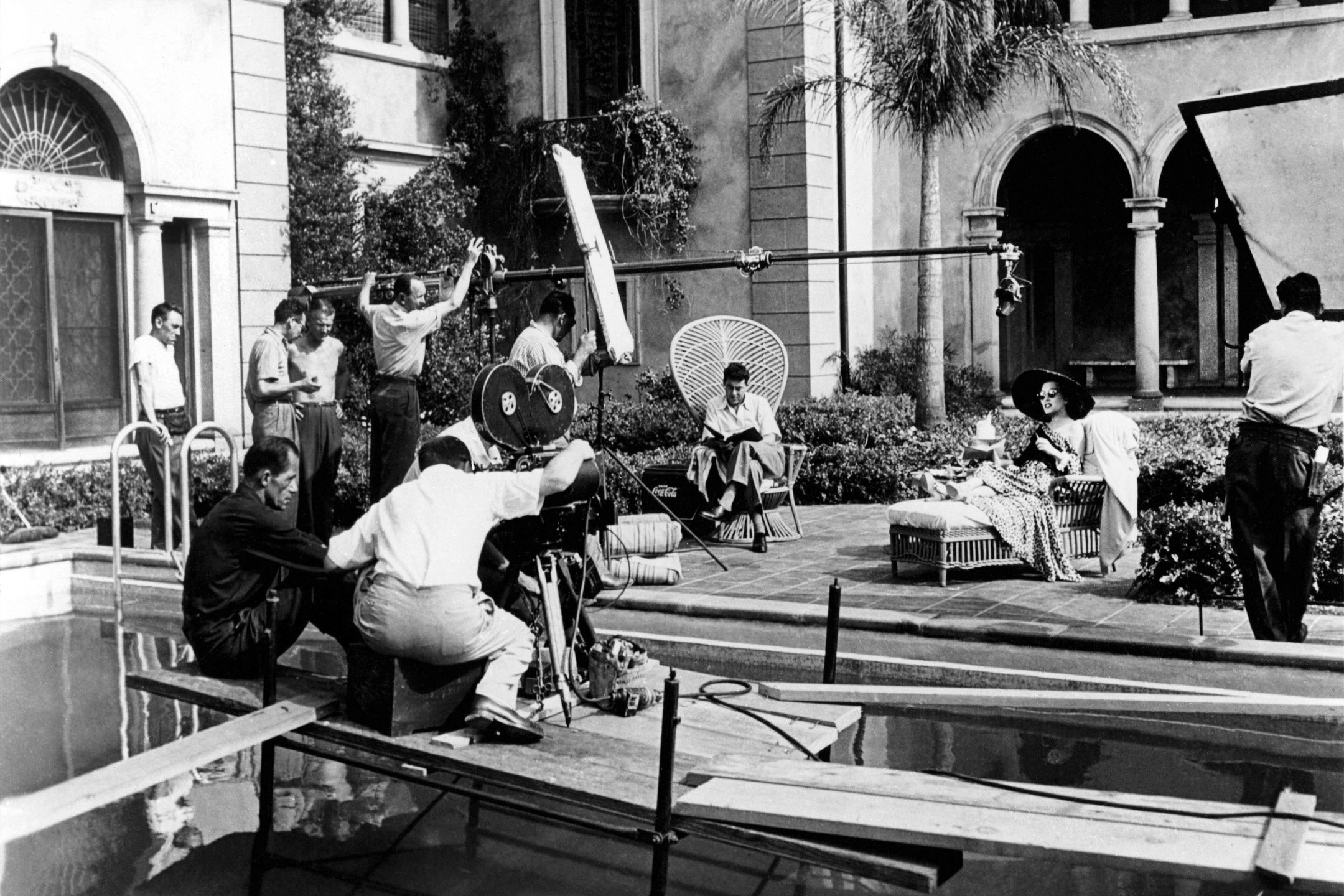
The beginning of Sunset Boulevard is as well known as the ending. An unusual image, shot from underneath, shows a fully clad body floating in a swimming pool accompanied by a voiceover narration from the dead man himself. He has a tale to tell, a story of desire, decline and self-deception explicitly connected to the place where it happened.
The book’s subtitle, The Making of Sunset Boulevard and the Dark Side of the Hollywood Dream, could refer to the film itself, or to its wider context, or both. Sunset Boulevard is deeply enmeshed with its location, subject and history. Almost all its characters are in the movies, or were, or want to be. Much of Hollywood’s past and present is folded into the narrative — characters, references, locations, real people playing themselves, names being dropped — all adding to the texture and resonance of the work and the mythologising it embraces.
It’s a rich subject for both analysis and anecdotes, and Lubin marshals his details well. He takes us through the production of the film from beginning to end, although not strictly chronologically. He spends time setting the scene, with extended portraits of the key creative figures, and breaks his sixteen chapters into segments — some extensive, some only short asides briefly exploring a theme or highlighting an intriguing piece of background information.
At the book’s centre is a double act: the productive, uncomfortable creative partnership of Billy Wilder and Charles Brackett. Sunset Boulevard followed the pattern they had established: Wilder, writing and directing; Brackett, writing and producing. From wildly different backgrounds, they had little in common and often disagreed with each other.
Wilder was born in 1906 in what was then Austro-Hungary. He moved from a small town to Vienna and then to Berlin, where he worked as a journalist and a taxi dancer before becoming a screenwriter. With the rise of Hitler, having accumulated experience and a director’s credit in Germany, he fled for France and then the United States. Arriving in Los Angeles in 1934, he threw himself into the business of learning English and making his way in Hollywood.
Brackett, thirteen years older, was from a well-off establishment family. He had a Harvard law degree, worked as a lawyer, but didn’t want to enter the family business. His passion was writing, and he had short stories, novels and theatre reviews published in the New Yorker before gravitating towards film. He also suffered from what Lubin describes as “persistent self-doubt and chronic self-loathing, which he disclosed only in his diary.
The two men were brought together to work on Ernst Lubitsch’s Bluebeard’s Eighth Wife (1938). As their unlikely partnership flourished, Wilder started to direct their screenplays. Their creative differences were what made them, Lubin writes: “The film is actually better for both of their divergent sensibilities — the sentimental and the cynical — actively in tension.” By 1949, though, they were in a slump and needed a hit.
Sunset Boulevard, says Lubin, was partly inspired by the fate of director D.W. Griffith (Birth of a Nation, 1915), who died in 1948, out of work and gripped by alcoholism. The pair started to craft a story about a fading silent star, a dead body, and a swimming pool; before long, they had their narrative.
When they cast Gloria Swanson to play the ferocious, controlling Norma, they were taking a chance. Swanson, who had been one of cinema’s most sought-after and highly paid stars, had gone abruptly out of fashion in the sound era. Unlike Norma, she pragmatically reinvented herself after Hollywood lost interest in her, running various businesses and hosting a television talk show out of New York.
It is impossible to imagine the film without her, but Wilder and Brackett looked elsewhere first: to Mae West (Wilder’s idea), Pola Negri and Mary Pickford. Only Swanson was astute enough to recognise the opportunity she was being given. Brackett and Wilder soon became aware of how much she could give to the role, and adjusted the character accordingly. Wilder, who hated allowing actors any creative leeway, even took dialogue suggestions from her, Lubin says.
The events of Sunset Boulevard are set in motion when Joe Gillis (William Holden), a would-be screenwriter desperate for a break, stumbles by accident into the rundown mansion Norma maintains as a monument to her glorious past. He takes a while to recognise her. “You used to be big,” he says. “I’m still big,” she retorts. “It’s the pictures that got small.”
The film’s aura of authenticity — its in-jokes and name-drops and Hollywood locations — gives it a kind of insider appeal. As Lubin explains, Brackett and Wilder made shrewd use of Holden and Erich von Stroheim, the actor and director who plays Norma’s devoted butler, and the various resonances their presence brought. Three figures from the silent era, among them the incomparable Buster Keaton, make brief appearances as visitors to Norma’s house. Filmmaker Cecil B. DeMille — for whom Swanson had made several films — plays himself, or at least an avuncular version of himself, sympathetic to the overwrought Norma when she turns up at the Paramount studio to see him while he is in the midst of a shoot.
Sunset Boulevard is not only a thick stew of Hollywood references, it is also an ingenious hybrid of styles. It is a “comedy, crime film, horror story, Hollywood exposé, romantic melodrama and psychological thriller,” as Lubin describes it. There is something for every viewer in its variety and shifting tone.
Ready for My Close-Up finishes with a rather cursory four-page epilogue in which Lubin considers the film’s legacy, focusing mostly on the curious fact that Sunset Boulevard is said to be Donald Trump’s favourite film. More could be said about its use of nostalgia. And although it might take a sardonic look at aspects of Hollywood, it is also a tribute — both critique and celebration. And there is also scope for a queer reading of the movie, considering its emphasis on artifice and the constructed self, its fluid gender roles (Norma’s heightened, extravagant performance of the feminine against Joe’s seemingly robust yet fragile masculinity). But Lubin leaves himself no space for analysis of this kind.
The title of Stephen Rebello’s Criss-Cross also comes from a line of dialogue, but the reference is not instantly recognisable. The subtitle spells it out: The Making of Hitchcock’s Dazzling Subversive Masterpiece, Strangers on a Train.
Like Wilder and Brackett, and at much the same time, Alfred Hitchcock embarked on a new film with a certain degree of anxiety. After four box-office flops in a row, he needed a hit. He acquired the rights to Patricia Highsmith’s suspenseful novel, Strangers on a Train, the story of a chance meeting in which one character suggests to another that the perfect crime can be committed by two people, unknown to one another, “exchanging murders.” The man with the audacious concept, Bruno Antony (Robert Walker), murmurs “criss-cross” as he contemplates the possibilities of the scheme. Guy Haines (Farley Granger), his target, has no idea what will follow from this encounter.
Describing how Strangers on a Train (1951) was brought to the screen, Rebello sets out a succession of frustrations and obstacles, many of them unresolved. Several of Hitchcock’s script collaborations went badly wrong. He failed to get the cast he wanted and had an actor imposed on him by studio head Jack Warner, who refused to let him cast Grace Kelly. Yet, Rebello argues, there are things about the film to celebrate. It was the beginning of Hitchcock’s fruitful partnership with director of photography Robert Burks, with whom he made twelve features. It has some striking set pieces: “six of the best thrill sequences Hitchcock achieved in his fifty-plus years of filmmaking,” according to Rebello. And there is Robert Walker’s “towering performance” as Bruno, “one of the dark princes of Hitchcock’s gallery of disarming, boyish psychopaths.”
In an introduction, Revello reveals that he was drawn to the queer thread that runs through Strangers on a Train. “The movie got under my skin decades ago,” he says, “and has stayed there ever since.”
While Lubin weaves things together in Ready for My Close-Up, Rebello breaks things down. Sidebars discuss Guy’s cigarette lighter, the recurrence of doubles, the significance of casting Ruth Roman as Guy’s fiancée, the way a murder scene was shot, and other matters. Somewhat hazy black-and-white photos and production sketches also punctuate the narrative. A couple of chapters cover the marketing of the film and its public reception, with images of publicity material and newspaper articles.
Rebello is particularly interested in how the script came together, and what made it into the final film and what didn’t. Two of the three appendixes testify to this in more detail: the first, “Pages on the Cutting-Room Floor,” is a selection of suggestions various screenwriters made for the movie, some of which ended up in later Hitchcock films. The second records differences between the film seen by preview audiences and the final version.
Part of Rebello’s project is to give more credit to Whitfield Cook, a playwright, novelist and friend of Hitchcock’s whose job was to make the work “less internal and more dynamic.” Rebello suggests that “the purportedly bisexual Cook responded to the novel’s homoerotic undercurrents, perversity and bleak humour,” as he believes Hitchcock anticipated. Cook wrote a forty-five page treatment for the movie and made several key suggestions the director took up. He changed Guy’s job from an architect to a tennis player; he gave Bruno a more complicated, ambiguous presence. He “succeeded in departing radically from Highsmith’s novel,” says Rebello, “and creating a template for future development, in addition to nailing most of the story beats and bravura visual touches.”
With treatment in hand, Hitchcock approached a number of writers, including Thornton Wilder, Dashiell Hammett and Ben Hecht. Raymond Chandler — who’d had an unhappy experience working with Billy Wilder on Double Indemnity (1944) — signed up for a stint, but didn’t fare particularly well with Hitchcock either. He did end up with a screen credit, however, and made some contributions to the final version.
Strangers on a Train was a relative critical and commercial success, but not enough to keep Hitchcock in favour at Warner Bros. In 1953, during a period of austerity, he was offered a deal that cut his salary by 90 per cent. He quit and went to Paramount, where he embarked on a remarkable run of films, including Rear Window (1954), To Catch a Thief (1955), The Trouble with Harry (1955), The Man Who Knew Too Much (1956) and Vertigo (1958), supported by a formidable production team. And he was able to cast Grace Kelly.
As for Brackett and Wilder, Sunset Boulevard marked the end of the partnership, as Wilder had planned. Brackett went on working with some success, but mostly as a producer. But nothing he worked on had the impact or resonance of that earlier collaboration. Wilder continued to write and direct, and found a new writing partner, I.A.L. Diamond, with whom he worked for thirty years; their films included Some Like It Hot (1959), The Apartment (1960), Irma La Douce (1963), The Fortune Cookie (1966) and The Private Life of Sherlock Holmes (1970).
One of the last movies they worked on together was Fedora (1978), which had a familiar ring to it. Starring William Holden, it was the story of a producer who tries to lure a celebrated actress out of retirement.
Sunset Boulevard’s elegaic, sardonic tone could easily have been about the present as well as the past. Things were in flux in Hollywood at the beginning of the 1950s. Legislation separating production and exhibition was about to go into effect, undermining the monopoly many of the studios enjoyed. Joseph McCarthy and the House Un-American Activities Committee had begun its repressive work, and television was providing challenges at a time when cinema audiences were already in decline.
Now, some seventy-five years on, Hollywood once again faces challenges, threats and the prospect of transformation. The studios that made Sunset Boulevard and Strangers on a Train still exist, at least for the time being. But their names are attached to multinational media and entertainment conglomerates; films are only a segment of a business that has has expanded into every conceivable direction with varying degrees of success. New players and new technologies are in the mix. AI has entered the scene in ways that provoke considerable anxiety. Conservative political pressure is already in evidence.
What’s more, Paramount and Warner Bros could soon become one. Paramount Skydance is negotiating to acquire Warner Bros Discovery in a highly contested, controversial multibillion-dollar deal that — regulators permitting — would create an unprecedented juggernaut. In this scenario, the pictures look rather small. Where this ends is anyone’s guess. •
Ready for My Close-Up: The Making of Sunset Boulevard and the Dark Side of the Hollywood Dream
By David M. Lubin | Hachette | $59.99 | 317 pages
Criss-Cross: The Making of Hitchcock’s Dazzling Subversive Masterpiece, Strangers on a Train
By Stephen Rebello | Hachette | $57.99 | 312 pages