In 2022, I got cranky with Australia over its News Media Bargaining Code — its convoluted scheme to get money out of big tech companies’ pockets and into news companies’.
The idea in a nutshell was this: Two giant American tech companies, Google and Meta, had abused Australian news publishers by “taking” their stories and including them in their search results and social feeds. Publishers were due compensation for this wrong — but the tech giants refused to negotiate over how much. So the government ordered these negotiations to take place; Google and Meta would need to strike individual deals to pay some undetermined number of publishers some undetermined amount of money.
If the government felt they’d paid publishers enough, then that’s that. If it didn’t, though, the government could mandate further bargaining and, eventually, require third-party arbitration that could cost companies bigly.
I am in favour of publishers getting money, and I am in favour of Google and Facebook being the ones writing the cheques. But the system had major problems, both philosophical and practical.
Last week, the Australian government announced a successor to the News Media Bargaining Code — the (annoyingly similarly named) News Bargaining Initiative. It’s a clear improvement. Indeed, with a single change, it’d be close to an ideal system. But without that change, I suspect it’ll end up repeating many of the old system’s flaws.
You can read my 2022 piece for a lengthy discussion of those flaws, but here’s a summary of the two big ones.
Problem 1: The code lied about what problem it was addressing
Australian media companies, like their peers around the world, have long complained of the tech giants’ “theft” of their intellectual property. That “theft” consisted of… letting Facebook users link to news stories and Google including news stories in search results. Those things are not theft; social media platforms and search engines are legal. And if you want to argue that they are theft, then why are they theft only for a small set of news companies and for not every site on the internet?
The intellectual-property theft claims have always been a way to paper over publishers’ actual complaint, which is what this has always been about: Google and Meta have a near-monopoly on digital advertising revenue. More than 80 per cent of all Australian digital ad dollars go to those two companies. It turns out that putting ads next to search results and social feeds is a much more lucrative and scalable business than putting ads next to news stories. News outlets used to make enormous sums from advertising in print and broadcast media, but online they only earn a fraction of a fraction of a fraction of what these two tech giants do.
This is, to be clear, a very legitimate complaint! Google and Meta having that much market power is a dangerous thing from an antitrust perspective. It is perfectly appropriate for both Australian publishers and the Australian government to be concerned that their nation’s media is being undercut by a new revenue paradigm they can’t win at. Liberals will argue quality journalism is a civic good essential to an informed democracy. Conservatives will argue this is an important Australian industry that deserves protection. Populists will argue the need to confront American cultural imperialism. They’re all correct.
But it’s not the complaint the News Media Bargaining Code was based on — the complaint that including news stories in search results and social feeds is somehow a violation of publishers’ rights and that they are due financial compensation for it.
You might say that’s just a philosophical quibble. But Meta turned it into a very practical one when it called Australia’s bluff — twice. First, in 2021, it announced that, if the problem was really how Australian news appeared in Facebook feeds, it had a solution: banning Australian news stories from Facebook. Problem solved, right? Of course not — because the “theft” of letting someone share your story on Facebook was never the actual problem. Meta lifted the ban after extracting concessions from the plan. (It repeated the move in Canada when faced with a similar program — except there, it’s never lifted the ban, making it clear to governments that it considers news very much optional on its platforms.)
Then, two years ago, Meta announced that it was done negotiating these deals with publishers and let all existing ones expire. Did the government then follow through with what the News Media Bargaining Code allowed — declaring Meta in violation of its obligation to negotiate fairly and force them into mandatory arbitration? No. Instead it did… well, nothing, really. It didn’t pursue further action (called “designating” Meta, in the code’s parlance) because it believed that doing so would just lead to Meta blocking news on Facebook again, and it wanted to avoid that outcome.
This has never, ever been about the platforms’ “theft” of news. It has always been about the platforms’ dominance of the digital advertising market and the hole that has left in publishers’ budgets.
Problem 2: The code had zero transparency and uneven power
The code set no firm requirements on what these “negotiations” needed to entail. It didn’t set how many publishers needed to be paid or how much. It just said that Google and Meta needed to show a good enough effort that the government wouldn’t designate them as unfair bargainers. Which basically came down to vibes — the companies weren’t required to share the totals with other publishers or even with the government itself. It was all done in secret. Deals contained clauses forbidding publishers from revealing how much they got.
That’s an artifact of the code’s fundamental lie that this was about business negotiations between private companies. Google was supposed to figure out how much it “owed” News Corp for the crime of including Brisbane Courier-Mail stories in search results, and News Corp could keep saying “higher” until it got a number it was happy with. It was a private act of theatre.
This had several negative knock-on effects. First, the country’s largest news publishers — Rupert Murdoch’s aforementioned News Corp and Nine Entertainment, owner of the Sydney Morning Herald and the Age — had some actual power in the negotiations, because they were big enough to plausibly complain to the government if they felt they weren’t getting enough. But smaller fry were either given perfunctory take-it-or-leave-it offers or excluded altogether.
(It surely didn’t hurt that the largest reported payments went to News Corp, which just happened to be a big supporter of the conservative prime minister Scott Morrison, whose government came up with the scheme.)
The contracts were also dishonest about what the tech companies were buying. On paper, the deals were all about Google and Meta licensing news stories for Google News Showcase and Facebook’s News tab. In reality, those products were constructed in part to be vessels for these payments to happen.
These are significant problems, and they all come down to that fundamental act of pretending what this is all about. If this is about how individual companies have been wronged, and all the government is doing is bringing the two sides to a negotiating table, then you can argue this secrecy and imbalanced power is fine. But cloaking a government-mandated subsidy in the language of “bargaining” made the system worse at every turn.
What the News Bargaining Initiative changes
Morrison’s party was ousted in 2022 and he was replaced by the Labor government of Anthony Albanese. While Albanese’s government was the one that declined to “designate” Meta after it stopped paying publishers, it recognised that a new approach was needed. After much process, it unveiled its proposed result last week: the News Bargaining Incentive.
It’s an improvement. But unfortunately, the Albanese government seems intent on continuing to dress up a public policy decision as the marketplace at work, and that will continue to weaken the system.
The NBI, as the name implies, still aims to offer an incentive for Google and Meta to bargain with Australian publishers. But it creates a different backup mechanism if they don’t do so to the government’s liking.
It expands the targeted companies from two to three — Google, Meta and now TikTok. Second, it creates a 2.25 per cent tax on those companies’ Australia-generated revenue, which the government expects to generate more than A$300 million a year. And it gives the companies a way out of paying that tax by instead negotiating deals with publishers.
Here’s how it would work: For every A$1 Google pays to News Corp via a negotiated deal, Google’s tax liability will be reduced by A$1.50. And for every A$1 Google pays to what the government defines as a “small or medium” publisher, that tax liability will be reduced by A$1.70.
That’s a good change. Instead of an incentive to overpay the loudest potential voices (*cough* Murdoch), tech companies will have a (mild) incentive to pay more to smaller outlets. The NBI also adds a (minimal) requirement to spread the money around by saying companies must make deals with at least four different media companies to offset their entire tax liability. (Under the old system, there was no rule saying a company couldn’t just give News Corp or Nine a giant lump sum and declare itself done.)
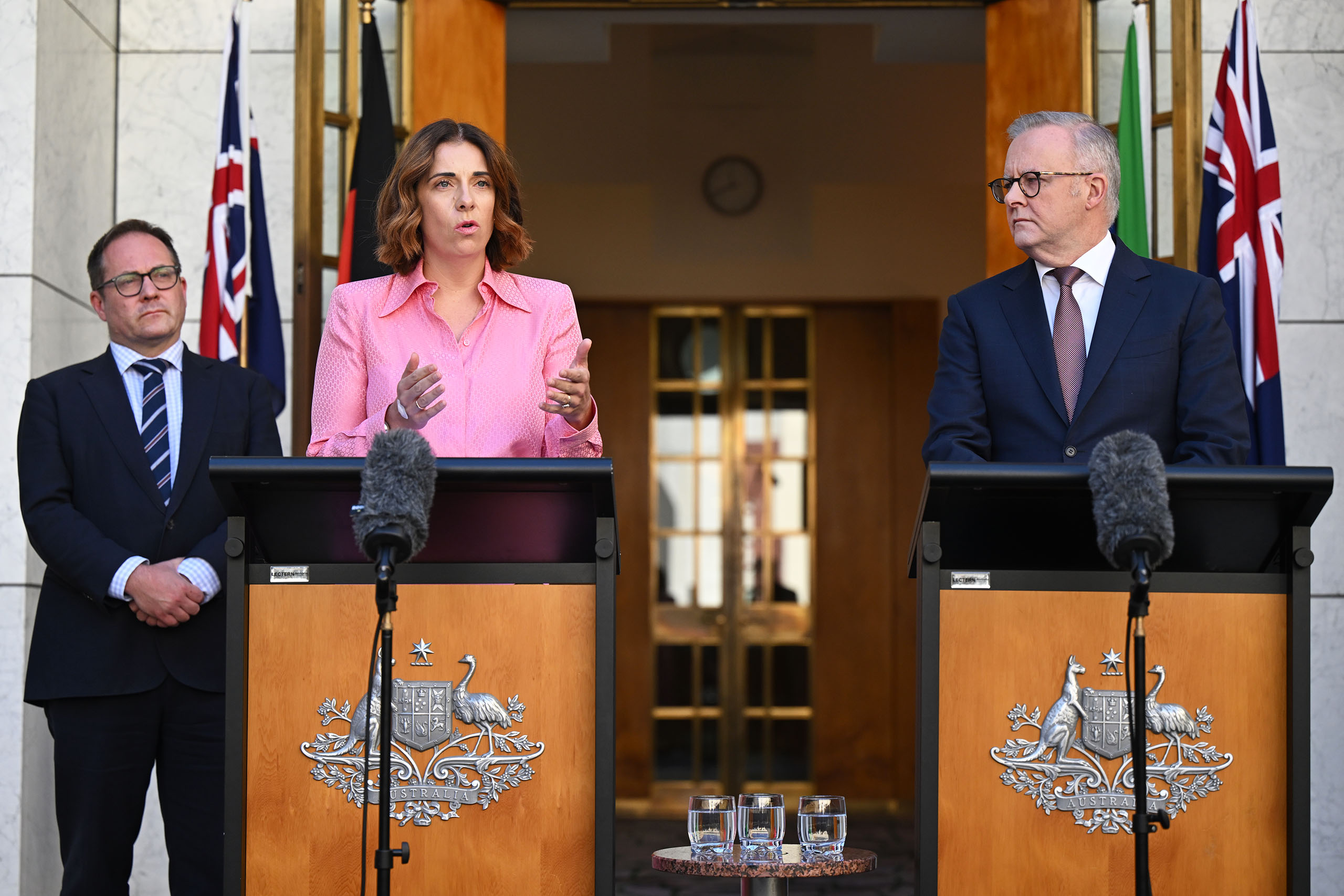
Is the NBI more honest about what this money is actually for? Well, yes and no. Not rhetorically — at his announcement press conference, Albanese still paid homage to the idea that this was about compensation for content being “taken”:
We think that investment in journalism is critical to a healthy democracy. It matters. It’s something that defines the way that Australian society operates. And frankly, if the work is being done by the people here at this press conference and in other places right around Australia, then your work needs to have a monetary value attached to it. It shouldn’t just be able to be taken by a large multinational corporation and used to generate profits for that organisation with no compensation appropriate for the people who produce that creative content.
Still talk of “taking” without “compensation,” alas. At the same press conference, assistant treasurer Daniel Mulino was closer to the mark: “What we know is that news media organisations are having to deal with large digital platforms which have very substantial market power, and that’s undermining the traditional business model.”
But what’s important is that the Albanese bill itself actually gets this right. It makes it clear that tech giants will be subject to this scheme regardless of whether they have anything to do with the news. As the government’s own explanation of the bill puts it, “A significant social media or search service does not need to carry news content to attract an NMI [News media bargaining incentive charge].”
In other words: Meta, don’t try to pull that banning-news-on-Facebook trick again.
The addition of TikTok to the program also shows how little this has to do with news “theft.” Google and Facebook do at least display headlines from news stories in the act of directing users’ attention to them. But TikTok? TikTok bans the sharing of links in all but a few specific contexts, and it wants nothing more than to keep you scrolling from vertical video to vertical video, forever. The idea that it is engaged in compensation-worthy theft of news is laughable.
Unfortunately, the NBI is only marginally better on transparency and market imbalance than the old code was. Tech companies would have to report their deals to the government in order to cancel their tax liability — so at least someone would know how much money was changing hands. But there’s no language requiring those deals to be reported publicly. Which means that Australians will still have no idea how much money outlets are getting — and, more importantly, other publishers won’t know either. So smaller outlets won’t be able to be more informed bargainers, and tech companies will still be able to play politics or favourites however they wish.
The solution that’s under everyone’s nose
So what happens under the NBI if the tech giants decide not to play along? What if Meta sticks to its guns and says we still won’t make any deals?
Well, they’d have to pay that 2.25 per cent tax to the government. And what would the government do with that money? It would give that money to Australian news organisations based on a simple formula — how many journalists they employ. Albanese:
Importantly as well, this is not about government revenue. Every single dollar will go back to journalists to pay for the journalism that you all produce here in the Gallery, but newsrooms right around the country produce as well.
Here’s Anika Wells, the government’s minister for communications:
The News Media Bargaining Incentive means if a platform doesn’t do a deal with a news publisher, the money will come to us and we will deliver that funding to news organisations based on how many journalists they employ. The more journalists they have, the more money they will get under this proposal.
That sounds… awesome?
A straightforward formula that directly incentivises news outlets to hire journalists. (There is zero requirement that tech company money given directly to publishers be spent on journalism at all. News Corp could use it all on a new jet for Lachlan if it wanted to.) It would completely eliminate the uneven bargaining power among small and large outlets. It would eliminate the need for kabuki-theatre “negotiations.” And of course there’d be more money to go around, since tech companies are getting those 150/170 per cent incentives to make deals.
Such a plan would create a reliable, sustainable revenue source that Australian news publishers could count on. No more need to hope that your corporate office did a good job debating made-up numbers at the negotiating table. I think it’s fair to assume that Google, Meta, and TikTok will keep increasing revenue in the coming years, which means that the amount going to publishers would automatically increase as well. And if some new platform comes along that starts to eat up ad revenue, they’ll get automatically added to the program when they reach a certain size.
In fact, a tax like the one Albanese is proposing is exactly what I proposed back in 2022:
Google and Facebook are too big and powerful for the good of society. Their business, highly targeted advertising, is one that naturally tends toward monopolies: the more data you have, the bigger you get; the bigger you get, the more data you have. And while they make some fine and useful products, they aren’t creating the civic good that the earlier advertising gods — newspapers and other local news organisations — did by doing good journalism on a huge scale.
So tax them. Say you’re going to put a 1.5 per cent tax on the targeted digital advertising revenue of all companies with a market cap over $1 trillion, or annual revenues over $20 billion, or whatever cutoff you want. That would generate billions of dollars a year in a way that doesn’t warp competition or let Google and Facebook use their cash as a tool for targeted PR payoffs.
Then decide how to spend it. Maybe you subsidise reporter salaries in a big way… Maybe you give it all to public media… Maybe you distribute it as vouchers to [Australians] so each of them can spend $100 a year on news subscriptions at no cost to them.
There are lots of ideas! Some you might like, some you might not. But they’re all better than giving Rupert Murdoch $50 million a year and small local publishers zilch because of who they know and how much the tech giants value their silence.
What’s frustrating about the News Bargaining Initiative is that it… incentivises bargaining. It creates this powerful, transparent system to sustain journalism — and then asks everyone involved to make the same sort of shady secret deals the old system encouraged. The Albanese government has been very clear that it doesn’t want tech companies to pay this tax and would rather they keep striking deals. Albanese:
We have engaged in extensive consultation. At this point, the three organisations, Meta, Google, and TikTok as well have been consulted with and we’ll continue to engage with. But we want to see these deals done as were previously done under the previous regime.
Mulino:
I’ll just conclude by saying that the intention here is that digital platforms will enter into deals, and that’s very much the way this has been designed.
Wells:
The News Media Bargaining Incentive encourages platforms to enter into deals with news outlets and to contribute its fair share to Australian laws. Platforms should do deals with news organisations. If they decide not to, they will end up paying more.
Albanese again, in response to a question about what happens if Meta decided not to do deals:
Then they will be subject to higher payments than they will if they do a deal with the news organisations. That’s why there’s this incentive being put in and the distinction that’s there between paying 2.25 per cent or paying 1.5 per cent. And by having that incentive, what we’re encouraging is for organisations to sit down with news organisations, get these deals done, and then we can move forward.
In other words, the Albanese government wants to create an efficient, equitable way to give more than A$300 million to Australian news outlets — and then ignore it, because it would rather give around A$200 million to a subset of those outlets who can do well in secret negotiations.
To make the News Bargaining Initiative better, all it has to do is reverse the incentives. Instead of offering tech companies a discount for striking secret deals with the most powerful news companies, give them a discount for paying the tax. Or don’t offer them a discount at all! There is no reason to believe that Google’s negotiators are going to distribute money more equitably than a clear, uniform government pass-through program that pays per journalist. Australia shouldn’t be asking them to. Relying on backroom deals will benefit the tech companies (by paying less) and the Murdochs (by emphasising their market power), but no one else.
This one change would repair the damage done by the News Media Bargaining Code’s fake free-market framing. This isn’t about individual news companies seeking compensation for imaginary thefts — it’s a question of public policy. The Australian government has good reasons to want to support its local media industry, and it has designed a good mechanism to do so. It should use it. Kill the bargaining — keep the tax. •