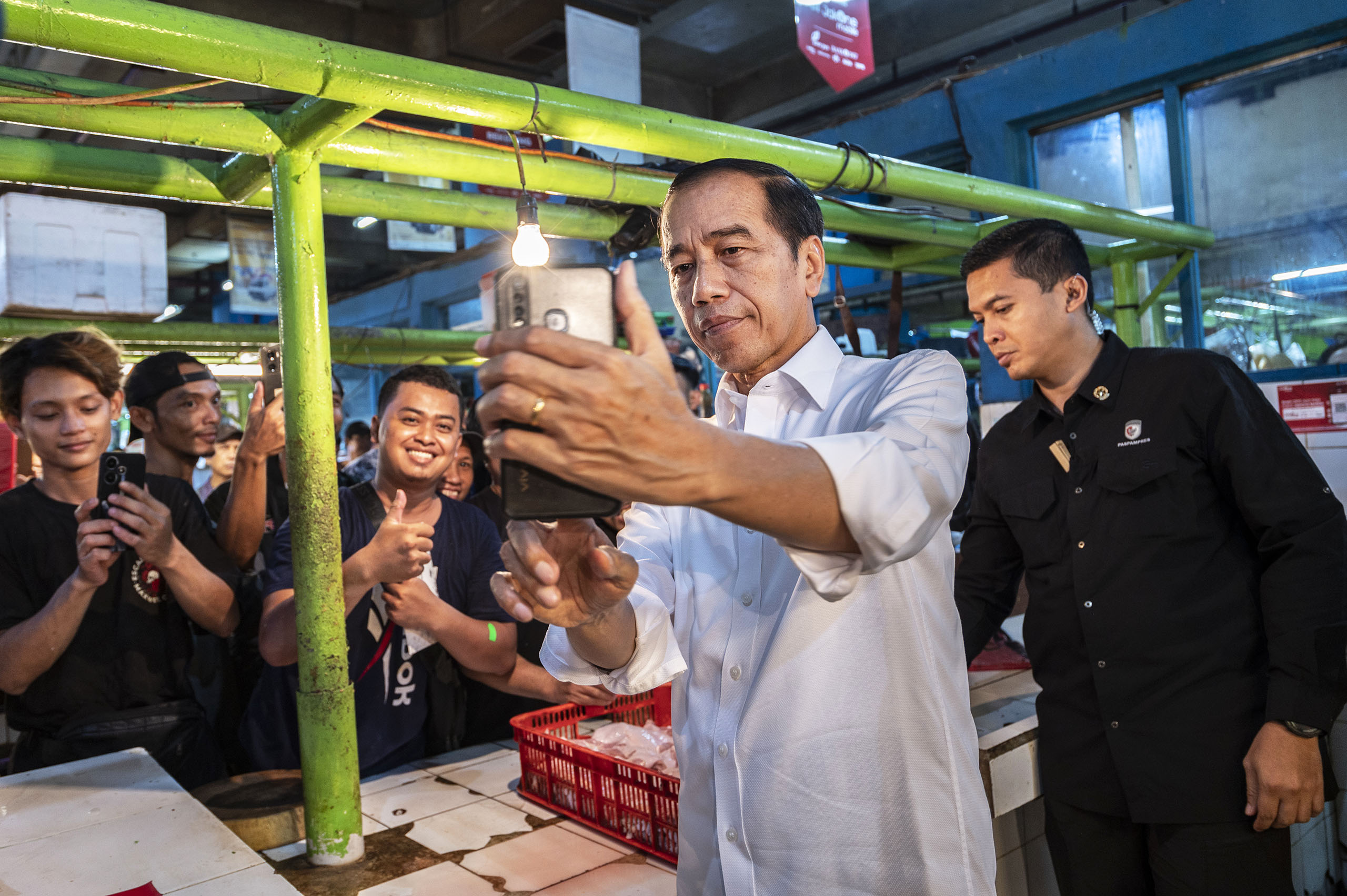
Indonesia’s most popular leader in the post-1998 reformasi era has left it worse off for his efforts. Joko Widodo, who won the presidency without the political patronage characteristic of Indonesian politics, wielded the power of his popularity to great effect. Yet his singular focus on economic advancement delivered only marginal gains in prosperity. And his methods, notably those he employed in a last-ditch effort to embed his dynastic ambitions, have eroded core democratic institutions.
ANU researcher Marcus Mietzner’s Ruling Indonesia is a timely, insightful and measured picture of the Jokowi presidency. His considerable access to key figures is reflected in the book’s useful insights into events and decisions. His conclusion has a hard edge: “While Jokowi was a lazy reformer of political institutions — in both the progressive and autocratic directions — his influence on Indonesia’s democratic culture was strong and primarily detrimental.”
Jokowi came to the job with a can-do attitude and an image as a man bent on practical measures to improve Indonesians’ lives. His headline priorities in both his terms, from 2014 to 2024, centred on infrastructure projects and skills development. The former, Mietzner found, arose from an early meeting with Chinese president Xi Jinping; the latter was never meaningfully tackled, despite a considerable investment of both rhetoric and cash.
Today, Indonesia’s roads, ports and airports are generally much improved. A fast train, the first in Southeast Asia, runs from Jakarta to Bandung. Yet Indonesia’s relative economic progress — measured by its share of global GDP — barely changed over the decade. Vietnam, a country Indonesians notice, has lifted its share by a third. More pointedly, Indonesia’s middle class shrank during his second term — by 20 per cent, according to official statistics.
Mietzner cites the presidencies of B.J. Habibie, Abdurrahman Wahid (known as “Gus Dur”), Susilo Bambang Yudhoyono and Megawati Sukarno Putri, all of whom delivered notable, lasting reforms. “It is less clear what will remain of Jokowi’s rule,” he concludes, allowing one exception. “By actively enthroning his successor, Jokowi became politically liable not only for his own decade in power, but also for whatever Prabowo [Subianto, his successor] would or would not deliver.”
Jokowi comes across as a man who crashed into Indonesia’s power elite through the sheer force of his personal appeal. He was a man who kept an extremely close eye on public opinion (and on his own colleagues and opponents), quickly dislodging the yoke of Megawati, his ostensible patron, and establishing a “coalition” that ultimately took in virtually all of the parliament. Despite everything, he managed to retain the favour of 80 per cent of the electorate right up to his last day.
A clue to this contradiction between popular power and policy weakness emerges when Mietzner explores the popular view of Jokowi’s erosion of Indonesia’s core democratic institutions. Among voters, political success was weighted heavily to economic outcomes — which is what Jokowi projected, relentlessly. Democratic safeguards rated well below rice and cooking oil.
Yet, as much as Jokowi used his popularity to effect and drove his agendas against (at times) firm opposition, the evidence is of a man who failed to penetrate Indonesia’s establishment. His infrastructure agenda suited the elites, and even his much-maligned national capital relocation — to Nusantara in Kalimantan — was humoured with (largely meaningless) support. He gradually imposed his own people to head the military and the police and, late in his presidency, wielded his influence over the anti-corruption commission and courts to improper ends. He emerges as an outsider who wielded his popularity largely to hold power without acquiring the authority to make deep or lasting changes.
Mietzner points to evidence of unusual interventions by police and government agencies to influence voting in the 2024 election, driven by Jokowi’s desire to plant his son, Gibran Rakabuming Raka, in the vice-presidency and thereby create a dynasty. The book’s epilogue includes post-election evidence that Prabowo scuttled Gibran’s political efforts and largely dismissed Jokowi’s efforts towards a continuing personal association.
While successive administrations have made much of Indonesia’s potential, the country’s signal achievement has been its stability. Many observers forecast serious disruption, including possible regional secessions, after the 1997 financial crisis and the fall of Suharto. Instead, the country has held a series of open, successful national elections in which — with occasional challenges — polling integrity has been confirmed and winning candidates have peacefully taken their place. Along the way, important reforms removed the military from civil affairs, introduced a globally recognised anticorruption agency and settled secessionist challenges, notably in Aceh.
Critically, Indonesia maintained a firm fiscal discipline that has helped to keep inflation under control and underpin wider economic stability. But the Jokowi years saw some of those stabilising planks decayed, and the signs from Prabowo suggest Indonesia may be ill-equipped for the challenges emerging in a more fractious and unstable global environment.
Even before the 2024 election, informed Indonesians were critical of loose spending. Sri Mulyani Indrawati, Jokowi’s highly regarded finance minister, was said to have quaked under pressure, absorbing into the budget the costs of supposedly private projects in the new national capital and the losses of the Jakarta–Bandung fast train. Since the election, Prabowo has reversed direction on military spending, adding substantial new allocations for soldiers and equipment. Along the way, his signature election promise, a massive program of free school meals, was handed to the military to deliver. Criticised initially for its budget impact and later for its efficacy, evidence has emerged of extremely poor delivery and even food poisoning.
Now, with volatile oil prices boosting domestic prices and government spending (Indonesia outlays a large public subsidy for fuel) and new spending priorities testing the legislated deficit cap (3 per cent of GDP), Indonesia’s middle class is likely to demand attention. In the years from 2003 to 2014 the middle class tripled in size. But in Jokowi’s second term, from 2019, and since, it has shrunk markedly. Managing that problem is likely to be the key to continuing political stability, especially if global economic conditions worsen.
Indonesia’s tax base can’t support a widening of its social spending. Its shrinking middle class, the driver of domestic consumption, has lost its dynamic influence over recent years. At the same time, flagrant displays of political indulgence — ranging from politicians voting to double their own housing allowance to a fuel embezzlement scheme run by executives of the national oil company that is alleged to have cost US$12.6 billion — highlight diverging public and political interests.
Jokowi’s almost exclusive focus on economic development might have been the foundation for more solid growth, potentially presenting Indonesia’s large market and labour force, like Vietnam’s, as a China+1 manufacturing location. Yet while he improved transport and logistics he didn’t tackle the bog of regulation and corruption that handicaps ventures attempting to operate domestically or export. His emasculation and later weaponising of the anticorruption commission appears even to punish people, like former ministers Nadiem Makarim and Tom Lembong, for having challenged an ethos of widespread indulgence in public administration.
Mietzner summarises Indonesia’s uncertain outlook and Jokowi’s lasting image in plain terms. “It was Jokowi’s particular blending of a stubborn focus on goals and a strategic willingness to moderate that made up the core of his political persona. Indonesians liked what they saw. Whether they will still be so kind to him in the future will largely depend on what Jokowi’s handpicked successor will do to them.” •
Ruling Indonesia: Jokowi’s Presidency in an Age of Democratic Crisis and Great Power Competition
By Marcus Mietzner | University of Michigan Press | US$39.95 (Free for onscreen reading) | 282 pages