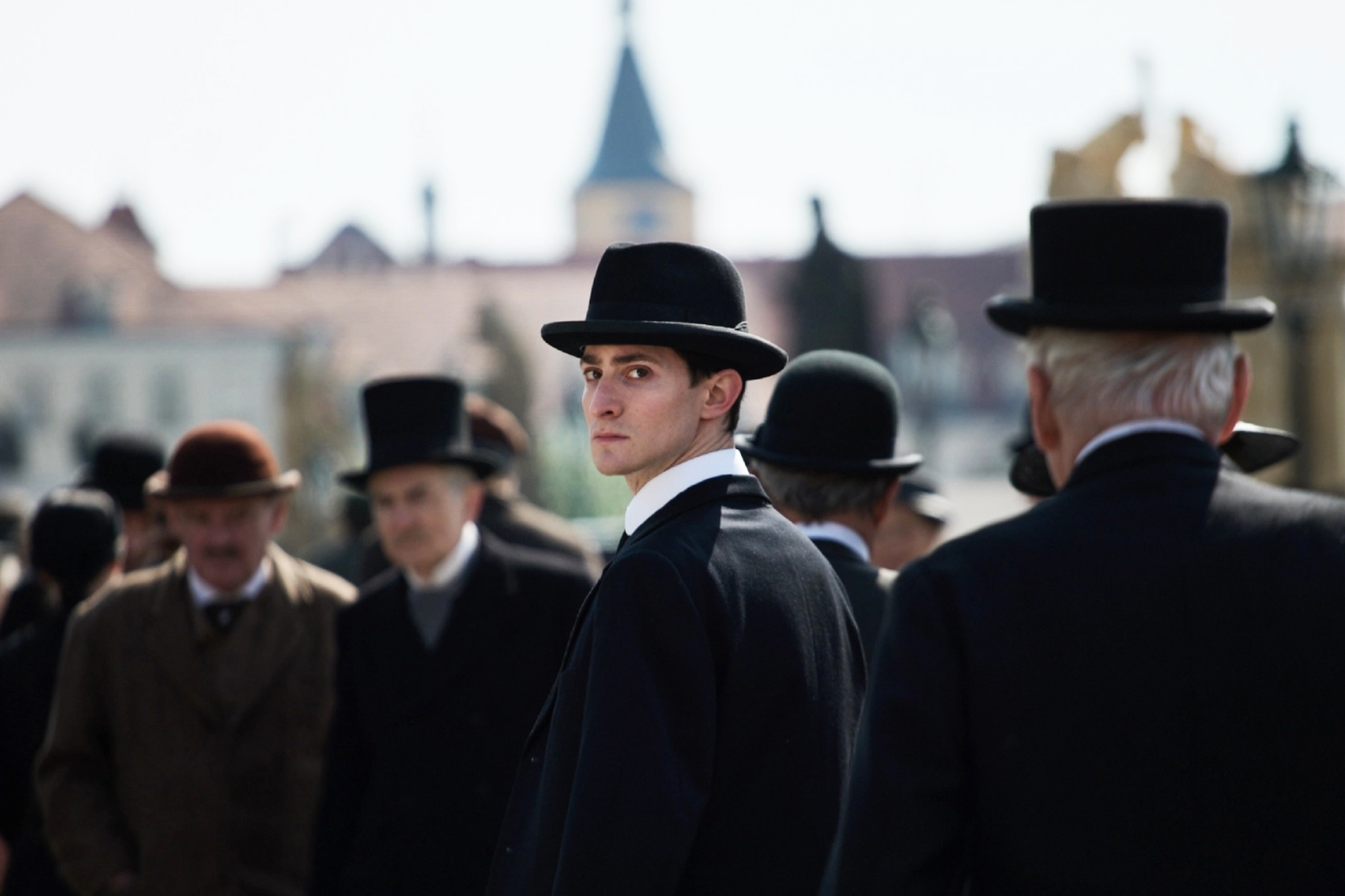
The deliberately simple title of Agnieszka Holland’s Franz avoids mentioning her subject’s surname, with its inescapable, almost clichéd associations. “Kafkaesque,” anyone? Becoming Kafka is used as a subtitle in the marketing, but doesn’t appear on screen.
It’s as if Holland wants to avoid the conventions of the biopic as much as she can. Her portrait, co-written with Marek Epstein, is an accumulation of vignettes and fragments that envelope the viewer in a concentrated, dense, sometimes playful fashion. It deals with aspects of an individual life and elements that lie beyond it. It is not chaotic, exactly, but the pieces don’t always add up or fully cohere.
Holland, seventy-seven, a Polish director whose strong, varied body of work includes Europa, Europa, In Darkness, The Secret Garden and Green Border, went to film school in Prague, where the German-speaking Kafka was born and lived most of his life. She first read his work as a teenager, and in 1980 adapted his novella The Trial for television.
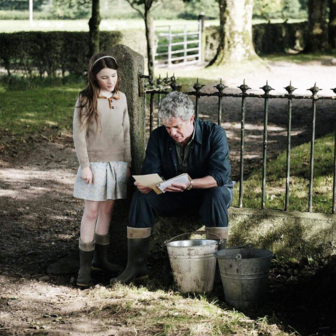
In her approach to Franz, Holland is still committed to the notion of character and performance. German actor Idan Weiss, who bears a striking resemblance to Kafka, embraces every aspect of his role: anxieties, idiosyncrasies, obsessions and philosophical speculations, as well as Kafka’s impulsive, light-hearted side. The relationship with his overbearing father (an impressive Peter Kurth) has a defining power from his earliest years.
Figures from Kafka’s life sometimes address the camera as if they were appearing in a documentary. They are not shown as conventional taking heads, but in the midst of activities of one kind or another. At times, their reflections serve a kind of narrative function; on other occasions they emphasise the contradictions inherent in trying to sum up a life.
Nor does Franz follow a strict chronology. Holland’s timeline extends well beyond her subject’s life: although Kafka died in a sanatorium in 1924, the film takes us into the future, sometimes only by a matter of years, sometimes directly into the contemporary world. We see Franz’s beloved sister, Ottla (Katharina Stark), wearing a yellow star as she discusses with her husband why it might be advisable to divorce. (She was to be murdered in Auschwitz in 1943.) We see Kafka’s close friend Max Brod (Sebastian Schwarz), encountering an SS guard on the train as he flees with his wife to Palestine carrying Kafka’s papers.
Holland plays with different possibilities when it comes to Kafka’s authorial afterlife and posthumous celebrity; there is a scene, for example, that imagines that Brod might have followed his friend’s wishes, and burned all his manuscripts. And her depictions of the Kafka-based tourist industry that flourishes in Prague have a heightened, often satirical tone, a mixture of the imagined and the real. A cafe offers Kafka Burgers; a kinetic sculpture of Kafka’s head, bigger than the Statue of Liberty’s, stands in a square. A Kafka museum is a stylised location. Theories are circulated: a tour guide claims him as a quintessential third millennium figure — a man who preferred to write to people rather than meet them in person. Another guide tells us the ratio of words written by Kafka to words written about Kafka is estimated to be around one to ten million.
A writer’s life and a writer’s work are different things, as Holland clearly acknowledges. There are scenes of Kafka reading aloud, but no attempts to capture surreal, nightmarish “Kafkaesque” moments, although — as Franz presents his short story “In the Penal Colony” to a stunned audience — Holland introduces a slightly disconcerting, visceral recreation of the hideous torture machine Kafka has imagined. It is a rare literal moment in a film that is generally elusive and allusive, alive to the impossibility and undesirability of locking down and defining a subject, especially one this complex.
Isabelle Huppert plays the title character in Thierry Klifa’s The Richest Woman in the World, a tale of affluence and influence closely based on a real-life scandal that rocked France from 2010 onwards.
In this fictionalised version Huppert is Marianne Farrère, who rules her billion-dollar cosmetics empire with an iron hand and exercises the same control at home. When she poses for a magazine shoot with photographer Pierre-Alain Fantin (Laurent Lafitte), everything changes: her life is turned upside down and her authority redefined. Before long Fantin takes charge of almost every aspect of her existence, reorganising her decor, her clothes, her social life, her holidays, her spending habits. Everything seems to be on the table. Frédérique (Marina Foïs), Marianne’s daughter, tries to fight his influence, but he’s a formidable opponent.
In many of its details this resembles the real-life story of Liliane Bettencourt, who presided over the L’Oréal conglomerate founded by her father. A power struggle within the family led to a scandal that included revelations of wartime collaboration, allegations of political bribes and favours, financial impropriety and elder abuse.
Klifa, also a co-writer, steers clear of the political dimensions, focusing mainly on the relationship between Marianne and Pierre-Alain. The performances are a study in contrasts. Huppert has an extraordinary less-is-more gift, a way of suggesting inner life with the smallest of details: a slight movement of the head, a sidewise look, the fluttering of eyelids. She can also be a commanding presence. Her Marianne has been sustained by the certainty that comes from knowing that wherever she is, everyone in the room must defer to her. She answers to no one. But in Pierre-Alain she has met her match.
While Huppert works with tight restraint, Lafite goes over the top. He’s a versatile actor accustomed to playing villains, and he gives Pierre-Alain a snarky, insouciant, gleefully provocative edge. He likes to humiliate others, to throw his weight around, to shock when he knows it’s safe to do so.
His relationship with Marianne is not sexual — he makes it clear he is gay and has a younger lover. He is more like a co-conspirator inviting her to share in his adventures. It’s as if the brash, bullying, wayward Pierre-Alain gives the tightly wound Marianne permission to indulge herself in ways she never dreamt of.
At the same time, he assumes her position of power. She allows him to order her around, to make decisions for her. She rewards him compulsively in the only way she knows how: by showering him with money and gifts. Over time, she becomes more vulnerable, a little vague, and he amps up his demands; finally, Frédérique decides that enough is enough, and she is willing to risk the publicity that is bound to follow.
In the end, however, there’s something cautious at the heart of this film, a lack of ambition. No matter how strong the performances, there is a limit to what the actors are able to achieve in a work that dilutes the strength of the material and its possibilities.
David Lowery’s heavyweight pop confection Mother Mary is not a biopic or a ripped-from-the-headlines drama, but it does revolve around a central figure who suggests a number of real-life inspirations.
Anne Hathaway plays the title character, a pop megastar who goes by the name of Mother Mary (no other name is mentioned). Her signature look involves a halo that appears in various forms in every costume iteration. She comes across as a kind of a diva soup: a little bit of Lady Gaga with a touch of Madonna and a sprinkling of Taylor Swift. Hathaway does her own singing, with new material courtesy of Charli XCX and FKA Twigs.
The performance footage of these songs is skilfully handled: Lowery has the resources to conjure up the look of a stadium show. But Mother Mary is essentially a chamber piece, a claustrophobic drama about the intense relationship between Mary and her onetime costume designer, Sam (Michaela Coel) re-ignited after a long estrangement.
The film opens with a bedraggled Mary finding her way to Sam’s home and studio workplace, ostensibly in search of a new dress for her imminent comeback performance. But it gradually emerges that she wants more than this.
Coel is masterful as the composed Sam, whose response is simultaneously guarded and ruthless. She coolly interrogates the seemingly penitent Mary about what she wants, and about their shared history, in scenes that are long on dialogue but short on detail. Coel carries them with the force of her delivery, which has both a forensic precision and an incantatory, mesmerising charge.
These scenes start to drag, however. Buried secrets threaten to resurface, but the mystery of Mother Mary concerns not so much the characters or their past, or whatever Faustian pact might exist in their shared narrative: in the end, it’s more a case of “What kind of film is this?” Halfway through it flips, taking a supernatural turn that feels almost arbitrary, a lurid conjuring trick that might be intended to haunt but barely lingers. •