Until the day before, the location was described only as “inner southeast,” and when my brother and I got there we found a guard outside. Such are the times we live in for any Jewish-run event. On a rainy morning a few Sundays ago the room held about fifty people, most of them Jewish, I assume, though a young Muslim woman later came forward to light a candle.
We were due to get a video message from Aziz Abu Sarah and Maoz Inon, a Palestinian and an Israeli who work together for peace after both losing relatives in the conflict — Sarah’s brother died of injuries sustained in Israeli custody and Inon’s parents were killed by Hamas on 7 October. But the computer failed. A few men stared at a laptop, balefully tapping a key, until a young, bearded bloke wearing a yarmulke took the mike: “I’m Hoff. I’m the tech guy. I’m an introvert, and not very good at public speaking,” He grinned shyly: “I’m also not a very good tech guy.”
But it was just a glitch, and soon the face of a handsome man in his early fifties, with wiry grey hair, filled the large screen at the end of the room. Mo Husseini, a Palestinian-American, was speaking to Friends of Standing Together, the Melbourne branch of an organisation of Jewish and Palestinian Israelis dedicated to — wait for it — peace in the Middle East.
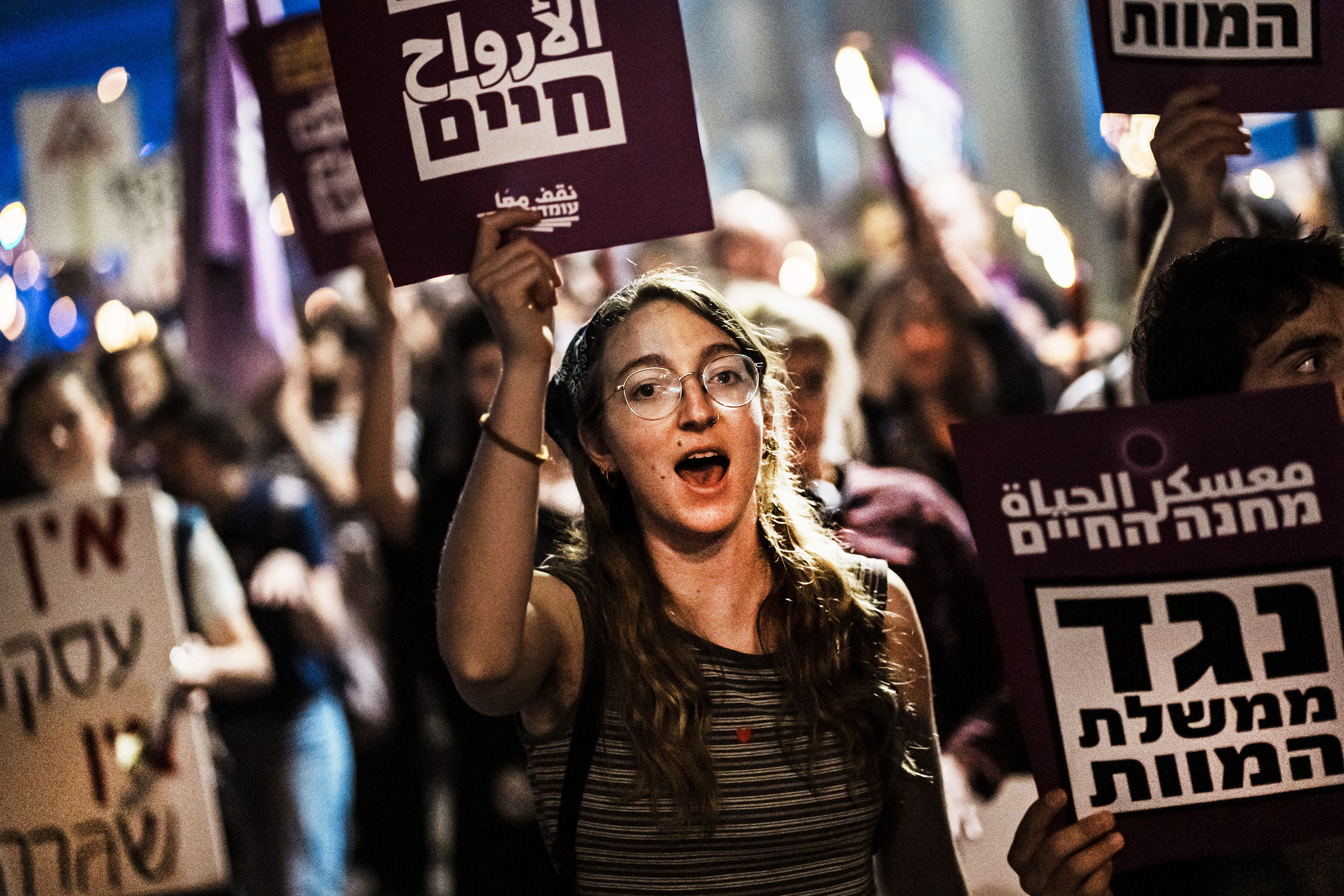
Founded in 2015, Standing Together stands for an end to the occupation of the Palestinian territories, peace and independence for both peoples, and “full equality for everyone in this land.” It has 7000 members in Israel, about two-thirds of them Jewish, a third Arab. It’s a small number but membership has more than doubled since October 2023. (It also has 250,000 followers on social media.) Standing Together has collected food and clothing for Gaza residents and protected food trucks entering Gaza from attacks by far-right Israeli groups. Israeli novelist David Grossman, who has written powerfully about the conflict, has spoken at Standing Together rallies.
Husseini, who lives in Washington State, is a filmmaker, novelist and member of the national launch committee for Friends of Standing Together USA. A piece he published in May 2024, “50 Completely True Things,” got more than half a million reads, perhaps because he found a fresh and funny and heartfelt way to write about a conflict that has nothing fresh or funny about it. Husseini grounds his writing not in the region’s endlessly litigated history and politics but in a principle. Two peoples live on this land and both have a right to live in peace and dignity. Start there.
But starting there is difficult, a point Husseini made right off the bat when he thanked people for coming. “I don’t say that as a pleasantry, I mean it. Being involved with Standing Together when the world is rewarding people for picking a side, for the comfort of tribe, for the dopamine hit of certainty, is a choice that carries a cost,” one that was rarely acknowledged.
Husseini spoke for half an hour without notes and in the strange intimacy of Zoom, which shows every twitching eyebrow or thought crossing a face. Noticing a young boy in the front row, he apologised in advance for a few “swears.” I sensed a man not convinced of his own wisdom but feeling his way, through speech, towards his version of the truth.
“I am a Palestinian,” he began. “I am not the Palestinian. I do not speak for any Palestinians. I can barely speak for myself most days.”
His family, carried across borders “by the shifting winds of history,” migrated from Palestine to Kuwait, where Husseini grew up, then to the United States. Husseini always felt he was from somewhere else, “somewhere you can’t go back to.” Belonging was a kitchen, food, a certain accent, the way his mother said the word, “home.” “Being Palestinian is frankly a shitty gig.” But “I wouldn’t trade it for anything. I carry it with pride and love, and a ferocity that sometimes surprises me.”
What profoundly shaped his thought was living in America after 9/11. As a cultural Muslim, with a name that “sounds like the names of the people who flew the planes,” Husseini felt a relentless pressure to make himself understood to people who saw him as dangerous or didn’t see him at all. A pressure to show in every conversation that he was a moderate, to condemn al-Qaeda and bin Laden, to make a “performance of harmlessness that is hard to describe unless you have lived in it.”
It was hardly the worst thing in the world, Husseini said, and he wasn’t asking for sympathy.
Nevertheless, in the looks he got on planes and in theatres, in the random body searches that weren’t random, “I learnt in my body, in my heart, what it feels like when a whole society decides that who you are matters less than your category or tribe or religion… when you stop becoming a person and become the representative of a people.”
That lesson was why he became a writer, and why he joined Standing Together. Because, Husseini said, “that same machinery, that same impulse to condense an entire people into a single dangerous silhouette,” was now being applied to Jews.
He didn’t elaborate much on what he meant, but in a recent piece he wrote of “the way Zionist has become, in some corners, a synonym for Jew… the way criticism of Israeli policy slides, sometimes by accident and sometimes very much on purpose, into something older and uglier.” Speaking to Australians while the royal commission was hearing testimony about the shocking extent of antisemitism in this country, Husseini didn’t need to explain.
Husseini said his listeners often asked him a hard question: how could he as a Palestinian extend understanding to a people that was actively oppressing Palestinians? By talking about Jewish pain alongside Palestinian pain, was he not letting Israel off the hook?
The answer was easy, Husseini said. “I’m not both-sidesing this.” The power was not equal; occupier and occupied were not on the same moral plane. “My anger at what Israel is doing to Palestinians is not diminished by one single degree… I judge the occupation, the settlements, the bombing of hospitals, the taking of land and the uprooting of olive trees, the entire apparatus of domination that has made Palestinian life broadly unliveable for generations.”
But, he said, he refused to take the next step: “that because the Israeli government is doing these things, somehow every Israeli is complicit… somehow all Jewish people are guilty.” Because that was the step that had always been used against Palestinians.
“Activists really need to hear this,” he said. “The people who want you to flatten, who want you to say they are all the same, who want to treat everyone on the other side as a stand in for the worst of the other side. You are handing the Israeli right the narrative it needs: ‘See, they all hate us, there is no partner, the only option is more walls and more bombs.’
“You don’t defeat an unjust system by becoming its mirror image, you defeat injustice by becoming the thing that injustice says is impossible — people from both sides in the same rooms refusing to be what the system needs them to be.”
Lest anyone think his vitriol ran only one way, Husseini took “careful aim” at his own side, because “intellectual honesty is not a buffet where you get to skip issues you don’t like.” The Palestinian leadership’s “corruption, authoritarianism and factional cannibalism” had catastrophically failed its people for decades, Husseini said. Leaders had refused to accept imperfect peace deals that might have saved lives. The Hamas “cult of martyrdom” that “feeds children into a meat grinder and calls it resistance” had gotten the people of Gaza killed in catastrophic numbers.
But he was not here, Husseini said, to weigh Israeli failures against Palestinian failures, misery against misery, who had suffered more — “that exercise itself is the poison, the thing that keeps the conflict locked in place.”
Instead, the path forward required “everyone to look at their own house with the same ruthless clarity that they bring to looking at the other guy’s.” Until that happened, “we are not serious about peace, we are serious about being right — and being right has never in the history of any conflict saved a single life.”
Husseini turned to the role of story-telling, and of Jews, in his life. “Before I had a conversation with a Jewish person, I had lived in Jewish stories: books, films, arts, music. They all did something no political argument could have done. They let me feel in my body what it is like to carry a different people’s history. Not to agree with it but just to understand it.”
It was through stories that Husseini learnt that Jewish people were “not performing their fear. Their fear and trauma is real, it comes from somewhere ancient and it lives in their children in the same way my trauma lives in me. A good story makes flattening impossible… you cannot reduce them to a slogan. You know they are a person.” Even a paragraph that “captures someone mid-scroll” on their phone — “that crack is the beginning of something, everything that happens in rooms like this.”
Husseini took a few questions from the room, then left with an apology and a grin: his son’s last soccer game of the season was about to begin.
A young guitarist, Samantha Levy, stepped up to sing Leonard Cohen’s Hallelujah in Arabic — words she said she had learnt from a Palestinian man. An organiser, Abe Schwarz, closed the event by pointing out that Husseini had quoted a line from Anthem, another Cohen song: “There is a crack in everything, that’s how the light gets in.” He asked us to support a project to provide food to Palestinian families in the West Bank displaced by Israeli forces. And if people wanted to stick around, he said, Jewish, Israeli, Palestinian and Arab people would be meeting that afternoon in this room to talk about the conflict.
People milled around, moved by Husseini’s talk. I was, too, yet something in me resisted these sweet notes at the end. Were they a balm to try to soothe the unending bitterness of this conflict? We would leave, stirred, with Cohen’s “sacred chord” humming in our heads, when only darkness seemed to lie ahead.
Five days after October 7, 2023, Standing Together signed a statement made by twenty-nine Israeli civil society groups calling for negotiations with Hamas to free the hostages and opposing the war that was about to begin. Dozens of members left the organisation as a result, no doubt feeling its line was too soft given the barbarity of the attacks and the ongoing threat posed by Hamas. At that time the organisation and one of its leaders, Alon-Lee Green, were getting 2000 threatening messages a day, after right-wing groups published their addresses.
And when an Israeli military action freed four hostages in Gaza in 2024, Jewish and Arab leaders of Standing Together struggled to write a joint statement that struck the right balance of joy at their release with pain at the collateral loss of Palestinian life. The organisation’s rule that it presents one united position to the two communities can be hard to uphold.
While Standing Together locates itself proudly on the left, it has few friends among the global left that has so ardently embraced the Palestinian cause. The Boycotts, Divestment and Sanctions movement, which since its founding in 2005 has sought to ostracise Israel in global forums, called Standing Together a “normalisation outfit that seeks to distract from and whitewash Israel’s ongoing genocide in Gaza.” Speaking on American campuses after 7 October, Alon-Lee Green and another Standing Together leader, Sally Abed, a Palestinian citizen of Israel, had the bizarre experience of white student protestors wrapped in keffiyehs telling her she was normalising Israel, and telling him to go back to Poland.
I wondered whether Standing Together’s traditional leftist rhetoric of solidarity, justice and struggle would limit its ability to grow in a country that has shifted sharply to the right since the suicide bombings of the Second Intifada in the early 2000s. But it is not the only voice calling for a middle way.
On the Palestinian side I’m thinking of Ali Abu Awwad, who founded the Palestinian non-violence movement, Taghyeer (Change), and Samer Sinijlawi, president of the Jerusalem Development Fund. In the diaspora there are the British-Palestinian blogger John Aziz, and in the United States, Ihab Hassan and Ahmed Fouad Alkhatib.
None of these writers is blind to the torment of their people. They’ve lived it. Alkhatib has lost thirty relatives, many to Israeli airstrikes, in the war in Gaza. Awwad and Sinijlawi both spent more than four years in Israeli jails after taking part in the First Intifada. In 2000 Awwad was shot by an Israeli settler while changing a tyre in the West Bank; an Israeli soldier shot his brother dead at a checkpoint. Nevertheless, all three have chosen to work with Israelis in calling for what Sinijlawi, in one of the most moving recent articles I’ve read on the conflict, calls dignity for Palestinians based on security for Israelis.
Such voices exist on the Israeli side — probably more of them — but given how much their people are the underdogs in this conflict, the voices of these Palestinian writers leap off the page. They get a lot of contempt — John Aziz is regularly called an Uncle Tom — and are seen as naive dreamers at best, but they might be not only the bravest but the most practical people in the conflict. They work in the space between millennial fantasies on the right and left: of one supremacist Jewish state and the elimination of the Jewish state. They have their own dream, but they also have a strategy to achieve it, one that looks hopeless… and is the only hope.
Husseini said he wasn’t by nature an optimist. “I’ve spent years writing about a conflict that has not gotten better and in the past two and a half years has gotten unspeakably worse.” Yet he held onto the “stubborn, possibly irrational, delusional” idea that “two peoples have lived before on this land and can again.”
Change would come “person by person, grain of sand by grain of sand” until, when the diplomats finally met to negotiate a final outcome, they would find the foundation for peace already built beneath them. Hope was not a feeling but an action, Husseini said. “It’s rolling up our sleeves and getting on with it.”
We left feeling a sliver of that hope, not a lot but a sliver. I’ll go to another Friends of Standing Together event. Hope to see you there. •
Hiba Qasas from the Geneva-based Principles for Peace Foundation and Gil Murciano from the Israeli Institute for Regional Foreign Policies are speaking on the Roadmap to Peace in Sydney on 1 June, Canberra on 2 June and Melbourne on 4 June. Details: New Israel Fund.