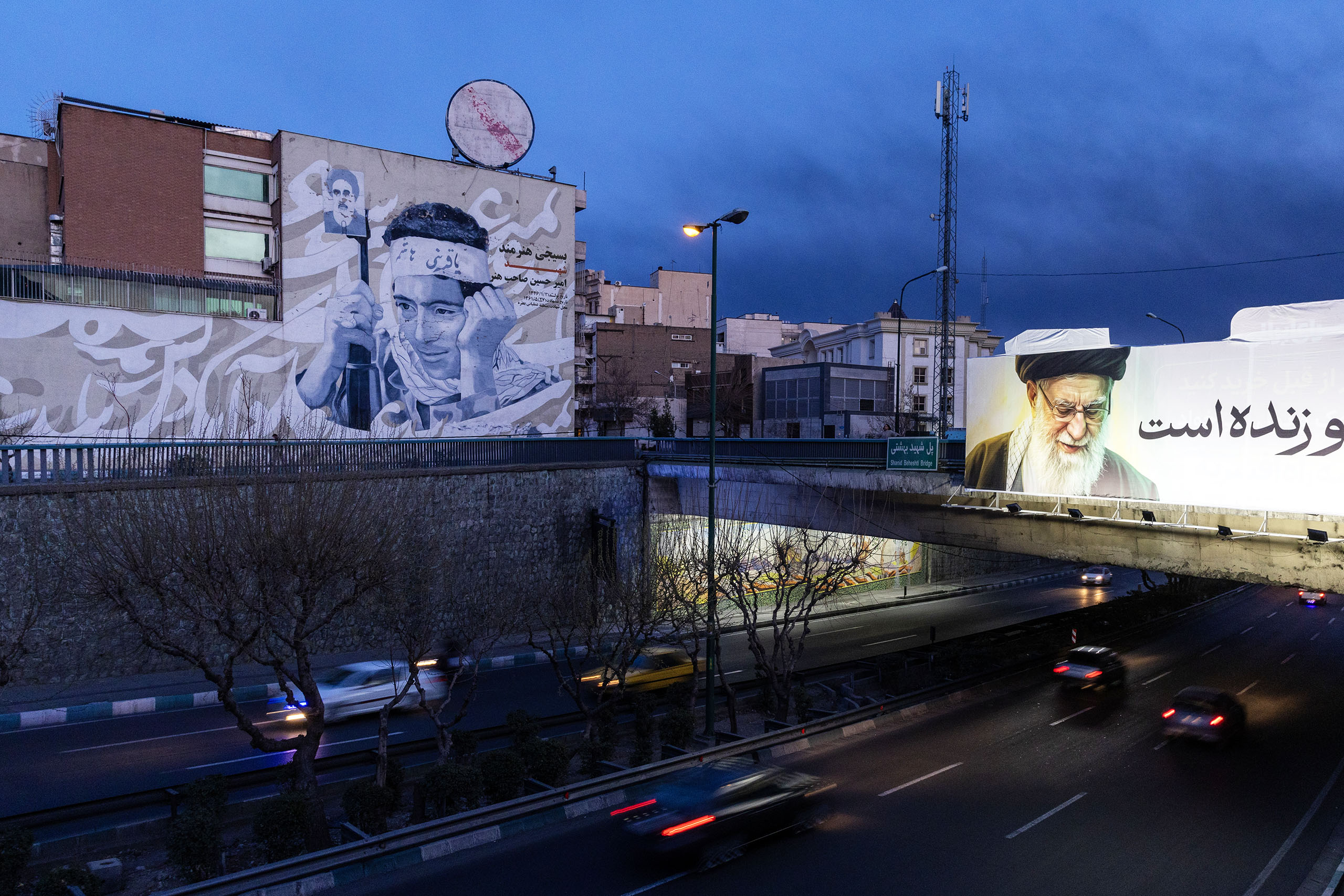
For some pundits watching Donald Trump and his cabal plunge the United States into another foreign strike, this time against Iran in alliance with Israel, the search for paradigms led to cartoon characters and plots. Among them was the conservative British-American historian Niall Ferguson. Despite supporting Trump’s action, he couldn’t resist opening his commentary on the attack with the sardonic anthem from Team America: World Police, the animated film released just after George W. Bush launched his war in Iraq:
America, fuck yeah
Comin’ again to save the motherfuckin’ day, yeah
America, fuck yeah
Freedom is the only way, yeah
Terrorists, your game is through
’Cause now you have to answer to…
America, fuck yeah…
“For the habitual critics of US foreign policy in general and Donald Trump’s in particular,” Ferguson wrote, “the analogy between today’s air raids against Iran and the invasion of Iraq nearly twenty-three years ago is too obvious to be resisted.” He even conceded that the South Park team (which made the film) “understood before many commentators that the United States has a track record of coming to save the day and leaving a trail of devastation.”
Yet, he went on, there’s “one thing I can confidently promise about the US–Israeli war against the Islamic Republic: it will not last long.” Unlike Bush in 2003, Ferguson said, Trump’s aim is “not to march into Iran and confer, much less impose, freedom on the Iranians. It is to decapitate the Islamic Republic’s political structure and leave the Iranians to take their freedom from the mullahs and their murderous henchmen.”
Defence and intelligence agency denizens headquartered at Russell Hill in Canberra, wary of instant punditry like Ferguson’s, will also have been looking for the logic in Trump’s Operation Epic Fury. Defence department secretary Greg Moriarty, heading to Washington to replace Kevin Rudd as ambassador, will be particularly focused. The message he is likely to take with him from Australia is: wrap it up quickly, don’t expect an immediate transformation of the Middle East (as some of Bush’s advisers did in 2003), and get your eyes back on the main game: the challenge of China.
The Middle East has long consumed American strategic attention, along with its military resources and political capital, notes Jennifer Parker, an analyst close to Canberra’s defence thinking. “That sustained focus constrained Washington’s ability to compete as effectively as it might have with China,” she wrote in the Nine papers. “The Indo-Pacific was emerging as the central theatre of strategic competition while the US and its allies remained absorbed elsewhere.”
In 2025 and 2026, Parker reminds us, “aircraft carriers were diverted from the Indo-Pacific, where they were intended to deter China, to respond to crises in the Middle East. For a country that identifies China as its primary strategic competitor, that reallocation sits uneasily with its stated priorities.”
In Canberra and elsewhere, defence ministries will also be wondering about the capacity of American forces to sustain operations while keeping stockpiles of munitions for contingencies in Eastern Europe and around Taiwan. The Financial Times reported the Pentagon has ordered fewer than 650 high-altitude interceptors since 2010 and could burn through large quantities quickly in a sustained exchange. As many as 150 are thought to have been used during last year’s twelve-day war with Iran. Officials said “magazine depth” might constrain the scope or duration of operations and force trade-offs affecting US commitments in Ukraine and the Indo-Pacific.
China has so far given no sign of taking advantage of the Abraham Lincoln aircraft-carrier group’s move to the Gulf region from its normal East Asia station. Ahead of the annual National People’s Congress session this month, Xi Jinping seems preoccupied with his purge of the People’s Liberation Army top ranks, his latest victim the general in charge of the military region facing Taiwan. Trump’s planned visit to Beijing next month is going ahead, with disruption of China’s oil supplies from Iran a reminder of his unpredictable power.
Trump’s justifications for the war are getting knocked down as soon as they are put up, as much as both his allies and his critics agree the Iranian paramount leader Ayatollah Ali Khamenei will not be missed.
Iran was resuming work on nuclear weapons, and getting close to producing them, Trump claimed. But after the US–Israel air strikes on its enrichment plants last June, he had already declared that capacity obliterated. The Iranian stockpile of enriched uranium seemed to be entombed under rubble, and a day before the 28 February attack, the Omani chair of Vienna talks between US and Iranian delegations had declared good progress towards agreement on meeting US concerns about nuclear enrichment and weapons development. The talks were due to reconvene on Monday, when an agreement would just meet Trump’s deadline.
Then there was Iran’s ballistic missile program. US officials told reporters they had information that Iran was planning a pre-emptive strike using ballistic missiles, creating an “intolerable” threat to US interests in the region and soon the American homeland. But sources in the Pentagon soon said that was nonsense: though it had missiles able to reach parts of Europe as well as the Middle East, Iran was many years away from achieving intercontinental missile capability.
And finally there was regime change: the aim of removing the theocratic tyranny that repressed its own people and pursued a regional agenda of violence and threats directly and through its network of allies in Lebanon, Syria, Gaza and Yemen against Israel and America. But the Iranian regime was already reeling from sanctions, currency collapse, drought and a recent wave of protests quelled only by massacres. For more than two years since the violent Hamas breakout on 7 October 2023, Israel had blitzed and decapitated Iran’s regional allies.
And then, two days after the attack, US war secretary Pete Hegseth said the operation was not a “democracy-building exercise” and nor was it an “endless” commitment like the Iraq war. “It turns out the regime who chanted ‘death to America’ and ‘death to Israel’ was gifted death from America and death from Israel,” said Hegseth. “This is not a so-called ‘regime change war’, but the regime sure did change.”
Assassinating a leader is not the same as regime change. If anyone is going to change the regime, it has to be the Iranian public, the people Trump is urging to rise up without giving a commitment to further help.
Adding to the discomfort in Canberra is the fact that the Trump administration has made crystal-clear that it sees Israel as its pre-eminent ally — and, what is more, an ally it is willing to be led by.
The administration was negotiating nuclear limits with Iran last June when Benjamin Netanyahu launched an air strike that Trump felt obliged to join. B-2 bombers carrying deep-penetration weapons were duly mobilised. This is what happened last Saturday too: Netanyahu acted to prevent any possibility of Trump reaching a nuclear deal with Tehran. If anything about the US attacks was pre-emptive, that was it.
As US secretary of state Marco Rubio admitted on Monday, the US attacked not because Tehran was preparing a missile strike but because the US feared Iran’s retaliation after Israel assassinated Khamenei. “There was absolutely an imminent threat and it was that we knew that if Iran was attacked and we believe that they would be attacked, that they would immediately come after us and we were not going to sit there and absorb a blow,” Rubio said. He tried to walk back this telling remark on Tuesday, with a new narrative taking Israel out of the decision chain.
The administration has drawn an unfavourable comparison between Israel and other old allies, notably Britain whose prime minister, Sir Keir Starmer, refused permission for any of the initial attacks against Iran to be launched from the Diego Garcia base on the British-controlled Chagos Islands in the Indian Ocean. Trump told London’s Daily Telegraph he was “very disappointed in Keir” over this refusal. “This is not Winston Churchill that we’re dealing with,” Trump said later at a White House meeting with the German chancellor, adding that the closure of British bases had added hours to transit times for the Iran attacks.
Hegseth also criticised “traditional allies,” accusing them of being hesitant and indecisive about using military force. Israel was a “capable partner” with a clear mission, Hegseth said, while other allies would “wring their hands and clutch their pearls, hemming and hawing about the use of force.” He went on: “America, regardless of what so-called international institutions say, is unleashing the most lethal and precise air power campaign in history… No stupid rules of engagement, no nation-building quagmire, no democracy-building exercise, no politically correct wars. We fight to win, and we don’t waste time or lives.”
So it really is: Fuck, yeah!
Starmer later changed British policy to allow its bases to be used for operations against Iranian missiles and drones, and for British forces to join such operations. This followed advice from his attorney-general, Richard Hermer, that any British military involvement in the conflict would have to be purely defensive to be legal.
“President Trump has expressed his disagreement with our decision not to get involved with the initial strikes,” Starmer said in parliament. “But it is my duty to judge what is in Britain’s national interest. That is what I have done. And I stand by it.” He declared his decision “in accordance with international law,” adding: “We all remember the mistakes of Iraq… we will not join offensive action now.”
Australia was too far away for its bases to be used directly for the attacks, though the joint satellite ground station at Pine Gap might have relayed operational signals to US forces. The only Australian forces in the Gulf region currently are about a hundred air force and army ground crew operating a transport base inside a vast US–Emirati military airfield near Dubai, which came under drone attack without damage.
Still, it has been an awkward time for Anthony Albanese, Richard Marles and Penny Wong. Although the US build-up was blatant and Trump’s threats explicit, they seem to have had no advance notice of the Israel-led attack. Now they are bystanders to a chill between their two partners in the AUKUS nuclear submarine and high-tech alliance. Moriarty will no doubt work hard to convince the US administration that Australia is not a “pearl-clutching” ally, but one to be trusted to do the right thing by America with scarce submarines.
But they supported the US action: Iran was a destabiliser, its nuclear and missile programs a risk, and Khamenei’s regime a cruel one. They have quickly dodged questions about its legality, saying this was a matter for the US and Israel to judge — as if international law is what protagonist nations say it is.
Like other allies relegated to the second rank, Canberra will be wondering how much more of the rule book will be jettisoned by Trump’s team. The dispute with the artificial intelligence developer Anthropic is hardly reassuring. The company wanted assurances written into its contracts with the Pentagon that its AI systems would not be used to direct fully autonomous lethal weapons or for mass surveillance of US citizens. Hegseth thought this an outrageous restriction and got Trump to bar Anthropic from any and all government contracts, though its AI application, “Claude,” was still being used by US forces to prepare the Iran attack.
Meanwhile, Albanese and other allied leaders will be dealing with the fallout: tens of thousands of travellers stranded in the Gulf; oil and gas prices possibly spiralling with the Hormuz Strait closed and Qatar shutting down its massive LNG plants; waves of Shia Muslim protests and mourning for Khamenei in far-flung Islamic communities including in Australia; and perhaps, when Iran’s rockets run out, a fanning out of terrorists seeking martyrdom.
Meanwhile, have the analysts all been looking at the wrong set of possible goals motivating Trump? In a perhaps prescient article, an anonymous writer in Asia Sentinel looks at Trump’s record and finds “neither a neocon warmonger nor a liberal interventionist” but “a distressed assets hunter.”
The article continued:
In the White House’s current calculus, Venezuela and Iran are not sovereign nations defined by borders and flags. They are underperforming energy super-majors holding a combined 511 billion barrels of reserves, run by boards of directors viewed as incompetent, hostile, and ripe for removal… If Venezuela was the pilot project, Iran is the Grand Prize. With 208 billion barrels of proven oil reserves and the world’s second-largest gas deposits, its strategic weight dwarfs that of Caracas. Control over Iran is not just about resources. It is about controlling the thermostat of the global energy market. Yet Trump views Iran through the same prism: a massive asset suffering from a severe liquidity crisis and a breakdown in internal order. The catalyst for Trump’s escalation was not a specific terrorist threat but the wave of protests beginning last December. The collapse of the rial [Iran’s currency] to historic lows and hyperinflation signalled that management in Tehran had lost its social capital and solvency.
The cynicism spreads even into the pages of Rupert Murdoch’s empire. “If you were in a bunker in Tehran or Karaj,” asked columnist Matthew Syed in London’s Sunday Times, “would you rise up against the Iranian regime on the basis of Trump’s call to arms when he might, even now, be negotiating with a Revolutionary Guard general to cement the regime in place, as he did in Venezuela, on the proviso oil flows west rather than east?”
So far, the Islamic Republic’s institutions are moving ahead with deciding on a successor to Khamenei, who was eighty-six. Three senior Islamic scholars appear to be contenders, including a son of Kamenei and a grandson of the regime’s founder Ayatollah Ruhollah Khomeini. The new ayatollah will be chosen by a panel of eighty-eight clerics, whom Israel is trying to assassinate as well through further air strikes. The officer corps of the defence and security services are already starting reshuffles to replace the generals also killed in US and Israeli air strikes.
A forty-day mourning period declared for Khamenei will be marked by orchestrated displays of anger and grief. The humiliated Iran Revolutionary Guard Force, with 190,000 personnel and controlling somewhere between 20 per cent and 40 per cent of Iran’s economy, along with the 450,000-member Basij security volunteers and the 420,000-strong regular military will be vigilant against any rejoicing at Khamenei’s death coalescing into protest.
Persuading a new ayatollah to retreat from Khamenei’s failed promotion of an “axis of resistance” against Israel and the West might be a more tangible goal for Western statecraft than an explicit revision of theology. Progress on Palestinian statehood and the promise of a lifting of sanctions linked to good behaviour would help.
So Australian defence planners will probably have to put up with American military efforts being drawn off to the Middle East for a long time yet. At least this time, there seems to have been no pressure, or willingness, to join in. •