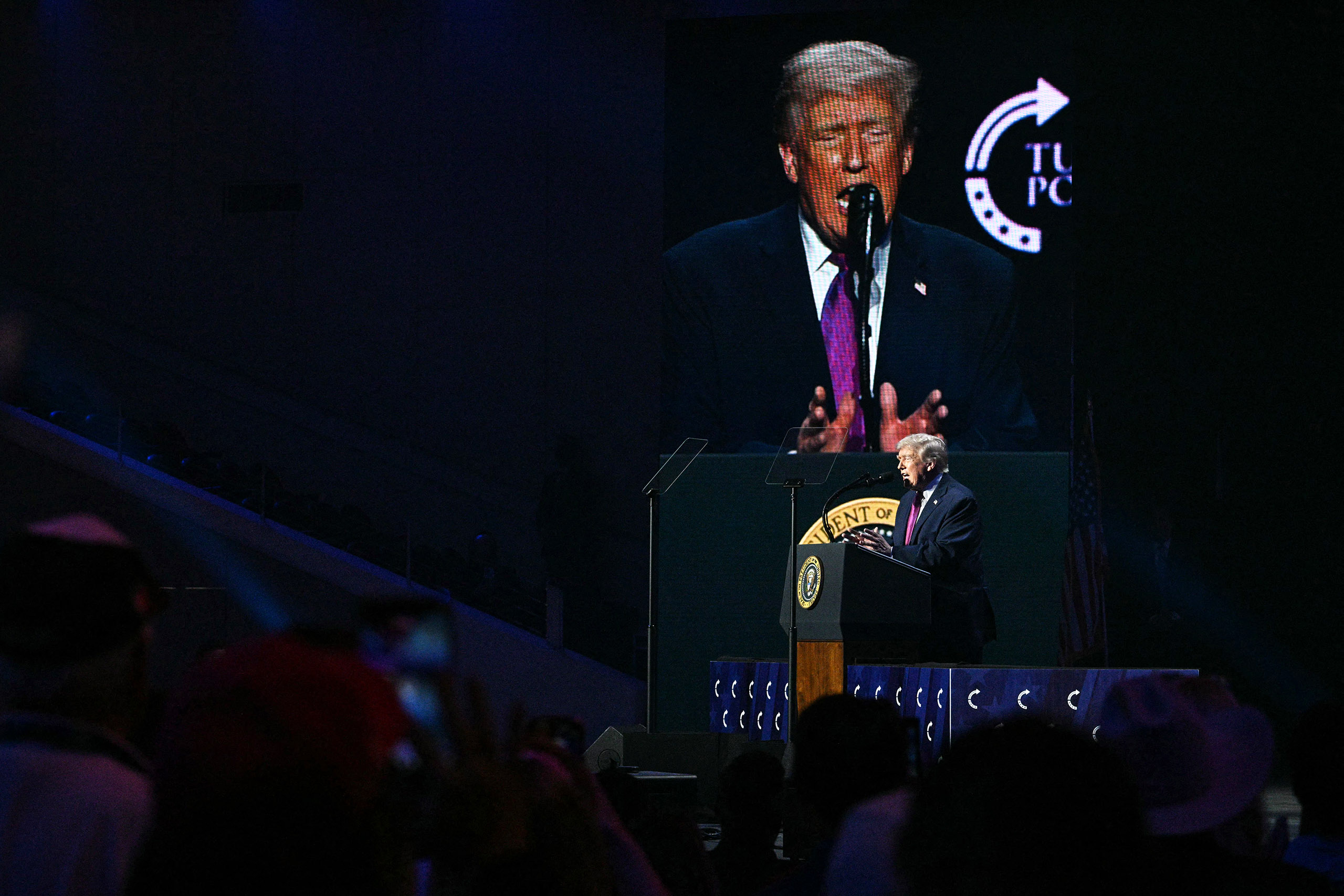
With the midterm elections just over six months away, Donald Trump and congressional Republicans are face with the likelihood of shocking losses. Not only is history against them — a president’s party has lost ground in twenty of the past twenty-two midterm elections — but polls show Trump’s historically low approval ratings are influencing party support where it counts.
Democrats need to flip just three seats in the House of Representatives to secure the majority. In the Senate, where Democratic gains were until recently considered unlikely, some pollsters see a possibility of a Democratic majority, with four seats in play.
A president’s job approval always strongly influences congressional losses in midterm elections and Trump’s is at an all-time low. (One poll average on 14 April had it at 39.7 per cent.) Approval of Trump among population groups that provided key support in 2024 — young voters, Hispanics, and independents — is low enough to more than offset gerrymandering by some Republican-led states. (California’s and Virginia’s retaliatory redistricting will help too.)
Trump — ever one to deny the facts — recently insisted in a Fox News interview that the Republican party is “going to do good” this year. Yet he also acknowledged the size of the task, telling host Maria Bartiromo: “When somebody gets elected president, that party always loses the midterms. I don’t know why. I don’t know why. Nobody can explain it. I ask people who are deep into the psychological world. I said, ‘Why is it that a voter votes for the opposite party?’ even when you have a good president. It doesn’t make sense to me. So we’re going to try turning it around.”
He’s worried because he knows what the loss of the narrow but unified Republican majorities in the House and perhaps the Senate would mean. There would be no more legislative victories (not that he has been keen on legislating this term) and lots more congressional oversight, potentially including more impeachment hearings. History also points to the likelihood of down-ballot losses in governorships and state legislatures.
Despite his concerns about the outcome, Trump’s focus has so far been scattered. He has implemented measures to undermine election integrity, issued orders to Republican states about gerrymandering, pushed to restrict mail-in voting (which could also work against his own supporters) and limit voting rights in general, and made selective endorsements of MAGA candidates. But his administration is doing little to tackle the issues voters are most worried about: cost-of-living pressures, the affordability of healthcare, jobs and the economy. Trump’s rallies almost always end up being about him and his grievances, and his insistence that the economy is booming is meeting with scepticism even among his supporters.
Republicans are increasingly worried that the Middle East conflicts, violent immigration enforcement and tariffs, along with Trump’s obsession with Washington buildings and monuments and nasty, unnecessary fight with Pope Leo, are making a difficult election even more so.
“Everything is made more difficult by the nonsense coming out of 1600 Pennsylvania Avenue,” a Republican close to the White House told Politico, which also reported a senior adviser to Trump’s 2024 campaign as saying, “The road to victory runs through a consistent economic message. Unfortunately, President Trump ignores the road map.”
Outside the United States, Trump is increasingly seen as out-of-touch, even unhinged, a bully on the issues he cares about, and an unreliable ally. Foreign policy and international opinion are rarely significant for American voters, but this year might be an exception.
Trump campaigned on a promise of American isolationism, pledging to end foreign military engagements and focus on domestic renewal. Instead he has inserted himself incessantly into global affairs — threatening Canada, Greenland and Cuba, bullying Ukraine, supporting right-wing politicians in Europe, violently changing the leadership in Venezuela, setting up a personally selected Board of Peace to run Gaza, and launching a war with Iran without any apparent exit strategy. Small wonder voters are anxious about global issues, and especially Iran.
Polling shows a majority of Americans (59 per cent, including 29 per cent of Republicans) say striking Iran was the wrong decision, with 61 per cent, including 31 per cent of Republicans, disapproving of Trump’s handling of the conflict. The fighting in the Middle East has led to MAGA factionalism and a significant drop in support among young Republicans.
It isn’t just that voters are concerned about increasing military involvement and the use of nuclear weapons. The enormously expensive war must be paid for, and Trump’s budget for the financial year that starts of 1 October demands a record-breaking US$1.5 trillion for defence. That means cuts to the social programs so many Americans rely on. At an Easter lunch, Trump said it’s “not possible” for the federal government to fund Medicare, Medicaid and childcare costs and argued these programs should be the states’ responsibility because “we’re fighting wars.” On top of that, petrol prices — always a consumer obsession — are continuing to climb.
In the months ahead, Trump and Republicans must walk a political tightrope to keep happy a number of key constituencies beyond those worried about the costs of Trump’s engagement in foreign affairs.
There are the many women are worried about how the Dobbs decision on Roe v Wade is limiting their access to reproductive healthcare, counterposed with the anti-abortion activists who have blasted Trump’s “lack of action” and claim he has “fooled” the pro-life movement with his failure to restrict abortion pills and decision to approve a new, generic version of mifepristone, which is used for medical abortions. There are Catholics appalled at his war of words with the Pope and his co-opting of religious imagery, and the ultra-conservative evangelicals and media figures (not to mention vice president J.D. Vance and House speaker Mike Johnston) who support this blasphemy. And there are the Make America Healthy Again supporters who are angry that Trump and his health secretary are supporting increased production and use of the toxic weedkiller glyphosate and want to see more done to eliminate vaccine mandates.
With Republicans’ planned hyping of Trump’s economy now looking less like a winning strategy, indications suggest the party will use the threat of impeachments to get MAGA out to vote. It will be interesting to see how individual members of Congress up for re-election behave over the next few months, especially as 15 April, the deadline for tax returns, is seen as the unofficial start to the midterm campaign.
A huge wave of Republican retirements can be read as a sign of congressional frustration. While none of those sticking around for re-election so far seem likely to speak out publicly against Trump — his control over congressional Republicans remains complete and unrelenting — their concerns about their own electoral futures might see them overcome this obeisance if his approval ratings continue to sink.
Democrats, meanwhile, have been buoyed by strong fundraising and some spectacular wins in special and state elections. Partly the wins reflect shrewd candidate picks, including Mikie Sherrill and Abigail Spanberger in the New Jersey and Virginia gubernatorial races. Democrats have flipped four state legislative seats in special elections this year after flipping seven in 2025.
Congressional Democrats know they can’t just be anti-Trump. They are reported to be focusing on affordability and the Trump administration’s fiscal policies, and planning to highlight healthcare, housing, electricity and other utilities, and caregiving. They will need to outline legislative solutions to these problems. To fund improvements in the social safety net, progressive Democrats have proposed (yet again) raising taxes on the rich. This time it might fly, after all, even if Trump has considered it.
Inspired by the ouster of Hungarian prime minister Viktor Orbán, Democrats are also looking to use the anti-corruption playbook against Trump, his family and his administration. House Democrats have just announced a taskforce to overhaul ethics rules, protect access to the ballot and examine the Trump family’s business dealings, corruption in the executive branch, and the president’s transformation of the federal government.
At the same time Democratic representative Jamie Raskin, the ranking member of the House Judiciary Committee, has introduced a bill to establish a “Commission on Presidential Capacity to Discharge the Powers and Duties of the Office” to examine whether the president is fit to serve in office (as per section 4 of the 25th Amendment). This bill won’t go anywhere in this Congress, but it signals how Democrats in the majority will push back against Trump and his administration.
While Democrats are demonstrating how they might function should they take back the House, Senate Republicans are acting to safeguard the conservative nature of the US Supreme Court (a sure sign they are worried about the outcome of the midterms). Trump has been nudging Justices Samuel Alito and Clarence Thomas to retire so he can appoint their replacements (they both say they are sticking around). Senate majority leader John Thune has said the Senate is prepared to confirm a replacement for Alito before the midterm elections should he retire — clearly indicating that Thune would not abide by the rule his predecessor Mitch McConnell invoked to block Merrick Garland from succeeding Justice Antonin Scalia (but then ignored so Amy Coney Barrett could succeed Ruth Bader Ginsburg).
More broadly, there is much uncertainty and anxiety about whether this will be a normal election year. As historian Robert Kagan has pointed out, it would be a mistake to think Trump will be happy to let adverse results stand: “There’s no chance in the world that Donald Trump is going to allow himself to lose in the 2026 elections, because that would be the end of his ability to wield total power… They could not be more obvious about what their intention is.”
Earlier this year, a Washington Post article showed how Trump, guided by the Heritage Foundation’s Project 2025 and what he and his advisers learned in 2020, is using “every tool he can find to try to influence the 2026 midterm elections and, if his party loses, sow doubt in their validity.” He may not have the authority to make many of these interventions, but history shows that doesn’t mean he won’t try. •