In November 1969 the Australian journalist Francis James failed to return home to Sydney from Hong Kong, his last scheduled stop on an extended overseas trip. On both his outward and return journeys he had visited China, a country in the throes of the Cultural Revolution, his ease of entry testifying to his good political standing in the socialist world.
Ease of entry doesn’t always mean ease of exit. En route to Hong Kong from the Canton Trade Fair, James was stopped at the border and taken away by security guards. Then, for more than eighteen months, his whereabouts were unknown. Australia didn’t recognise the People’s Republic of China at the time, and even if the government had been interested in James’s plight no official routes of communication existed between the two countries.
As it happened, opposition leader Gough Whitlam was a friend of the missing journalist. During his historic first visit to China in 1971, Whitlam received confirmation James was alive and in prison on charges of spying. Elected in December 1972, Whitlam promptly initiated diplomatic relations with China and James was released. By the time he made it back over the border into Hong Kong he had spent 1169 days in prison, much of it in solitary confinement.
Half a century later, that story played out again for another Australian journalist, Cheng Lei. Her new play, 1154 Days, is a dramatisation of the events in August 2020 that wrenched her out of a comfortable life as a TV business journalist in Beijing and subjected her to six months’ detention in solitary confinement followed by a formal arrest and imprisonment on charges of spying.
Like James, Cheng was released after a change of government in Canberra and a consequent improvement in Australia–China relations. Her story has been told often and on different platforms. She has written a book about her experience, A Memoir of Freedom (reviewed for Inside Story by Hamish McDonald) and has appeared in a documentary, Cheng Lei: Her Story, broadcast on Sky News. With this play, which premiered on 28 May at the North Melbourne Arts House and ran for five nights, she tells her story yet again. It’s worth seeing, and I imagine its creators hope to have it staged in other cities.
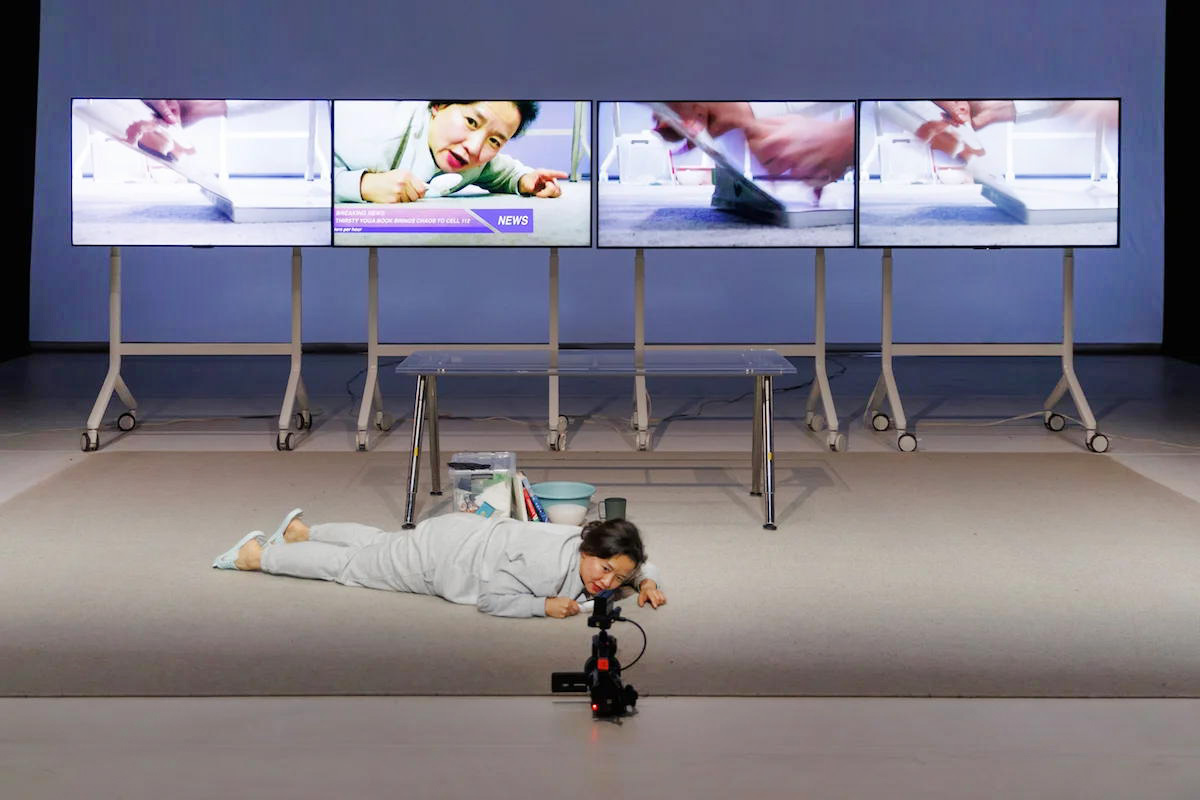
Cheng worked with two collaborators, Emma Valente and Clyde White, to develop the script, and performs her own character. Accompanying her on stage are two young people who act as her prison guards early in the play and then, in the final scene, assume the characters of her half-grown children. Otherwise, 1154 Days is a one-woman show. In a public but intimate space — the theatre enables an audience of no more than 132 — she acts out what happened to her. There is something cathartic about the performance.
The play falls into six parts. In the opening scene, performed in front of closed curtains at the front of the stage, she describes her life before prison. We see a busy, confident, breezy Cheng talking in Chinese and English, singing, appearing on television (a constant prop) and changing in and out of the clothes that equip her for her many roles in life as a television journalist with two children and a busy social life in Beijing.
The contrast could not be greater with the Cheng Lei of Part 2, a woman in prison garb, sitting motionless and reduced to silence, with one guard by her side and another standing directly before her. She can ask permission to exercise (one or two paces forward and back) and to use the toilet, guard still by her side. Such is life for someone under what the Chinese legal system calls “residential surveillance at a designated location,” which might sound like house arrest but is actually a form of enforced disappearance.
Six minutes of this on stage — sitting, exercise, toilet break, bed, sitting, exercise, toilet break, bed — is sufficient to give the audience a good idea of the six months she spent in those conditions. Her relief at finally being moved to a normal prison is palpable.
Part 3 of the play is about life in prison with three cell mates. Four television screens show four pairs of feet, scuffs and trouser ankles differentiated, prison tubs showing the few belongings of each. The cell mates come to life in Cheng’s interactions with them. Together they pace out the closely regulated days.
She takes time out from the re-enactment to talk to the audience directly. Her first Christmas in the cell was memorable, she says, for the first time they all sang together. She taught them “Silent Night.” The singing went on, surreptitiously, for the next twenty-two months.
Disarmingly, there is a kind of love story. In Part 4, Cheng Lei makes contact with a male prisoner in the neighbouring cell, devising a laborious code to communicate with him by knocking on the wall. The man’s name is Bo (which means wave) and she discovers he is a nuclear scientist. He owns a dog and she surmises he is kind. He occupies her waking hours, filling her starved human heart. After two weeks, guards discover the knocking. They are both punished, and he is moved away. The audience is left wondering where he is now.
The denouement comes in Part 5. After more than three years, Cheng Lei is finally about to be sentenced. She sings what will be a last song with her cell mates, although she doesn’t yet know that she won’t see them again. The song is Cindy Lauper’s “True Colors”:
You with the sad eyes
Don’t be discouraged
Oh I realize
It’s hard to take courage
Taken from her cell, she is again in court, willing herself not to hope for a short sentence. At this and many other points in the play she shows the strategies she employs to stay sane. Reading is one, although her quota of books is limited; singing is another; learning the names of all the world’s capitals cities is a third. But with the struggle against hope in this final stage of her imprisonment, she reveals more clearly than at any other point the importance of mental health for her survival.
In fact, the sentence is for time she has mostly already served. The means to convey the drama of this moment has eluded the playwrights and the audience can only lean into the moment as the real woman who has been through this real experience covers her face in front of them on the stage, overwhelmed.
For this audience, it is touching to hear Cheng Lei’s expressions of nostalgia for things Australian: the sunshine, most of all, but also mangoes and broccoli. Perhaps she had always thought of herself as having two home countries, just as she speaks two languages, hardly noticing when she shifts from one or the other. But it has become clear to her that China is not home. In the final scene, “back home,” a green coverlet on the stage serves as grass for a picnic with the children. The kids squabble briefly. The boy wants his sister’s chips. The girl is fixated on her phone. After a while they are all up on their feet, kicking a soccer ball around the stage. The sun is shining.
That contrast between the prison and the picnic inevitably leaves an impression of “Australia good, China bad.” Perhaps for this reason, the play ends with a corrective message, delivered in a sequence of didactic statements rolling across the screen at the back of the stage. “China is not simple,” the audience is told. It needs to be considered with “nuance.”
There was a moment of nuance in the Q&A held after last Friday’s performance, when Cheng Lei spoke about the prison guards during her initial time of “residential surveillance.” They were very young, she remarked, technical school students recruited for a job they took on without much knowledge about what it entailed. Cheng felt for them. One was ill with diarrhoea during her shift and had to stand on guard in her soiled clothing, having her pay docked afterwards for the breach of whatever bizarre rule might have covered this exigency.
But there was little in the Q&A to mitigate the critique of China offered in the play. In discussion with compere Qian Jinghua, Cheng engaged with the larger political issues it raised. Among these was journalism: namely, the reduction in truthful, fearless reporting about China, a place where everything is focused on the stability of “the system” (the Communist Party) and nothing is for the people. Qian and Cheng spoke together of the need to support the citizen journalists in China. “There are now knocks in the middle of the night to check on people’s ID,” remarked Cheng. “That never used to happen.”
Even as this discussion was taking place, news was breaking that the New York Times journalist Vivian Wang had been expelled from China in February. Wang follows a long line of journalists in recent years who have either been expelled from China or have fled the country in fear of their personal safety. Australian journalists Bill Birtles (from the ABC) and Mike Smith (Australian Financial Review) were evacuated in September 2020 after being subjected to interviews about Cheng Lei by the Ministry of State Security.
In his 2025 review, Hamish McDonald places Cheng Lei’s A Memoir of Freedom in a genealogy of works by Australians held aspolitical prisoners abroad: Peter Greste, Kylie Moore-Gilbert, Sean Turnell. It might be better placed in the rather longer genealogy of books written by political prisoners of the People’s Republic of China. The writers are mainly foreigners but they include some Chinese. Jean Pasqualini (Bao Ruowang) was both: the son of a French father and a Chinese mother. His Prisoner of Mao, published in French in 1973 with an English translation appearing in 1976, is a searing account of his seven years detention in laogai (reform through labour) camps and stands as the archetype of the China incarceration story.
Francis James didn’t write a prison memoir, but his story, like Cheng Lei’s, has been staged. The James Dossier, written by journalist and playwright Bob Ellis, was a musical celebration of James as the hero of his own life — an eccentric production befitting a truly eccentric man. Prison seems not to have made much impression on James other than expanding his knowledge of the works of Mao Zedong. Back in Australia he would advise bemused audiences they should be reading Mao alongside the Bible. When the Chinese government cleared him of all charges in 1986 and invited him back to China on an all-expenses-paid tour, he accepted with alacrity.
It is difficult to imagine anything comparable happening to Cheng Lei. Asked in the Q&A whether she would ever go back to China, she answered simply that she had been deported and there was no way for her to return. She simply wouldn’t get a visa. Her reply brings to mind the reflections on exile by US-based writer and academic Kang Zhengguo. Kang spent three years in a labour camp but he found the constraints on his life outside the camp almost as unbearable as the conditions within it and in mid-life was glad to exchange his Chinese passport for an American one. In his memoir, Confessions: An Innocent Life in Communist China, he reflects on the irony of having a native land that is a place of danger rather than safety, one you want to flee rather than return to.
Kang Zhengguo grew up during the Mao years. Watching Cheng Lei’s play about imprisonment during the Xi years prompts the question: after all this time, what has changed? “Like a spider in its web in a dark corner of the room,” writes Kang Zhengguo, “the Security Bureau [is] always lying in wait for its prey.” •