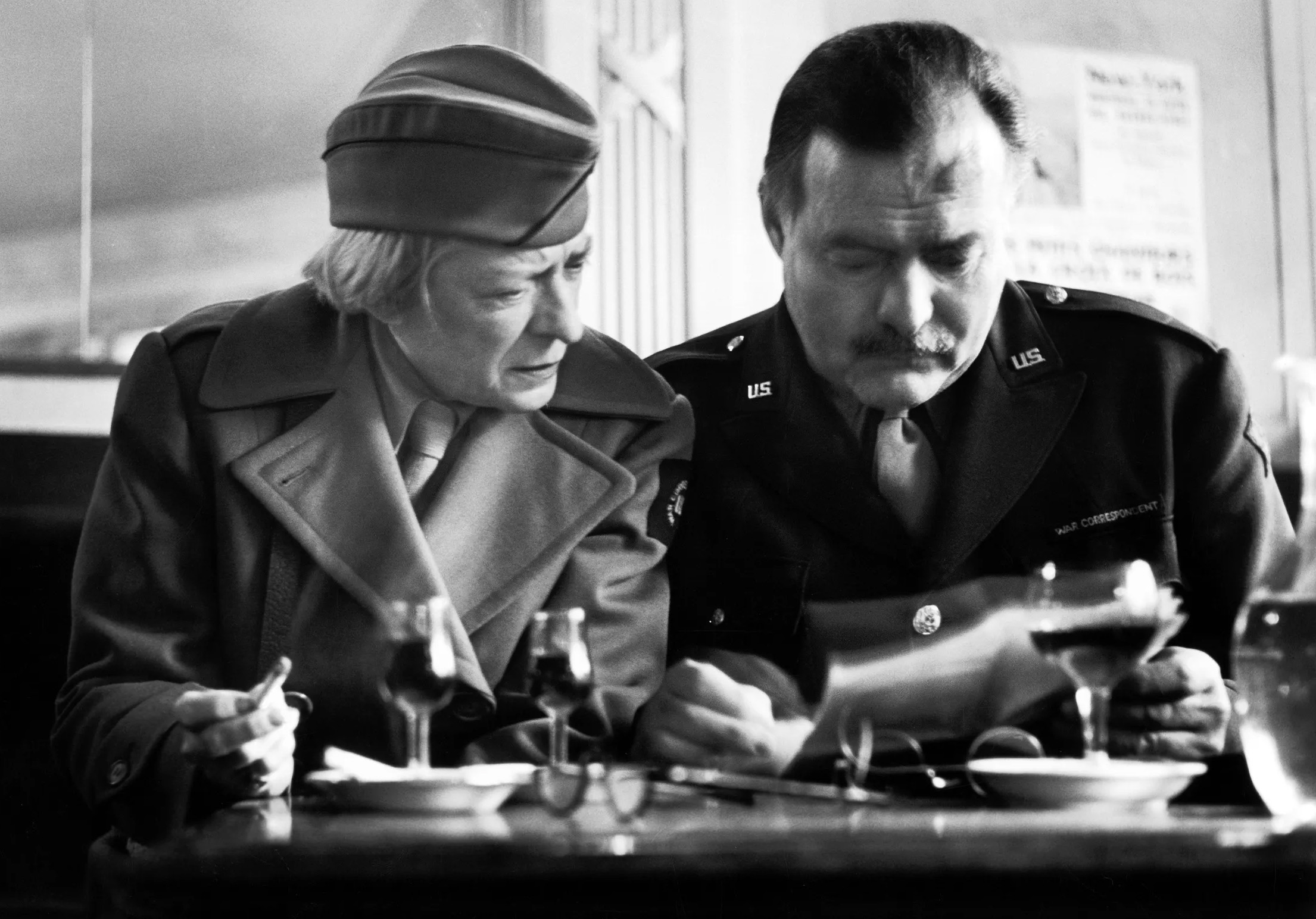
She was a novelist and journalist, a member of the Algonquin Roundtable, a pal of Hemingway’s, and for half a century the New Yorker’s Paris correspondent. In the latter guise, she moulded the magazine’s voice and outlook, helped establish its mix of “essay journalism,” and paved the way for the reconstructed narratives John Hersey made famous. She profiled Hitler, scooped journalist colleagues with articles about Nazi war crimes, and in later years was the bemused audience to a televised slanging match between Gore Vidal and Norman Mailer.
Janet Flanner is not a familiar name today, but by any measure her career is worth knowing about. Born in Indianapolis in 1892, she saw in her hometown’s endless tabletop of corn fields a life of excruciating boredom. At age twenty, she reacted to her father’s suicide by choosing to live wildly, careering out of her university studies and into a succession of journalism jobs she swiftly made her own. Unwisely married, she escaped to New York and then into a relationship with actress and writer Solita Solano, with whom she decided to emigrate to Paris in 1922.
Like so many other young Americans, Flanner was intent on writing about “beauty with a capital B” in the City of Light. With aspirations on a level with Henry James, Laurence Sterne and “any of the Brontës,” she picked up the odd bit of journalism while pouring her early energies into a novel. Cubicle City (1926) was the result. Though it has since been grouped with landmark works of queer literature including Radclyffe Hall’s The Well of Loneliness (1928), Virginia Woolf’s Orlando (1928) and Djuna Barnes’s The Ladies Almanac (1928), its lack of contemporary success tempered Flanner’s willingness to persevere with fiction. As a friend said, her desire to write fiction exceeded her talent at it.
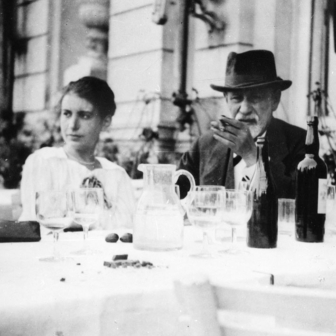
But Flanner’s ability with the real was something else. Her letters about life in Paris to family and friends back in the United States sparkled. Whether she described the people strolling through the Tuileries Gardens, what was being said around the nightclubs and galleries, or the dramas and scandals of the American expatriates who increasingly crowded the cafes and bistros, she had a talent. As friend Jane Grant said, Flanner’s letters were “so gay and attractive.”
Moreover, in Grant’s view, such letters would fill a vital gap in the new, weekly magazine her husband had recently founded. “The New Yorker,” Harold Ross famously declared, “will be a reflection in word and picture of metropolitan life. It will be human. Its general tenor will be one of gaiety, wit and satire, but it will be more than a jester. It will not be what is commonly called highbrow or radical. It will be what is commonly called sophisticated, in that it will assume a reasonable degree of enlightenment on the part of its readers.”
Finding a Paris correspondent was part and parcel of such a pitch: Ross expected his readers to be versed in all things French and regard Paris as the world’s centre of art and fashion. For them, Flanner’s letters — as Grant soon wrote to her — were “just the thing.” Thus, for $40 a pop, she should commence sending to the magazine 1000-word letters containing “anecdotal and incidental stuff familiar to Americans… Dope on fields of the arts and a little on fashion, perhaps… There should be lots of chat about people seem [sic] about and in it all he [Ross] wants a definite personality injected.”
Flanner swiftly realised that tone and voice were more important than subject matter. Ross was an editor obsessed with finding the precise word, with prose that was direct and as tight as a drum. Thus, Flanner’s voice became cultivated but detached, wry and often pithy. It resulted in letters that were endlessly amusing. Ulysses, she wrote, was the book “the civilised half of a half-civilised world has long been humbly waiting.” The dadaist writer Tristan Tzara was “a great man of small stature.” A book by Jean Cocteau provided “an hour’s delight” and a memorial to the inventor of camembert cheese unfortunately resembled “a slice of gruyere.” “There is no justice,” she added.
Signed “Genêt,” Flanner’s letters began appearing in September 1925. She would continue filing them — albeit with breaks — for another fifty years. And the magazine she likened at this time to an “oversized minnow learning how to swim” soon became the blue whale of the literary and publishing world.
Mark Braude’s Typewriter and the Guillotine tells the story of that evolution through Flanner’s experiences and work. It is the most notable and most interesting thread of his book, and if it is a story told before — in Brenda Wineapple’s fine biography of Flanner (1989) and in Ben Yagoda’s comprehensive history of the New Yorker, About Town (2000) — it gets a welcome retelling here.
Perhaps most refreshing is Braude’s focus on the women in that “Lost Generation” of artists in Paris. While Hemingway, Joyce and the others make their due appearances, Braude pays more attention to the innovative women also working at their craft and enjoying life on the continent. Cameo appearances by Gertrude Stein, Alice Toklas, Nancy Cunard, Collette, Edith Wharton and more are enlivened by striking details: Djuna Barnes’s preference for nude suntanning, for example, or Toklas’s single-minded interest in herbs.
A central conceit of the book is that the New Yorker’s evolution paralleled an evolution in Flanner’s work. At first, Braude writes, Flanner wrote in a “casual, loose style,” conversational and reminiscent of the cafes in which she gathered information, and left it to editors to refine her prose. Soon, however, she was doing that herself.
The context of her work also evolved. If the Paris she initially wrote of was simultaneously elegant and rough, glittering and squalid, it was also an old-world metropolis in a period of sustained change, where iconic cafes were unceremoniously shuttered and new fashions and ideas in art were constantly swirling. But Flanner rarely wrote about the “lingering sense of mourning” that abided in Paris. Exacerbated by Europe’s economic uncertainty and social unrest, the trauma of the first world war arguably lay at the root of the hedonism and pursuit of abandon charted by Flanner’s letters.
This was not a subject Flanner was prepared to probe: as Wineapple wrote, she believed her Genêt persona was “a high-class gossip columnist.” It couldn’t do that kind of work. Nor was the New Yorker pushing Flanner to do so. As magazine colleague E.B. White once joked, the only strong political stance the New Yorker took in the 1930s was on a proposal to relocate the information booth at Pennsylvania Station. It simply was not part of the magazine’s outlook to be overtly political or so engaged.
This began to change in the 1930s, when Flanner started regularly visiting Germany. At first, her attention to the darkness amid the glitter was fleeting: writing in 1931, she acknowledged that Germany had produced “workers without work and capitalists without capital,” that there was “terrible want in certain quarters.” But, as Braude notes, Flanner then “moved quickly from that gloomy material” to the giddy decadence of the Weimar Republic’s restaurants and cabarets and general party atmosphere.
Two years later — by which time Adolf Hitler had been sworn in as Germany’s chancellor — the darker facets of the country were clear. Signs outside towns announced that Jews were not welcome, Nazi flags were everywhere, and the harassment of foreigners and Jews was not even disguised. During one trip, Flanner saw a Jewish boy “being marched down the street with a placard around his neck, confessing to the sin of kissing a non-Jewish girl.” And yet still her despatches shied away. As she wrote lightly, “All over Europe, 1933 has been a worrying kind of year.”
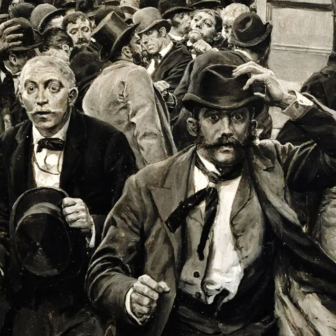
The New Yorker didn’t want her to look closer. “AVOID DANGER TAKE NO CHANCES,” the magazine telegrammed when news of riots in Paris reached American shores. The magazine needn’t have bothered: when she realised she couldn’t get through the crowded streets to see the action, Flanner left to have a beer at a brasserie with friends.
As time went on, though, that detachment, that deliberate inattention, became untenable. Flanner’s friends and social circles increasingly acknowledged there might be another war in Europe, and the social unrest evident in those riots continued to swell. By the second half of 1934, convinced Germany was going to “come and gobble France as sure as we sit here,” Flanner was pitching to Harold Ross a profile of the German chancellor. She was second-guessing herself, conscious of her limits and uncertain whether she could transcend them to write about such an important subject. Ross, meanwhile, was reluctant: he had earlier vetoed an interview with Mussolini as “out of bounds for us” and thought serious current affairs material was ill-suited for what he persisted in calling a “humour magazine.”
When it went ahead, the resulting three-part profile didn’t entirely vindicate either Flanner or Ross. Flanner had been fascinated by Leni Riefenstahl’s Triumph of the Will and aroused by the magnitude and precision of the German military she saw at the Nuremberg rally in 1935. But conversations with everyday Germans and a prolonged period of reading Hitler’s speeches and writings, including Mein Kampf, convinced Flanner that Hitler was a fanatic, that Germans were crazy, that war was likely, and that she shared all anti-Nazi attitudes. And yet she feared a profile saying as much would be used as crude anti-Nazi propaganda. As Braude writes, keenly, “She was a writer, not a publicist. She was certainly no diplomat.”
And so Flanner decided to write that profile in the style she would use for anybody, writing of Hitler’s life without any mention of whether people might agree with his views. She included a considerable amount of information about Nazi dogma, the number of bodies Hitler had climbed over in his scramble for power, and the violent outlook at the heart of the Nazi regime. Yet there was also a measure of detachment and wryness that seemed incongruous. As it began: “Dictator of a nation devoted to splendid sausages, cigars, beer and babies, Adolf Hitler is a vegetarian, teetotaller, non-smoker and celibate.”
It marked a change nonetheless. In 1936, when he asked Flanner to cover the Berlin Olympics, Ross added a new request — that she “get something of the [German] political and economic situation” into her work. And, particularly once the Spanish civil war broke out, Flanner focused more and more on political and military developments in Europe. Over the next three years, the tone of detachment faded and a sense of immediacy and presence took root. “It’s melancholic to see,” she wrote in May 1938, “how quickly humanity, if left free after its initial success, deserts the early, earnest union that gave its cause strength and squabbles itself to bits.”
Within two years, recognising the Genêt persona and style was now fundamentally wrong for the moment, Flanner began signing her columns with her own name. She would not return to Genêt until after Paris had been liberated.
Braude tells this story well, with evocative prose and a sharp eye for the tangible detail: readers will encounter many smells and tastes in this book. Less successfully, he also tries to graft another story onto Flanner’s life — that of German serial killer Eugen Weidmann.
In short, fragmentary chapters spliced between chapters about Flanner, creating an ominous drum beat through the book’s first two-thirds, Braude tells of how this social outcast and misfit turned criminal. Imprisoned in Germany for theft, Weidmann and several accomplices escaped to Paris with a plan to enrich themselves by kidnapping and ransoming rich foreigners.
The men were inept, and soon turned to murder. Weidmann killed six people, including a young American woman, Jean De Koven, unleashing a short and dramatic police hunt in the latter half of 1937 that ended with a shoot-out at a villa just outside Paris. Tried and convicted — a task made easier by his willingness to confess — Weidmann was executed, in public, by guillotine, in June 1939.
Given the geopolitical tensions and anxieties as well as the American press attention engendered by De Koven’s murder, it was no surprise that the trial took on a broader significance than its senseless and squalid crimes deserved. The prosecution and defence, for example, tried to claim Weidmann was representative of a broader German outlook and nature — of violence, bloodthirstiness and depravity. Told in hasty and cluttered chapters, the story of Weidmann’s trial is profoundly anti-climactic, not the least because of Braude’s decision to open the book with the scene of Weidmann’s execution.
According to Braude, strong parallels in Flanner and Weidmann’s lives warrant their stories being told together. But the parallels are generic and strained: “Both were foreigners in France… Both adapted quickly to their new surroundings… Both longed for beauty.” The intersection of their lives, meanwhile, is momentary. While Flanner reported on Weidmann’s trial and execution, nothing suggests it left a deep impression on her.
As a mark of her evolution, the fact she covered the trial is telling. As Braude writes, “She hadn’t come [to Paris] to write about decapitated murderers.” But the more important mark is surely that of her engagement with the looming Nazi shadow in the lead-up to the second world war.
Flanner certainly saw that. Her coverage of war crimes perpetrated by the Nazis, her reportage of the Nuremberg trials and her work on the Nazi looting of priceless cultural artefacts were indefatigable. And they inflected the New Yorker’s style and outlook thereafter.
As Ross wrote to her, in June 1946, “I think our transition to peace, art, amusement, frivolity, etc, will be gradual, and probably the magazine will never get back to where it was.” •
The Typewriter and the Guillotine: An American Journalist, a German Serial Killer, and Paris on the Eve of WWII
By Mark Braude | Grand Central Publishing | $65.99 | 421 pages