When the British ambassador George Macartney went to Beijing in 1793 with gifts of clocks, cannons, swords, woollen blankets and other British wares in the hope of creating the conditions for a reversal of Britain’s persistent trade deficit with China, Emperor Qianlong was unimpressed. “Our Celestial Empire possesses all things in prolific abundance and lacks no product within its borders,” he famously pronounced. “There is therefore no need to import the manufactures of outside barbarians in exchange for our own produce.”
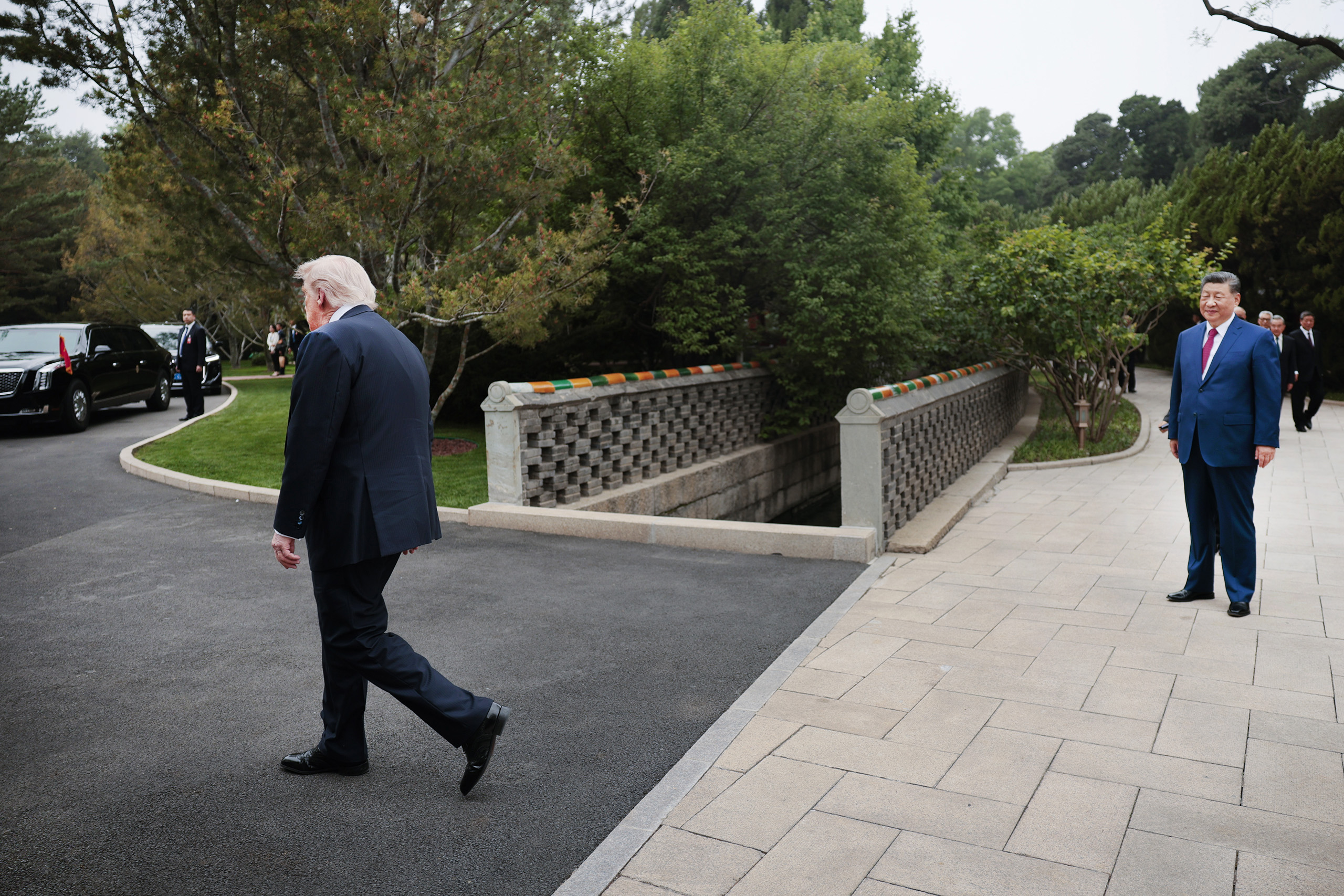
When Donald Trump went to Beijing last month he didn’t have to bend the knee, at least literally, to Chinese president Xi Jinping, as Macartney had to Qianlong. But the American president’s visit had echoes of that 1793 mission. Trump was the importunate barbarian, Xi the aloof possessor of all the advantages. Trump was effusive in his praise of Xi, who reciprocated in stiffly formal terms.
For the United States, the export pay-off was desultory: just the usual Chinese purchases of soy bean for its pigs and Boeing jets for its airlines. Hard questions about tariffs, semiconductors and rare elements were passed to new bilateral trade and investment boards. Xi offered no help with Iran.
In return for these meagre results, Trump bowed to China on two fronts. One was to concede equal status in world affairs, at least in the economic sphere. The other was to cross a bipartisan line on Taiwan, to some alarm in both Taipei and Washington.
In the first case, Trump agreed to Xi’s concept of a “constructive relationship of strategic stability.” Xi expressed the hope this would “transcend the so-called Thucydides Trap and create a new paradigm of major country relations.” (The reference was to the ancient Greek historian Thucydides, who recorded Sparta’s fatal effort to thwart the rise of Athens.)
If Trump understood and agreed, he seems to have willingly committed America to accepting that China is here to stay as a great power and abandoned any hope of squashing its strategic ambitions. The concession builds on the G2 (Group of Two) concept Trump and his team took away from their meeting with Xi in South Korea last October, a concept that alarmed America’s China hawks and some US allies as an implicit retreat from US “primacy” in the Western Pacific. Not only are many Americans unsettled but the Chinese and their neighbours in Asian are trying to deconstruct Xi’s words and Trump’s response.
A survey of Chinese-language commentary published in Sinification, an independent American newsletter that translates and unpicks policy debates within China, gives an insight into how Chinese analysts see the visit and its aftermath.
According to initial analysis at the China Institutes of Contemporary International Relations, an arm of Beijing’s Ministry of State Security, the Trum-Xi meeting puts US–China rivalry in “a new phase of strategic stalemate” — though it still needs careful attention to avoid “capsizes.” Another analyst under the State Security umbrella, Zhang Jian, sees May’s successive visits by Trump and Russian president Vladimir Putin as signs China was becoming a key “connecting point” in the emerging multipolar world.
Zhao Minghao of Shanghai’s Fudan University sees Trump’s willingness to accept “constructive strategic stability” as an important adjustment on the American side, demonstrating that flexible realism had become the foreign-policy principle US president favoured. America specialists Da Wei and Zhou Wuhua at Beijing’s Tsinghua University merge the concepts of the G2 and multipolarity into a “dual-core multipolar order” with China and the United States as the key players but middle powers having the space to hedge selectively between them, avoiding the hardening of cold war–style blocs.
But others see America aiming to hold on to the commanding heights in a new global economy. Among them is the Shanghai Development Research Foundation’s Jia Min, who dismisses the notion of “the East rising and the West declining” and points to the United States entering a new cycle driven by artificial intelligence. Far from having retreated from the globe, says Jia, the US has grown more flexible, more strategically attuned and more expansionary.
Di Dongsheng and Ji Xianbai at Beijing’s Renmin University argue that an emerging “techno-industrial complex” is driving the United States to abandon free-market orthodoxy for state-led industrial policy, civil–military fusion and resistance to regulation. This digital-age heir to the military–industrial complex would fuse big tech, the national-security state and venture capital into a single-interest bloc.
As the line between public power and tech capital blurs, Di and Ji expect the big technology companies’ grip on Washington to intensify. The increasingly powerful data and AI company Palantir has already shown how government contracts, revenue and valuation could rise together. Abroad, this techno-industrial complex is harvesting “war dividends” in the Ukraine, Gaza and Iran conflicts while using “small yard, high fence” containment to preserve American technological hegemony.
Even some of the optimists think that constructive stability can quickly be upset. “Since Washington’s overarching goal of strategic competition with China is unchanged,” writes Peking University’s Jia Qingguo, “relevant US government departments are still likely to roll out policies that Beijing reads as confrontational, thereby undermining the stability of the relationship.”
Contrasting with those mixed views, China’s strategic analysts have generally been cheered by remarks Trump made about Taiwan immediately after his talks with Xi. The Chinese leader had warned of “clashes and even conflicts” if the US and Taiwan began overtly asserting the island’s independence.
Trump’s response was to tell Fox News he was holding back a US$14 billion package of arms exports to Taiwan, comprising missiles, anti-drone defences and a powerful air defence command system. The arms deal is “a very good negotiating chip for us, frankly,” he said, without making clear what he would be seeking from the Chinese in return for withholding the weaponry. “It’s a lot of weapons,” he added.
Using arms sales to Taiwan in talks with China would cross a red line laid down by president Ronald Reagan in 1982 as part of his “Six Assurances.” His administration had transferred diplomatic recognition from Taipei to Beijing in 1979 and was seeking to maintain stability in the region.
Trump also took an implicit swipe at Taiwan’s president Lai Ching-tei, whose Democratic Progressive Party has been arguing Taiwan is effectively independent of the mainland while retaining a formally status as part of a Republic of China. Trump said the US remained neutral on Taiwan’s position, but added: “I will say this: I’m not looking to have somebody go independent. And, you know, we’re supposed to travel 9500 miles to fight a war. I’m not looking for that. I want them to cool down. I want China to cool down.”
Trump’s remarks have caused deep unease in Washington, among opponents and Republicans alike, as well as in allied capitals. “The net effect of his comments,” says the Brookings Institute’s Ryan Hass, “was to suggest that his views on Taiwan independence were closer to Beijing’s preferences, that Taiwan had a greater responsibility to avoid provoking conflict, and that America’s security support for Taiwan was negotiable with China.”
Hass adds: “Trump’s public openness to negotiating with Beijing over America’s posture on Taiwan will serve as the diplomatic equivalent of a matador waving a red flag in front of a bull. It will cause Beijing to intensify its efforts to test the boundaries of what it can gain in terms of loosening America’s commitment to Taiwan’s security.”
Trump’s words certainly cheered a late-May roundtable of Chinese specialists on Taiwan, Sinification reports. Xiamen University’s Li Peng acknowledges Trump’s unpredictability but argues that repeated interactions between Trump and Xi could stabilise the American president himself and thereby support stability in cross–Strait and US–China relations. Shao Yuqun of the Shanghai Institute of International Studies sees Trump’s willingness to discuss arms sales with Beijing as a partial abandonment of the Six Assurances, while his refusal to endorse Taiwan independence implies a policy of non-intervention if conflict intensified between Taiwan and China.
Wang Hailiang of the Shanghai Institute of East Asia Studies, says Beijing must use the next three years — more or less the remainder of Trump’s term, though he did not spell that out — to create a positive, irreversible trend in China–US–Taiwan interactions and push Washington towards “informal honourable neutrality.” In other words, China has to work on a pliable US president while it can.
The importance of using the next two or three years to draw in Taiwan is underlined for some Chinese observers by the entry of a third player, Japan, into the equation. Recent changes to Japan’s defence exports rules would strengthen that country’s defence-industrial base, sustain wartime production capacity, and push the country towards becoming a regional “source of trouble,” write Xu Yongzhi and Duan Zhiyou, two Japan-watchers under State Security’s academic arm. Exports to the United States, Australia, the Philippines and other partners would reinforce a “grid-like” US alliance system, deepen first-island-chain military integration, and help Japan court neighbouring states into a potential China-containment network.
“China’s immediate strategic focus with regards to Taiwan should remain on the United States under Trump, but Japan may become a far more dangerous obstacle after 2028,” writes Renmin University’s Jin Canrong. “First, Japan is moving from backstage involvement to open confrontation, hollowing out its pacifist constitution, expanding arms exports and joining first island chain military activity, yet it still depends heavily on US intelligence, space and strike systems. Second, if constitutional revision succeeds after the 2028 upper-house election, a fully militarised and potentially nuclear-armed Japan would greatly complicate China’s Taiwan strategy, thereby compressing the current window of opportunity for resolving the Taiwan issue.”
Up until the late 1980s, many in the US and other parts of the West might not have been too worried if Taiwan had been taken over by the People’s Republic and merged with the mainland. The island was governed by a harsh one-party dictatorship, first under Generalissimo Chiang Kai-shek and then under his son Chiang Ching-kuo. Censorship was pervasive and the regime’s secret police weren’t averse to working with criminal triads to assassinate critics, including exiles in the United States.
But the younger Chiang’s death in 1989 freed up Taiwanese politics. Elections were held under his successors in the Kuomintang (the Chinese Nationalist Party, or KMT), with the KMT and the new Democratic People’s Party alternating in power. Despite having fought the communists ardently in the years before 1949, the KMT today is more sympathetic towards reunification than its main rival party.
In Beijing, meanwhile, attitudes hardened after the 1989 killings in Tiananmen Square, and flickering hopes of political “convergence” were rekindled after Xi Jinping came to power in Beijing at the end of 2012. In the West, Taiwan acquired new importance as a gain for democracy and supplier of the world’s main source of semiconductors — the latter an attraction for the Chinese too.
On taking office, Xi made clear that the reunification of Taiwan was one of his key goals. It was not an issue that could be passed along from generation to generation, he told a visiting KMT leader in 2013. The build-up of China’s naval and air power intensified, aimed at making it harder for American forces to operate safely around Taiwan. In about 2019, China dropped the word “peaceful” from its formula for reunification.
But this very maritime ambition, transforming China’s military from land power to one with extensive reach into the oceans, had the effect of quietly enhancing Taiwan’s importance to American strategy. As UNSW strategic analyst Clinton Fernandes pointed out last month, Taiwan has become more and more important in bottling up this Chinese naval power. “Taiwan is a critical node in a chain of islands consisting of US allies and partners: Japan to its north and the Philippines to its south,” he wrote, adding that US forces in Japan and the Philippines control vital sea routes for the Chinese.
“The US can detect, track and follow Chinese submarines as they cross the sensor barrier,” Fernandes went on. “It can trail them covertly with its own very quiet submarines, or use maritime patrol aircraft and ships equipped with antisubmarine warfare helicopters to trail them overtly. It can sink Chinese ships if ordered to do so in a crisis.” This makes the strategic calculations easy to understand: “For China, incorporating Taiwan allows it to deter hostile forces off its own coastline. For the US, if China were to take Taiwan, it would be free to project power into the Pacific Ocean.”
With Xi about to turn seventy-three and positioning for a fourth five-year term as leader, the question is how patient he will be. He is quietly working on the current KMT chairman, Cheng Li-wun, who visited Beijing in April. There, Cheng emerged from a meeting with Xi urging a resumption of cross-strait exchanges.
Back home, the KMT and its allies in Taiwan’s legislature have been blocking and cutting President Lai’s defence budget, reducing the funds available to take up the US$14 billion arms package Trump is holding back. Now in America talking to congressmen and think-tanks, Cheng is presumably arguing for the increasingly unpredictable Trump to keep sitting on it the aid. •