Less famous than Aboriginal leaders like Bennelong and Pemulwuy and less notorious than later Aboriginal outlaws like Jimmy Governor, Musquito (c.1778–1825) was a First Nations man who yet deserves more historical attention than he has received. Naomi Parry Duncan’s new book, Musquito, goes to great lengths to enrich public knowledge about this complex, mobile and illuminating character.
Musquito’s life falls into three major phases. The first extended from his birth to his late twenties, the years he spent in his homeland Country of Waran (soon to be renamed Sydney by the newcomers who began settling there in 1788). A defining event of this period was his unfair conviction for acts of violent resistance carried out by numerous fellow Aboriginal warriors.
Carrying the blame for a persecuted collective, Musquito entered the second phase of his life as an exile on Norfolk Island. Those eight years were spent in a blurry halfway zone between banished criminal and government servant. It was probably during this time that Musquito picked up his decent grasp of English, along with a keen understanding of settler laws, customs and weaknesses.
His third phase was spent in Van Diemen’s Land after the Norfolk Island settlement began to be wound up from 1813 until his untimely killing in 1825. He was sent there as unfree crew and was made to serve colonists for several years as a tracker, but then took part in years of Black War agitation. At about fifty years of age he was hanged for his resistance within the colony.
Duncan has traced as much detail about Musquito as is probably obtainable by a settler historian at the present time. It amounts to an impressive stitching together of largely ephemeral sources and passing mentions, and also involves a good deal of disentangling of truths from the myths about Musquito that emerged after he died.
Even so, the parts of the biography that focus solely on Musquito amount to under a third of the book. This slimness suggests much about what is still unknown or seemingly unknowable about Aboriginal life in early colonial Australia. A life that spanned three vastly different locales, lasted more than four decades and lit the hearts of dozens of comrades and kin can leave a devastatingly small legacy for historians two hundred years later. This is significantly more true for Indigenous lives than for the lives of those who got to create the sources most loved and trusted by a later settler profession.
Duncan made a critically important choice to combat this problem by weaving within every chapter details of an extraordinary finding she stumbled on while pursuing Musquito’s history — the discovery that many of her own ancestors intersected in bizarre ways with Musquito’s various worlds.
The gentle interweaving of Duncan’s family history with Musquito’s is the outstanding feature of this book. Duncan explains that she had once thought her relatives were “a pretty ordinary pack of Anglo-Celtic convicts.” But digging further revealed she is related to the once-naval Gronos family who ran sealing ships between Sydney, Norfolk Island and Tasmania during Musquito’s lifetime.
The links don’t stop there. Duncan is also a descendant of the Mobbs family who took part in the arrest of Musquito in Parramatta in 1805 and of John Batman, who led roving parties against Aboriginal people in Van Diemen’s Land before attempting to buy the Country of the Kulin Nation that is now called Melbourne. Her ancestors give unusual colour and detail to the life of Musquito, who would otherwise appear even more murkily if glimpsed only through official or obvious sources.
The harsher activities of Duncan’s ancestors are sensitively positioned to illuminate an early colonial Australia rarely seen in sweeping surveys. These include the agency of vigilantes, industry-men and chancers, as well as the desperate loneliness, terrifying newness and casual brutality of frontier life. With so much space given to the making and unmaking of landscapes in eastern Australia, to anecdotes about similar or parallel lives, and to the ways that the past abides in the present, Musquito is far more historical meditation than straight biography.
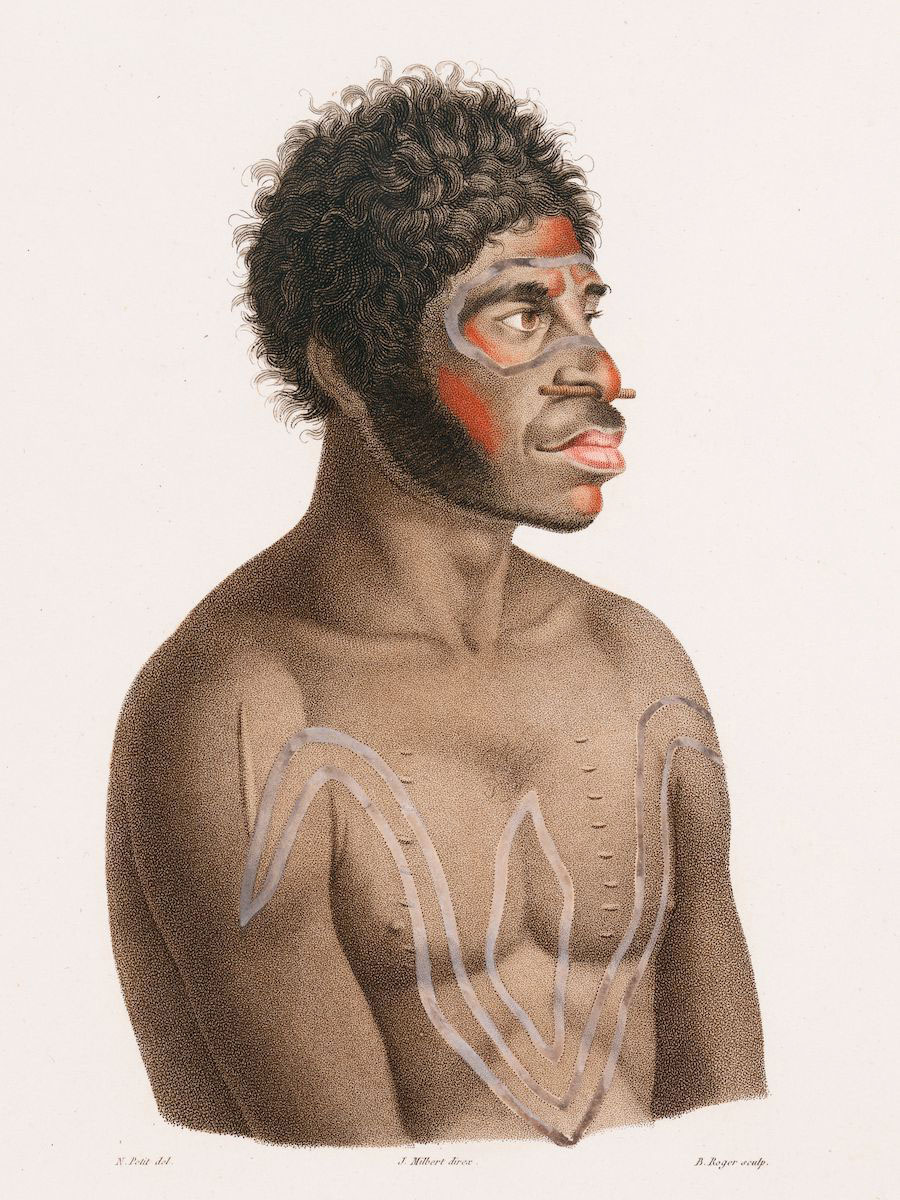
Particularly fascinating is Duncan’s discussion of Musquito’s encounter with the French Baudin expedition. She describes the beautiful portrait by the party’s draughtsman, Nicolas-Martin Petit: “All biographers long to see images of their subjects,” she writes, and she is lucky to have such a lovely and revealing example to gaze upon.
The French chapter also helps explain Musquito’s curious name. Duncan hazards that it was the result of a conventional name-swap with a member of Alejandro Malaspina’s Spanish voyage that anchored briefly in Sydney in 1793. “I’m no etymologist (or entomologist),” she writes, “but I know the word mosquito means ‘little fly’ in Spanish.” The passage is a wonderful example of Duncan’s engaging and concise writing, which is a joy to savour throughout the book.
Duncan insists “history must always be read against the grain to identify whose interests were being served, even with the most primary of sources.” She does a deft job of this on several occasions, though she does ultimately claim some sense of solid ground that other historians might dispute when she suggests that, after sufficient effort, we can finally know “who [Musquito] really was and what he really did: to peel away the layers of historiography.” The variety of Musquito’s experiences, and the heaviness of the myths overlaying them, might indicate to other readers that his reality will always elude us. We don’t even know whose Country he ultimately belonged to.
As outsiders in time and culture, most readers of Duncan’s book will learn more about what is not known than what is known when it comes to discerning “the real story of a legendary colonial warrior.”
The book’s chronology bounces back and forth at times without apparent rationale, and the index is frustratingly brusque. In the French chapter, Jean-Jacques Rousseau’s influential theories about “natural man” are credited to the nineteenth-century painter Henri Rousseau. But these are all minor issues compared to the book’s wealth of insights. Duncan has conjured a sensitive, multilayered picture of a man living through unprecedented disruption, a moving host of human connections, and a lasting sense of Indigenous Country. •
Musquito: The Real Story of a Legendary Colonial Warrior
By Naomi Parry Duncan | Allen & Unwin | $36.99 | 308 pages