Mainz, of all places. Conservative, Catholic, comfortable Mainz, founded by Roman invaders more than 2000 years ago. It was here, in the mid-fifteenth century, that Johannes Gutenberg invented the movable-type printing press. Much later, a company set up by German-Turkish biotech entrepreneurs Uğur Şahin and Özlem Türeci joined with Pfizer to develop the very first mRNA-based immunisation against Covid-19 from its appropriately sited headquarters at An der Goldgrube 12 (12 At the Goldmine).
The city’s third claim to have been at the forefront of history is a little different: in March 1793 Mainz hosted Germany’s first democratically elected parliament. Admittedly, only a small fraction of the population cared to vote, and the republic was only possible because French troops had forced out the city’s ruler, Elector–Archbishop Friedrich Karl Joseph von Erthal. The republic was shortlived, too, collapsing in July 1793 when a Prussian army took over the city.
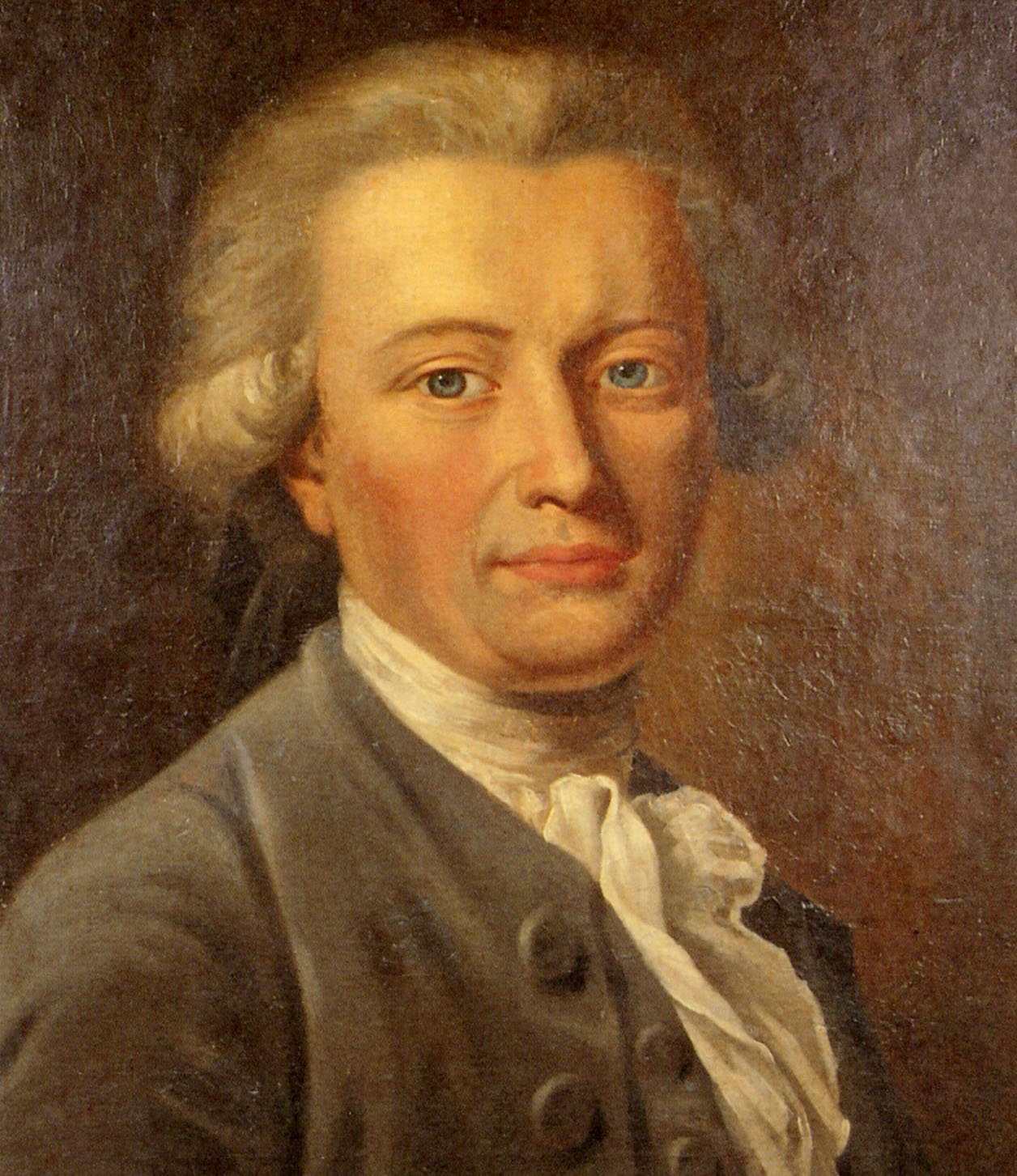
The French can’t take all the credit for the Mainz republic. A couple of days after the city’s surrender to French revolutionary troops, twenty locals (all of them men, of course) formed the Society of the Friends of Liberty and Equality, also referred to as the Mainz Jacobin Club. Soon to join was the scholar, writer and translator Georg Forster. Only thirty-eight years old, he was already famous well beyond Mainz, and indeed beyond Germany, not least as the author of A Voyage Round the World, his first-hand account of the circumnavigation of the globe aboard James Cook’s Resolution from 1772 to 1775.
Forster had been appointed director of the small Mainz University library in 1788, a job that gave him time to pursue other projects. In 1790, accompanied by twenty-year-old Alexander von Humboldt, he took a four-month trip to the Netherlands, France and England, which he later described in his celebrated Views of the Lower Rhine, from Brabant, Flanders, Holland, England and France, a book Goethe liked so much that he reread it straight away.
In Paris, Forster and Humboldt witnessed the upheavals of the French revolution and joined a 200,000-strong crowd, including Louis XVI, carting sand and soil to build an amphitheatre on the Champs de Mars. Forster remembered all of them working in a “frenzy of freedom.”
A couple of years later, with his home town no longer ruled by the Elector, Forster believed that what had been possible in Paris could also be possible in Mainz. “How could the wonderful transformation happen so quickly, from oppressed, abused, silent subjects of a priest, to unbending, vocal, free citizens, in the bold joy of freedom and equality, ready to live free or die!,” he marvelled in a much-publicised speech. “To be free and equal, the motto of rational and moral people, has also now become our motto. For the use of his strengths, his body, and his spirit, everyone demands the same rights, the same freedom; only the diversity of these strengths determines their diverse application and usefulness.”
The French made Forster vice-president of the provisional government, responsible for, among other things, street lighting and fuel. He also became president of the Society of the Friends of Liberty and Equality. And then, on 17 March 1793, the newly elected parliament chose him as its vice-president. A few days later, Forster and a couple of other Mainz representatives travelled to Paris to seek their republic’s accession to France.
Forster was no longer as enthusiastic about the French revolution as he had been three years earlier, and he grew more disenchanted as time went on. The revolution had turned more violent — not only against representatives of the ancient régime but also against its own. On 24 July, Adam Lux, a Mainz delegate with whom Forster shared lodgings, was arrested for criticising the Jacobins and guillotined not long afterwards.
Mainz had fallen to the Prussians a day earlier. The Elector returned, and key figures of the Mainz republic were imprisoned or on the run. Forster, unable to return home, became an unhappy exile in Paris. He fell ill in December 1793, and died on 10 January 1794, aged only thirty-nine. He left behind a large oeuvre: books, essays, letters and diaries, which in a German edition of his collected works amount to more than 10,000 pages.
Although Forster’s life was comparatively short it was extraordinarily eventful. Born in 1754 in a small village near today’s Gdansk and baptised George (though usually referred to as Georg), he was the oldest child of Johann Reinhold and Justina Elisabeth Forster. At the age of ten he accompanied his father, a pastor and self-taught naturalist, on a 6000-kilometre journey to the Volga River and beyond to report to the Russian government on the circumstances of the German colonists there. Young Georg’s only formal education took place, over just a few months, in St Petersburg, where father and son stayed during 1765–66. From Russia, the two of them moved to England, where Georg’s father took up a teaching position.
A falling-out between James Cook and Joseph Banks provided the chance for Reinhold Forster to accompany Cook’s second voyage as a naturalist. Georg, not yet eighteen, was nominally his father’s assistant, but proved to be a naturalist, anthropologist, linguist and artist in his own right. His English-language account of that trip, A Voyage Round the World in His Britannic Majesty’s Sloop Resolution, Commanded by Capt. James Cook, During the Years 1772, 3, 4, and 5, which he had aimed at a general public, made him famous. Before moving to Mainz, he held two teaching positions, first at the Collegium Carolinum in Kassel and then at Vilnius University.
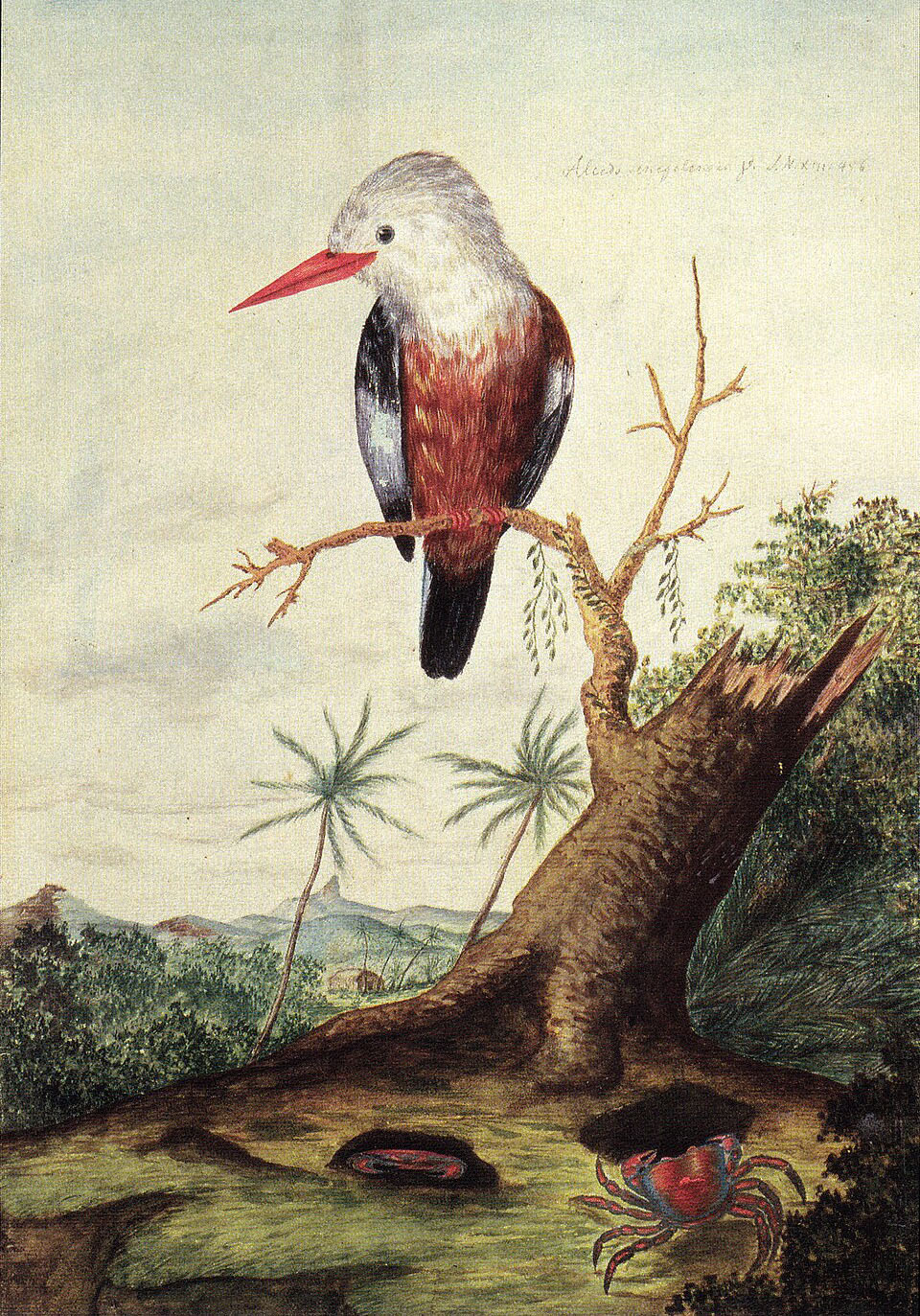
Forster’s depiction of the Halcyon leucocephala actyeon, a subspecies of the grey-headed kingfisher found in the Cape Verde Islands. Natural History Museum, London
Up until the 1960s, Forster was largely forgotten — or, in Germany, despised as a Francophile traitor. Germans began reappraising Forster in the 1960s (in East Germany) and in the 1970s (in the West), as they rediscovered the country’s democratic tradition. Andrea Wulf, the author of well-regarded books about Alexander von Humboldt and the German Romantics, has written a new biography of Forster. Empathetic, detailed and meticulously researched, it reads very well and is richly illustrated. Her The Traveller — like Todd Kontje’s Georg Forster: German Cosmopolitan (2022) — is evidence of a sustained interest also outside Germany in Forster’s work and life.
Two aspects, in particular, make a biographical account of Forster interesting for today’s readers: his personal life (which at times make him appear a man of his times) and his writings as a cosmopolitan and prominent thinker during the Age of Enlightenment (which make him appear to be well ahead of his times). It is a life is marked by complicated and conflictual exchanges with the two people closest to him — his father and his wife — and Wulf devotes much space to both relationships.
Wulf depicts Reinhold Forster as an overbearing, choleric egomaniac who seemed to care little for his wife or the rest of his family and exploited his son’s talents without acknowledging them. Even as a child Georg was expected to provide for his father. When the Forsters arrived in England, Wulf reports, eleven-year-old Georg “was immediately set to work by his father to translate and abridge a history of Russia by the esteemed polymath Mikhail Lomonosow from Russian into English,” a language Georg, a “polyglot even at a young age,” had apparently picked up from the sailors on the trip from St Petersburg to London. The impact of his father’s personality on the young Georg is open to speculation, but Wulf refrains.
In a letter written in 1784, Forster summed up the early part of his life: “I believe suffering has significantly shaped the way I think… I led a rather gloomy and burdensome life as a boy and young man, one that drained both my physical and mental energies.” This period of his life includes the time aboard the Resolution. Readers of his beautiful depictions of nature and his empathetic portraits of Pacific Islanders could scarcely have guessed that they were penned by a young man who was often unwell and unhappy.
His father’s lack of consideration had an unintended effect. After the Resolution’s return, Reinhold Forster sold his son’s watercolours and sketches of the voyage to Joseph Banks for less than £1 per image. Wulf believes that might have been a blessing in disguise: “With his drawings sold, George had to paint with words — or Wortgemählden as he later called it — conjuring his readers into forests garlanded with resplendent blossoms and populated by wondrous birds [and] segueing from descriptions of fish dissections to howling storms.”
“At almost thirty, George Forster decided that he needed a wife,” Wulf writes. “She should be young, innocent, healthy and ideally wealthy, he thought, and while she didn’t need to be beautiful, she should not be too ugly.” Therese Heyne, the eldest daughter of a Göttingen professor who was friends with Forster, was intelligent, good-looking and young but, according to the standards of the time, far from innocent. She also had a mind of her own (she was “capricious,” “wild” and “free-spirited,” Wulf says), and it may have been Therese who in 1874 proposed to Georg, rather than the other way round.
The day after their engagement, Forster left Therese with her father and departed for Vilnius, where he had been promised a teaching position at the local university. The idea was for Therese to join him as soon as he was settled. Vilnius is some 1400 kilometres from Göttingen, assuming a traveller takes the most direct route. Forster did not, visiting Prague, Vienna and other places on the way and spending almost seven months — seven weeks in Vienna alone — on the journey. He seemed neither in a hurry to take up his post, nor overly eager to be reunited with his fiancée.
Wherever he went, he was fêted as the man who had travelled to the South Seas and written so eloquently about their inhabitants. Aristocratic women, in particular, called him “our seafarer” and seemed to have enjoyed his company, and he theirs. “Beautiful women and lovely girls abound here,” he wrote to his fiancée from Vienna, and he recorded in his diary when he was sexually aroused.
Meanwhile Therese embarked on an affair with Wilhelm Meyer, an assistant librarian at the University of Göttingen. That continued when Forster returned to Göttingen in August 1785 to collect his bride-to-be. He said he didn’t mind, and the three of them spent much time together. In September, Therese and Georg married, with Meyer as their witness, and departed for Vilnius — but without Meyer.
What Georg had called the “alliance of the trinity” repeated itself in a different constellation a few years later when the Forsters lived in Mainz. There he befriended Ferdinand Huber, a Saxon diplomat, who soon became more than a friend to Therese and fathered her third child. Huber even lived with the Forsters. In November 1792, after Mainz had fallen to the French, Therese and her children left Georg and moved to Switzerland, where Huber eventually joined them. The couple married three months after Georg’s death.
Maybe Forster, too, was in love with somebody else. The most obvious candidate would have to be Samuel Thomas Soemmerring, whom Forster had first met in England and who became his colleague in Kassel, teaching anatomy. When Forster went to Vilnius, he seemed to miss Soemmerring — “my only, my most dearly loved, my often longed-for and sighed-after friend” — more acutely than he did Therese, who anyway seemed to be an imperfect substitute: “Since I can’t have you,” he told his friend, “Therese is the second on the list.” When Forster moved to Mainz, it was also because that’s where Soemmerring had gone.
The second, less obvious candidate was Caroline Michaelis-Böhmer, a close friend of Therese and, like her, from Göttingen, who also lived in Mainz while the Forsters were there. Unlike Therese, Caroline shared Georg’s political views. She also matched his intellect. Therese later claimed that her close friend and her husband had been lovers, which had also been rumoured around Mainz. Wulf doesn’t think so, and I couldn’t find any evidence either. But it’s fascinating to consider what would have happened if Caroline, who later married first the philologist August Wilhelm Schlegel and then the philosopher Friedrich Schelling, had taken up with Forster? These two exceptional intellectuals would have been a formidable pair.
Like Georg, Therese left behind many letters, and thus we can gauge her views of her first marriage. As she survived both her husbands, she was also able largely to control the narrative. She published collections of Georg’s and Huber’s letters (edited, or rather censored, by her) and a biographical portrait of her second husband, which together might have inspired Goethe to write his 1809 novel Elective Affinities.
Wulf takes Georg’s side: “Therese invented, embellished and lied to present herself as the mistreated partner in her marriage.” Therese’s father, and friends of the couple, were also critical of her. But things were complicated by the fact that some of what her husband wrote was self-incriminating. The least that can be said about him is that his actions did not always match his lofty ideas about the rights of women.
Wulf’s account of Forster’s marriage distinguishes her book positively from others, such as the German philosopher Jürgen Goldstein’s prize-winning 2015 biography. Goldstein provides fascinating insights into Forster’s mind yet barely mentions that he was married. Wulf’s focus on his personal life raises an intriguing the question (which she does not answer): to what extent did his relationship with Therese, and, more broadly, his emotional entanglements with others, have a bearing on his life as a scholar and writer?
Forster might, after all, have been a man of his times when it came to aspects of his relationship with his wife. But with his commitment to what he called “the general rights of mankind” in his account of the Resolution’s voyage, his views about human diversity and his abhorrence of racism he was well ahead of his contemporaries. “It would take more than two hundred years for the world to catch up with him,” observes Wulf.
For example, after visiting the Ehrenbreitstein fortress near Koblenz and observing the prisoners held there, he wrote in Views of the Lower Rhine that an individual’s freedom “is indisputably a right tied to the human condition, and therefore inalienable.”
One of my favourite Forster quotes comes from the 1792 speech in Mainz I mentioned earlier. To claim that Māori were no less human than Germans and highlight the former’s human dignity was unusual in a travel account published in the 1770s. But it was an even bigger step to call out European racism in front of a crowd of Germans who needed a lot of convincing that the right to liberté, égalité and fraternité should extend beyond the walls of their city. Talking about the “degenerate, weak-minded, privileged” aristocracy, Forster said:
Among the thousands of inventions with which they hoodwinked their underlings was this one — they carefully let it happen that the belief in hereditary differences among people was extended universally, enforced by laws, and preached by hired apostles. Some people, it was said, were born to decree and rule, and others to possess sinecures and offices; the great mass was made to obey; the Negro because of his black skin and flat nose was intended by Nature to be the slave of the whites; and there were more of the same profanities against the sacred healthy rationality.
Forster’s approach to knowing the world also differed from that of most of his contemporaries, including other Enlightenment intellectuals. He was not interested in facts as such. “Those thinkers who worshipped cold evidence alone ‘had their wish; facts were collected in all parts of the world, and yet knowledge was not increased,’” Wulf explains, quoting Forster’s Voyage Round the World. “Years later he would explain that ‘the first point from which all knowledge is gained is based on Empfindung.’” Here Forster was referring to the use of one’s senses. This is something German Romantics like his good friend Caroline Böhmer, the Schlegel brothers and Novalis also championed. Elsewhere, Forster talked about the danger of “elevating cold reason into a universally worshipped idol at the expense of feeling.”
In the late eighteenth and early nineteenth centuries, Georg Forster was not the only well-travelled naturalist who could write beautifully, who could be considered a cosmopolitan and whose ideas challenged established thinking about cultural and ethnic diversity. Alexander von Humboldt, who accompanied Forster to England and France in 1790, was another. So was Adelbert von Chamisso, born twenty-six years after Forster, a French refugee who became one of nineteenth-century Germany’s most celebrated poets and served as a naturalist on a Russian-led expedition to the South Pacific. But Forster was the most radical of the three.
That raises another question that I wish Wulf had not just posed but also attempted to answer, namely “how someone who was brought up in a society pervaded by racism was able to accept other cultures with such an unbiased mind.” At least she offers her readers several possibilities:
Was it because he had been exposed to different cultures from the age of ten when he had travelled through Russia? Was it because he didn’t even know to which country he belonged? To Prussia? To England? Was it his limited conventional schooling?… Or was his tolerance a reaction against his narcissistic father whom he had watched shout at friends, colleagues and strangers throughout his life?
Wulf doesn’t pursue this. Her main concern seems to have been to paint the portrait of a man who could provide an alternative vision — not for his contemporaries, but for us. “At times like ours, when the world seems to retreat behind national boundaries… I see George Forster as a light in the darkness,” she writes. A much-needed light, I would like to add, because more than two centuries after Forster’s death, the world at large has arguably not yet caught up with him.
Yet this man, who loved humankind, “embraced the otherness of others” (to use Wulf’s words) and believed in a just world, was himself a troubled individual, who seemed to have often suffered from depression. But that’s what makes him such an intriguing biographical subject and a book that pays attention to his life and not just his scholarly output a fascinating read. •
The Traveller: The Revolutionary Life of George Forster and his Search for Humanity
By Andrea Wulf | Allen Lane | $55.50 | 512 pages