When IBM’s custom-built Deep Blue computer beat world champion chessplayer Gary Kasparov in 1997 — the first time a machine had defeated a world champion — a threshold was crossed, at least symbolically. Some saw the victory as a death knell for chess. But trains and cars have for many years gone faster than humans without destroying athletics. Human-versus-human chess will continue, though computers will affect the game more significantly than trains affected athletics.
The first casualty of technological change was correspondence chess, whereby players sent each other their moves by what we now call snail mail. (Australian Cyril Purdy won the first world correspondence chess championship in 1953.) Now it’s impossible to be sure remote players aren’t consulting computers, and the protracted time matches take isn’t well suited anyway to the pace of modern life.
Correspondence chess has been more than surpassed by online chess. After steady growth for a decade or two, its popularity grew enormously during the Covid pandemic, and since then numbers have continued to increase. But the rapid growth of online chess brought with it a surge in cheating. By August 2020, reported ESPN, the main chess website Chess.com had blocked 400,000 accounts for cheating.
Attempts to cheat crop up in surprising places. At the Melbourne International Chess Tournament in April, a thirteen-year-old girl was disqualified for cheating. She had performed much better than her record suggested she could, arousing suspicions in the hall. Then it was discovered that underneath the jumper on her lap was a mobile phone.
It is surprising that it took so long to stop her, given the strenuous efforts to prevent such possibilities. When the arbiter in a chess tournament talks about a phone box, they are not talking about the place where Clark Kent changes into Superman. Rather must deposit their phones in a box while play is in progress. When I play in a tournament I have to dispose of my Apple Watch.
In tandem with the increase in cheating came an increase in false accusations. The most tragic case involved twenty-nine-year-old American grandmaster Daniel Naroditsky. Naroditsky, known as Danya, had won popularity during Covid with his presentations on YouTube and commentary on chess matches.
At first it was thought his death in 2025 was a suicide, but a coroner found the more likely cause was cardiac arrhythmia. Whatever the immediate reason, the last year of his life was made miserable by accusations of cheating levelled against him by former world champion Vladimir Kramnik, who in his retirement has accused many prominent players of transgressions.
Kramnik first made accusations against Naroditsky in October 2024 and followed up several times over the following year. Naroditsky denied all charges but also referred several times to the distress they caused him. He felt that now, whenever he did well, people would think he was cheating. His death brought an outpouring of grief, plus finger pointing at Kramnik. After investigating, the international chess federation FIDE banned Kramnik from all official activities and events for two years.
Cheating controversies go back decades. When the cycle of world chess championships that began in the late 1970s pitted model Soviet citizen Anatole Karpov against a defector, Victor Korchnoi, more than normal antagonism was inevitable. But Korchnoi’s cheating accusations soon descended into farce. His camp charged that one of Karpov’s team kept staring at Korchnoi in an attempt to hypnotise him, and that secret messages were being conveyed to Karpov when he was given yoghurt during matches.
A later round of world championship games produced the “toiletgate” controversy. In this case, ironically, the victim of the false accusation was Kramnik. His opponent, Veselin Topalov, asserted that Kramnick was spending so long in the toilet he must somehow be receiving advice there. That controversy quickly petered out.
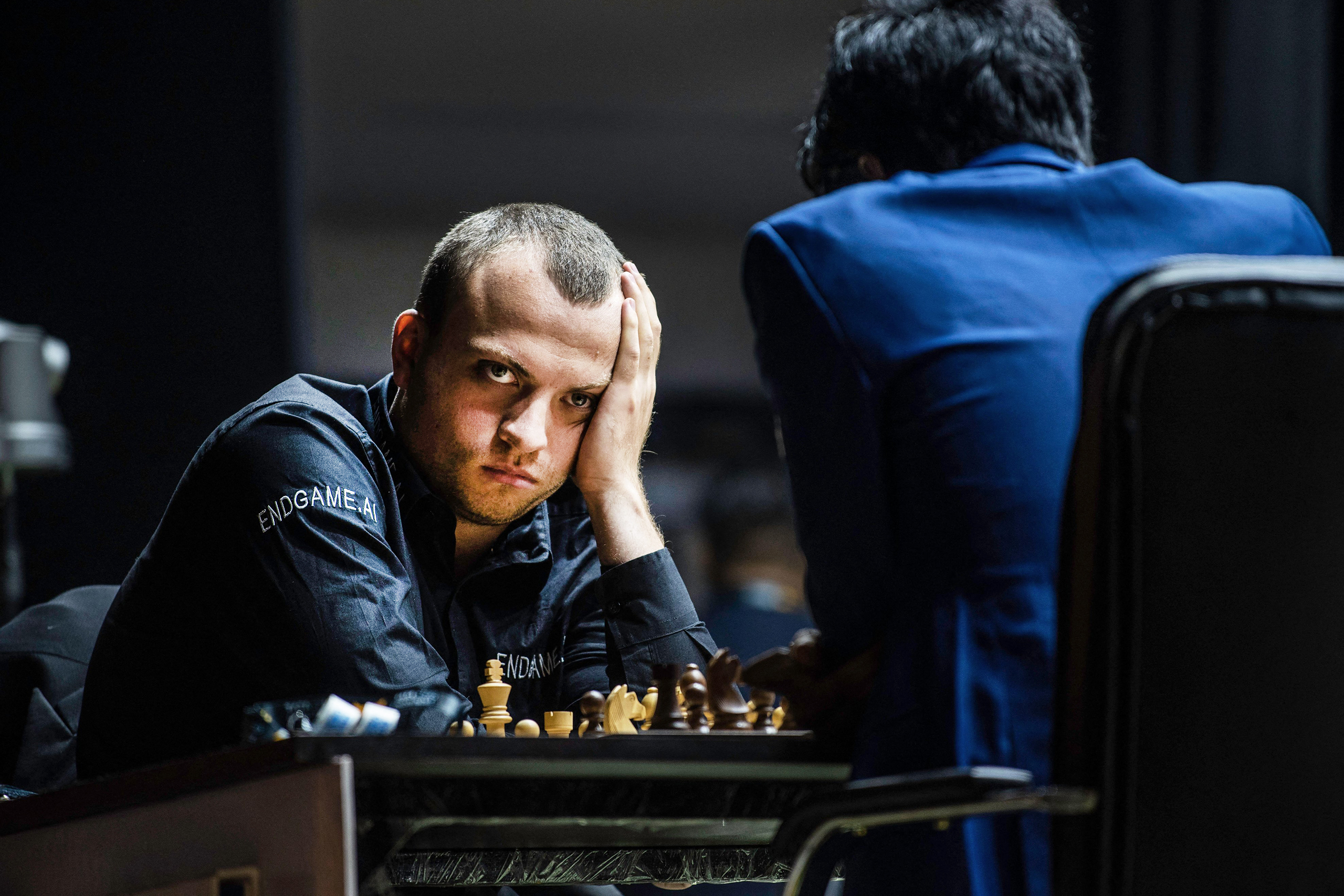
By far the most prolonged and contentious of international chess controversies began four years ago, and its effects are still being felt. At the most prestigious tournament in America, the Sinquefield Cup, world number one Magnus Carlsen was drawn to play nineteen-year-old American Hans Nieman. Carlsen’s previous limited encounters with Nieman had led Carlsen to conclude that he would be fairly easy to beat.
Nieman won. But some of his body language and his relaxed, almost bored, demeanour at moments of high tensions during the game struck Carlsen as unnatural. After he left the venue he told his two companions — his father and his second — that Nieman had cheated. Carlsen had never felt or said anything like that after a loss before.
A scenario for such cheating would involve an accomplice outside the playing venue getting the moves over the internet, feeding them into a computer and then sending the best move back to Nieman through a listening device, an earpiece or, much less comfortably, with what are called “anal beads.”
The incident came at a momentous time for Carlsen. He had just struck a deal with Chess.com for it to buy out his website, Play Magnus Carlsen, for US$80 million. He had also announced that after winning the world championship five times over thirteen years he had decided not to contest it again.
That night Carlsen and his father, Henrik, were wondering how to proceed with their suspicions. They called the head of Chess.com, Danny Ronsch, who confirmed what had already been rumoured in chess circles — that Chess.com had once suspended Nieman for cheating in online competitions.
The next morning Carlsen withdrew from the tournament without offering any public explanation. Attached to his tweet announcing his withdrawal was a clip of film from the soccer coach Jose Mourinho after his team Chelsea had lost: “I prefer not to speak. If I speak, I am in big trouble. In big trouble.” Others soon filled the silence, and Nieman, boiling with rage, wanted revenge.
Carlsen and Nieman next met over a chess board a couple of weeks later in another American tournament. They sat down, Carlsen made one move, and then he resigned and walked away. A week later Carlsen finally made a statement charging Nieman with cheating in their previous encounter and with having done so in the past. There was no “smoking gun’,” just lots of circumstantial suggestiveness.
The leaders of Chess.com compiled a file on Nieman and his participation in online competition. Leaked to the Wall Street Journal, its main findings appeared under the headline “Chess Investigation Finds that US Grandmaster ‘Likely Cheated” More Than 100 Times.” It gave no evidence, however, that Nieman had cheated against Carlsen.
Nieman, still just nineteen, responded belligerently. Some of his interviews verged on the unhinged, and one night, after playing badly and losing a game, he trashed his hotel room. Then he launched a defamation action against Carlsen, Chess.com, its head Daniel Rensch and another grandmaster Hikaru Nakamura for US$100 million. The action was later settled out of court on undisclosed terms.
In a way, the immediate battle finished at a tournament in Paris in September 2024. Never predictable, Nieman arrived with a bodyguard in tow. But in their rapid games of chess, eventually Carlsen triumphed 17.5 to 12.5.
Prolific American author Ben Mezrich covers the highs and lows of this saga in his new book Checkmate. At least three of his books have been made into films, and the film rights to this one have already been sold.
Checkmate is a ripping yarn, and mostly very well told. Occasionally Mezrich’s thirst for superlatives and eccentric taste in metaphors (Nieman “hit the Bay Area chess scene like a Tasmanian devil,” Carlsen “felt as foreign in this place as a quesadilla would be in the ocean”) is distracting, but he vividly charts the shocks and fears and hopes of the participants at each key moment.
Mezrich writes with a seductive certainty, as if he is eyewitness to the dramatic scenes he is describing, and skilfully evokes a sense of the players’ emotions. His account is based, he says, on exhaustive interviews with the participants.
It seems to me that he is a reliable reporter of Magnus and his father Henrik, and of Danny Ronsch and the senior figures at Chess.com, who come out of the book looking competent and honest. There is, and probably must be, less certainty about what Nieman was thinking and feeling at any time, apart from his resolve to one day be the best player in the world. Mezrich’s account has him full of resentments, often lapsing into paranoia.
The two main protagonists are still active in competitive chess. Carlsen continues his unbroken run of fifteen years as the top chess player in the world. Nieman currently ranks twentieth, a strong grandmaster but, at least for now (and remember he is still only twenty-three), a cut below the very best. •
Checkmate: Genius, Scandal and the Billion-Dollar Rise of Chess
By Ben Mezrich | Macmillan Business | $36.99 | 304 pages