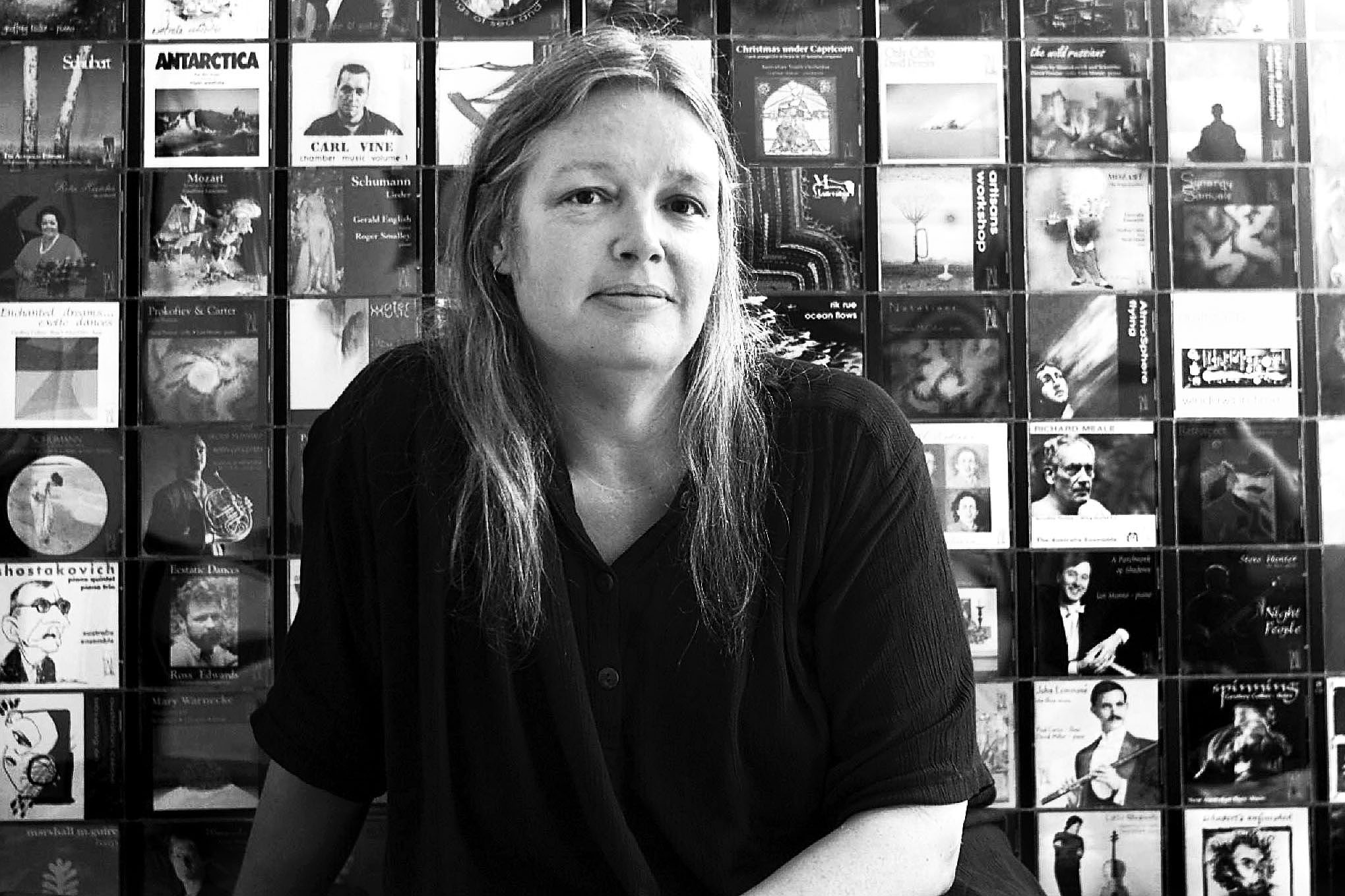
Some years ago, Belinda Webster, the founder of Tall Poppies Records, received in the mail a cheque for $10,000 from the writer and arts patron Barbara Blackman. It wasn’t payment for a large order of CDs or even a donation to the not-for-profit label, but a personal gift — a token of appreciation. Webster, who seldom had much money, sat down outside her local post office in Kangaroo Valley, NSW, and burst into tears.
Belinda Webster’s death this last week at the age of seventy-four has robbed Australian music — and, more especially, Australian musicians — of one of its great figures. No one in this country involved in classical music or jazz — certainly no one over forty — would be unaware of her contribution. Webster was more than the founder of her label; she was the label. She chose the musicians (nearly always Australian) and the repertoire (very often Australian); she produced, engineered and edited the recordings; she designed the covers and commissioned the artwork — or supplied it herself (she was an accomplished photographer); she commissioned and edited the sleeve notes; she oversaw the production and marketing of the finished album. And she filled in funding applications, hundreds of them.
Tall Poppies was launched at a garden party in Sydney’s Glebe in 1991, TP001 being an album of solo piano music for children by Bach, Bartók, Mozart, Prokofiev, Schubert, Schumann and Tchaikovsky played by Geoffrey Tozer. Over the next thirty-five years, Webster recorded standard repertoire performed by Australian musicians: the Australia Ensemble’s Mozart wind quartets; Lisa Moore’s Janáček; Ian Munro’s Schubert sonatas, with completions by Munro; David Pereira’s Bach.
But alongside more familiar repertoire were literally hundreds of Australian works, most receiving their first recordings, some on albums devoted to single composers: Anne Boyd, Nigel Butterley, Ross Edwards, Peggy Glanville-Hicks, Elena Kats-Chernin, David Lumsdaine, Richard Meale, Peter Sculthorpe (the complete string quartets), Margaret Sutherland and Carl Vine, to name only a few. And there was jazz: Roger Frampton, Judy Bailey, Mike Nock and Sandy Evans. The Tall Poppies catalogue runs to 278 titles, including four of my music.
But there was a Belinda Webster before Tall Poppies. This was the Sydney University English graduate (she remained an incessant reader) and flute player, who came to specialise in baroque flute. The fact that Webster was a musician first meant that, in the recording studio, her ears would quickly spot inexact rhythms, dodgy intonation and wrong notes, and she made no bones about pointing these out. There’s a story (possibly apocryphal, though it sounds right enough) of a recording session in which she remarked to the performer that a particular passage had been “a bit of a mess.” “But the composer has written ‘Wild’ over those bars,” the player remonstrated. “True,” Webster replied. “Still, I think if the composer had wanted a mess he would have written ‘Mess.’”
Webster made her first recording after being shown, for all of ten minutes, how to plug in the microphones and switch on the tape recorder. The concert in Bathurst Cathedral was a program of choral music by Kodály, and it was for 2MBS-FM, Sydney’s community classical station. When it turned out surprisingly well she was hooked, going on to record more than six hundred live concerts for the station over more than a decade. If you rang her up and asked her to come and record your show, she would almost invariably turn up with her gear. And remember, this was (and remains) a volunteer radio station. For a time, Webster supported herself by driving a taxi. It sums up her dedication not only to recording, but to her fellow musicians and to music itself.
Because Tall Poppies began in 1991, the heyday of the CD, it got off to a good start; it gained international attention and distribution not only because the product was of high quality but also because the repertoire, in most cases, was unique. The distribution tended to be hit and miss, Webster always more interested in making records than in selling them, but even so, it was possible to walk into Harold Moore’s shop in London or Tower Records in midtown Manhattan and find your CDs in the racks. Tall Poppies started to seem like a label that mattered, and being on it was a vote of confidence in performer and composer alike.
It feels odd to have been referring to her here as “Webster,” because she was “Belinda” to everyone, her surname completely unnecessary. “Have you asked Belinda?” was one of the most common questions in Australian music. Whatever it was, Belinda would likely have the answer. And if she didn’t have the answer, she’d have an opinion.
When I first arrived in Australia in 1983, I went to see the music impresario James Murdoch, who gave me the names of people I should look up. One of them was Belinda. I rang her, and we met at 2MBS, immediately hitting it off. She was, I suppose, my oldest Australian friend. Due at our place for lunch last Sunday, she’d texted a few days before to ask what wine she should bring. She didn’t come. I rang. There was no answer. The rest of us ate our slow-cooked lamb, minus Belinda’s promised shiraz, while at the end of the table was an empty chair and a still-folded napkin. We missed her. Now we always will. •