The partnership of Alfred Hitchcock and that most Hitchcockian of composers, Bernard Herrmann, is notable for so many things that it’s easy to miss how they worked together to manipulate our sympathies. Psycho (1960) is a good example.
In Phoenix, Arizona, we meet Marion Crane (Janet Leigh) during a lunchtime tryst in a hotel room with her boyfriend Sam (John Gavin). She wants to marry him, but he is reluctant to commit until he has paid off his debts. Leaving work early that afternoon, complaining of a headache, Marion steals $40,000 from a client and decides to drive to Sam’s home in California. We see her in her apartment, packing a suitcase and getting changed. Initially, we had sympathised with Marion: back in the hotel room, as the hopeful bride to be, Marion had worn a gleaming white bra; now, as a criminal, her bra is black, and she has lost our sympathy.
The music that accompanies Marion on her drive was first heard under the opening credits, but at night, on the highway, in the pouring rain, with windscreen wipers in sync, it is more urgent, more dangerous. The tension Hitchcock and Herrmann create together here put us firmly back on Marion’s side, and when she stops at the Bates Motel and tells its proprietor, Norman (Anthony Perkins), that she intends driving back to Phoenix in the morning to put everything right, she might have put the white bra on once more. Instead, she takes a shower.
What happens next is too well-known to need any description, but while the shower scene is rightly famous, the lead up to it and the scenes afterwards are no less remarkable. For sixteen minutes, this film has no dialogue. The only voice we hear is Norman, off-screen, briefly berating “mother.” Beyond that, we hear sound effects (that’s a cabbage being stabbed) and music.
The slashing strings of the shower scene might be the most famous cue in film history but consider the following ten minutes in which Norman cleans up the murder. He goes round the bathroom with his mop, wraps the body in a shower curtain, clears away all evidence that Marion was ever there, spots, at the last minute, the folded newspaper that (unknown to him but not to us) is wrapped around the stolen cash, and puts everything in the boot of Marion’s car.
As we watch Norman at work, we finally relax. It is partly that we are still recovering from the shock of the murder — and the fact that, in a breach of Hollywood protocol, the star has been killed forty-five minutes into the film — but it’s also Herrmann’s score. Following the insistent “windscreen wiper” music and the stabbing violins of the shower scene, his music for the clean-up, though intense, is almost consoling. At the end of the scene, the music stops and we watch Norman push Marion’s car into a swamp, accompanied by the sound of frogs, crickets and glugging water as the vehicle sinks. Suddenly the glugging stops and we hear only nature. The car is just three-quarters submerged, the roof still visible. Norman looks anxiously about him, and we hold our breath. Then the glugging starts up again as the swamp swallows the rest of the car. Norman smiles and we smile too. We’ve shifted allegiance once more.
Originally, as Steven C. Smith reminds us in his book, Hitchcock and Herrmann, the director hadn’t wanted music for the shower murder, but when Herrmann played him the cue he had recorded on spec, Hitchcock was convinced. Psycho is a black and white film — the director said he wanted to frighten his audiences, not nauseate them — and Herrmann matched this with a monochrome sound, scoring his music for strings alone.
The typical Herrmann sound palette was far richer, involving lots of brass, low winds — bass clarinets always a favourite — and plenty of percussion: these were the colours in which the composer excelled and, like most of the greatest film composers, he insisted on doing his own orchestration: “This whole rubbish of other people orchestrating your music is so wrong. I always tell them, ‘Listen, boys, I’ll give you the first page of “Lohengrin Prelude” with all the instruments marked. You write it out. I bet you won’t come within 50 per cent of Wagner.’ To orchestrate is like a thumbprint.”
Bernard Herrmann’s career in film was bookended by his work on two certifiable masterpieces: Orson Welles’s Citizen Kane (1941) and Martin Scorsese’s Taxi Driver (1976). Herrmann died in his sleep on Christmas Eve 1975, following his final day of work on Scorsese’s picture. In between those titles were The Magnificent Ambersons, Jane Eyre, The Ghost and Mrs Muir, The Day the Earth Stood Still, The Snows of Kilimanjaro, Cape Fear and Fahrenheit 451. But at the heart of it all were the nine films on which he worked for Hitchcock between 1955 and 1966: The Trouble with Harry, The Man Who Knew Too Much, The Wrong Man, Vertigo, North by Northwest, Psycho, The Birds (which has no score, but credits Herrmann as “sound consultant”), Marnie and Torn Curtain. It was from the last of those films that Hitchcock sacked Herrmann.
It all started so well. Mutual admirers for years, director and composer wanted to work with each other from the early 1940s, but the timing was never right. Their first collaboration, The Trouble with Harry (1955), was a black comedy. There were nearly always humorous moments in Hitchcock’s films, but comedies were as rare for him as they were for Herrmann. The plot of this one involves a series of characters who walk past, ignore, fail to see, trip over or feel guilty about a body (Harry) lying in an idyllic landscape. This allowed Herrmann to compose a series of vivid character pieces for the ensemble cast, setting out his musical wares with different styles and colours, and influences ranging from Stravinsky to Vaughan Williams. A tramp, who waddles like a penguin, is given a version of Vaughan Williams’s penguin march from his score for the film, Scott of the Antarctic.
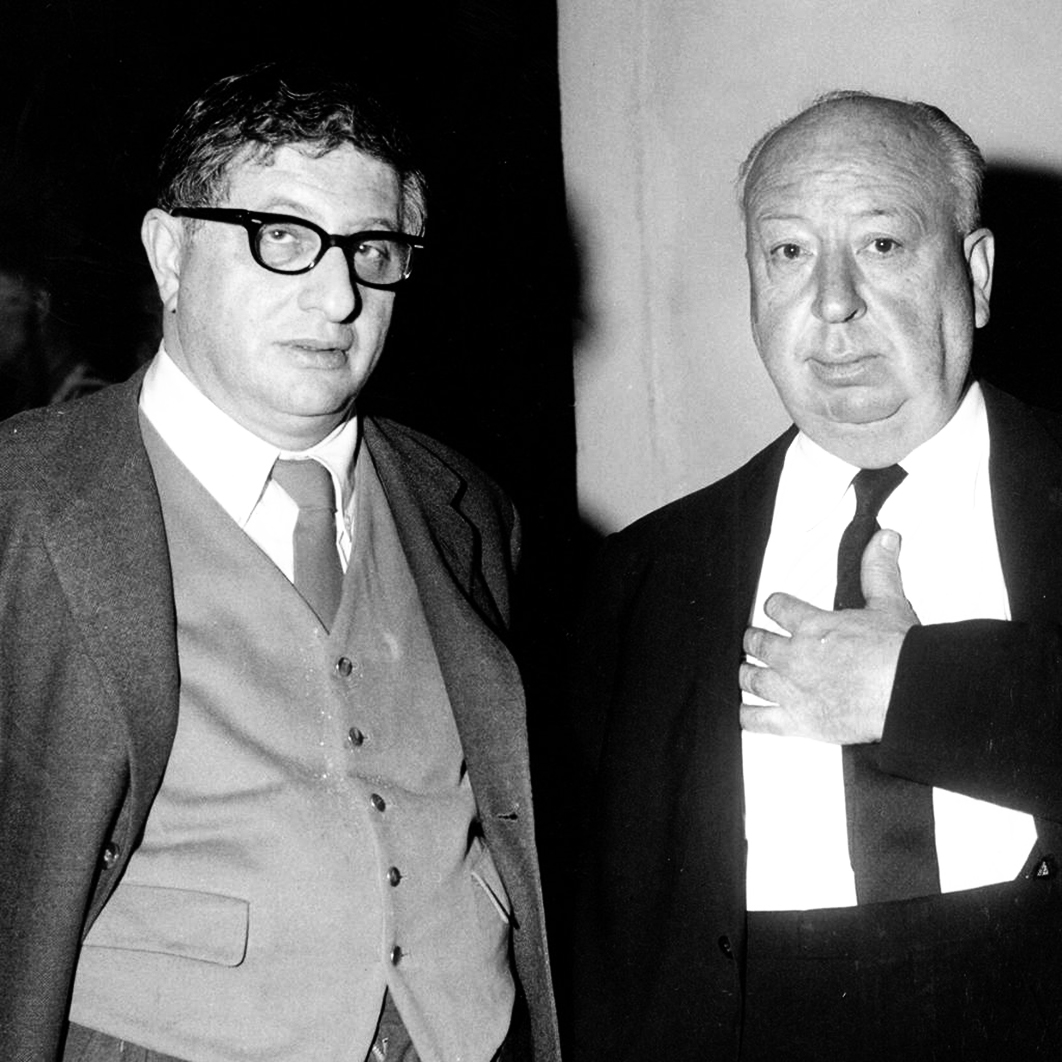
The Trouble with Harry was not a box office hit, but it remained a favourite of Hitchcock’s, and he was delighted with Herrmann’s contribution. Hitch and Benny (always Benny, never Bernie) now embarked on what the twenty-first century might call a “bromance.” They deferred to one another and quoted each other’s witticisms to their wives.
In his next film, a Hollywood remake of his 1934 film, The Man Who Knew Too Much (1956), Hitch put Benny on screen conducting the London Symphony Orchestra at the Royal Albert Hall — another long scene with no dialogue. We see a shot of the poster advertising Herrmann’s performance; we see several close-ups of Herrmann conducting and another of his score; it is even Herrmann’s baton that cues the cymbal crash that, in turn, cues the attempted murder, the film’s main plot point.
The subtitle of Smith’s book is “The Friendship and the Film Scores that Changed Cinema,” and the “Friendship” is important. Herrmann and Hitchcock could read each other’s minds.
The composer became adept at giving the director what he wanted: a cool-jazz score for the noirish true-crime story, The Wrong Man (1957); a lush, neon-lit romantic score, shot through with tragedy and lashings of harp glissandi for Vertigo (1958). But he also gave the director what he didn’t yet know he wanted: a tambourine-heavy fandango for North by Northwest (1959) and those slashing violins in Psycho.
Another word about that scene. Much of its effect is in the editing. There are fifty-something edits in under ninety seconds, the cutting of the film mirroring the nature of the murder. (In Rope, where the murder weapon is a single length of rope, there are no cuts at all.) But if it had played out as Hitchcock intended, without music, just running water, stabbing and screams, it would have been yet more confronting and very hard to watch — even in black and white; even in the knowledge that a cabbage was involved. In a sense, Herrmann’s musical cue ameliorates the horror and turns the scene into art. Where Hitch was concerned, Benny had strong instincts.
Yet these instincts, allied to a deal of hubris, would finally prove Herrmann’s undoing. By the mid-1960s, films had changed, and Hitchcock — a maker of popular films with an eye to the box office — understood the changes. James Bond movies had pop scores and came with hit songs, and so when he came to make his spy movie, Torn Curtain (1966), with big stars, Paul Newman and a wildly miscast Julie Andrews, Hitchcock (and Universal Studios) wanted a lighter, poppier score, maybe something with an electric guitar.
The studio asked for a different composer, but Hitchcock stood by Herrmann, telling him “no fewer than four times” what he must do. Herrmann agreed to the lighter score, but he also remembered how Hitch had been wrong in the past, how he would have missed out on the shower music in Psycho if Benny hadn’t written it behind his back. Once again, the composer went his own way.
Like Psycho, Torn Curtain has a set-piece murder. Newman and an East German woman he has only just met murder a Stasi agent in her cottage. They must do it in silence so as not to alert the agent’s driver, waiting outside, but in any case they can’t speak each other’s language. After a minutes-long struggle and much grunting, they finally succeed in getting Gromek’s head into a gas oven. This time, Hitchcock didn’t specify no music, but he later said he’d wanted to show how hard it was to kill someone. In other words, we needed to hear the grunts.
Herrmann’s response to Hitchcock’s request for a pop score in Torn Curtain was to go weird and lavish. Lots of low brass — sixteen horns, nine trombones, two tubas, two timpani players, and “a large group of cellos and basses.” So, no electric guitar, but also no violins or violas and no woodwind except for twelve flutes! (“The sound of all those flutes will be terrifying!” he said.)
Herrmann felt sure that when Hitchcock heard the dark, sonorous, dramatic score he had composed — exactly the opposite of what he’d been asked for and agreed to — the director would gratefully change his mind, just as he had on Psycho. Herrmann was wrong. Hitchcock attended the recording session where the composer was in high spirits, cracking jokes. The director asked to hear an early scene in which a group of scientists is trapped on a ship in the arctic weather. The scene is essentially played for laughs, and Hitchcock had stipulated light music. Herrmann’s music was dark and dissonant, underlining the freezing temperatures. Hitchcock stopped the orchestra after ten bars and fired the composer. He returned to Universal Studios, apologised and offered to pay Herrmann’s fee out of his own pocket. They engaged John Addison, composer of light comedies and films set in 1960s Britain (such as A Taste of Honey) to write the score.
It’s clear from Smith’s book that neither Benny nor Hitch quite got over their breakup. Hitchcock was on his final stretch; no one would put Topaz, Frenzy or Family Plot in their pantheon of his great films. Herrmann fared better, being taken up by François Truffaut, then Brian De Palma and finally Scorsese. In 1968, he released an album of his music for Hitchcock’s films, including Psycho, Vertigo and North by Northwest, his sleeve notes praising the director. But he received no response. If he listened to it, perhaps it only served to remind Hitchcock that his greatest films — and his greatest collaboration — were behind him. •
Hitchcock and Herrmann: The Friendship and Film Scores that Changed Cinema
By Steven C. Smith | Oxford University Press | $73.99 | 312 pages