Whether it was intended or not, the latest book by the accomplished Australian journalist and author George Megalogenis was published not long after census night last month. As I thumbed through my review copy, I allowed myself the mischievous thought that those five-yearly collections of population data must be red-letter occasions for Megalogenis. After all, he has carved out a niche by crunching demographic data to offer distinctive interpretations of the country’s politics and psyche. He is, as he confesses at one point in this book, a soul with a “nerdish mind’s eye.”
Three Shocks is trademark Megalogenis. Following three preliminary scene-setting chapters, it provides an account of Australian politics from Paul Keating’s against-the-odds victory at the March 1993 election to the re-election of Anthony Albanese’s Labor government in May 2025. All of this is explained through the prism of the nation’s changing demography and workforce.
Two trends, or “shocks” as he dubs them, are in Megalogenis’s sights. The first is Australia’s “glorious, confronting transformation” to a “majority migrant national population” (as defined by citizens who are migrants or have at least one migrant parent). This “nation of genuine diversity” crossed that threshold in 2018.
The second shock is “the feminisation of the economy.” Ironically enough, the key milestone — the point at which “women with tertiary qualifications working as professionals across the care and creative industries … overtook men in trades and technical work as the nation’s largest group of workers” — arrived during the prime ministership of the hyper-masculinist Tony Abbott.
For Megalogenis, the failure of the major parties to come to terms with these two developments condemned the country “to a decade of electoral gridlock.” Trust in democracy “went into freefall” as the political system ignored “the new middle-class constituencies of skilled migrants and professional women.”
His third shock is of a different kind. It is the turbulence in Australia’s relationships with its traditional security ally, the United States, and with its major trading partner, China, each a capricious player in a fractious globe.
Like all Megalogenis’s writings Three Shocks radiates an infectious intellectual curiosity; it is adventurous and consistently intriguing. He winkles out currents in the nation’s life that are overlooked elsewhere. Nevertheless, I admit to a nagging concern that his work can be too deterministic: too much a case of politics dancing to the iron law of demographics. He writes as if philosophies and values are subordinate to electoral maps and population patterns.
In this account, for example, the contest between conservative and liberal tendencies in the Liberal Party and the populist germ that infected its bloodstream under John Howard are set aside, or at least not explicitly discussed.
Megalogenis argues that Howard’s successors neglected to move on from his model, and in doing so estranged themselves from contemporary Australia. I agree, though I see this more as a slavish adherence to — and maladroit accentuating of — the conservative populist direction in which Howard oriented the Liberal Party. This has included emulating Howard’s flirtation with race politics, scepticism towards multiculturalism, dereliction on climate change, failure of historical imagination towards First Nations people, hostility to identity politics, dalliance with culture wars, and an electoral strategy of plundering suburban working voters from Labor.
Megalogenis focuses overwhelmingly on the Liberal Party’s myopia towards the nation’s changing electoral map. That this myopia is fundamentally a result of a divergence in values between the twenty-first-century nation and the finger-in-the-dyke mindset bequeathed to the party by Howard is less his thing.
As Megalogenis explains it, the Liberals remained mesmerised by the Howard-inspired “battler myth,” concentrating its efforts on the outer suburbs, the regions and the frontier states of Queensland and Western Australia. They have shown a cavalier indifference to the ethnically diverse cosmopolitan metropolises of southeastern Australia, Sydney and Melbourne, epicentres of what he terms the “New Australians.” Simultaneously, the Liberal Party was stubbornly heedless of the rising electoral force of professional women.
The ultimate “reckoning” was delivered at the 2022 election: “The eviction of the Liberals from the capitals was both stunning and inevitable… inevitable because of the contradiction at the heart of the Howard era — the party that had run the country for twenty of the past twenty-six years was behaving like a protest movement against the cities, where two-thirds of the people live.”
Three Shocks takes a special interest in Melbourne. Indeed, the first chapter contains semi-autobiographical fragments of Megalogenis’s growing up as the son of Greek migrants at the tail end of the Liberals’ postwar ascendancy in the city’s eastern suburbs. From there he launches into a discussion of Melbourne’s fluctuating political and economic power since the late nineteenth century. I enjoyed this excursion: one thing the book does well is to remind us just how much the 1890s depression knocked the stuffing out of the Victorian capital, its dark legacy lingering as long as the middle of the twentieth century.
On the other hand, his rendition of the great Victorian and ringmaster of national politics in the decade following federation, Alfred Deakin, excessively shrinks the three-time prime minister to an arch white supremacist. Megalogenis might also have made more of the primacy Melbourne received from its hosting of federal parliament between 1901 and 1927, a beguiling, if intangible, factor in the shaping of the early Commonwealth.
The purpose of Megalogenis’s meditations on the oscillations in Melbourne’s influence only becomes fully clear later, when he emphasises the cost of the Liberals cocking a snook at the country’s fastest-growing metropolis, heartland of the nation’s most cosmopolitan and progressive state. This was the state Howard notoriously wrote off by dubbing it the “Massachusetts of Australia.” “Howard and his successors,” writes Megalogenis, “thought that Melbourne was becoming irrelevant. This was a grave misreading of Australian culture.”
Megalogenis is right to say Labor was intimidated by Howardism in the early decades of this century. I would view this in terms of Labor’s submission to some of Howard’s defining policies, but for Megalogenis it is principally about electoral strategy. By his reckoning, Labor only truly exorcised Howard’s ghost following its shock loss to Morrison in 2019, which forced the party’s leaders to sort out who they represented: “Would they stick to the nostrums of the Howard era and continue to chase the blue-collar male vote in the suburbs and regions? Or would they make a historic switch and reposition Labor as the party of working women?”
He suggests Labor’s transition was led by its newly installed national secretary, Paul Erickson, in tandem with its freshly elected federal leader, and son of a single mother, Albanese. The lightbulb moment arrived courtesy of Erickson’s research showing that “Labor’s continued focus on male-centred politics and policy had placed the equivalent of a glass ceiling on its female vote.”
That seems too simple. Since at least the 2010 election, when Julia Gillard’s prime ministership was saved by women voters, Labor must have been fully aware how increasingly vital they were as a constituency. Megalogenis does acknowledge, though, that Labor’s evolving advantage with female voters had its roots in the affirmative action principles adopted at the party’s 1994 National Conference, which began fundamentally altering the gender balance of its parliamentary ranks. The growing influx of female MPs helped prise open Labor’s eyes to women’s electoral power while the Liberals, obdurately resistant to the idea of quotas, remained eyes shut.
In a characteristic observational flourish, Megalogenis proclaims: “In the end, Labor got there despite itself. And this proved the final irony of the 2022 campaign. Paul Keating’s quota ultimately killed the Howard era… The men who ran Labor just had to remove their Howard-era blindfold to convert that advantage into power.”
As I say, I’m less convinced of Labor experiencing an epiphany on the importance of working women’s vote during 2019–22. At the same time, Megalogenis persuasively homes in on just how much ground Labor has stolen on the Coalition in terms of female representation. He points out, for example, that there are now more Labor women in the House of Representatives than the entire complement of Coalition members, male and female alike.
I would quibble with other aspects of Megalogenis’s telling of Australian politics across this century. It seems to me he accepts too readily John Howard’s conversion to climate change action as expressed in his support for an emissions trading scheme in the lead-up to the 2007 election. Howard’s longer governing record, as disclosed in the cabinet papers from that period, shows a prime minister determined to stymie international progress towards binding and uniform emission-reduction targets. Howard’s memoir, which Megalogenis quotes, makes clear his embrace of an emissions trading scheme was chiefly a political fix for the 2007 election. In his public statements once out of office Howard reverted to climate change scepticism — a position he has consistently and artfully styled as agnosticism.
Equally, I found Megalogenis’s treatment of Scott Morrison’s prime ministership undernourished on issues such as the Covid pandemic and climate change management. I think he’s right to conclude that Morrison’s early handling of the pandemic was admirably evidence-based, but health policy analyst Stephen Duckett and others have shown how badly that management deteriorated in areas like vaccine procurement.
On climate, Megalogenis’s interview with Morrison discloses that his decision to commit the Coalition to a 2050 net-zero emissions target was significantly designed to garner support from Joe Biden’s administration for the AUKUS defence agreement and from Boris Johnson’s government for a sought after free-trade agreement. Other sources show the hollowness of that pledge given the Coalition government didn’t have anything remotely like the policy mechanisms to steer towards net zero and highlight Morrison’s tawdry performance at the Glasgow UN climate change summit in 2021, where he positioned Australia with Sauda Arabia, Russia and India in lobbying for the phasing out of coal and subsidies for coal to be deleted from the conference communique.
It’s hard not to blanch as well when Megalogenis baldly quotes Morrison’s assertion that he would have given his “full support” to Allegra Spender if she’d been the Liberal candidate for Wentworth at a 2018 by-election, triggered by the resignation of Malcolm Turnbull, if he had been aware she had political ambitions. What we unequivocally know is that Morrison threw his weight behind Katherine Deves, notorious for her anti-transgender prejudices, at the 2022 election in the neighbouring seat of Warringah.
Surprisingly too, Megalogenis doesn’t apparently draw upon Morrison’s prime-ministerial memoir. A strange book indeed, it is nonetheless perhaps the most revealing source we have on Morrison. It lifts the lid on how much of an exotic he was in Australian public life, with his belief system and approach to politics heavily coloured by North American-style evangelical convictions and sensibilities that help explain his serial evasions. (The memoir itself miraculously vanishes robodebt, the 2019–20 bushfires, his clandestine commandeering of ministries, and so on.)
Of Megalogenis’s three shocks, the third — navigating relations with a wilful United States and China — is the most lightly explored in the book. Yet it is also the subject of one of its most compelling chapters, which discusses China’s rocketing economic growth after it joined the World Trade Organization in 2001 and its emergence as Australia’s largest trading partner during the final years of Howard’s prime ministership. Megalogenis details how the trade bonanza, led by exports of iron ore, reversed two decades of structural decline in male-dominated blue-collar employment by boosting jobs in Australia’s construction and mining industries.
But this was only a temporary reprieve from the feminisation of the workforce. As Megalogenis’s analysis illustrates, Australia was, to put it colloquially, bitten on the bum by a rainbow — China’s stratospheric economic development — and thereby affords a counter to narratives interested in claiming that the country’s “miracle” economic performance at the start of this millennium was a natural and overriding consequence of the neoliberal reforms of the late twentieth century.
As he has done in his previous books, Megalogenis holds the later Howard government to account for its splurging of the rivers of gold flowing from exports to China on middle-class vote-buying handouts: concessions that Howard’s successors have had so much trouble clawing back.
There is much else to enjoy in the book, including some telling revelations courtesy of his interviews with the current prime minister. We learn that in the long lead-up to the Voice referendum, which Megalogenis nicely christens the “passion project” of Albanese’s first term, the prime minister privately met with Peter Dutton on seven occasions in a futile effort to gain bipartisan support. Albanese warned Dutton of the political cost if he chose to oppose the referendum: it would effectively cruel the chances of the Liberals winning back teal-held and other inner-urban seats because Yes voters in such electorates “will never, ever forgive you or the Liberal Party if this goes down.”
This chimes with Noel Pearson’s excoriating assessment (following the Coalition’s crushing defeat at the 2025 election) that Dutton, “along with the blackfellas,” had become “a victim of the failure of the Voice” since it had been purchased at the price of chilling attitudes to him and embedding his hard-man persona.
Equally, it is fascinating to learn that even as the published opinion polls soured on his government in the second half of 2024, Albanese was confident that Labor would increase its majority at the next election. Interviewed by Megalogenis that August, he went as far as nominating a dozen Coalition seats he considered winnable, including Dutton’s Queensland electorate of Dickson. “Few if any members of his government believed him,” says Megalogenis. The prime minister’s instincts were, of course, spot on.
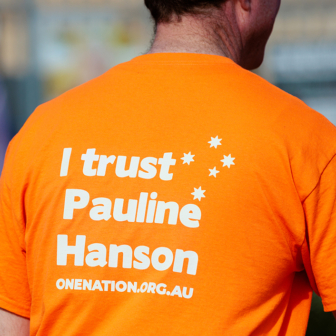
Importantly, the book closes with the challenge posed by the politics of grievance, as represented by the contemporary surge of support for One Nation. Contrary to those commentators who quaver that Pauline Hanson’s march has irresistible momentum, Megalogenis believes that “these grievances do not lead to an easily identifiable majority with which to blow up the political system. The New Australian branches of our family tree are now approaching 55 per cent of the national population.”
Where some of us are comforted by the long-term traditions of Australia’s political culture — a lack of truck with demagoguery and extremism — and institutional ballasts such as compulsory voting forming a bulwark against the nation’s conquest by right-wing nativist populism, Megalogenis once again defaults to the view that demographics will draw a containment line around Hansonism. For him, the extraordinary scale of the country’s migrant population, which he points out is proportionally much greater than that of either the United States or Britain, constitutes Australia’s true exceptionalism. He is not starry-eyed, counselling an urgent need to bridge the cultural chasm between the cosmopolitan southeast metropolises and the “Old Australian” parts of the country. But he retains a gladdening true believer’s faith in the nation’s multicultural project.
What Megalogenis doesn’t mention — it is a curious lacuna in the book — is the influence of Australia’s younger voting population. By the time of the next federal election, Millennials and Generation Z, joined by the coming gen Alpha, are projected to form the largest contingent in the electorate. With diversity as their life experience, according to political science research, these cohorts, female and male alike, are not only skewing left-of-centre but doing so in a durable way. That is, they are not growing more conservative in voting habits as they age, as have earlier generations.
That young men are predominantly holding for the progressive side of politics is another distinctive aspect of Australia compared to other advanced democracies. I and others worry, however, about how long this will persist in conditions of what has been described as “generational bastardry” in fields such as housing and climate change. For now, though, the young are the most consequential demographic time bomb for the Coalition. Maybe ripe pickings for Megalogenis’s next project. •
Three Shocks: Who We Are Becoming in the 21st Century
By George Megalogenis | Penguin | $36.99 | 368 pages