“Our vision is that you’ll never know we were here,” says Alcoa’s Warren Sharp. “We want to be an exemplar for mine rehabilitation.”
Tall and wiry, Sharp wears safety glasses, a high-vis shirt and matching yellow helmet. His manner is genial. His audience — a delegation from the Friends of the Anglesea River — is more reserved.
We’re standing on a grassy bank in the hinterland behind Anglesea, about ninety minutes’ drive southwest of Melbourne. Holidaymakers come to the Great Ocean Road town for its beaches, and to walk on the Anglesea Heath, a biodiversity hotspot.
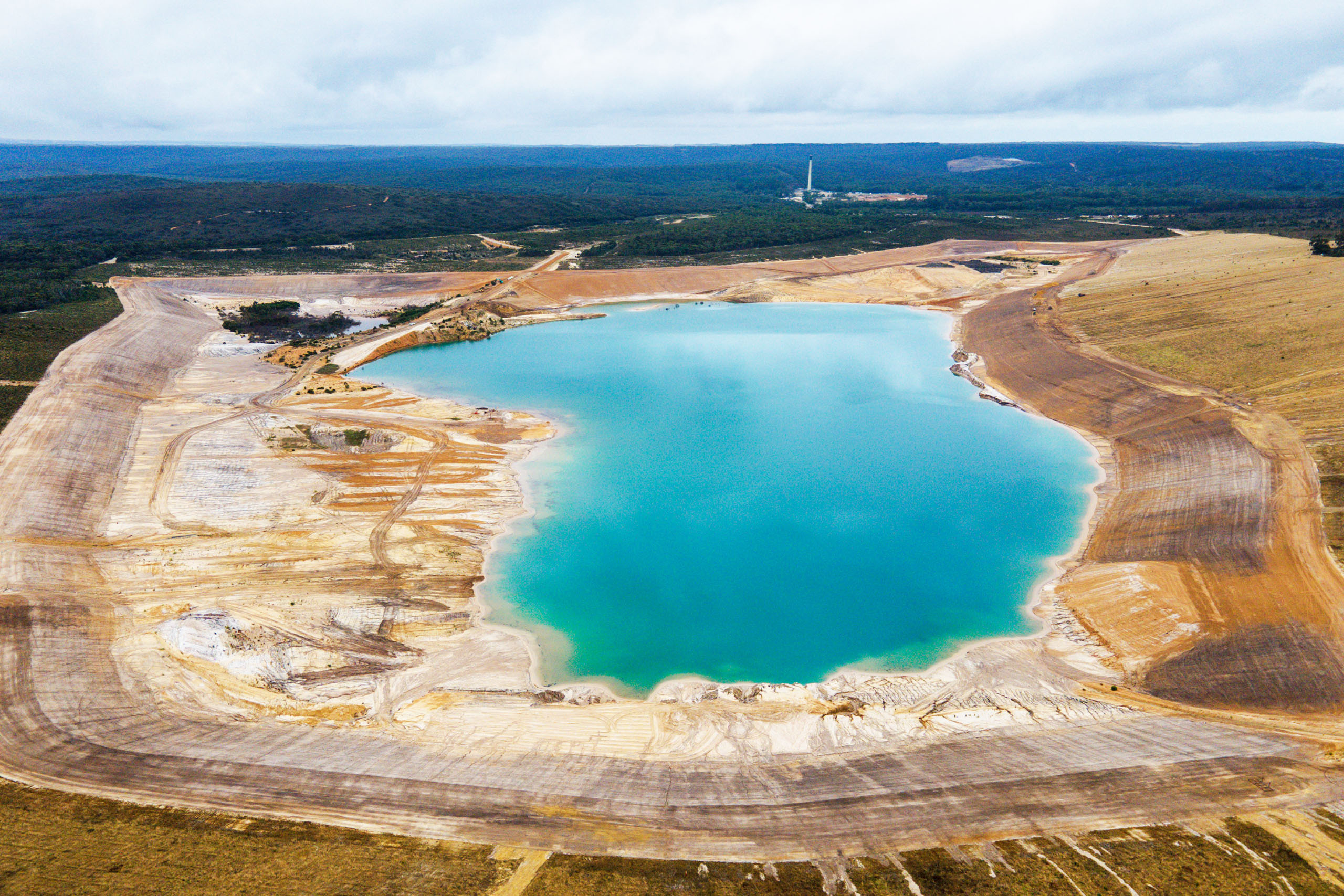
We’re on the edge of the Heath and below us is what looks like a half-empty lake; in the distance a single, tall chimney rises from the scrub, a remnant of the Anglesea power plant that supplied electricity to Alcoa’s Point Henry aluminium smelter for almost half a century. The lake is artificial, formed by Alcoa from the open-cut coalmine that fuelled the plant.
Alcoa closed the mine and power station in 2015, a year after shutting its Point Henry smelter, and the global aluminium producer has been restoring the site ever since. But the Friends of the Anglesea River have doggedly resisted a central plank of Alcoa’s plans — its scheme to fill the pit with water pumped from beneath the earth.
The lake may look half-full today, but is really three quarters empty. “It’s like filling a cone,” Sharp explains. “You need a lot more water at the top than at the bottom.” In fact, topping it would require another fourteen gigalitres — roughly enough to fill 5600 Olympic swimming pools.
To speed the process, Alcoa applied for a licence to extract 1.5 gigalitres of groundwater each year for up to a decade. The company saw its request as a reasonable amendment to an existing licence that allowed it to draw more than double that amount — up to four gigalitres annually — to operate the now-demolished power station.
“They used to consume a massive amount of water,” says Dick O’Hanlon, one of the founders of the Friends of the Anglesea River and a former engineer at the power plant. “Drawing groundwater to run a power station is uncommon,” adds Friends co-founder, Keith Shipton.
The two men believe those forty-six years of pumping made the Anglesea River acidic. In their view, extracting yet more water to fill Alcoa’s empty pit could only make matters worse.
The intense disagreement between Alcoa and the Friends mostly takes a back seat during our tour, which focuses on remediation of the mine site. After a three-year trial of different varieties, the bank on which we’re standing has been seeded with Wallaby grass. Local to the area, fire tolerant and able to cope with poor soils, fifty hectares of the grass has stabilised the banks to prevent erosion.
Birds swoop around us, bugs and insects have taken up residence and native shrubs are self-seeding from the surrounding bush. “Life has returned,” says Sharp.
Before leading us through the cyclone fence onto the mine site, Sharp warns us to keep an eye out for Tigers and Eastern Browns, though he reckons they’ll slither away before we get close. He guides us through a second fence to a site he calls the topsoil section. Here we find yellow blossomed acacias, pink and white flowering heath, clumping native sedges, bush pea and tea tree. Eucalyptus saplings push up through the soil, and he tells us orchids have been found amid the regrowth.
For its earthworks to smooth the gradients around the open-cut mine, Alcoa removed five hectares of nearby bush. They carefully stripped the soil in three layers, says Sharp, retaining dormant seeds and tubers, and then laid those layers of soil back down in reverse order. By spreading the layers more thinly, Alcoa succeeded in revegetating double the area that had been lost. Seven years later, we’re standing in shoulder high scrub.
Sharp hopes this regrowth will soon be indistinguishable from the rest of the Anglesea Heath, which is home to more than 700 plant species, 100 different native birds and twenty-nine mammals, including the rare white-footed dunnart. Alcoa’s original lease included more than 7000 hectares of the Heath, and if mining had continued for another half a century, as once envisaged, more would have been lost. But once the mine closed, Alcoa handed all but about 800 hectares back to the state, enabling Anglesea Heath to be added to the Great Otway National Park.
Sharp pulls out a sallow wattle as he explains that contractors are constantly weeding the site to remove such invasive plants. An Alcoa employee for thirty-five years who has worked at Anglesea since 2001, he has moved from electrical engineer to site manager overseeing remediation. He tells us the Heath has poor soil and tough vegetation and says regrowth is partly an engineering solution for preventing erosion. Behind the technical detail, his pleasure at seeing the bush regenerate is palpable.
I sense that even the more sceptical Friends are infected by Sharp’s enthusiasm and impressed by his efforts. But when talk turns to water, differences emerge between the company man and the nature lovers.
Alcoa and the Friends agree that rainwater leaching through sulphate soils is the immediate driver of acidity in the Anglesea River, pushing the pH so low that fish can’t survive. The dispute is about why this is happening.
Alcoa says acidity is “influenced by naturally occurring factors” like periods of drying followed by heavy rain. The Friends point out that the single biggest disturbance to the catchment in the past six decades was the mass pumping of underground water to operate the power plant. Ironically, this may have temporarily masked emerging problems in the river, because Alcoa diverted some treated, pH-neutral water into the estuary.
The science is complex, contested and uncertain. At issue is the relationship between river flows and water levels in shallow alluvial swamps and in the deeper aquifer from which Alcoa drew its water. The company says rigorous testing and analysis show pumping has had “no adverse impact on groundwater dependent ecosystems, including the Anglesea River.” The Friends say Alcoa’s pumping lowered the water table, reduced stream flow, dried out swamps and exposed more acid sulphate soils to leaching.
After the mine visit, Keith Shipton and Dick O’Hanlon take me on a tour of their own. We walk over a lightly wooded hill that looks like a natural feature but was formed by earth dug from the mine. Down the slope, beneath an elaborate tree house constructed by local kids, we arrive at the spot Shipton and O’Hanlon jokingly call “the waterfall.” They come here regularly to check if water from two tributary creeks is flowing into the Anglesea River.
“The Salt and Marshy Creeks join at Alcoa,” says O’Hanlon. “There is always water here, but it rarely flows.”
On this day in late winter, water is trickling over their “waterfall.” The flow began roughly three weeks earlier, they say, but they believe it would have started sooner, been stronger and lasted for more than just a couple of months if the catchment was healthier. They point out clumps of dead tea-tree they think was killed by acid.
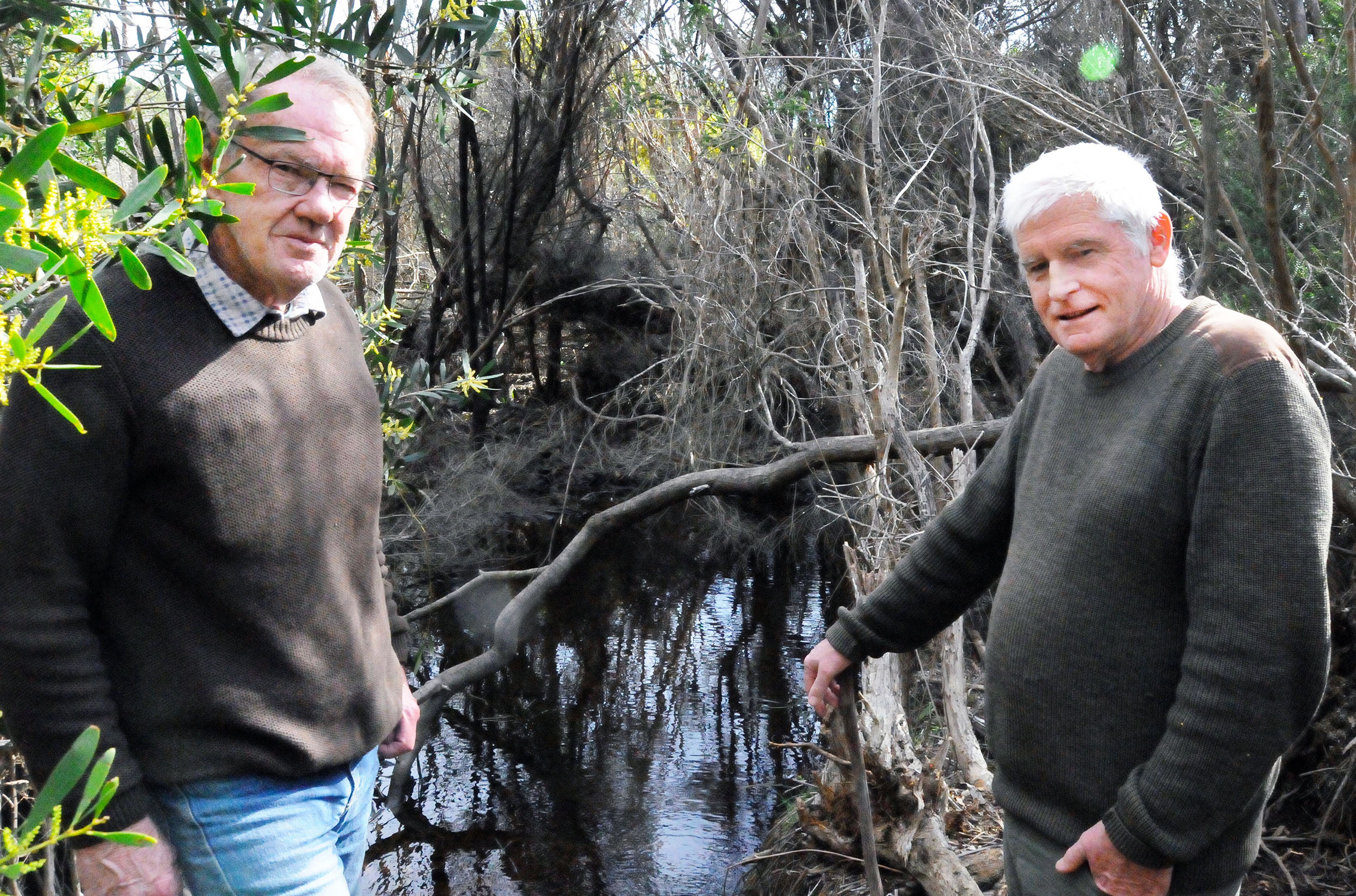
“The killer water is also the rescue water”: Keith Shipton and Dick O’Hanlon. Peter Mares
“The river used to flow more than 200 days a year on average,” says Shipton. “Now you can go for a year with no flows at all.”
Like most waterways along Victoria’s Great Ocean Road, the Anglesea River isn’t permanently open to the ocean. The mouth is often blocked by a ridge of sand known as a berm; when heavy rains flood the catchment, the berm gives way and river water flows out to the ocean. Big storms and high tides can also breach the berm from the other side. The mingling of river and sea water neutralises acidity in the estuary and creates the unique ecology of a salt-wedge, with a layer of fresh water sitting above denser salt water.
In recent years, though, low flows mean the river opens to the sea less often. The estuary has remained toxic for up to three years at a stretch, too acidic for aquatic life.
“The killer water is also the rescue water,” says Shipton. While rain washes acid into the river, it can also flood the catchment and open the mouth, restoring equilibrium to the system.
Historically, they think, that’s exactly what happened. While seasonal rains leached acid from dry soils, high flows also flushed the system, breaching the berm so river and ocean mixed. Incidents of acidification were weaker, shortlived and self-correcting.
Alcoa’s pumping changed the hydrology, they argue, not only by exposing more acid soils, but also by reducing stream flow — since more rain soaks down to replenish the aquifer, less water finds its way into the river. This analysis is supported by a detailed study prepared for the Friends by Ralf Haese, a professor of environmental geochemistry at the University of Melbourne.
The Friends draw a parallel with a case of acidification in the Otways. Studies found that when the local utility, Barwon Water, extracted water to supplement Geelong’s supply the water table fell, drying out a wetland called the Big Swamp. Rain leached acid from the exposed soils into a tributary of the Barwon River. Barwon Water is now remediating the site.
When it was healthy, the Anglesea River was home to eighteen fish species, including galaxias, gudgeon, cobblers, flounder and migratory short-finned eel that must travel the ocean to breed. The local Wadawurrung people call Anglesea Kuarka Dorla, “the place for fishing mullet,” which breed in the ocean and feed in the estuary. It was a significant breeding ground for black bream, a popular recreational catch, which also moves between river and sea when the berm is breached.
“The last time there was an opening in 2022, lots of great big bream came in, bigger than plate size,” says Shipton. “You could see the river coming back to life,” adds O’Hanlon.
But in August 2025, fish started dying again. Shipton says the small native galaxias were the first to go. “You’d see them coming up in the swamp land, very distressed,” he recalls. Predatory birds flew in for a feast, including pelicans, rarely seen in the estuary. “I’ve only seen one fish in the last year,” says O’Hanlon, “and that was gasping for oxygen.” The 2025 deaths marked the seventh mass fish kill since 1999.
The river looks clean enough at the waterfall, but when Shipton convinces me to taste a sample I get a sense of what is killing the fish. It tastes sharp and metallic, and I instinctively spit it out.
A July survey sampled water at six points of Anglesea River and found it to be acidic at every location, “ranging from a pH of 5.01 to 2.48.” Neutral water, neither acid nor alkaline, has a pH of 7.
The researchers found four dead fish, but the only living fauna they observed were mosquito larvae and one Eastern long-necked turtle.
We walk back to our cars, parked where the river pools into the reedy estuary. Even though it’s not yet spring, we’re swatting at mosquitos. “Mozzies can survive in water of pH 4,” says Shipton. Without fish and frogs to eat the wrigglers, he worries that Anglesea could be at heightened risk of Ross River fever as the weather heats up.
There is little data about flows or acidity in the Anglesea River before Alcoa began digging for coal in the 1960s, making historical comparisons difficult. To complicate matters, during the 1983 Ash Wednesday bushfires the estuary was permanently altered by deliberate flooding to extinguish burning peat. This too, may have changed the ecology.
Still, the Friends reason that if severe acidification was driven by climate induced periods of low rainfall and streamflow, then fish deaths would have been recorded during sustained dry spells in the twentieth century too. They trawled through the archives of the Geelong Advertiser and the Anglesea Rowing Club looking for evidence.
“They report on drownings, bushfires, floods and good fishing,” says Shipton. In some years, they reported very low water levels in the estuary, but the Friends found no mention of mass fish kills.
In July, after a two-year review, Southern Rural Water refused Alcoa’s application to extract more groundwater to fill the mine pit. The regulator reasoned that even if outbreaks of acidification in the catchment were a natural occurrence, Alcoa’s plan was likely to increase their “frequency, extent and severity” and lead to more “no-flow days” on the river.
Alcoa remained confident its proposal was the best way forward but chose not to challenge the decision. It didn’t want to risk more time and money on an unpredictable outcome or extend the uncertainty for all involved. “We think Southern Rural Water didn’t get it right, but we accept the umpire’s decision,” says Sharp.
“The community appreciates you not appealing,” responds one of the Friends at the mine site. The organisation sees the licence knock-back as a major victory for the river and threw a party to celebrate. “We dumped the pump!” boasted the invitation. “The Southern Regional Water decision changes everything,” says Shipton, “because it shows drawing groundwater does affect the ecosystem.”
Without underground pumping, the pit will fill through natural run-off and seepage. Citing a figure drawn from Alcoa’s groundwater impact assessment, Southern Rural Water said this could take twenty-six years. But Warren Sharp says the agency overlooked other data showing the process will take at least half a century.
Even full, the lake is likely to remain fenced off from the public — no swimming, boating or fishing — because the water will be too acidic. At best, it will be a useful source of water for fighting bushfires.
Sharp says the quality of the water in the lake will be the same as the quality of the water in the river, because of the catchment’s acid sulphate soils. The Friends think — and hope — that he’s wrong.
Later, Dick O’Hanlon emails me a chart that tracks seventeen years of water levels in a bore near the “waterfall.” Monitored by Barwon Water, the bore taps into a section of Upper Eastern View Formation, the aquifer from which Alcoa drew water for its power station. The chart shows water levels rose rapidly after 2015 when the plant closed and pumping ceased. In 2021, Alcoa resumed pumping to test its scheme to fill the pit, and water levels fell sharply. Twelve months later, when that trial ended, levels recovered. The same pattern can be observed in two other bores near the mine on the same section of the aquifer.
O’Hanlon sees this “spectacular” recovery of the aquifer as the first stage of the river returning to health. In time, he expects a rising water table will reflood swamps, reducing the area of sulphate soils exposed to the air. Run-off into the river will increase but be less acidic, and the berm will breach more often, allowing river and sea to mix. Eventually fish will return, and future outbreaks of acidification will again be shortlived.
This is still a theory, he acknowledges, but since Alcoa abandoned its pumping plans, it’s a theory that can be put to the test.
“The science doesn’t support this,” says Warren Sharp when the Friends put this scenario to him at the mine site. “But I hope you’re right.” •
This article was financially supported by the Walkley Grants for Freelance Journalism Fund.