After years of unsuccessful talks, the Vanuatu government has walked away from negotiations with France over its maritime boundary with the neighbouring French Pacific colony of New Caledonia. At the heart of the dispute is sovereignty over two uninhabited volcanic islands, Umaenupne (Matthew) and Umaeneag (Hunter), located east of New Caledonia and southeast of Vanuatu.
Conflicting claims to Matthew and Hunter date back to before the joint French–British condominium of New Hebrides gained independence as Vanuatu in 1980. Since then, repeated French assertions of sovereignty have angered not just governments in Port Vila but also the Kanak independence movement in New Caledonia, which supports Vanuatu’s position in the dispute.
The national councils of chiefs in both Melanesian nations — the Malvatumauri in Vanuatu and the Senat coutumier in New Caledonia — agree Matthew and Hunter belong to Vanuatu. Citing legend, oral tradition and cultural pathways, customary leaders in both countries have jointly recognised the cultural connections between the two islands and Vanuatu’s southern province.
So why have these two isolated, rocky outcrops been disputed for more than four decades? And why do indigenous Kanak in New Caledonia support their Melanesian neighbour, to the anger of French officials in Paris and anti-independence politicians in Noumea?
France, with its far-flung colonial empire, gains significant economic and strategic benefits from the rules embedded in the UN Convention on the Law of the Sea. In Europe, hemmed in by other European states, its exclusive economic zone, or EEZ, is just 340,290 square kilometres. But with the EEZ extending up to 200 nautical miles from the low-water shoreline, France’s overseas dependencies add another eleven million square kilometres, giving Paris management and control over marine resources around every islet, reef and archipelago. Without its Pacific, Caribbean, Indian and Atlantic Ocean territories, France’s EEZ would rank forty-fifth in the world rather than second.
French governments have paid more attention to maritime policy over the past two decades, hosting the third UN Ocean Conference in Nice last year and extending the country’s military, environmental and maritime research programs. Despite a current moratorium on deep sea mining, exploration for seabed minerals, fisheries and deep-sea oil and gas is continuing in the Pacific, where France claims more than seven million square kilometres of EEZ around New Caledonia, French Polynesia, Wallis and Futuna and the uninhabited Clipperton Atoll.
In December 1975, half a decade before Vanuatu won independence, French troops installed a plaque on Hunter purporting to assert sovereignty — just as nineteenth-century French explorers had buried bottles on Pacific beaches to symbolise their annexation of territory. The following year France unilaterally declared a maritime zone off New Caledonia, taking in the disputed islands.
In 1983, after independence, a delegation of ni-Vanuatu officials and customary elders travelled to Hunter to raise the Vanuatu flag and remove the French plaque. Today Vanuatu regards Matthew and Hunter as part of its territory, and the country has even issued postage stamps depicting the two islands as part of the archipelago.
The French government was undeterred. In May 2007 it attempted to extend New Caledonia’s maritime boundaries beyond the traditional 200-mile EEZ limit by lodging a claim with the UN Commission on the Limits of the Continental Shelf. The dispute ramped up after Vanuatu issued fishing licenses for areas near Matthew and Hunter.
Since then, the Vanuatu government has sought support from other members of the Melanesian Spearhead Group, the sub-regional organisation that links four Melanesian states with New Caledonia’s independence movement, the Front de Libération Nationale Kanak et Socialiste, or FLNKS. From the mid-1980s, the Spearhead Group led diplomatic initiatives in support of New Caledonia’s independence from France, with the long-running dispute over Matthew and Hunter becoming one more front in the broader contest with Paris.
The debate over Matthew and Hunter is also driven by customary leaders in both countries. Meeting in Noumea in April 2009, chiefs from Vanuatu and New Caledonia signed a joint statement reaffirming — in customary law and Melanesian culture — Vanuatu’s right to Matthew and Hunter. “With regard to the annexation of the Matthew and Hunter Islands to New Caledonia and its dependencies,” they declared, “it must be considered that this act has no historical or customary basis and that, according to Melanesian tradition, these islands therefore belong to the Republic of Vanuatu.”
In July of that year, Vanuatu’s prime minister Edward Natapei and the FLNKS’s Victor Tutugoro travelled to Tanna in Tafea province, joining customary leaders to witness the signing of the Keamu Accord, described as “a solemn commitment between the Kanak people and the people of Vanuatu, that whatever the political and institutional future of New Caledonia, Matthew and Hunter Islands will always remain the property of the people of Vanuatu.”
“It was a great event,” Victor Tutugoro told me years later. “This customary exchange showed that Kanak chiefs renounced any claims, of any sort, over Matthew and Hunter, and that the sovereignty of the islands remained with the customary authorities of Vanuatu, especially from Tanna and Tafea province.”
The French government was angered by the agreement, Tutugoro recalled. “The French high commissioner reproached me several times that we were undercutting international negotiations over areas that could have significant resources, such as oil deposits or undersea minerals. Invariably, we’d reply to these people: we are acting according to law — these islands don’t belong to us, and the agreement is between brothers of the same culture. And we won’t go back on this. If tomorrow they discover great wealth around the islands, then it belongs to them.”
The Keamu Accord boosted Vanuatu’s pressure on France to defer its bid to extend New Caledonia’s continental shelf and come to the negotiating table.
For ni-Vanuatu, the dispute draws on deep memories of more than seven decades of French colonial rule. Speaking before the UN General Assembly in 2012, Sato Kilman, Vanuatu’s prime minister at the time, affirmed that the territorial dispute “is a reminder that we must continue to uphold the notion that the rule of law should not be used as an instrument of powerful nations to coerce weak and small nations, especially over territorial disputes.”
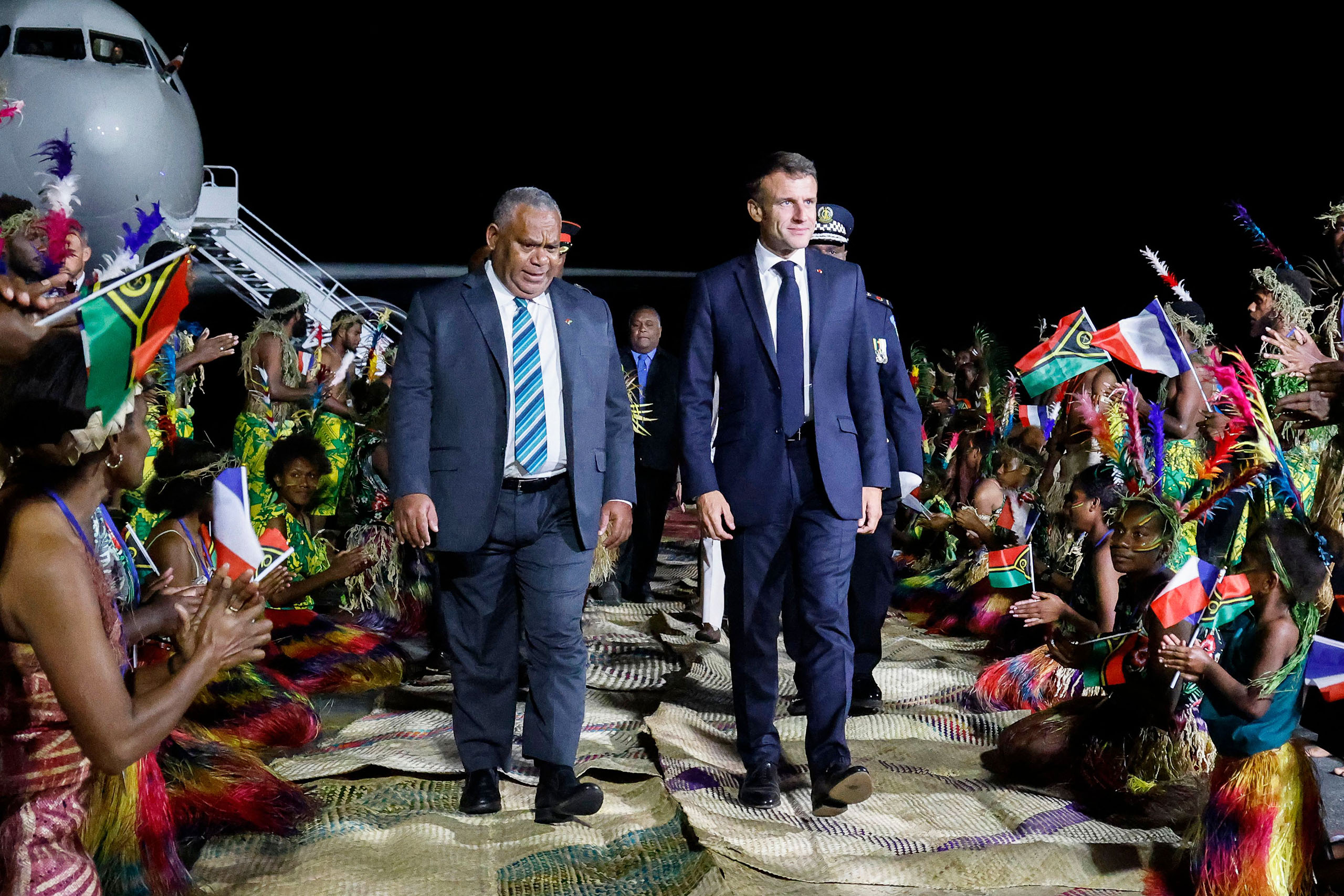
Delegations from France and Vanuatu finally met for a first round of negotiations in early 2018 at the University of New South Wales in Sydney. A second round followed in Brussels in June of the following year. But further talks scheduled for 2020 were delayed by the pandemic, and the process foundered until French president Emmanuel Macron visited Port Vila in July 2023, the first ever visit by a French president to post-independence Vanuatu. During his brief stay, Macron pledged that talks would resume by the end of the year — a cultural commitment to agreement sealed with a drink of kava.
Little happened, though, until newly elected Vanuatu prime minister Jotham Napat visited Paris in July last year to push for action. According to a joint statement from that meeting, “the two States expressed their willingness to identify a rapid and pragmatic solution.” Napat and Macron agreed officials would meet in Port Vila in November before formal negotiations resumed in Paris in early 2026.
Further progress was threatened after the November meeting — initially ignored by the French media — became controversial a month later. The conservative French newspaper Le Figaro speculated that the two islands could be ceded to Vanuatu and raised alarm over “the major geopolitical risks such a precedent could create.” Far-right politicians erupted at the perceived threat to French sovereignty, targeting Macron and angering the French government, which was doing everything possible to hold onto the islands.
Never one to miss an opportunity to denigrate Macron, Marine Le Pen, leader of the extreme-right party Rassemblement National, tweeted that national sovereignty “is neither negotiable nor something to be relinquished. The French people do not expect the Macronist government to carve up our overseas territories, which are real levers of power, influence and economic development, behind their backs.”
Her attack was echoed on social media by another far-right leader, Marion Maréchal, who argued that “the prospect of transferring our Pacific islets, Matthew and Hunter, to Vanuatu would represent a major strategic breach and blunder for France, threatening its heritage, security and credibility alike. It would be an affront to our national heritage, as these islets off the coast of New Caledonia are not mere specks of rock. They grant France a vast exclusive economic zone, rich in potential fisheries, energy and mineral resources.”
Surrendering the islands “would be a breach of our national security,” Maréchal thundered, “as any territorial cession sets a precedent. It would inevitably lead to further claims. The very credibility of the nation is at stake. By giving in, the President of the Republic would be committing a historic error in the eyes of France and the French people.”
In response, the French foreign ministry affirmed that “no cession of territory or renunciation of our sovereignty was discussed” during discussions with Vanuatu leaders. The Napat government was angered, since the unresolved issue of sovereignty over Matthew and Hunter is at the very heart of the maritime border dispute.
In the years since the signing of the 2009 Keamu Accord, the FLNKS has repeatedly reaffirmed its support for Vanuatu’s historic claim over the two islands. The issue erupted again in May this year when FLNKS president Christian Tein, arriving in Port Vila for a trade fair, casually told journalists that Matthew and Hunter belong to Vanuatu regardless of attempts to resolve the disputed maritime boundary.
FLNKS’s Mickaël Forrest, newly elected as provincial president of the Loyalty Islands, told me Tein’s statement was simply a reaffirmation of the long-held understanding between customary leaders in the two Melanesian nations. “All we did was to recall the historic connections, because these islands are part of the cultural heritage of Melanesian peoples,” he said. “This is nothing new — the status of these two islands is a matter between Melanesian peoples.”
“We’re aware that in the colonial context, there are discussions under way about these islands,” he added. “But even if it raises concern amongst some observers, there’s no problem on our part to repeat our longstanding position. For Kanak, for the FLNKS, for the Sénat coutumier, Matthew and Hunter are part of the Republic of Vanuatu’s natural heritage, full stop.”
In Vanuatu, meanwhile, prime minister Jotham Napat pledged that his government would not abandon its claim. “We will defend our sovereignty with determination,” he told parliament. “We have carefully evaluated all of the legal options that are available to us. We are trying the diplomatic pathway, but we are also ready to change strategy as soon as is necessary.”
Earlier this month Napat’s deputy, Johnny Koanapo, travelled to Paris for the long-awaited negotiations. But after two days of discussions with France’s Europe and foreign affairs minister Jean-Noël Barrot, neither country would budge on sovereignty. A statement from the French foreign ministry simply noted that “the minister reiterated the government’s position regarding French sovereignty over Matthew and Hunter Islands.”
At this point the Vanuatu government decided to abandon the process. Returning to Port Vila, Koanapo declared “we’re not going back to the bilateral discussions anymore.” He rejected France’s proposal to conclude a maritime boundary agreement while the sovereignty issue remained unresolved and said that New Caledonian representatives should have been involved in the talks.
“Our journey to full independence will not be complete until Vanuatu’s rightful ownership of Matthew and Hunter Islands is fully recognised,” Koanapo said. “Now that we have reached an impasse, Vanuatu will pursue other legal options available under international law. Let international law, let the International Court of Justice or any arbitration for that matter decide on this. To us, what France has done is an insult to us all.” •