Karl Stefanovic loves being the centre of attention. Last week he succeeded in getting everyone talking about his podcast, The Karl Stefanovic Show, by publishing a chummy interview with far-right Islamophobe and convicted criminal Tommy Robinson. Then the former Today host managed to get himself sacked from his day job at Nine in a sequence of events that has been widely reported and dissected.
If you missed the news cycle, here’s a quick recap.
When the latest episode of The Karl Stefanovic Show appeared last Tuesday it featured the infamous Robinson “interview” (actually an extended monologue interspersed with softball questions and approving chuckles from Stefanovic). It immediately drew widespread criticism for its derogation of journalistic responsibility.
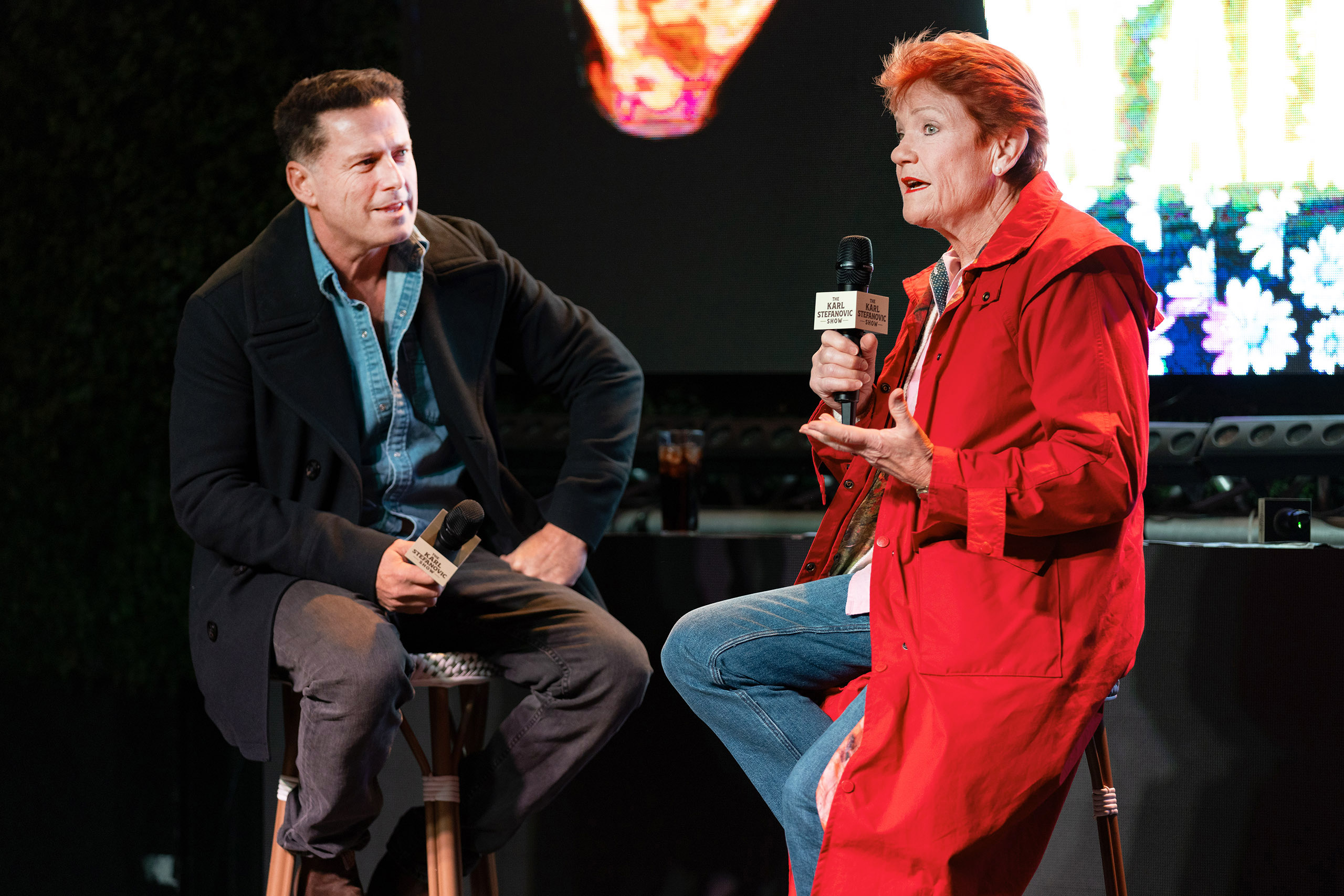
A day later, the episode was taken offline — apparently by Stefanovic’s team — and republished by Pauline Hanson on her YouTube channel, where it has since been viewed more than 500,000 times.
By the end of the week, Nine had declared it was parting ways with Stefanovic, prompting its former star to release an unapologetic YouTube video declaring himself “free” and “truly independent” from mainstream media.
These highly publicised events generated commentary in all corners of the Australian media. Much of the discussion has focused on the terms of Stefanovic’s exit from Nine, the viability of his podcast venture, and the strategy behind the Robinson interview. (Was it a misstep on Stefanovic’s part or a deliberate move to stoke controversy and hasten his exit from Nine?)
These are important issues, but for those interested in media and politics they aren’t the only questions worth considering.
Why is it that one of Australia’s most highly paid media personalities would abandon national breakfast television — a platform that attracts a wide audience and helps to set the daily political agenda — for a highly uncertain future as a fringe podcaster catering to conspiracy theorists and neo-fascists? And what does all this tell us about the status of television within a rapidly changing global media ecosystem?
Stefanovic’s podcasting experiment may seem a counter-intuitive move for a figure who clearly relishes national celebrity. But performers like Stefanovic are not in the habit of choosing smaller audiences, less prestige and less income. They make strategic decisions based on where they think media markets and audiences are going.
Stefanovic is gambling that a prominent position within the global far-right mediasphere may be more impactful — and potentially more lucrative — than his current position at the apex of an established but fast-declining mass medium.
This is not an unreasonable assumption. Commercial television audiences and advertising revenues have been in freefall for years. While shows like Today still attract hundreds of thousands of viewers daily, those audiences are old (the average age of linear free-to-air viewers is fifty) and steadily decreasing in number. There are simply not enough young viewers tuning in to replace them.
As Stefanovic knows, the power and prestige of commercial broadcast television is in terminal decline — along with the advertising revenues that sustain that sector. Twenty years ago, when Stefanovic took the reins at Today, television was an industry of long lunches and lavish compensation packages, with the biggest stars endlessly indulged by management. No longer. Television is now a business of shrinking markets; aggressive cost reduction is the only route to profitability.
These dire economics may explain why Nine moved swiftly to sack Stefanovic. Scrubbing his $2-million-plus annual pay package off the budget sheet while simultaneously reassuring risk-averse advertisers that broadcast television remains a safe space for their brands was clearly the smart choice — and perhaps Nine’s only viable option.
One of the most interesting commentaries about the Stefanovic affair came from a Nine stablemate, the business columnist Elizabeth Knight. In her column for the Age and the Sydney Morning Herald, Knight took a stab at interpreting the business logic behind Stefanovic’s lurch to the right.
Stefanovic “astutely picked the direction of media monetisation – the fragmentation of audiences and the rise of the podcast,” she wrote, noting that the most popular podcasts are those populist titles that “push… back on the status quo and [promote] the politics of grievance.”
For Knight, though, Stefanovic’s move represents a misunderstanding of the Australian media market. “In larger markets such as the UK or the US, there is a good living to be made by the likes of Joe Rogan,” she wrote, “but the same can’t necessarily be said for a market the size of Australia.”
Has Stefanovic fundamentally misunderstood the economics of national media? Is Australia not big enough to sustain the kind of fringe media that he is trying to cultivate? This may well be the case. But perhaps Stefanovic and his team have their eyes set on a different prize: a shot at stardom within the global far-right media sphere, which extends well beyond our national borders.
You can see, then, why Stefanovic may be willing to trade a declining national television audience for a dispersed, transnational and highly engaged audience of far-right YouTubers.
One thing is clear: old assumptions about mass and niche media are being tested by these strange events. When Australia’s best-known commercial TV news personality can suddenly reinvent himself as a far-right media celebrity and then try to take a chunk of the national audience with him on a journey into the fringes of the manosphere, something important has shifted in Australian media.
The distance between television — a nationally regulated, “old” broadcast medium — and the echo chambers of social media now seems smaller than ever.
Perhaps we shouldn’t be surprised by this. After all, the commercial free-to-air networks have long stoked the fires of anti-immigrant sentiment with their racialised coverage of crime, boat arrivals and housing affordability. Stefanovic’s politics may represent only an intensification of, rather than a radical departure from, this ignoble tradition. •