There’s no standard formula for becoming a prime minister, let alone being good at it.
Some people seem destined to rise, propelled by a commanding presence, a mellifluous voice, agreeable bone structure or a privileged upbringing. Some can inspire others to better possibilities with an advocate’s passion and soaring turns of phrase. Some win with empathy, an easy manner and the common touch, or a fighter’s defiance and fearless disposition. Some climb on superior political skills, dogged persistence and administrative competence. Mostly, it’s a mix of all those elements in varying proportions. And then there’s timing, circumstance and a bit of dumb luck.
The sudden propulsion of One Nation party leader Pauline Hanson into conversations about national leadership makes it an opportune time to consider exactly what we’re after in a prime minister. It’s also a good reason to contemplate how past leaders’ personalities and practices have contributed to the political climate we’re now experiencing. With the prime ministerial office carrying complex, high-pressure responsibilities, the character of its occupant has immense consequence.
If we were to design the ideal leader — not such a ridiculous concept in this accelerating AI universe — there’d be a long list of desirable attributes to incorporate. For starters, you’d want a top-notch public communicator who can engender confidence. They’d need to be able to clearly speak to Australians as a whole and engage easily with all kinds of people, from colleagues and staff to bureaucrats, businesspeople, foreign leaders and regular folks.
Thoughtful intelligence is important, too, the kind that can discern the source of a problem, find the best solution and implement it for the nation’s benefit. In an optimum model, you’d also include a ready ability to see things from other points of view and anticipate the possible consequences of different courses of action.
The perfect PM would be steely enough to stand up to pressure, courageous enough to take hard decisions for the greater good, and self-assured enough to front up and explain why, in ways people can understand. It goes without saying, they’d be authentic. Resilient. Reassuring. Intuitive. Able to think simultaneously about what’s required now and for the future and find ways to tackle both at once. They’d be able to stay on course but also pivot as circumstances require.
This prime minister would be a team builder who can keep the cabinet and backbench together and motivated. They’d be capable of working all hours across time zones while keeping a stable temperament. They’d be inspiring and visionary but also good at prioritising, making decisions and getting things done on time and on budget. Administrative competence is a much underrated skill, assumed in all prime ministers but absent in a few.
They’d be relatable — enjoy a laugh — but have earned and retained widespread respect. They’d place the people’s interests ahead of their party’s or their own. They’d lift up, not punch down. And they’d be able to distil what makes us all Australian and remind us of it whenever we need to pull together.
Of course, leadership perfection doesn’t exist and Australians will have differing views on which characteristics are most important. We tend to recognise them best by their absence.
Breaking down the component qualities can be a bit awkward because it naturally leads to measuring the incumbent against them, likewise their predecessors and any gathering pretenders. The analysis becomes even more uncomfortable and possibly slightly precarious when it extends to assessing prime ministerial competence and individual leadership styles through the lens of personality and the influence of upbringing.
Despite the perils of this kind of endeavour, Monash University political historian Paul Strangio argues it’s a necessary discomfort. Strangio acknowledges he’s on dangerous ground with his new book The Alchemy of Leadership, which takes an unvarnished look at the first seven Australian prime ministers of the twenty-first century, how they grew up, how that informed their stewardship — and where Australia finds itself as a result.
Strangio confesses he should know better, having engaged in something similar two decades ago when he was examining the complex past relationship between Gough Whitlam and his treasurer, Jim Cairns. He describes the horror of discovering before presenting a paper about the formative influence of Whitlam’s doting mother that his octogenarian subject was in the audience. Less surprising, the former prime minister was unafraid to deliver an eviscerating response in real time.
“Despite the risks and elusiveness of the enterprise, I still hold that venturing to fathom those who govern over us is a vital task,” Strangio insists in his introduction. “At the quarter mark of a turbulent century, the evidence for its urgency is all around.” Besides, he adds, “it is an itch that had to be scratched.”
The temptation to engage in deep personality analysis of our leaders is one that those who observe them at close range tend to resist. Political journalists can be blunt about character but are wary of straying too far into psychology lest it be deemed highly subjective, unnecessarily personal and prejudicial — to their subjects and ultimately themselves. After all, you do need people to keep speaking to you. But it’s morbidly fascinating to see someone else do it from a distance.
As his title suggests, Strangio’s volume presents primarily as an assessment of each of the Australian leaders of a period that produced seven prime ministers. Declaring it “too common to be merely coincidental” that our foremost PMs all benefited from “special maternal investment,” he illuminates the patterns in their backgrounds and considers their personalities alongside benchmarks of success.
Strangio uses several sets of metrics laid out in others’ work. He cites respected scholar Patrick Weller, longstanding politics professor at Griffith University, on three measures of prime ministerial accomplishment. Do they survive and win re-election at least once? Are they clearly in charge of their own government? Do they have an agenda they manage to introduce?
Strangio also references the work of political psychologist Graham Little, who identified three main leadership types: strongman, inspirational and group. And he also looks to the early twentieth-century political sociologist Max Weber’s 1919 work Politics as a Vocation, which concludes that “a firm taming of the soul” — or what American presidential scholar Fred Greenstein described as emotional equilibrium — was the singular indispensable attribute.
To diagnose who possesses it and who doesn’t, he groups the seven by leadership type and looks at how the circumstances of their early years may have influenced their approaches.
Strangio’s harshest assessment is reserved for Scott Morrison, who he says left office “abhorred by voters but still mostly a leader of cryptic motive and intent.” He examines Morrison’s religiosity and summarises the self-comparisons he makes in his memoir, Plans for Your Good, including with Jesus, as “staggering self-conceit.”
Beyond stinging conclusions like those, he finds things to praise and criticise in all of them.
A popular Kevin Rudd beat Howard at his own game, presenting as a younger, more modern, version. But after he shelved a core policy promise of an emissions trading scheme, his damaged popularity left him “dangerously exposed.” Strangio calls him “a figure singularly ill-suited to the rigours of high office.”
Gillard’s calm competence saw her pass more legislation in minority government than Howard managed in his final term. But she was undermined by conservative-led misogyny, her own communication problems, and how she had got the job, a process that blindsided voters and invited Rudd’s vengeance.
Abbott, Strangio says, triumphed through aggression and “implacable negativity,” not the policy creativity that had distinguished both Menzies and Whitlam. Turnbull tried to return to Menzies’s model but showed “insufficient mettle in holding the line against his tormentors.” Each of the past prime ministers, he observes, effectively boobytrapped the job for those who followed.
But Strangio goes beyond free character analysis based on background and common traits to make some highly relevant observations about the genesis of our current politics and its arc over the first quarter of this century.
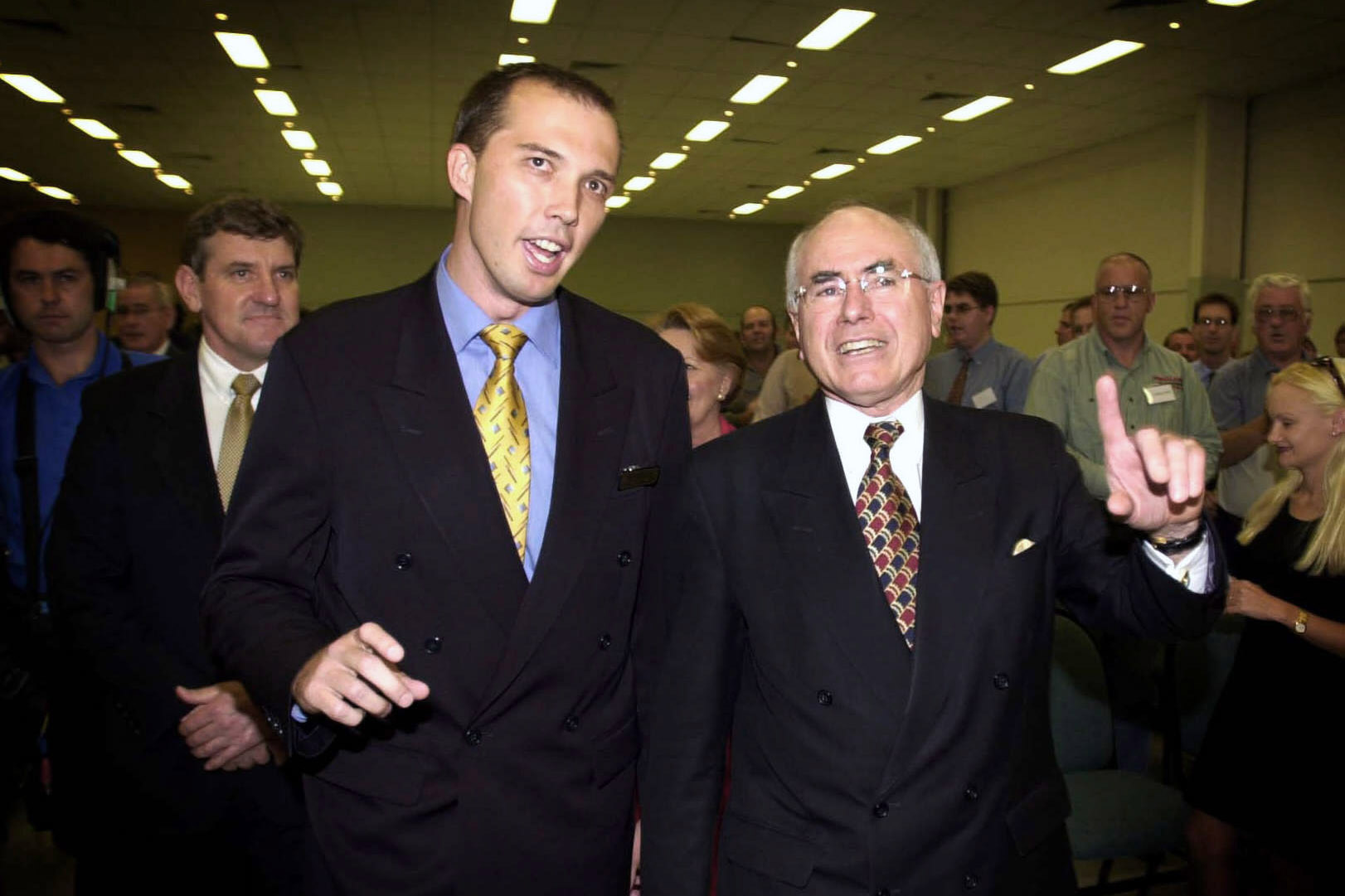
He unpicks the leadership styles and policy hallmarks of each prime minister in the context of a core theme: the influence of the man who led Australia into the new millennium, John Howard. His premise is that Australia has lived under “Howard’s settlement” ever since.
Strangio identifies the year 2001, which hosted Australia’s first twenty-first century federal election, as having marked two significant shifts still influential today. Describing Howard as “a supreme escape artist, an election-time Harry Houdini” and “the fountainhead of contemporary Australian politics,” he argues that 2001 saw a prime minister who’d been raised with “impeccable courtesy but also plain tastes” remodel himself as a strongman. This process was aided by public anxiety over asylum seekers and a world-changing terrorist attack on the United States.
Strangio posits that 2001 also marked the completion of the Liberals’ transition away from their Menzian philosophical foundations as a progressive party of economic reform to what he calls “populist-hued conservatism.” He says this “heralded a new era in the nation’s politics and gave impetus to dynamics that would prey on Australian democracy in the new century.”
Separate from the psychological profiling, what makes this a timely piece of analysis is that a major driver of Howard’s moves at the time was the threat from a surging One Nation and its leader Pauline Hanson. Elected in 1996 as an independent former Liberal candidate who was disendorsed mid-campaign for comments about Indigenous welfare, Hanson won by still appearing on the ballot paper as a Liberal, boosted by her sudden notoriety.
From the platform of parliament, she then resurrected, albeit in a less filtered manner, the kinds of sentiments about Asian immigration that had cost Howard a tilt at the prime ministership when he expressed similar thoughts twenty years earlier from within what was then still the party of Menzies. Hanson’s was a more extreme populism than Howard would come to embrace. After her party won eleven seats at the 1998 Queensland election, it started to threaten the Liberals’ base federally, just as economic pressures were further eroding their vote ahead of seeking a third term.
Strangio highlights Howard’s decision to go all-in on border protection and security as the way to recapture fleeing support, the 11 September attacks only amplifying fears he’d seeded and ripening them for reinforcement. The author marks it as a tipping point from which Australian political practice has not recovered.
Strangio acknowledges Howard’s mastery of politics. Having been initially, like William McMahon decades before, a “leader of last resort” for his party, Howard had cemented himself through such vastly superior political skills that the comparison falls away. Having entered representative politics with an unwavering opposition to the kind of social reforms Gough Whitlam had championed, and been able to fight them all over again in the form of Paul Keating, his 1996 win allowed him to start entrenching his attitudes in his party. Strangio argues Howard’s embrace of an “unthreatening, mild-mannered” form of populism began with that election, built on positioning with the “mainstream” and against “elites” and minority special interests.
He describes Howard as “a great learner” who wouldn’t have misread the electoral messages in 2022 and 2025 as his more “militant” heirs appear to have done and has since counselled against extremes. But he also argues that the deep conservatism of his upbringing, which saw him drive the Liberals to oppose cultural and social modernisation, has left the party alienated from young voters and on an unsustainable course.
The analysis doesn’t spare Labor from blame for the state of our politics. Strangio argues that Labor’s philosophical uncertainty emerging from the neoliberal, reform-heavy Hawke–Keating years allowed Howard to raid its traditional working-class constituency and claim them as his “battlers.” He says this identity crisis helped populism grow roots in Australia.
“Howard’s flirtations with reactionary populism were always likely to turn perilous,” Strangio observes. “Once that fire was lit, the probability was that it would be impossible to douse and control; instead it would escalate. That escalation… is now dangerously close to a conflagration point.”
Although Howard unquestionably belongs in the top tier of Australia’s prime ministers, says Strangio, the quality of his leadership deteriorated through his later years in office and was “ultimately corrosive” for the country.
His assessment of incumbent Anthony Albanese’s leadership is necessarily hampered by the fact that it isn’t over yet. Strangio suggests he has claims to being the most significant leader since Howard, not least for having broken the run of instability by managing to be re-elected. He also points to Albanese’s 2025 victory as delivering “a mighty blow to Howardism” by denying Peter Dutton’s version the chance to flourish in office.
He doesn’t spare Albanese, highlighting an “inability to animate with words,” though that’s balanced by praise for a political skillset similar to Howard’s and a “thread of kindness” he says is “precious in this ill-tempered century.”
Strangio notes that both Albanese and Howard served lengthy political apprenticeships, something he determines is also key to leadership success.
That’s a qualification Pauline Hanson can also claim to have earned, albeit nowhere near the levers of power. Strangio’s vivisection predates her party’s recent acceleration and his interest is in those who’ve reached the summit, not the many more who’ve tried to climb. But it’s not hard to see how Hanson’s already-tectonic impact on politics could give rise to a new irresistible itch. •