I have sat on reviewing this book for too long, partly because the recent dynamics of political populism have been in such flux (exemplified in Donald Trump’s America but hardly peculiar to it) and partly because the task was offered to me with an encouragement to reflect on the relevance Hayek’s Bastards might have to Australia. Just when I thought I could tidy up along came another fracture between the Liberal and National parties, precipitated in part by the apparent ascendancy of One Nation.
The connections that might be made between this third book in Quinn Slobodian’s forensic engagement with neoliberalism’s armoury of ideas and two local phenomena — the internal trauma of those two major parties, and the surge of the populist third, either into the “mainstream” or pulling further to the right — have become more pressing if also no less elusive.
Slobodian has focused on how we might understand the penetration of free-market ideology into many aspects of the contemporary world. Those lines of influence, he insists, need not be overt, are often ingenious, and can seem so deeply constitutive of institutional power that they become enmeshed in “normative” and ostensibly “non-economic” practices.
In Globalists (2018) he charted neoliberalism’s response to the calls of “the Global South” in the 1970s for access to fair trade. Instead, the World Trade Organisation, or WTO, engineered “a world of information and rules” that effectively eroded the capacity of those states to control their own development. Crack-Up Capitalism (2023) examined the emergence of “zones” of exclusion from national authority in pursuit of accelerated, less-regulated growth and less-accountable “externalities,” from cheap transitory labour to environmental impact.
This superficial summary of two closely argued books might at least suggest one of Slobodian’s core themes: the trenchancy with which the anti-state imperatives of neoliberalism erode democracy, given that rights and representation are largely premised on the ministry of elected governments.
Slobodian is primarily an intellectual historian, but while he is interested in the lineage of ideas he is also attentive to how they must be brought “down to earth” in political projects. His meticulous reconstruction of those processes gives the apparent obviousness of that anti-state theme a fresh purchase. Those first two books show those problems contained in relatively formalised practices — ones in which, of course, states are far from irrelevant, precisely because they are less constrained by demands on their resources.
Globalists exposes “a doubled world kept safe from mass demands for social justice and redistributive equality by the guardians of the economic constitution” — at least as drawn by the WTO. Crack-Up Capitalism tracks “a radical form of capitalism in a world without democracy,” from Hong Kong in the 1970s, to Singapore in the 1990s, and then to Dubai.
Hayek’s Bastards doesn’t have the same firm framing: it deals with a more febrile domain of ideological manoeuvring among the networks of think tanks, foundations, societies, journals, grants and subsidies that have rallied since the 1980s to meet a more diffuse challenge — to corral in domestic affairs what was modelled from successes in those more controlled international domains. For groupings such as the free-market Mont Pelerin Society, the end of the cold war was not so much a victory over communism as an external threat but the opening of a more alarming internal vacuum in advanced Western societies. What, they worried, would constrain the excesses of the liberal welfare state if the claims of environmentalists, humanitarians, feminists, equal opportunity advocates — the whole panoply of “new class” special pleaders — had their way?
In crafting an answer, the many “bastard” progeny of economic philosopher Friedrich Hayek (1899–1992) did not simply follow their master in disputing the “fatal conceit” that planning could ever do better than the market. They also picked up a range of less resolved ruminations that could be “instrumentalised, adapted and weaponised” to serve this new purpose. As some critics have suggested, the links in what Slobodian concedes are the “often tangled genealogies” of ideas turned to this purpose — less as “solutions” to be imposed in an exercise of power than “problems” to exploit among an uncertain public — can seem strained as intellectual history, with its predisposition to lineages of reason rather than opportunism.
There is also the question of how best to contextualise the field in which this battle for influence was conducted. Slobodian’s is essentially a supply-side perspective, one emphasising the cleverness with which his diverse cast of advocates manufactured a product to meet an inchoate need. Some of the deepest “roots” of contemporary populism, as his subtitle puts it, are to be found in “neoliberalism” as an ideology. But this can leave unexamined the demand side of the story: the possibility that the post–cold war welfare state was not so much a void to be reclaimed by “the virtues of self-reliance” but one actively generating its own needs and contradictions. The possibility of this more active dialectic is one of the least examined aspects of the book, and perhaps one that requires closest attention as we reflect on the apparent crisis of non-Labor politics in Australia, and its equivalents elsewhere.
Slobodian discounts the “stubborn story” that a contradiction exists between advocacy for a globalised free market and a surge of populism premised on the “national sovereignty” and “cultural homogeneity” that unites “the people” against elites from “nowhere” and the diversity from “elsewhere.” Hayek’s Bastards was written largely before Donald Trump’s 2024 election and disputes any suggestion that Trump’s 2016 victory was “a grassroots rejection of… market fundamentalism” (and its variant, Brexit’s “take back control” slogan). The trends since then, however, largely confirm his central argument.
Rather than a “backlash,” a resurgent populism exemplifies a “frontlash”: an always awkward but never more powerful fusion of conservative traditionalism and libertarianism. The moral crusade that brought those interests together in the 1950s has been transformed since the 1990s by “ordoglobalism” out there (international markets protected from the reach of national governments) and oligarchy at home (exemplified in the billionaire profile of Trump’s MK II cabinet). Combined, they offer the kind of “perfect capitalism” dreamt of by neoliberalism’s founders.
Much more than the grotesque theatre of tariffs, says Slobodian, this synthesis gets its populist edge from a “flight to nature.” Hayek’s Bastards zeroes in on a newly “biologised” take on economic freedom, especially evident in a localised, even geneticised “culture” raised above the claims of “the social,” accorded an effectively “premarket” status, and mobilised around a repurposed concept of “race.”
This is a bald summary. Slobodian’s articulation is more subtle, though it is underpinned by alarm that these “nature”-based formulations (in education theory, psychology, drawing on revived anthropology, promoted in books, journalism, on the celebrity circuit, in novels, perfectly adapted to YouTube etc) are, for all their sophistication, still on “the slippery slope” well known in neoliberal ideology. “Shoddy science” is used to marginalise, disentitle and “other” the dependent, the poor, the displaced and inefficient. If echoes of overt eugenics seem implausibly archaic here (and Slobodian treads carefully around the attribution of “racism”), the mobilisation of “difference” is pervasive.
Slobodian suggests the aspiration for an “ethno-state” — the populist call to protect a homogenised culture — might be “better understood as the demand for an ethno-economy” determined by the retreat of government and its proxies from interfering in the lives of “the people.” “Elites” become suspect precisely because they presume to impede the logic of reverting to an ostensibly natural or at least national community: they advocate and enable diversity serves only to consolidate their influence and draw a population away from their more immediate affinities, more genuine efficiencies. Professional politicians fall under the same shadow, courting votes from special interests, from the less assimilated, the less able.
Slobodian quotes Jeff Diest who, as president of the free-market Mises Institute, welcomed Trump’s first election as offering “the gift of populism.” MAGA crafted a bridge of influence in red caps and on Twitter that had so far eluded Diest’s colleagues’ “niche” advocacy in their commentary and conferences. “Our job is to unwrap [that gift]: to turn the nation’s contempt for politicians into a contempt for politics itself” and so, effectively, create a “people” defined within the culture of their tribe but stripped of a sense of themselves as citizens with claims on the state. As Slobodian suggests, the intended result would be “the extension of competitive dynamics ever deeper into social life.”
As an armoury of ideas this synthesis is daunting, and no doubt familiar. But it can still raise the question: how does all of this actually connect to those “people” and effectively deal with the issues “populism” as a demand might reflect. Is “populism” — even its most simplified “paleo” forms (“hardwired human nature, hard borders, and hard money”) — more than the ideological ingenuity of those who seek to claim the political agenda from above? To what extent does it reflect the pressures of those restless for change from below?
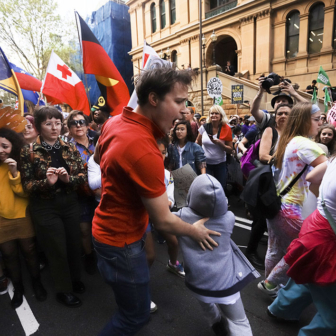
Given my brief for this review, I found myself reflecting on the experience of riding to work, in early February 2022, through the “Convoy to Canberra” encampment on the lawns of the National Library. As someone very much inside the Canberra “bubble,” this has been my only direct experience of populism. For me, and for many observers, it was the diversity of that assembly that was most striking. Its precedent, the Canadian “Freedom Convoy” to Ottawa, was primarily an anti-lockdown protest. That issue was prominent in Canberra too, but the campers included “Sovereign Citizen” campaigners, ultra-religious groups, anti-immigration or pro-mining protesters, Q-Anon sympathisers, a sizeable representation of retirees (some in sophisticated motorhomes) alongside rather residual “alternative lifestylers” (more ad hoc in equipment) with their rather different anxieties about or visions of the future, and many others searching for solidarity in gesture rather than cause.
John Farnham’s You’re The Voice was on near-continuous loop — its “we’re not gonna sit in silence; we’re not gonna live with fear” open to a range of what Slobodian might call “instrumentalisations” — and the jeer “paedophile!” seemed habitual (if unfocused) among attendees from a range of still-protean right-aligned groupings who dropped in. The Aboriginal Tent Embassy, nearby on the lawns of Old Parliament House, was reportedly a site of some awkward exchanges, co-opted by a few into assertions of a shared denial of rights, contested by others as a prior claim to “sovereignty” and “belonging.” The many and very active social media platforms associated with the Convoy were similarly sites of dispute and in terms as much defined by the media as by the proliferating messages.
This camp — dispersed soon enough by police — was clearly far from Slobodian’s circles of intellectuals and higher-minded influencers in the United States or Germany. If some messages were shared, though, they were being acted out with a greater sense of immediacy — of wanting to be heard rather than told what to think — under red ensigns, Eureka “southern crosses” or in prayer vigils.
If the contrast between Mont Pelerin and campers on the Patrick White Lawn seems stretched, an intermediary representation of the processes that Slobodian traces might be found in the diet offered by the Institute of Public Affairs, the established home of Australian neoliberalist advocacy. Here, too, the rather strained, or over-rehearsed, neoliberal–populism fusion can be seen in play over recent years. The IPA’s luminaries have declared the old divisions of “left” and “right” irrelevant to circumstances that now set “globalists” against “nativists.” “Postmodernism, cultural Marxism, and the varieties of woke” have drained away national pride. In the IPA Review columnists declare that “pro-natalism” must be the urgent response to an influx of ethnic diversity; such a recovery of identity, purpose and people would help in combatting the fashionable post-colonial critique that meant “we the settlers are being rounded up at last.” And, for inspiration, there was Trump’s second cabinet of maverick billionaires which was at last showing it might be possible to break down an alliance between “rent-seeking capitalists and empire-building bureaucrats.”
This necessarily brief selection from IPA publications suggests the Australian right has readily seized on the imperative for a more militant, combative conservatism. One of the organisation’s main figures, Michael Barnett, applauded Trump for showing how a “rights-based approach to liberalism has been a disaster,” and declared that “how we harness libertarian and conservative populist activists impulses is the challenge of our age.”
This summary might also suggest that the message from Hayek’s bastards has gotten through even in the antipodes. But what if we look behind populism as manipulation to ask how effectively it meets the discontents so evident in contemporary politics? Analyses of New Right mobilisations in Australia — Dominic Kelly’s account of prominent advocacy groups formed in the 1980s onwards, for example, and Jordan McSwiney’s attention to the more recent struggle by right-wing parties for organisational sustainability — suggest that populist orchestration struggles for coherence and enduring purchase. Robert Manne’s memoir has recently captured his own discomforting experience of the intellectual narrowing that came as Quadrant magazine moved from an older liberal-conservatism to a neoliberalism subsidised and directed from the boardrooms of mining magnates — rent-evaders who were certainly capable of exercising political influence but not of gaining enduring electoral purchase.
Analysis of the defeat of the Voice referendum has suggested that it was not so much the treachery of “elites” that was at stake for voters — however much that rhetoric was deployed in populist terms — or a resurgence of racism, but a sense of the potential “risks” of change that related more to issues of “equality of treatment” (not simply the creation of “special rights”), a wavering “trust” in government, and a frustration at the stalemate of party politics. Seen in these terms, that result was more complex than a victory for either populism or the right.
Yes, the Convoy to Canberra was a “free choice” campaign. Its anti-vax origins reflected a naive, gullible and perhaps calculating use of “science” but also a pervasive distrust of an “unholy alliance” between the state and globalised pharmaceutical corporations. Yet in its fixation on the child, the home, the rights of parents, even the retreat into keeping the body safe from violation, more than neoliberalism’s ideological reach seems to have been at stake for those drawn to its message
Similarly, as Arif Dirlik, Paul Gilroy and others have suggested, the increasing salience of “race” in contemporary political culture across the developed West might more usefully be seen as an issue of “racialisation” rather than latent or inherent racism. What’s the difference? Why do so many issues now find themselves on that “slippery slope” from culture to race? The clever manipulation of neoliberals? Or deeper, structural processes in which elements such as an older politics of class and gendered identities in work, sociability and opportunity have been confronted by an unprecedented global mobility of labour, the displacement of populations, systems of welfare provision less premised on “the social” and more on identities for selective support — this list could be extended. It is, from this perspective, “race talk” — what Dirlik sees as “the fetishisation of race (and ethnicity) by its proponents as well as its opponents” — that needs to be tackled as an interdependent process, not one effectively controlled by either side.
These deeply structural shifts were well underway before they become the kind of ideological opportunities taken by Slobodian’s thinkers — including the Tory politician he quotes who, in 1984, at least conceded that immigration posed “a special difficulty peculiar to our times.” The tension between what was enabled by concepts of “race” and “culture” given global mobility and the demands made on the state, was a “problem” Slobodian’s neoliberals clearly saw as an opportunity to “supply.” But, in its peculiarity to our times, it was also a demand, and a much more pressing one that can seem strangely absent from this account of the “weaponisation” of ideas.
Slobodian concedes Hayek’s Bastards was, to some extent, assembled from “much that was culled” from his first two books on neo-liberalism’s ascendancy. That shows: the “fugitive flock” of thinkers here, seeking to steer debate “at home,” might have been more effectively related to “the world” their brethren were also hoping to bring into line. •
Hayek’s Bastards: The Neoliberal Roots of the Populist Right
By Quinn Slobodian | Allen Lane | $28.99 | 288 pages