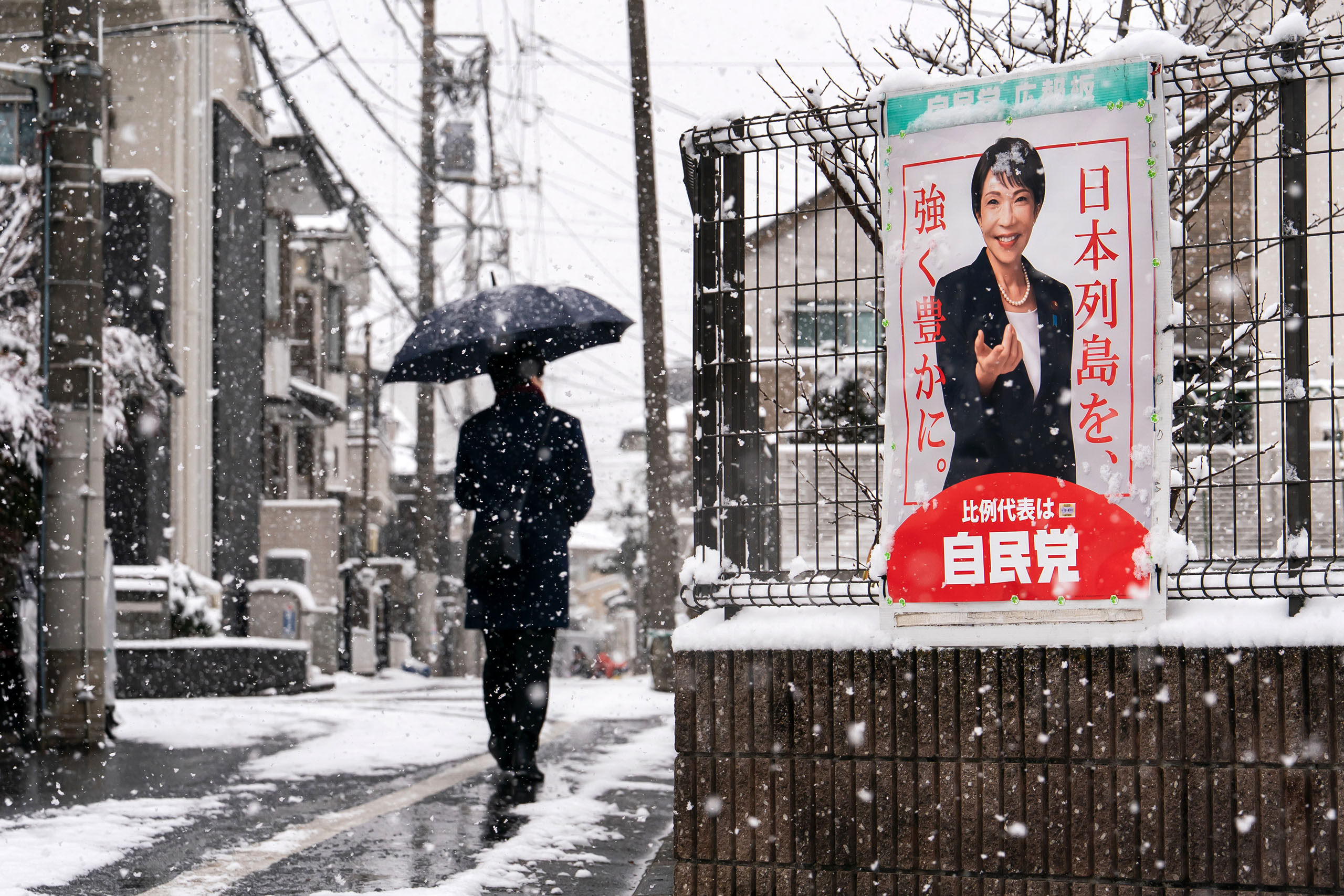
Election day in Saitama, above Tokyo on the map, had begun with snow that at last gave a taste of the gigantic, weeks-long falls to the north and west. Outside the polling station the two of us briefly parted, I to a nearby park that had acquired a dozen scattered, sprightly snowmen, their charm akin to the familiar stone figures (o-jizo-sama) that line temple pathways across Japan. Their child-architects were now immersed in exuberant play as mums clasped pushers, dads balanced family dog and phone, and tinier explorer-tots, untethered, pottered around. With snow decorating every branch and bench, the park evoked a Breughel scene.
Had the grown-ups already voted? There was no sign. In any case, when my relative, warned to expect a long wait, emerged to announce that “almost nobody was there!”, my only thought was to waft an arm and repeat a mantra: “Japan is dying!” I didn’t ask how she had voted, nor did she offer, as if this vivid Sunday morning was silently casting its own.
A sixteen-day campaign, the shortest in memory, had foretold the result. Thus the 8pm exit poll, showing a big victory for prime minister Sanae Takaichi’s Liberal Democratic Party, came with a twist. Head of government only since October — the first woman in the job, opposed by many on her own side, well regarded by the public — Takaichi had gained the most seats for a single party (316 out of 465 in the lower house, or House of Representatives) in any post-1945 vote. She had reduced the combined, divided opposition to 113 seats, and seen a regional coalition partner take 36 seats.
More, she had secured the two-thirds “supermajority” required to pass constitutional amendments, if necessary by overriding objections of the upper house, or House of Councillors. For once, the word “historic” could be used without blushing.
The twist is that so might the word “undramatic.” For only the snap election’s opening days had brought any suspense. Takaichi had called the vote at a time of pinched livelihoods, jittery markets, perilous geopolitics, worries over demography and immigration, and extreme weather in half the country. Many in the LDP, no fans of their leader, were happy to echo vox-pops scorning (to summarise) a rushed, ill-timed decision with no rationale. A splashy merger of two centrist parties with sizeable voting blocs — one of them Komeito, an LDP coalition partner from 1999 to 2025 — then pitched to oust the LDP. A flurry of columns echoed the international press in citing Japan’s rising bond yields, ultra-low interest rates and Takaichi’s spending plans to warn of an impending crunch.
Such elements failed to coalesce. The unified opposition party, two old stagers at the helm, fell flat. Everyday worries — mainly about prices — stayed just that. The bond vigilantes held off. The minimal suspense faded. More salient, Takaichi commanded the stage and never surrendered it.
Two of her remarks are illustrative. First, announcing the election at a press conference on 19 January, she declared that the choice to “serve at the helm” was between “Takaichi Sanae” and (naming her paired rivals) “a Prime Minister Noda, a Prime Minister Saito, or someone else entirely.” Second, in a leaders’ debate on 26 January, she promised to resign if unable to turn her coalition’s lower-house seat advantage into an actual majority.
Unnerving as Takaichi’s third-person syndrome may be, and allowing for a tactical element, that double elevation — of the contest as political life-or-death, and of her rivals as avowed democratic equals — confirmed a boldness, clarity and urgency that no one else came near to matching.
It would be wrong to overstate things: turnout was 56.26 per cent, up just 2.41 per cent from the previous contest. When politics call, Japanese voters are not a compliant bunch. That said, Takaichi was the foremost election winner, far ahead of her party. (The LDP, never truly popular, if almost always in office, had a constituency vote share of 49.09 per cent; in February, its public approval rate was 30.1 per cent.)
In retrospect, it was the LDP’s post-2020 drift that accelerated Takaichi’s reputable if slow-burning career. From a modest salaried background with no connections, she served as a lower-house member from 1993 (a three-year gap aside) and as a versatile minister. In 2020 her mentor Shinzō Abe, strategist of the country’s modern right, resigned after eight years in office. (Abe was killed in 2022 by a troubled young man firing a self-made gun.) A trio of ineffectual, shortlived PMs proceeded to alienate the public.
Then, after the LDP lost seats in the 2024 and 2025 elections to each of Japan’s parliamentary chambers, an end-of-regime mood took hold. Takaichi had finished third and runner-up in successive votes for the party “presidency”; this time she took the role by defeating Shinjirō Koizumi, an ex-PM’s son whom she went on to appoint defence minister. In this context, a hint of her drive — and of the system’s constraints — is that three of these five erstwhile colleagues-rivals are PM’s sons. Dynastic politicians in Japan’s Diet account for a third of the total, and that 14.6 per cent of lower-house lawmakers are women. In the face of such primacy, her latest leadership pitch revealed Takaichi to have another asset that distinguished her from PMs of the it’s-my-turn type: a certain quirkiness.
The novelty of a woman PM amid domestic politics’ staleness would always have provided the ingredients of a classic — which also means evanescent — Japanese “boom.” (Takako Doi’s emerging to lead the Socialist Party in 1986, also a first of its kind, was a sensation.) In the symbolic part thus assigned to her, Takaichi has so far played a blinder. Admiration for Margaret Thatcher, tick; motorcycle-loving, rock-chick phase, double-tick; intriguing family story (remarrying her ex-husband, adopting his children, caring for him post-stroke), treble-tick; handing Trump a putter owned by his golf-buddy “Shinzō,” a gift from Abe’s widow, quadruple-tick; skilled K-Pop drumming with a plucky Republic of Korea president, their meeting’s cordiality a bonus, off the scale.
Approval ratings for her cabinet between October and January were often upwards of 70 per cent, and higher still among women and young people. In the election itself, her cross-generational appeal was evidenced in large crowds at some of her public speeches and additional demand for her reputedly favourite clothing, shoe and stationery brands.
Broad credit for a pioneer will doubtless stick even as adulation wanes. Far more weighty is that the Takaichi phenomenon has a political core with connected and still-fluid elements. Japan’s voters want change; Takaichi’s rise to PM, and triumph on 8 February, made herself its vehicle; her great task now is to give it shape and build a consensus around it.
There are no guarantees. The tone of her 19 January address was in parts daunting: “To make the Japanese archipelago stronger and more prosperous, we must start now, or else it will be too late… I also want to resolutely take up challenges that include bold policies and reforms that could split public opinion… These three months have given me a painfully clear sense of the unstable state of Japanese politics and the harsh realities of Nagatacho [Tokyo’s political district]. As the ancient saying goes, ‘Without trust, nothing can stand.’”
Japan’s underlying problems in coming years will likely test her abilities to the max. Pressing disputes already arise over this year’s budget, an onerous but lucrative food-sales tax, and public spending as a whole. The punchy finance minister Satsuki Katayama, one of two other women in the cabinet, will be at their centre.
At least as grave are questions of national security amid a vacuum of global order, where Japan — with Takaichi planning upgrades in defence, intelligence and cyber capacity — has three unbenign nuclear-armed neighbours (China, North Korea and Russia) and is exposed to the whims of a fourth (Trumpland.) On regional matters, Takaichi is an advocate of the concept mooted by Shinzō Abe in 2015, a “free and open Indo-Pacific,” and of defence projects with variable clusters of allies (Australia, India, Italy, and the Philippines, as well as the US, among them).
Looming over all such initiatives is the perceived challenge posed by China to Japan’s security, even national integrity. If Beijing’s military harassment of Taiwan escalates to invasion in 2027, the year Xi Jinping has identified as decisive, all appraisals of the region’s future become moot. In any event, the proximate effects on Japan — concerned that democratic Taiwan survives intact — would be seismic.
Takaichi was always going to be a chief target of Beijing. The chance came, or was devised, on 7 November at, of all things, a Diet budget committee meeting. In response to insistent, non-relevant questions, the PM mused (probably unwisely) that a Chinese maritime blockade of Taiwan involving armed force, which the US then asks Japan to help counter, could become “a survival-threatening situation” for Japan. Cue Beijing’s instant, contrived delirium: sanctions, a clampdown on Japan-bound tourism, abuse from its Osaka-based consul, reported airforce-radar interference.
That Takaichi’s interrogator was Katsuya Okada, an ex-foreign minister with durable ties to the Chinese Communist Party who had hosted the Chinese ambassador the previous day, was barely mentioned in the kerfuffle. On 16 December Takaichi told an Okada ally, with a touch of lesson-learned: “I recognise that my answer was understood as going beyond the government’s established stance, and I will take this as a point for reflection as I approach future Diet debates.” Her calm attitude to the hysteria, without retraction or retort, prompted a widespread view — consolidated by the election weeks later — that she was now on firmer ground in being, as she has said, “open to dialogue” with China.
But if Beijing whisked Takaichi’s words into a diplomatic cauldron, the episode has a lesson for domestic politics too. (Here I draw on an article by Asahi University’s Hiroaki Kato, while adding my own gloss.) In brief, the sterile mode of political debate about security matters in Japan — above all, about the need for legislation to comply with the constitution’s Article 9, renouncing war — exalts a “theological” style of contention above one of substance. Thus, opposition voices routinely employ nit-picking questions to do with “defining terms and debating hypothetical scenarios” in an effort to make Japan’s constitutional doctrine immutable; and government and LDP figures, wanting to keep options open, respond with ambiguities. The result is an evasive style of dialogue that traps both sides. Now, in a social media age where “a dry Diet debate” can spark a Japan–China firestorm, the “peculiarities inherent in Japan’s security policy discourse” may act less as a bulwark of the country’s security than as a potential menace to it.
In this light, an opposition prepared to think anew would benefit Japan — and raise the stakes for Takaichi, who needs a big political argument she believes she can win. (Here references to Thatcher, and to Giorgia Meloni, for once may actually work.) But this would require her foes to go beyond name-calling and constitutional what-iffery alike.
Takaichi herself has long faced the former on account of her — oft-described — rightwing, ultraconservative, ultranationalist and anti-feminist views. (For what it’s worth, the Japan Times reporter Gabriele Ninivaggi unearthed an interview, admittedly given during Takaichi’s later LDP leadership run, where she said she was no longer “an uncompromising conservative” but “more of a moderate conservative, maybe even a conservative centrist.”)
Her detractors’ labels, often with scant or context-free detail, find an echo in authoritative outlets including the Asahi Shimbun newspaper and the public broadcaster NHK. The antipathy, overt and coded alike, is then often recycled in influential overseas media. It is a closed circle for the incurious.
That much of Japan’s political argument has indeed migrated to social media, to be soaked in the latter’s often far more explicit and extreme bias, is partly a by-product of such quasi-moderate partisanship. The shift may now be irreversible, as the great coarsening of public life — to which Japan’s genuine far right is an alarmist contributor — has become sui generis. But were establishment coverage to become more inquiring and scrupulous (in Japan as elsewhere) it might yet regain public trust and fortify democracy.
For the moment, the Takaichi cabinet “is” a repository of trust. In late February it had 63.8 per cent approval and 18.4 per cent disapproval. Much will no doubt go wrong: obstacles abound, luck and contingency make leaders their plaything. Those figures are more test, and perhaps hope, than reward. But Japan has a prime minister with serious vigour and purpose. Now comes the hardest part of all. •