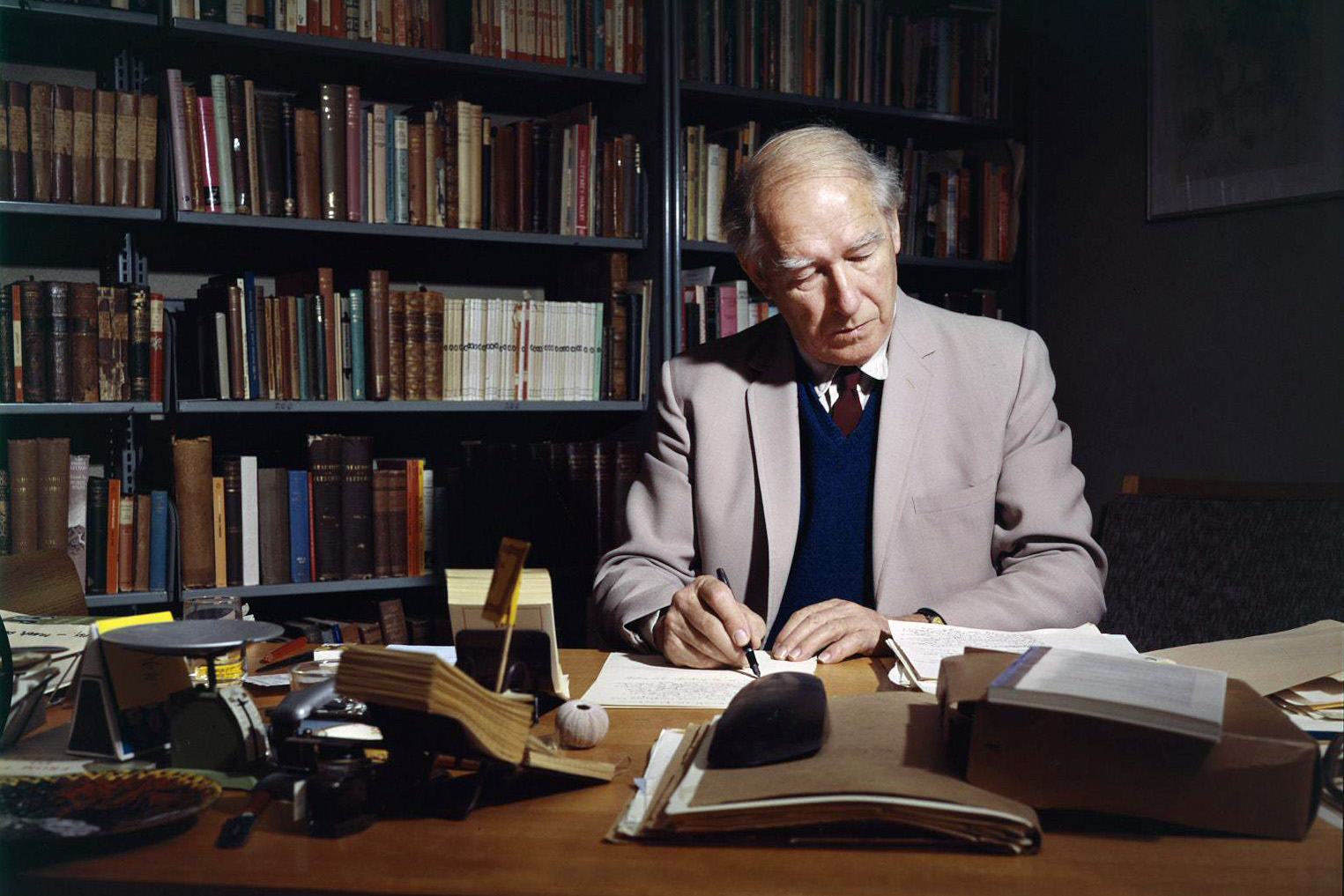
It is a little hard to picture the moment these days, but there was a time when poetry commanded a moral authority that reached up to the highest echelons of the nation. Susan Lever’s wonderful new biography of the poet and academic A.D. Hope allows us to revisit this lost epoch and understand how this came to be.
For Hope and the literati of mid-century Australia, poetry was sacred and pivotal. This was not their private delusion, but a state of affairs that generally prevailed in the civic life of this time. Only poetry, it was felt, could express the entire universe, from its most profound metaphysics to its most profane politics, in its irreducible particularity. In the words of Hope’s lifelong friend James McAuley, poetry offered a “grammar of the real.”
From the 1930s to the 1960s it was possible to speak in this way with the general assent of the literate world. But by the 1970s this view had already started to seem preposterous. Poetry, now free of the formal constraint Hope and his followers demanded, lost its status as a metalanguage and slid once more into the bohemian margins.
Lever begins her book by acknowledging the fall of A.D. Hope in the public estimation. It was a double demotion: not only had poetry itself fallen from its ascendency but Hope’s brand of poetry was thoroughly defeated by the newer forms he had derided. To the extent that Hope is remembered at all these days, it tends to be as a stuffy and rigid formalist. His derision of new varieties of poetry helped keep Australian creativity captive behind the bars of his classical delusions.
Lever’s biography acknowledges this caricature had some basis in the words and actions of the man himself. But she gently sets aside such suppositions and assesses Hope’s life in light of the world that existed for him. Her approach marks a refreshing change from the reflexive presentism that has become an occupational hazard in contemporary biography. Hope’s life stretched the length of the twentieth century and encompassed its momentous changes and calamitous collapses. The ardent investment by Hope and his generation — which included Judith Wright, James McAuley, Douglas Stewart, David Campbell, Gwen Harwood, Francis Webb and Rosemary Dobson — in poetry as an enduring testament has to be understood in the light of these cataclysmic times.
Despite a reputation for elitism, neither Hope nor most of his generation were born with silver spoons in their mouths. Indeed, they grew up in a material hardship that would shock many of us today. Hope was born on a snowy July night at the Presbyterian manse in Cooma in 1907. His father Percival was the local minister and young Alec grew up in rural Presbyterian parishes in New South Wales and Tasmania. After mediocre marks in his final year at Bathurst High School, he managed to get into Fort Street Boys’ High to repeat his final year. On that basis, he scraped into the University of Sydney, where he studied English, Philosophy and Psychology. It was here he began to write poetry seriously.
Still, while he was a well-known and charismatic figure at university, Hope was generally outshone academically by brighter stars. It was only after someone backed out at the last minute that he was offered a bare-bones scholarship to Oxford University in 1928.
Hope’s memories of this period are not joyous, but instead paint a picture of penury and loneliness. At least the syllabus at Oxford was in sympathy with Hope’s inclinations. Over at Cambridge radical new methods of “practical” criticism were being introduced, but Oxford’s approach was resolutely philological, concentrating on early and middle English and drawing a sharp line in 1832 with the romantics. Hope’s time at Oxford coincided with the appointments of J.R.R. Tolkien and C.S. Lewis, though before either had become famous for their fantasy novels.
Back in Australia after two poverty-stricken years and with a third-class degree to his name, Hope trained at Sydney Teachers’ College in 1931. As the Depression tightened its grip, work was scarce even for a massively over-qualified teacher, and he took relief jobs in Katoomba and Newcastle. He eventually found work as a vocational counsellor in the NSW Department of Labour in 1934, a job he held until he accepted a position with the Department of Education. This took him to Canberra, which at the time boasted a population of around ten thousand people and resembled a sheep paddock crossed with a building site.
Hope spent two years in Canberra, not knowing then that he would return there after the war and spend the latter fifty years of his life in the capital. It was also in Canberra in 1936 that he met his future wife, Penelope Robinson. He left Canberra in 1938 to take up a lectureship at Sydney Teachers’ College, located on the campus of Sydney University, bringing him back into proximity with Sydney’s literary life.
The late 1930s proved a remarkably fertile period in Australian literature. At Sydney University, Southerly magazine, the first scholarly journal for Australian writing, began its life in 1939. That same year in Brisbane, Clem Christesen founded Meanjin. The following year, Douglas Stewart began an influential tenure as editor of the Bulletin’s “Red Page,” which reviewed Australian literature and culture. In Adelaide, competing schools of poetry emerged in strident new magazines such as the Jindyworobak Review, Max Harris’s Angry Penguins and Flexmore Hudson’s Poetry.
It is at this point in Hope’s story that things really start to heat up. He was a central figure during the tempestuous literary upheavals of the 1940s, a period that suffers from having been endlessly studied by literary historians and largely forgotten by the Australian public. Lever deftly copes with this predicament by bringing the events to life again, but as if for the first time. The freshness of her account comes from the fact that she is attempting to understand them from Hope’s position.
The era’s contest of literary ideas was brought to a fever pitch by the existential crisis posed to Australia by the Pacific War. The cultural nationalists were exemplified by the “Jindyworobaks,” who sought to ground Australian poetry in the continent’s unique landscapes and Indigenous cultures. Then there were the avant-gardist “Angry Penguins,” who were inspired by surrealism, dadaism and experimental literary modernism. And finally, there were the classicists led by Hope and his younger protégés James McAuley and Harold Stewart.
The simmering resentments and playful jousting erupted into a fully blown national scandal when McAuley and Stewart submitted poems to Angry Penguins under the pseudonym “Ern Malley” complete with a fictional biography sent to them from his fictional sister “Ethel” who had discovered these poems after “Ern’s” recent death. The poems were published with great fanfare, only for McAuley and Stewart to reveal they had invented Ern and composed his pseudo-poems to expose what they saw as the fundamental vacuity of the modernist boosters. While he had no direct role in the hoax, Hope was in on the joke from an early point and celebrated its success. The whole matter descended into farce as police, missing the point of the hoax, decided to prosecute the editor Max Harris for obscenity.
Whether this was a watershed moment in Australian literary culture or a colourful sideshow is a question Lever’s book helps us to answer. It is possible it was both of these things. Because Hope and McAuley went on to occupy lofty positions in the academy, becoming celebrated national and international poets, and exercising significant cultural influence in the 1950s and 60s they appear to be the victors. But in more recent accounts of this history, both Hope and McAuley are typically cast as the villains.
What is helpful in Lever’s biography is that the hoax doesn’t fall into these easy categorisations. One of her claims, indeed, is that despite his vigorous assertions to the contrary, it is probably right to consider Hope’s poetry modernist insofar as it was in quite clear dialogue with Yeats, Eliot, Pound and Auden.
Lever’s biography is greatly enriched by her training as a literary historian and critic. This might seem natural enough, but it is not always the case with literary biographies. Even biographers who have a literary background will sometimes seem to forget this training when they write about writers and treat their works as survey points for their real lives. What Lever does is to give Hope’s poems their own biographical status. They sit next to the more conventional biographical facts as documents of Hope’s most intimate thoughts. His early poems, “The End of a Journey” (1930), “The Damnation of Byron” (1934) and “Pygmalion” and “Standardisation” (both 1938) are read as biographical, offering a compressed but detailed image of a young man’s interior life.
Many consider crossing from a fictional literary work into the life of its author fraught with risk. But Lever shows us it can be done if one is able to understand how a poem makes it subjective claims. In the years before confessional poetry, for instance, there were accepted codes of self-revelation: in this respect, the mythic figures and situations of Hope’s poems (Ulysses, Byron, Pygmalion) offer up an image of the author in coded form. Certainly, Hope’s contemporaries understood his poems in this way, just as he understood theirs to be doing similar work. It is why Judith Wright, who admired Hope’s poems and the rigour of his work, could also say she found them to be “self-pitying.”
What struck me in reading Lever’s biography was how Hope’s work was well known to his literary community well before he finally published his first book of poems, The Wandering Islands, in 1955. People had already come to know his individual poems, and on their basis alone had concluded he was a poet of the highest order. Within contemporary standards, Hope’s achievements might seem meagre. But his contemporaries, even his enemies, never thought of him in this way. They all understood him to be a person of gravity and substance. This was true even though he was also notorious for his risqué comic verse, much of it as unpublishable then as it would be today.
Individual poems meant something at this time, and in Hope’s case they were often composed over many years. For example, he composed the opening stanzas of his most famous poem “Australia” in 1933. He then added the final stanzas some years later, in 1939. The complete poem, with its seven seismic stanzas, was eventually published in Meanjin in 1943. During the decade the poem was being composed it remained a living statement Hope was not quite ready to release. He understood it needed to be tempered by the long seasons of his soul and exposed to the unsparing criticism of his confidantes.
“Australia” offers a withering assessment of the nation as a “vast parasite robber-state / where second-hand Europeans pullulate / Timidly on the edge of alien shores.” But it ends by asserting Australian possibility. It is true this affirmation is wafer thin, but it is there all the same.
In many ways, that poem is exemplary of the contradictions and counter currents Lever so evocatively traces in her biography. Hope, the grave prophet is put against Hope, the wicked satirist. The ferociousness of his literary reviews sits next to the hidden generosity he extended to so many colleagues and friends. In the embryonic Canberra of the early 1950s he rubbed genial shoulders with Robert Menzies, but by the end of the decade ASIO had opened a file on him. He envied and respected McAuley’s conversion to Catholicism but could not follow him down that path and remained an agonised atheist. He consistently maintained there was neither the depth nor the quality of Australian literature to warrant it being taught at university, yet Lever reminds us he was also one of Australian literature’s most important champions.
Susan Lever’s biography faithfully follows the arc of Hope’s life. The account comes to life in those middle decades when it seemed everything was up for grabs — when Australia’s moral future seemed to rest improbably in the hands of poets. The final stages of the book slow down again. By the late 1960s, Hope was finally acclaimed as a great poet in Britain and America, forcing his way into influential anthologies. But the whole game was about to shift again and these achievements, seemingly so lasting, would drift into polite oblivion.
Lever does a great service by salvaging Hope from the wreckage of the ideals he had helped forge. Her clear-eyed biography is not blind to Hope’s failings, but is also not unduly detained by them. Instead she provides us with the terms to understand the dignity and meaning of his life. •
A.D. Hope: A Life
By Susan Lever | La Trobe University Press/ Black Inc. | $36.99 | 311 pages