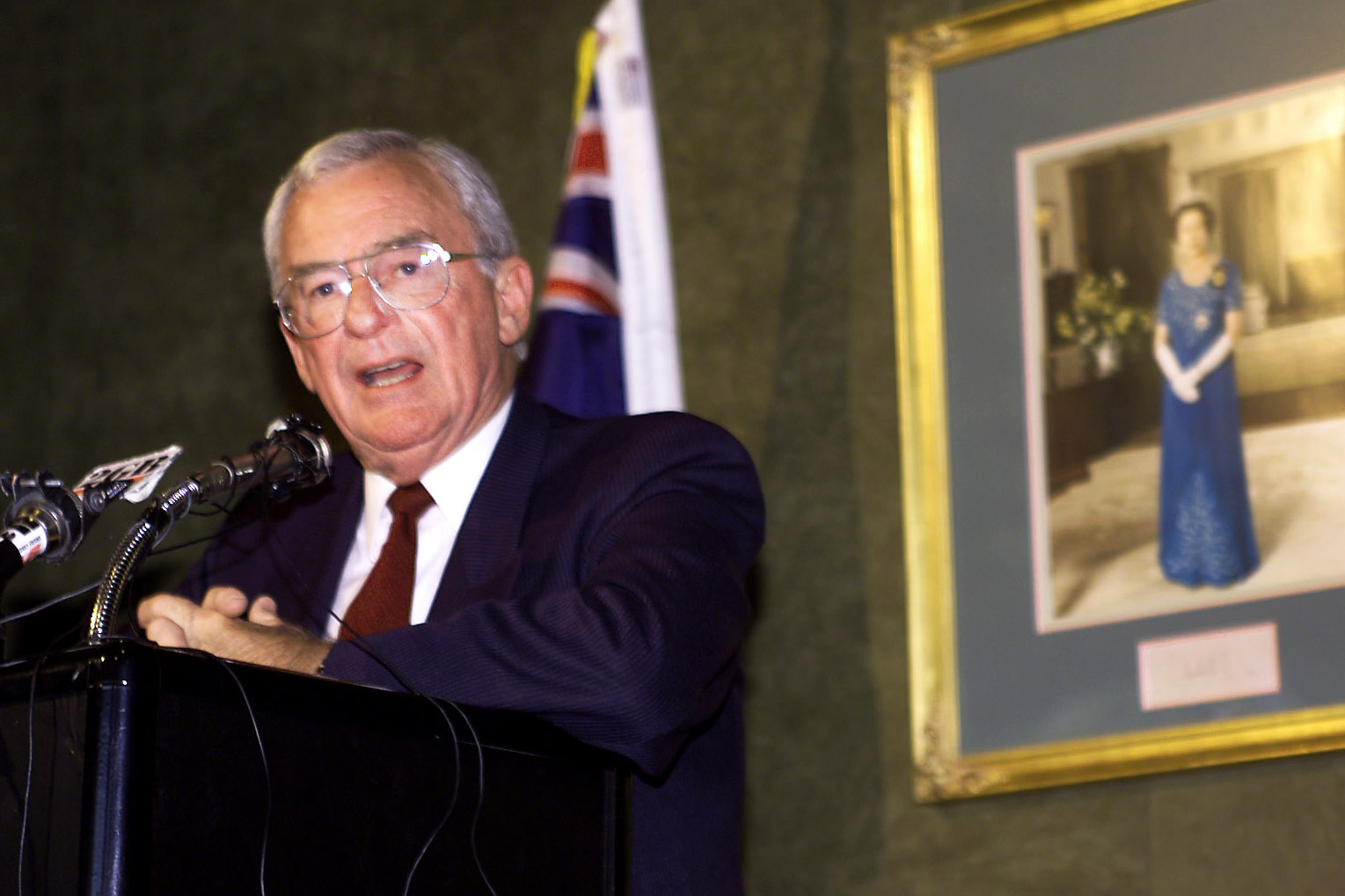
“Your Excellency, we find the Australian constitution a puzzling document and would appreciate your clarification,” said Kazakhstan’s president Nursultan Nazarbayev. “I would be most obliged if you would set out for me what powers it confers on you.”
Nazarbayev’s guest was the Australian governor-general Bill Hayden. It was April 1994, and Hayden had arrived that day in Almaty, capital of newly independent Kazakhstan, on an official visit.
Having whispered “No notes” to diplomat Ian Parmeter, Hayden replied, “Yes, it’s a complex document, and has been controversial, but it invests my office with sweeping powers. I appoint the prime minister and ministers; I open and close the parliament; I give formal assent to legislation passed by the parliament; I am the commander-in-chief of the armed forces: as such I can call out our army and surround the federal parliament.”
This means, he added, “I could run the country by myself if I chose to.”
“So, if you have all these powers, why not use them?” responded the Kazakh autocrat.
Amid the laughter of everyone in the room except Nazarbayev, Hayden replied that there were certain conventions in Australian democracy he was obliged to follow.
News of governor-general Hayden’s planned visit to Kazakhstan had first reached the Australian embassy in Moscow ten weeks earlier. Australia’s ambassador to Russia, Cavan Hogue, was also accredited to Kazakhstan, so it was the embassy’s responsibility to obtain the Kazakh government’s agreement to the visit and negotiate appropriate arrangements. It was to prove a little more complicated than expected.
As Parmeter related recently, staff at the embassy prepared a “third person note” setting out details of the proposed visit. Hayden was described as “effectively Australia’s head of state,” with no mention made of the fact that Queen Elizabeth II was Australia’s actual head of state. Parmeter, deputy head of mission, flew to Almaty, sought an appointment with the chief of presidential protocol and presented the note.
As a landlocked state near the centre of the Eurasian land mass, Kazakhstan had been visited by very few heads of state since its recent separation from post-communist Russia. The chief of presidential protocol, apparently unfazed by the word “effectively,” became visibly excited as he read the note, and then began sketching out a possible program: Nazarbayev receiving the governor-general at the airport, accompanying him to his hotel, meeting formally the following day and then hosting an official banquet the following evening. Having secured formal agreement to the visit, Parmeter returned to Moscow and reported to Canberra.
“About a month before the visit,” Parmeter recalls, “I flew to Almaty again to check on the program. As before, I called on the chief of presidential protocol, but this time he was not as friendly. His staff had investigated the position of governors-general in Commonwealth countries, discovering that the governor-general was the representative of the British monarch and concluding that Queen Elizabeth II was actually Australia’s head of state.”
All that was true, Parmeter responded, and it was why the word “effectively” had appeared in the note. Governors-general in Commonwealth performed all the duties of heads of state entirely independently of the British monarch. As the Australian constitution set out, the British monarch had delegated the role to the governor- general, whom he or she appointed on the advice of the Australian prime minister.
The protocol chief was unimpressed. He was obviously animated by the fact that President Nazarbayev had until recently been merely the first secretary of the Kazakh Communist Party — head of a Soviet “republic” and therefore a Soviet satrap. Now, as president of an independent Kazakhstan, he was determined to be recognised internationally as a head of state. “As such,” recalled Parmeter, “he would have formal meetings only with fellow heads of state. He was not going to be sold a pup.”
As the Queen’s representative in Australia, said the chief of protocol, the governor-general sounded more like an ambassador. The president would never host a state visit for an ambassador: “Send us your Queen!”
After Parmeter again took him through the constitutional arrangements, stressing the Australian governor-general’s constitutional authority to perform all the duties of a head of state, the chief of protocol said he would consult the president.
Parmeter phoned Hogue in Moscow; Hogue flew to Almaty that night. At a meeting next day the chief of protocol said that the president, in view of the friendly relations between Kazakhstan and
Australia, had graciously agreed to host a state visit for the governor-general. The two Australians flew back to Moscow satisfied that nothing further was likely to impede the visit. How wrong they were.
Returning to Almaty four days before the governor-general’s arrival, Hogue and Parmeter immediately called on the chief of protocol, who took them through a program that was substantially as agreed. Nazarbayev would meet Hayden at the airport and accompany him to his hotel. A full meeting with officials would be held the next day, followed by a formal banquet.
But then, just a day before Hayden’s arrival, the chief of protocol called Parmeter to his office. He explained some fundamental changes to the program: the governor-general would be greeted at the airport not by Nazarbayev but by Yerik Asanbayev, occupier of the largely ceremonial vice-presidency, who would also host the talks and a dinner (not a state banquet) the following day. There would be no meeting with Nazarbayev. The chief of protocol could give no reason for the change.
Hogue sought out the British chargé d’affaires, Owen Jones, who revealed that the Kazakhs had asked him whether Hayden should be received as Australia’s heard of state. Jones had replied that, yes, Hayden should be received with all honours and courtesies due to a head of state. The Kazakhs clearly weren’t persuaded.
Hogue and Parmeter declared the proposed changes, so close to the governor-general’s arrival, to be unacceptable. The chief, clearly embarrassed, left them in his office while he called the presidential staff. The upshot was that Nazarbayev would condescend to meet Hayden with officials at his residence on the evening of his arrival, but would still not be available to participate in the program the following day.
Hayden, en route, couldn’t be advised of the change of plan. So the two men went to the airport the following day to brief him on arrival. A seasoned professional, Hogue parlayed permission to go to the control tower to speak with the captain of Hayden’s VIP jet now it was in Kazakh air space. He was able to let a member of Hayden’s staff know that the vice-president would meet the governor-general when he landed, so at least that aspect of the visit wouldn’t be too much of a surprise.
In protocol terms the Kazakhs had emasculated the visit. But Hayden knew a refusal to comply would risk irking Nazabayev, who was known to place a premium on building personal ties with the heads of those states that had been prominent in supporting Kazakhstan’s — namely his — aspirations. And the government in Canberra, lobbied by Australian firms lured by Kazakhstan’s bountiful minerals and energy resources, had sought to building a solid bilateral relationship. Significant interests needed to be protected and promoted. Such, indeed, was the goal of Hayden’s visit.
Deeply concerned by the threat of a proliferation of nuclear- powered states following the breakup of the Soviet Union, Australia’s foreign minister Gareth Evans had endorsed a measured, pragmatic approach to post-Soviet Russia and the Soviet possessions that had claimed independent statehood. The government’s aim was to balance the twin imperatives of maintaining longstanding relations with Moscow while building ties with those of the newly independent republics — especially the Baltic States, Ukraine and Kazakhstan — that mattered to Australia.
The embassy in Moscow had been instructed to build contacts in all of the new republics. “We could only take a pragmatic, flexible attitude,” recalled Parmeter. “In the present case, such pragmatism meant acquiescing in Nazarbayev’s wishes.”
Other aspects of a visit rich in piquant ironies are not to be found mentioned in Hayden’s autobiography, but were noteworthy in the view of Hayden’s staff. They began at the airport, when Hayden undertook his first duty: inspecting the guard of honour. In accordance with Russian military tradition, the members of the guard were selected for their imposing height — all were about 190cm. But the aide-de-camp pacing along behind the GG, RAAF Flight Lieutenant Crosby, was a diminutive female person, bearing an unsheathed, highly polished cavalry sabre.
Hayden and his wife Dallas had been greeted by Asanbayev, the vice president (then, as now, a largely honorary position). The governor-general and his ambassador were ferried to the Presidential Palace in a capacious ZIL, the Soviet-produced limousine designed to rival the official vehicle used by Soviet leaders.
“Your Excellency’s aide-de-camp is a woman?,” Asanbayev politely enquired during the drive.
“Yes, she is,” said Hayden. “Almost all of my staff are women — I find I can trust them.”
Early on the second day of Hayden’s visit the chief of protocol informed Hogue that Asanbayev would host the governor-general and his delegation to a dinner at a private restaurant. That evening found the vice-regal couple seated with vice-president and his wife at the head table, accompanied only by the Australian ambassador, his wife, and the Australian interpreter.
Hayden, known to be partial to a glass of red wine, was on his third glass and clearly at ease when Asanbayev invited him to savour a Kazakh national dish, қазы (kazy), a salami made from smoked horse meat. The governor-general agreed with alacrity, remarking to Asanbayev that he was aware the horse occupied a special place in Kazakh culture.
“But of course!” responded Asanbayev. “As nomadic herders and drovers of the steppes, we rely on our horses for our very existence. Quite apart from transporting us to and from seasonal pastures, we use virtually every part of the horse. It supplies the hair for our pleated ropes, sinews for sewing, its milk for food and fermented as alcohol. The list is endless! And according to an ancient tradition, if a man over sixty fathers a child, the child’s name should contain a reference to its sire’s horse.”
Hayden appeared to find this revelation intriguing: “So, according to your traditions, the vigour, the vitality of the horse is somehow invested in its rider?”
“Not really,” replied Asanbayev. “We are a down-to-earth, practical people. We see it rather that if a man over sixty continues to spend much of his time in the saddle, a certain part of his anatomy tends to remain in good, productive working order.”
Dallas Hayden, who hitherto had taken no part in the conversation, whispered to her spouse: “Bill, perhaps we should buy a horse…” Asanbayev pounced, demanding of the interpreter: “What did she say?” Within seconds the whole restaurant was convulsed by laughter. Inadvertently, the vice-regal party had won their hosts’ hearts.
Bright and early the following morning the chief of protocol appeared with yet another proposal. The Kazakhs had been pondering how to honour the governor-general.
President Nazarbayev had been most glad to have been informed that last night’s banquet had been a jolly affair, and that the governor-general had taken a particular interest in a subject dear to every Kazakh. “He has decided that Kazakhstan should confer a particular honour on His Excellency,” said the chief. “Please to be ready to depart soon, in casual dress.”
The full delegation soon found itself bouncing along rutted tracks across the semi-arid steppe to be disgorged at a corrugated-iron barn on a stud farm for the breeding of the horse prized by Kazakh and Turkmen riders, the Akhal-Teke. The stud had recently been blessed by the birth of a colt that was an outstanding representative of one of the oldest and most distinctive breeds. He would be formally entered in the annals of the breed and globally recognised. Only one thing was needed: an appropriately dignified name.
The breeders, repositories of one-thousand-years of tradition, had been directed by the president himself to ask the governor-general to name the colt. The only condition was that tradition required that the name begin with a “P.” The arcane reasons behind this stipulation baffled the interpreter.
The governor-general turned to his staff: “Right, you lot are paid to think, so give me a name.” Said staff, some perhaps dealing with the effects of a surfeit of kazy and wine, pondered, until Hayden himself broke a tense silence: “Possum!”
According to that authoritative guide, The Horse Encyclopedia, the Akhal-Teke, bred to withstand desert conditions, is said to be “rather obstinate.” As the visit concluded and the delegation set off for Mongolia, some felt that this adjective aptly described Kazakh officialdom in 1994.
Two postscripts. Five months after the visit the Canberra Times reported briefly in its “vice-regal” column that the governor-general had been admitted to hospital with a fractured leg, having fallen from a horse.
Later, in the lead-up to the Australian republic referendum in 1999, Hayden took the monarchist side. Ian Parmeter recalls seeing him in a television debate claiming that when he travelled abroad as governor-general he was always accepted as Australia’s head of state. “I felt like kicking the television screen,” said the man who had steered the rocky preparations for the 1994 visit. •