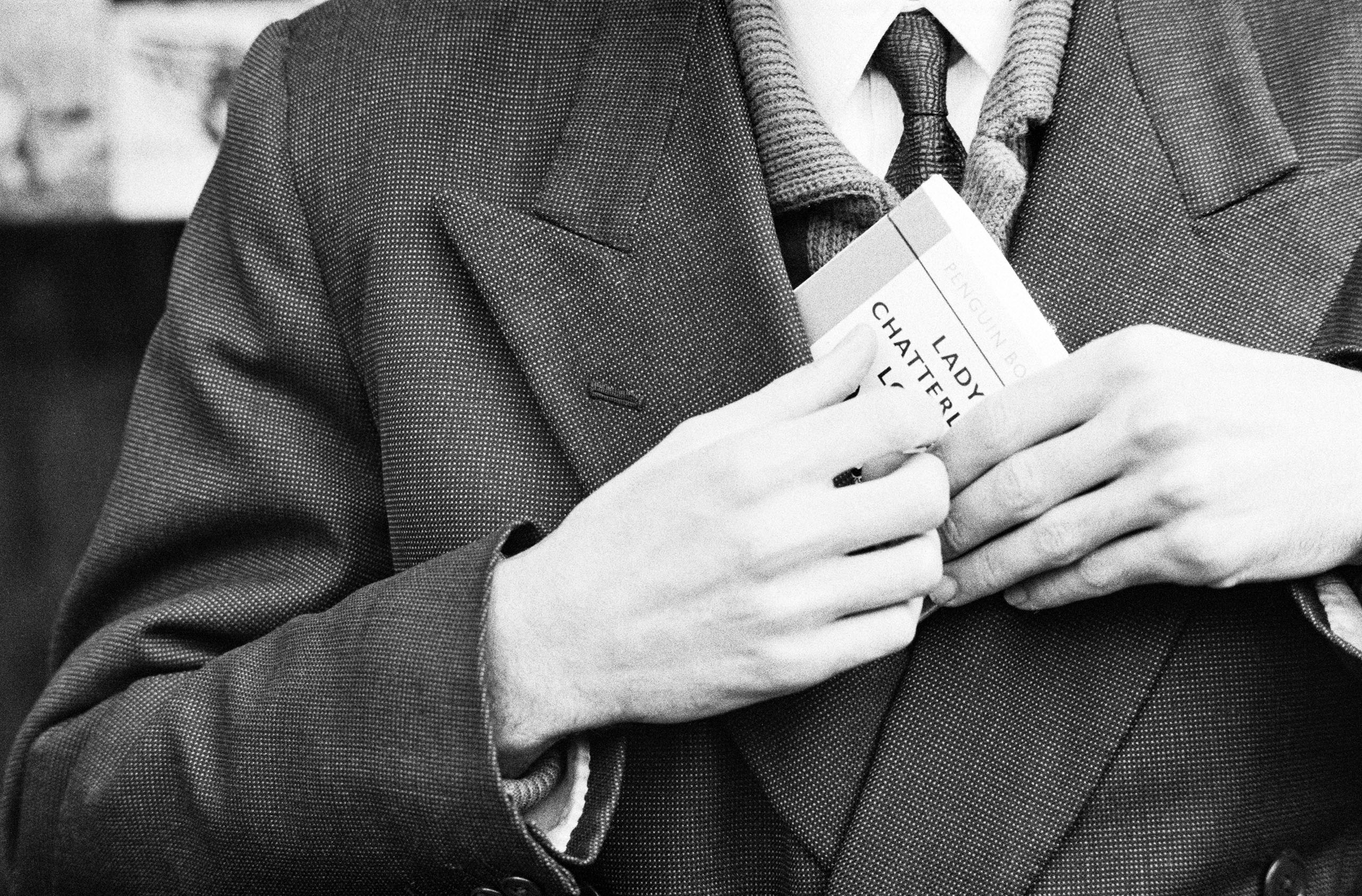
Mentioning Australia’s history of literary censorship to people of a younger vintage often causes befuddlement followed by amazement. In its heyday, our censorship system was a nation-building enterprise designed to make Australia a promised land for straight, white, monarchy-smitten, Christian-worshipping, empire-loving capitalists. It was so conservative that many books now regarded as classics were banned, and it became so notorious that Australia was known as the Ireland of the South Pacific. Some fifty years after its trimming down and reconfiguration as the seemingly benign Classification Board, that censorship system seems like something from a fever dream.
But Australia wasn’t always alone in banning works of literature, and chief among the books prohibited almost the world over was that totemic object of censorship fights, D.H. Lawrence’s 1928 novel Lady Chatterley’s Lover.
This story of a married upper-class woman’s affair with a gamekeeper had a tortured path to publication. Lawrence had drafted two earlier versions, in 1926 and 1927, that progressively crystallised his intentions and the techniques by which he was realising them. His restoration of tenderness and beauty to a world he believed to be succumbing to horror involved, on the page, an explicit depiction of sexual intercourse and free use of profanities, including “fuck,” “cunt,” “shit” and so on.
Lawrence was aware that these would make the book controversial, that he was pushing at the bounds of public decency, and that his novel might be banned. But he saw his work as educatory, not offensive; as artistic, not pornographic. He wanted his book to be read, not banned.
That wasn’t to be. Published by private subscription and then in a limited edition in Italy, Lady Chatterley’s Lover was quickly suppressed in Britain, the United States and then further afield. Efforts to evade the censors soon saw the book pirated, then hacked at and sanitised in various editions — some authorised, most not.
Lawrence’s death in 1930, and the studies of his work that proliferated in universities afterward, meant that Lady Chatterley soon had something of a double life: as infamous for what it represented as for what it was. Even expurgated editions still had the potential to cause scandal; finding unexpurgated copies called for subterfuge, tact and friends in the right places. Readers smuggled them in under the noses of prying customs officials or relied on samizdat editions, passed around like contraband, that either fell apart or fell open to the notorious passages.
This went on for more than thirty years. Then, in 1960, Penguin Books decided to test new British obscenity laws by publishing the book and inviting a prosecution. At a storied trial in the Old Bailey, a who’s who of mid-century British literati came to defend the book’s merit and deny its potential to corrupt. The proceedings were often comic — “Is this the kind of book that you would even wish your wife or servants to read?” asked the prosecutor at one point — but they were invested with deep purpose. To look back on them, now, is to glimpse a moment when literature was taken seriously, when its effects for good or ill were a matter of public concern, when the state of the nation’s soul was front page news.
Penguin’s success at the trial is generally accounted a cultural watershed — the moment when “sexual intercourse began,” as Philip Larkin was to write in “Annus Mirabilis.” For not only did Lady Chatterley become available to British readers — selling more than three million copies in the three months afterward — but it also seeded the field with imitators and heirs. “Lady Chatterley’s little bastards,” as these were sometimes called, took the freedoms won in 1960 to greater and greater lengths. They pushed the boundaries so far that Lady Chatterley can now seem comically inoffensive and, indeed, impossibly mannered.
Guy Cuthbertson, a professor of British literature and culture at Liverpool Hope University and author of Lady C, is aware that the way we read Lady Chatterley’s Lover is coloured by its role in the censorship fights. In his view, that context is as important as the book itself: its influence, the reactions it has caused, the backlashes it has provoked, the reputation that orients and frames every reader’s experience of it. “This book will continue to play a part in the future,” he writes, “and that future role will be the result of its impact in the past.”
Thus, while Lady C is styled as a biography of the novel, it is instead a study of the novel’s diffuse influence and impact. The circumstances around its composition; the story of its path to publication; its succession of tortured, expurgated and pirated editions; the influences that Lawrence was bringing to bear — Cuthbertson is done with all that stuff by page 20. Instead, we get a sprawling account of the book’s spread and its reception.
The comic moments are many. There’s King George V, confiscating a copy of Lady Chatterley from Queen Mary, his wife, because he, as sovereign, had a duty to “study the kinds of temptations to which his subjects were exposed.” There’s the woman who bought a copy and then set it alight outside the bookshop, declaiming: “That which is Satan’s should be returned to Satan!” There’s the coalition of moralising Nottingham councillors — one of whom described himself as “the flail of fornication” — that succeeded in banning Lady Chatterley from the local library after arguing that a rising rate of illegitimate births would grow steeper should the book be available in the public library. Of course, the book was already available in the library.
Some of the book’s legacies are surprising. Did you know that, during obscenity proceedings over the novel’s publication in postwar Japan, the court asked an electrical engineer to produce a machine that would determine whether readers were stimulated, psychologically or sexually, by the novel? And that it was this task that led to the development of the first Japanese lie detector? This reader certainly did not.
Cuthbertson is tireless in following such leads, running down every little cultural byway to see where it leads. Sometimes, it’s into a cul-de-sac; more often, it’s a pleasurable excursion into winding and unexpected fields. Thus Cuthbertson’s lengthy close reading of Otis Redding’s Try a Little Tenderness, his speculation about whether Ziggy Stardust’s clothing choices are a homage to the novel, and his study of the annotations left on Sylvia Plath’s copy of the book. “We are kidding ourselves if we think that underlinings and marginal marks give us Plath,” he writes of the latter, pointing out that there is no way to even guarantee that she made them. Happily, if not entirely persuasively, he follows with three pages of speculation about the motives and resonances of the marks in the book. (Are the marks revealing? Not really.)
More interesting is his attention to the novel’s literary reception. James Joyce, author of the much-banned Ulysses — which features its own magnificent adulteress, in Molly Bloom — disdained Lady Chatterley as poorly written and full of boring sex. Evelyn Waugh thought it codswallop. And despite being an adulteress who enjoyed playing tennis in the nude (which might suggest a spirit in vogue with Lady Chatterley), and despite writing books that have important things in common with Lady Chatterley (the value of the natural world, in particular), Enid Blyton refused to come to the Old Bailey during that famous 1960 trial. To Penguin, she said her husband had vetoed her participation; to the Archbishop of Canterbury, she expressed concern about the book’s effect on children (unsaid was her concern about her own book sales).
And while that sour priest of great literature, F.R. Leavis, sanctified Lawrentian studies in academia, he was ambivalent about Lady Chatterley, a response that had the happy effect of ensuring that Lady Chatterley was, as Cuthbertson wisely puts it, “never killed by becoming a classic classroom text.” Instead, it could thrive on the margins, dusted with the allure of the forbidden, even after censors around the world were forced to back down.
It helped that the novel lent itself so easily to new fashionable readings, from the many earnest and highbrow academic monographs — “Largely unneeded,” Cuthbertson writes cuttingly — to the baser reformulations and adaptations found in Mills & Boon novels, unofficial sequels, prequels and spinoffs, and film and TV versions. But there has been a warp in how we read the novel, a twist in the perspective and outlook we infer from it. Modern adaptations, for example, portray Oliver Mellors as a salt-of-the-earth labourer, virile and vigorous and, thanks to his duties as a gamekeeper, in touch with nature. He’s the very opposite of Clifford Chatterley, the sterile and conservative aristocrat and cuckolded husband, who — thanks to the disability that confines him to a wheelchair — is more machine than man.
But this is an inversion, Cuthbertson notes. At the time Lawrence was writing, gamekeepers like Mellors were the equivalent of the Tate brothers’ security guards: they were “persecutors and murderers of innocent animals,” the “enemy” of the poor, loathed for their association with the Highland Clearances of the nineteenth century. Clifford, meanwhile, is a successful modernist writer, experimental in his approach, who has been confined to that wheelchair by very honourable war injuries.
Closer scrutiny of Mellors, moreover, suggests that his attractions are profoundly limited. He is a lonely sad sack with no sense of community or belonging who endlessly predicts Britain’s doom, has a bizarre belief in the miracles to be enacted by wearing red trousers, and indulges in excruciating monologues on behalf of his penis. As the novel ends, “John Thomas says good-night to Lady Jane, a little droopingly, but with a hopeful heart.”
Lady Chatterley never got the big trial in Australia she’d had in Britain. Here, the Menzies government was so unmoved and undaunted by Penguin’s success in the imperial capital that it decided to maintain its ban — and, for good measure, ban C.H. Rolph’s edited transcript of the court proceedings, The Trial of Lady Chatterley.
That latter ban spurred a group of activists here to smuggle the text of The Trial… into the country and print their own edition, in 1965. Having bypassed the federal government by doing so, the illicit publishers invited prosecution by the states. While Victoria prepared to take them up on that, activists in New South Wales announced their intention to challenge the ban on another book that contained extracts from Lady Chatterley. With defiance in the air, inaction rife, and further embarrassment inevitable, the federal government finally beat an unwilling retreat. “If we yield on this,” predicted one minister, “[it] will encourage further stunts.”
As Penguin would show again, in 1970, with Philip Roth’s novel Portnoy’s Complaint, this was true enough. But Lawrence might well have commiserated with those ministers, the defeated censors, and their sense that their little promised land was taking a wrong turn. As he wrote at the start of Lady Chatterley: “The cataclysm has happened, we are among the ruins, we start to build up new little habitats, to have new hopes. It is rather hard work: there is now no smooth road into the future: but we go round, or scramble over the obstacles. We’ve got to live, no matter how many skies have fallen.” •
Lady C: The Long, Sensational Life of Lady Chatterley’s Lover
By Guy Cuthbertson | Yale University Press | $41.95 | 352 pages